Exhibition | Meta-painting: A Journey to the Idea of Art
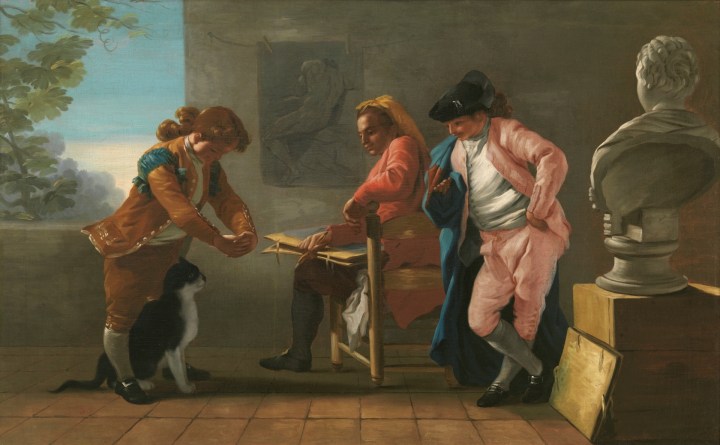
José del Castillo, The Study of Drawing, 1780, oil on canvas, 105 × 160 cm
(Madrid: Prado).
◊ ◊ ◊ ◊ ◊
Now on view at the Prado:
Meta-painting: A Journey to the Idea of Art / Metapintura: Un viaje a la idea del arte
Museo Nacional del Prado, Madrid, 15 November 2016 — 19 February 2017
Curated by Javier Portús
With Meta-painting, the Museo del Prado is offering a new approach to its collection in the latest in a series of exhibitions that began in 2010 with Rubens and continued with Captive Beauty (2013) and Goya in Madrid (2014). This series has aimed to offer visitors the chance to reflect on the Museum’s own collections and to look at its works in a new context which encourages different interpretations. Meta-painting proposes a journey that begins with mythological and religious narratives on the origins of artistic activity at the dawn of the modern age and concludes in 1819, the year of the Prado’s foundation. The exhibition thus also celebrates the 197th anniversary of the Museum’s founding as a temple of the arts, signifying their full acceptance as disciplines of social utility.
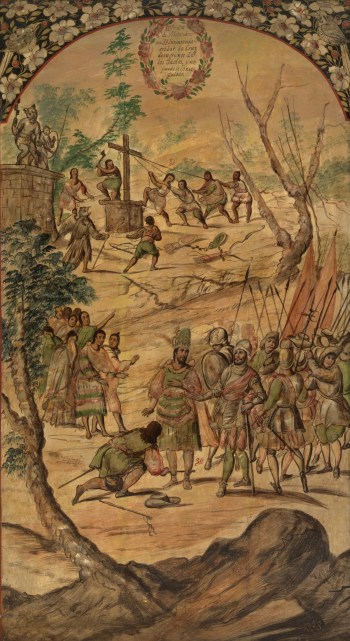
Juan González / Miguel González, Conquista de México por Hernán Cortés (30 y 31), 1698. Enconchado, Óleo sobre lienzo sobre tabla, 97 × 53 cm.
Two aspects central to the Prado—the Spanish royal collections and Spanish art—provide the context for the exhibition’s structure. Furthermore, these are two inseparable terms, given that the evolution of Spanish art was determined by the existence of the royal collections. The survey offered by the exhibition is a wide-ranging and varied one, including paintings, drawings, prints, books, medals, examples of the decorative arts and sculptures. Twenty-two of these works have been loaned by eighteen museums and collections, including the Fundación Casa de Alba, the National Gallery in London, the Museo de Bellas Artes in Seville, the Banco de España, and the Museo de la Real Academia de Bellas Arts de San Fernando in Madrid.
All the 137 works in the exhibition refer to art or to images, either as self-portraits of creators such as Titian, Murillo, Bernini and Goya; or because they include other paintings and sculptures, such as Saint Benedict destroying Idols by Ricci and Arachne by Rubens; or because they analyse issues relating to the definition of art and its history, such as José García Hidalgo’s book Principles for studying the very noble and royal art of painting […] and Goya’s Portrait of Jovellanos.
The exhibition’s ‘journey’ is divided into different phases. Fifteen sections focus on the relationship between art, the artist and society, each one of which looks at a specific issue, among them: the powers attributed to religious images; the role played by the ‘painting within the painting’; artists’ attempts to break through the pictorial space and continue it towards the viewer; the origins and practice of the idea of artistic tradition; portraits and self-portraits of artists; places for the creation and collecting of art; the origin of the modern concept of art history; the subjectivity that emerged in self-portraits from the Enlightenment onwards; and the importance of the concepts of love, death and fame in the modern artistic discourse.
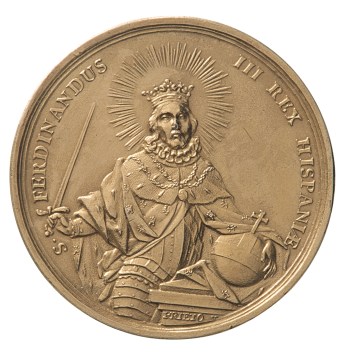
Francisco Tomás Prieto, Segundo premio de primera clase de la Academia de San Fernando, 1753, Silver-gilt, 44,5 mm diameter (Madrid: Prado)
The exhibition also represents a tribute by the Museo del Prado to Cervantes on the 400th anniversary of his death as it includes a section on Don Quixote as one of the great examples of self-referential literature, juxtaposed with Las Meninas. Thus, just as Cervantes’ text is a ‘novel within a novel’ so Velázquez’s painting is a ‘painting on painting’ in which the artist not only depicts himself painting but which involves various important issues regarding the potential of the art of painting and the role of the painter.
Las Meninas will remain in Room 12 of the Villanueva Building where it is habitually displayed but it is present in the exhibition through a modern facsimile of part of Laurent’s graphoscope which is displayed alongside editions of the two parts of Don Quixote, reminding visitors that these two masterpieces of the Spanish Golden Age are both reference points in the history of meta-fiction.
Javier Portús, Metapintura: Un viaje a la idea del arte (Madrid: Museo Nacional del Prado, 2016), 304 pages, ISBN: 978-8484803270.
New Book | Painting and Narrative in France
From Routledge:
Peter Cooke and Nina Lübbren, eds., Painting and Narrative in France, from Poussin to Gauguin (New York: Routledge, 2016), 218 pages, ISBN: 978-1472440105, $150.
 Before Modernism, narrative painting was one of the most acclaimed and challenging modes of picture-making in Western art; yet, by the early twentieth century storytelling had all but disappeared from ambitious art. France was a key player in both the dramatic rise and the controversial demise of narrative art. This is the first book to analyse French painting in relation to narrative, from Poussin in the early seventeenth to Gauguin in the late nineteenth century. Thirteen original essays shed light on key moments and aspects of narrative and French painting through the study of artists such as Nicolas Poussin, Charles Le Brun, Jacques-Louis David, Paul Delaroche, Gustave Moreau, and Paul Gauguin. Using a range of theoretical perspectives, the authors study key issues such as temporality, theatricality, word-and-image relations, the narrative function of inanimate objects, the role played by viewers, and the ways in which visual narrative has been bound up with history painting. The book offers a fresh look at familiar material, as well as studying some little-known works of art, and reveals the centrality and complexity of narrative in French painting over three centuries.
Peter Cooke is Senior Lecturer in French Studies at the University of Manchester. His most recent book is Gustave Moreau: History Painting, Spirituality and Symbolism.
Nina Lübbren is Art Historian and Principal Lecturer in Film Studies, and Deputy Head of Department of English, Communication, Film and Media, Anglia Ruskin University.
◊ ◊ ◊ ◊ ◊
C O N T E N T S
List of Figures
Notes on Contributors
Acknowledgements
Introduction: Narrativity and (French) Painting, Peter Cooke and Nina Lübbren
I. Ancien Régime
1 Units of Vision and Narrative Structures: Upon Reading Poussin’s Manna, Claudine Mitchell
2 Figures of Narration in the Context of a Painted Cycle: The North Bays of the Grande Galerie at Versailles, Marianne Cojannot-Le Blanc
3 The Crisis of Narration in Eighteenth-Century French History Painting, Susanna Caviglia
4 Obscure, Capricious, and Bizarre: Neoclassical Painting and the Choice of Subject, Mark Ledbury
II. Restoration and July Monarchy
5 Delacroix and ‘The Work of the Reader’, Beth S. Wright
6 Narrative and History in Léopold Robert’s Arrival of the Harvesters in the Pontine Marshes, Richard Wrigley
7 Narrative Strategies in Paul Delaroche’s Assassination of the Duc de Guise, Patricia Smyth
III. Second Empire and Third Republic
8 Eloquent Objects: Gérôme, Laurens, and the Art of Inanimate Narration, Nina Lubbren
9 Tyrannical Inopportunity: Gustave Moreau’s Anti-narrative Strategies, Scott C. Allan
10 Theatricality versus Anti-Theatricality: Narrative Techniques in French History Painting (1850−1900), Pierre Sérié
11 The Conflicted Status of Narrative in the Art of Paul Gauguin, Belinda Thomson
IV. Key Issues of Pictorial Narrative
12 Narrativity, Temporality and Allegorisation, from Poussin to Moreau, Peter Cooke
13 Towards a Study of Narration in Painting: The Early Modern Period, Étienne Jollet
Index
Exhibition | Bitter Sweet: Coffee, Tea, and Chocolate
Overlapping, at least partially, with The Edible Monument, this DIA exhibition explores luxury drinks:
Bitter|Sweet: Coffee, Tea, and Chocolate
Detroit Institute of Arts, 20 November 2016 — 5 March 2017
Curated by Yao-Fen You
The Detroit Institute of Arts presents Bitter|Sweet: Coffee, Tea & Chocolate, on view from November 20, 2016 to March 5, 2017. The introduction of coffee, tea, and chocolate to Europe, beginning in the late 16th century, profoundly changed drinking habits, tastes, and social customs, and spurred an insatiable demand for specialized vessels such as tea canisters, coffee cups, sugar bowls, and chocolate pots. The exhibition is organized by the Detroit Institute of Arts with support from the National Endowment for the Arts.

Pineapple Coffeepot, ca. 1750, creamware with colored glazes, Staffordshire, England (Detroit Institute of Arts).
The 68 works of art in Bitter|Sweet are mostly from the museum’s comprehensive holdings in pre-1850 European silver and ceramics. Highlights include three exquisitely decorated beverage services: a rare 24-piece set made by Germany’s Fürstenberg Porcelain Manufactory; a set once owned by Prince Louis, Duke of Nemours that illustrates the refinement of early 19th-century French Sèvres porcelain; and a Vienna Porcelain ensemble for two associated with Archduke Joseph of Austria. DIA paintings, prints, and sculpture related to the arrival and impact of the beverages in Europe help create new contexts and connections for objects from the permanent collection.
Other key works include Madame de Pompadour’s coffee grinder from the Musée du Louvre; a 1684 handwritten Spanish manuscript satirizing the vogue for chocolate from the Hispanic Society, New York; and an 18th-century German breakfast set containing chocolate beakers from the Clark Art Institute, Williamstown, Massachusetts. Diego Velázquez’s painting Infanta Maria Theresa from the Museum of Fine Arts Boston helps tell the story of the cocoa bean’s migration from the New World to the French royal court of Louis XIV via Spain.
Bitter|Sweet will be the first DIA exhibition to engage all five senses. In addition to the artworks, there will be videos about the preparation of coffee, tea, and chocolate as well as opportunities to touch, to hear, to smell, and even to taste. Such interactive components demonstrate the DIA’s commitment to engaging visitors in meaningful experiences with art.
“The exhibition is a very exciting venture for the DIA, with regards to the rich, complex story we’re telling and the innovative visitor-centered ways in which we are presenting it,” said Salvador Salort-Pons, DIA director. “While European art will be at center stage, the exhibition examines global interconnections from centuries ago that we hope will resonate with all visitors today. Just about everyone—regardless of culture or background—has a personal relationship with one or more of these beverages. I’m also excited about the ways the exhibition engages the permanent collection. Of course, I love that several of the loans in Bittersweet comment on Spain’s relationship to chocolate.”
Bitter|Sweet also touches on the human cost of procuring the raw materials to produce coffee, tea, and chocolate as well as the sugar used to alter the beverages’ bitter taste. Coffee was imported from Africa through the Middle East, tea from Asia, chocolate from the Americas, and sugar harvested by slaves on colonial plantations. To meet demand and keep prices down for the European market, merchants—such as the Dutch East India Company and the British East India Company—eventually found ways to cultivate tea and coffee bushes on foreign lands colonized under their rule.
◊ ◊ ◊ ◊ ◊
From Yale UP:
Yao-Fen You, with essays by Mimi Hellman and Hope Saska, Coffee, Tea, and Chocolate: Consuming the World (New Haven: Yale University Press, 2016), 142 pages, ISBN: 978-0300222500, $25.
 Coffee, tea, and chocolate were all the rage in Enlightenment Europe. These fashionable beverages profoundly shaped modes of sociability and patterns of consumption, yet none of the plants required for their preparation was native to the continent: coffee was imported from the Levant, tea from Asia, and chocolate from Mesoamerica. Their introduction to 17th-century Europe revolutionized drinking habits and social customs. It also spurred an insatiable demand for specialized vessels such as hot beverage services and tea canisters, coffee cups, and chocolate pots.
This beautiful book demonstrates how the paraphernalia associated with coffee, tea, and chocolate can eloquently evoke the culture of these new beverages and the material pleasures that surrounded them. Contributors address such topics as the politics of coffee consumption in 18th-century Germany; 18th-century visual satires on the European consumption of tea, coffee, and chocolate; and the design history of coffee pots in the United States between the colonial period and the present.
Yao-Fen You is associate curator of European sculpture and decorative arts at the Detroit Institute of Arts.
New Books | American History and the Enlightenment
As these six books underscore, America has always been a complicated place. All the best for a Happy Election Day! –CH
From the University of Georgia Press:
Jennifer Goloboy, Charleston and the Emergence of Middle-Class Culture in the Revolutionary Era (Athens: University of Georgia Press, 2016), 208 pages, ISBN: 978-0820349961, $55.
 Too often, says Jennifer Goloboy, we equate being middle class with ‘niceness’—a set of values frozen in the antebellum period and centered on long-term economic and social progress and a close, nurturing family life. Goloboy’s case study of merchants in Charleston, South Carolina, looks to an earlier time to establish the roots of middle-class culture in America. She argues for a definition more applicable to the ruthless pursuit of profit in the early republic. To be middle class then was to be skilled at survival in the market economy.
What prompted cultural shifts in the early middle class, Goloboy shows, were market conditions. In Charleston, deference and restraint were the bywords of the colonial business climate, while rowdy ambition defined the post-Revolutionary era, which in turn gave way to institution building and professionalism in antebellum times. Goloboy’s research also supports a view of the Old South as neither precapitalist nor isolated from the rest of American culture, and it challenges the idea that post-Revolutionary Charleston was a port in decline by reminding us of a forgotten economic boom based on slave trading, cotton exporting, and trading as a neutral entity amid warring European states. This fresh look at Charleston’s merchants lets us rethink the middle class in light of the new history of capitalism and its commitment to reintegrating the Old South into the world economy.
Jennifer L. Goloboy is an independent scholar based in Minneapolis, specializing in the history of the early American middle class. She is the editor of Industrial Revolution: People and Perspectives. Goloboy earned her PhD in the history of American civilization from Harvard University.
◊ ◊ ◊ ◊ ◊
From Basic Books:
Nicholas Nicholas Guyatt, Bind Us Apart: How Enlightened Americans Invented Racial Segregation (New York: Basic Books, 2016), 416 pages, ISBN: 978-0465018413, $30.
 Why did the founding fathers fail to include blacks and Indians in their cherished proposition that “all men are created equal”? The usual answer is racism, but the reality is more complex and unsettling. In Bind Us Apart, historian Nicholas Guyatt argues that, from the Revolution through the Civil War, most white liberals believed in the unity of all human beings. But their philosophy faltered when it came to the practical work of forging a color-blind society. Unable to convince others—and themselves—that racial mixing was viable, white reformers began instead to claim that people of color could only thrive in separate republics: in Native states in the American West or in the West African colony of Liberia. Herein lie the origins of “separate but equal.” Decades before Reconstruction, America’s liberal elite was unable to imagine how people of color could become citizens of the United States. Throughout the nineteenth century, Native Americans were pushed farther and farther westward, while four million slaves freed after the Civil War found themselves among a white population that had spent decades imagining that they would live somewhere else. Essential reading for anyone disturbed by America’s ongoing failure to achieve true racial integration, Bind Us Apart shows conclusively that “separate but equal” represented far more than a southern backlash against emancipation—it was a founding principle of our nation.
Nicholas Guyatt is a university lecturer in history at the University of Cambridge. He is a regular contributor to The Nation, London Review of Books, and The Guardian. Guyatt lives in Cambridge, England.
◊ ◊ ◊ ◊ ◊
From The University of North Carolina Press:
Robert Parkinson, The Common Cause: Creating Race and Nation in the American Revolution (Chapel Hill: The University of North Carolina Press, for the Omohundro Institute of Early American History and Culture, Williamsburg, 2016), 768 pages, ISBN: 978-1469626635, $45.
 When the Revolutionary War began, the odds of a united, continental effort to resist the British seemed nearly impossible. Few on either side of the Atlantic expected thirteen colonies to stick together in a war against their cultural cousins. In this pathbreaking book, Robert Parkinson argues that to unify the patriot side, political and communications leaders linked British tyranny to colonial prejudices, stereotypes, and fears about insurrectionary slaves and violent Indians. Manipulating newspaper networks, Washington, Jefferson, Adams, Franklin, and their fellow agitators broadcast stories of British agents inciting African Americans and Indians to take up arms against the American rebellion. Using rhetoric like “domestic insurrectionists” and “merciless savages,” the founding fathers rallied the people around a common enemy and made racial prejudice a cornerstone of the new Republic. In a fresh reading of the founding moment, Parkinson demonstrates the dual projection of the “common cause.” Patriots, through both an ideological appeal to popular rights and a wartime movement against a host of British-recruited slaves and Indians, forged a racialized, exclusionary model of American citizenship.
Robert G. Parkinson is assistant professor of history at Binghamton University.
◊ ◊ ◊ ◊ ◊
From Yale UP:
Steve Pincus, The Heart of the Declaration: The Founders’ Case for an Activist Government (New Haven: Yale University Press, 2016), 224 pages, ISBN: 978-0300216189, $26.
 From one election cycle to the next, a defining question continues to divide the country’s political parties: Should the government play a major or a minor role in the lives of American citizens? The Declaration of Independence has long been invoked as a philosophical treatise in favor of limited government. Yet the bulk of the document is a discussion of policy, in which the Founders outlined the failures of the British imperial government. Above all, they declared, the British state since 1760 had done too little to promote the prosperity of its American subjects. Looking beyond the Declaration’s frequently cited opening paragraphs, Steve Pincus reveals how the document is actually a blueprint for a government with extensive powers to promote and protect the people’s welfare. By examining the Declaration in the context of British imperial debates, Pincus offers a nuanced portrait of the Founders’ intentions with profound political implications for today.
Steve Pincus is the Bradford Durfee Professor of History at Yale University. He is the author of several books on seventeenth- and eighteenth-century British history.
◊ ◊ ◊ ◊ ◊
From Johns Hopkins UP:
Richard Alan Ryerson, John Adams’s Republic: The One, the Few, and the Many (Baltimore: Johns Hopkins University Press, 2016), 576 pages, ISBN: 978-1421419220, $60.
 Scholars have examined John Adams’s writings and beliefs for generations, but no one has brought such impressive credentials to the task as Richard Alan Ryerson in John Adams’s Republic. The editor-in-chief of the Massachusetts Historical Society’s Adams Papers project for nearly two decades, Ryerson offers readers of this magisterial book a fresh, firmly grounded account of Adams’s political thought and its development.
Of all the founding fathers, Ryerson argues, John Adams may have worried the most about the problem of social jealousy and political conflict in the new republic. Ryerson explains how these concerns, coupled with Adams’s concept of executive authority and his fear of aristocracy, deeply influenced his political mindset. He weaves together a close analysis of Adams’s public writings, a comprehensive chronological narrative beginning in the 1760s, and an exploration of the second president’s private diary, manuscript autobiography, and personal and family letters, revealing Adams’s most intimate political thoughts across six decades. How, Adams asked, could a self-governing country counter the natural power and influence of wealthy elites and their friends in government? Ryerson argues that he came to believe a strong executive could hold at bay the aristocratic forces that posed the most serious dangers to a republican society. The first study ever published to closely examine all of Adams’s political writings, from his youth to his long retirement, John Adams’s Republic should appeal to everyone who seeks to know more about America’s first major political theorist.
Richard Alan Ryerson, the former academic director and historian of the David Library of the American Revolution, was the editor-in-chief of the Adams Papers from 1983 to 2001.
◊ ◊ ◊ ◊ ◊
From Yale UP:
Caroline Winterer, American Enlightenments: Pursuing Happiness in the Age of Reason (New Haven: Yale University Press, 2016), 368 pages, ISBN: 978-0300192575, $35.
 The accepted myth of the ‘American Enlightenment’ suggests that the rejection of monarchy and establishment of a new republic in the United States in the eighteenth century was the realization of utopian philosophies born in the intellectual salons of Europe and radiating outward to the New World. In this revelatory work, Stanford historian Caroline Winterer argues that a national mythology of a unitary, patriotic era of enlightenment in America was created during the Cold War to act as a shield against the threat of totalitarianism and that Americans followed many paths toward political, religious, scientific, and artistic enlightenment in the 1700s that were influenced by European models in more complex ways than commonly thought. Winterer’s book strips away our modern inventions of the American national past, exploring which of our ideas and ideals are truly rooted in the eighteenth century and which are inventions and mystifications of more recent times.
Caroline Winterer is Anthony P. Meier Family Professor in the Humanities at Stanford University and director of the Stanford Humanities Center. The author of three previous books, she received an American Ingenuity Award from the Smithsonian Institution.
New Book | The American School: Artists and Status
From Yale UP:
Susan Rather, The American School: Artists and Status in the Late-Colonial and Early National Era (New Haven: Yale University Press, 2016), 316 pages, ISBN: 978-0300214611, $75.
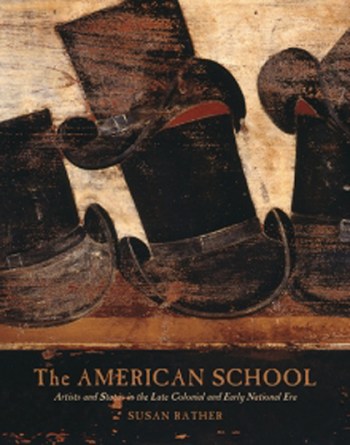 An in-depth look at the changing status of American artists in the 18th and early 19th century This fascinating book is the first comprehensive art-historical study of what it meant to be an American artist in the 18th- and early 19th-century transatlantic world. Susan Rather examines the status of artists from different geographical, professional, and material perspectives, and delves into topics such as portrait painting in Boston and London; the trade of art in Philadelphia and New York; the negotiability and usefulness of colonial American identity in Italy and London; and the shifting representation of artists in and from the former British colonies after the Revolutionary War, when London remained the most important cultural touchstone. The book interweaves nuanced analysis of well-known artists—John Singleton Copley, Benjamin West, and Gilbert Stuart, among others—with accounts of non-elite painters and ephemeral texts and images such as painted signs and advertisements. Throughout, Rather questions the validity of the term ‘American’, which she sees as provisional-the product of an evolving, multifaceted cultural construction.
Susan Rather is a professor in the Department of Art and Art History at the University of Texas, Austin.
Exhibition | On Time
Now on view at The Grolier Club:
On Time: The Quest for Precision
Linda Hall Library of Science, Engineering, and Technology, Kansas City, 2012
The Grolier Club, New York, 14 September — 19 November 2016
Curated by Bruce Bradley
From sundials to atomic clocks, the exhibition On Time: The Quest for Precision explores the history of precise timekeeping through rare books that taught readers techniques of timekeeping, announced new inventions, and provided instructions on the construction and use of timekeeping instruments. On view at The Grolier Club from September 14 through November 19, 2016, the works are drawn from the comprehensive collections of the Linda Hall Library of Science, Engineering, and Technology, Kansas City, Missouri.
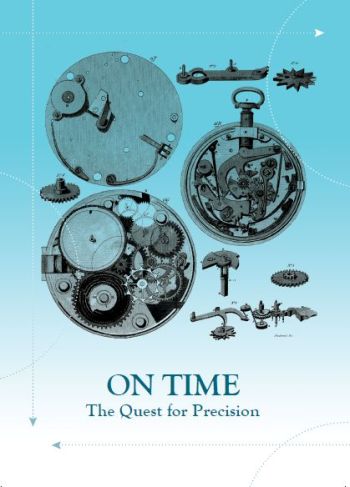 Curator Bruce Bradley tells a timely story with 86 illustrated books dating from the fifteenth century to the present that graphically and artistically depict the sweep of timekeeping. “These books are fascinating and ornate, as well as informative about the innovations that have led to increasingly precise timekeeping devices,” notes Mr. Bradley. As a complement to the printed books, the exhibition includes a small selection of historical clocks and timepieces from the collection of Grolier Club member Fortunat Mueller-Maerki.
The early books describe techniques for timekeeping with fantastic illustrations of sundials and water clocks. The sunflower clock described and illustrated by Athanasius Kircher in his book, Magnes siue De arte magnetica opus tripartitum (Rome, 1641) shows a detailed, full-page engraving of the sunflower clock floating on a piece of cork with its roots in the water. Vegetable magnetism supposedly caused the flower to follow the sun, so that a pointer fixed in the center would indicate the hour on a clock dial. A book that featured more traditional types of sundials is Sebastian Münster’s Horologiographia (Basel, 1533). This comprehensive treatise was first issued as Compositio horologiorum in 1531, but it was popular enough to warrant this second enlarged edition just two years later. Both editions illustrate all manner and variety of sundials with beautiful woodcuts, some of which are attributed to Hans Holbein the Younger.
Early mechanical clocks offered several advantages over sundials, such as portability and the ability to show the time during cloudy weather and at night. They lacked precision, however, and had to be readjusted periodically to synchronize them with local solar time. Even after the appearance of mechanical clocks, books about sundials and how to make them remained popular. Demand for them continued throughout the sixteenth century and into the seventeenth.
A book that described and illustrated some of the best astronomical instruments of the sixteenth century is Tycho Brahe’s Astronomiae instauratae mechanica (Nuremberg, 1602). Of the four clocks in his observatory, two of the smaller clocks are shown in the plate of the famous mural quadrant that Brahe used for making observations of star positions. Brahe explained that he used two clocks to reduce errors in recording the exact moment of observation.
The sixteenth century also saw the first printed depictions of mechanical clocks, published in books by the Italian natural philosopher Girolamo Cardano. The innovation that made mechanical clocks possible, the escapement mechanism, was first illustrated in a seventeenth-century book by Robert Fludd. An English clergyman, William Derham, produced the first practical manual on clock making, The Artificial Clock-Maker (London, 1696), which was popular enough to go through several editions in the early eighteenth century. Much of Derham’s knowledge of clocks came from his friend, the natural philosopher Robert Hooke, who was involved in priority disputes over horological innovations such as the anchor escapement and the balance spring regulator for watches.
Pendulum clocks represented a revolution in timekeeping devices. They had greater accuracy than any other clocks and became standard pieces of scientific equipment, particularly for astronomical observatories. Christiaan Huygens designed the first successful pendulum clock and described it in his classic book on display in the exhibition, Horologium oscillatorium (Paris, 1673). It includes a famous woodcut of the clock’s mechanism.
Another milestone was the marine chronometer built by John Harrison in the eighteenth century. The Principles of Mr. Harrison’s Time-Keeper (London, 1767), includes a preface by Nevil Maskelyne, Astronomer Royal, who insisted on detailed accuracy in the engravings of the chronometer’s mechanism, so others could make duplicates of the watch.
In the twentieth century, Nature, a scientific journal known for publishing important new advances and original research, published the description of the first atomic clock, designed and built by Louis Essen with Jack Parry at the National Physical Laboratory in Teddington, England. Atomic clocks are more precise than the Earth’s rotation and led to a new definition of the second at the 1967 meeting of the International Bureau of Weights and Measures in Paris.
Accompanying the illustrated books and journals are a variety of intricately designed horological objects. Included are a selection of sundials, a clepsydra or water clock, a variety of clock maker’s tools, weight driven clocks, marine chronometers, examples of American railroad-grade pocket watches, and an uncommon Accutron desk clock.
A 60-page illustrated catalogue is available which includes short essays and descriptions by Mr. Bradley for each book in the exhibition. The exhibition and its associated catalogue are supported by a generous grant from the Ascher Family Foundation and by the Linda Hall Library Foundation.
Linda Hall Library is among the world’s foremost independent research libraries devoted to science, engineering, technology, and their histories. Founded in 1946 through an endowment created by Linda and Herbert Hall, the library is a not-for-profit, privately funded institution, and is open to the public free of charge. Scholars, technologists, engineers, researchers, academic institutions and businesses, nationally and internationally, use Linda Hall Library’s collections to investigate, invent, and increase knowledge. The library’s holdings range from rare books to private papers, including extensive collections in diverse areas such as aeronautics, astronomy, engineering standards, a resource center for patents and trademarks and more. In addition to the library’s resources, hundreds of people attend the library’s public programs throughout the year to expand their awareness and understanding of science and technology.
The Grolier Club of New York is America’s oldest and largest society for bibliophiles and enthusiasts in the graphic arts. Founded in 1884, the club is named for Jean Grolier, the Renaissance collector renowned for sharing his library with friends. The club’s objective is to foster the literary study and promotion of arts pertaining to the production of books.
Bruce Bradley, On Time: The Quest for Precision (Kansas City: Linda Hall Library, 2016), 64 pages, ISBN: 978-0976359067.
New Book | Prints in Translation, 1450–1750
From Routledge:
Suzanne Karr Schmidt and Edward Wouk, eds., Prints in Translation, 1450–1750: Image, Materiality, Space (New York: Routledge, 2016), 252 pages, ISBN: 978-1472480125, $150.
 Printed artworks were often ephemeral, but in the early modern period, exchanges between print and other media were common, setting off chain reactions of images and objects that endured. Paintings, sculpture, decorative arts, musical or scientific instruments, and armor exerted their own influence on prints, while prints provided artists with paper veneers, templates, and sources of adaptable images. This interdisciplinary collection unites scholars from different fields of art history who elucidate the agency of prints on more traditionally valued media, and vice-versa. Contributors explore how, after translations across traditional geographic, temporal, and material boundaries, original ‘meanings’ may be lost, reconfigured, or subverted in surprising ways, whether a Netherlandish motif graces a cabinet in Italy or the print itself, colored or copied, is integrated into the calligraphic scheme of a Persian royal album. These intertwined relationships yield unexpected yet surprisingly prevalent modes of perception. Andrea Mantegna’s 1470/1500 Battle of the Sea Gods, an engraving that emulates the properties of sculpted relief, was in fact reborn as relief sculpture, and fabrics based on print designs were reapplied to prints, returning color and tactility to the very objects from which the derived. Together, the essays in this volume witness a methodological shift in the study of print, from examining the printed image as an index of an absent invention in another medium—a painting, sculpture, or drawing—to considering its role as a generative, active agent driving modes of invention and perception far beyond the locus of its production.
Suzanne Karr Schmidt is Assistant Curator of Prints and Drawings at the Art Institute of Chicago.
Edward H. Wouk is Lecturer in European Art, 1400–1800, at The University of Manchester.
◊ ◊ ◊ ◊ ◊
C O N T E N T S
List of Figures
Preface
Notes on Contributors
Abbreviations
1 Edward Wouk, Toward an Anthropology of Print
2 Alexandra Onuf, From Print to Paint and Back Again: Painting Practices and Print Culture in Early Modern Antwerp
3 Lelia Packer, Prints as Paintings: Willem van de Velde the Elder (1611–1693) and Dutch Pen Painting, circa 1650–65
4 Freyda Spira, Between Paper and Sword: Daniel Hopfer and the Translation of Etching in Reformation Augsburg
5 Jonathan Tavares, Hunting Erotica: Print Culture and a Seventeenth-Century Rifle in the Collection of the Hessisches Landesmuseum, Darmstadt
6 Patricia Simons, Mantegna’s Battle of the Sea Gods: The Material and Thematic Interaction of Print and Sculpture
7 Suzanne Karr Schmidt, Making Time and Space: Collecting Early Modern Printed Instruments
8 David Pullins, The State of the Fashion Plate, circa 1727: Historicizing Fashion Between ‘Dressed Prints’ and Dezallier’s Recueils
9 Arthur J. DiFuria, The Concettismo of Triumph: Maerten van Heemskerck’s Victories of Charles V and Remembering Spanish Omnipotence in a Late Sixteenth-Century Writing Cabinet
10 Stephanie Porras, St. Michael the Archangel: Spiritual, Visual, and Material Translations from Antwerp to Lima
11 Yael Rice, Lines of Perception: European Prints and the Mughal Kitābkhāna
Bibliography
Index
New Book | Witchcraft and Folk Belief
From Palgrave Macmillan:
Lizanne Henderson, Witchcraft and Folk Belief in the Age of Enlightenment Scotland, 1670–1740 (New York: Palgrave Macmillan, 2016), 382 pages, ISBN: 978-0230294387, $110.
 Taking an interdisciplinary perspective, Witchcraft and Folk Belief in the Age of Enlightenment represents the first in-depth investigation of Scottish witchcraft and witch belief post-1662, the period of supposed decline of such beliefs, an age which has been referred to as the ‘long eighteenth century’, coinciding with the Scottish Enlightenment. The late seventeenth and early eighteenth centuries were undoubtedly a period of transition and redefinition of what constituted the supernatural, at the interface between folk belief and the philosophies of the learned. For the latter the eradication of such beliefs equated with progress and civilization, but for others, such as the devout, witch belief was a matter of faith, such that fear and dread of witches and their craft lasted well beyond the era of the major witch-hunts. This study seeks to illuminate the distinctiveness of the Scottish experience, to assess the impact of enlightenment thought upon witch belief, and to understand how these beliefs operated across all levels of Scottish society.
Lizanne Henderson has been a lecturer and cultural historian at the School of Interdisciplinary Studies, University of Glasgow since 2004. She is Editor of Review of Scottish Culture and has published on the Scottish witch-hunts, folk belief, ballads, critical animal studies, Scottish diaspora, polar explorers, and the transatlantic slave trade. Her books include Fantastical Imaginations: The Supernatural in Scottish History and Culture (2009) and, with Edward J. Cowan, Scottish Fairy Belief: A History (2001), and A History of Everyday Life in Medieval Scotland, 1000–1600 (2011).
◊ ◊ ◊ ◊ ◊
C O N T E N T S
List of Illustrations, Figures, and Tables
Preface
Acknowledgments
List of Abbreviations
Introduction: Following the Witch
1 Fixing the Limits of Belief
2 The Idea of Witchcraft
3 Demons, Devilry, and Domestic Magic: Hunting Witches in Scotland
4 Darkness Visible
5 Bemused, Bothered, and Bewildered: Witchcraft Debated
6 ‘Worshipping at the Altar of Ignorance’: Some Late Scottish Witchcraft Cases Considered
7 The Survival of Witch Belief in South West Scotland: A Case Study
8 The Persistence of Witch Belief
Conclusion
Appendices
Bibliography
Index
Display | Garnitures: Vase Sets from National Trust Houses

Five-piece vase set, porcelain, China, ca. 1690, H: 26.9 cm; rescued from Clandon Park, Surrey, the night of the fire, 29 April 2015 (The Mrs. David Gubbay Collection, Clandon Park, Surrey, National Trust, 1440409.1-5 / National Trust Images/ James Dobson).
◊ ◊ ◊ ◊ ◊
Now on view at the V&A:
Garnitures: Vase Sets from National Trust Houses
Victoria and Albert Museum, London, 11 October 2016 — 30 April 2017
This ground-breaking display at the Victoria and Albert Museum, organised in collaboration with the National Trust, explores the phenomenon of matching sets of vases and garnitures. In the 1650s, assembled sets of Chinese porcelain beakers, bottles, bowls, and jars—often in odd numbers—were used in elite European interiors as an integral part of the decorative scheme— displayed on chimney-pieces, cupboards, tables, or over doors. Specifically for the display, a mid-seventeenth-century garniture in the French taste has been recreated from Chinese porcelain of the 1630s. When imports of Chinese porcelain officially ceased between 1657 and 1683, European potters at Delft and Nevers copied the exotic Asian forms but unified the elements with matching patterns to form sets of from three to eleven vessels. In the Netherlands, merchants also ordered jars and beakers from Japan, and, in England, sets were ordered from London silversmiths. In France, merchants in luxury goods applied matching metal mounts to form sets from assembled objects and vessels. When the export trade resumed in the 1680s, ornamental jars and beakers with matching patterns were produced in Jingdezhen specifically for the West. The fashion continued throughout the 1700s, with almost every ceramic manufactory producing examples. It came to its conclusion during the Arts and Crafts period, when the singular vase became the rage and sets were broken up and dispersed.
A day-long symposium on ceramics and interiors is planned for 17 March 2017. The display, publication, and symposium are generously sponsored by The Headley Trust.
Patricia Ferguson’s blog entry on the display is available here»
◊ ◊ ◊ ◊ ◊
Patricia Ferguson, Garnitures: Vase Sets from National Trust Houses (London: V&A Publishing, 2016), 64 pages, ISBN: 978-1851779000, £10.
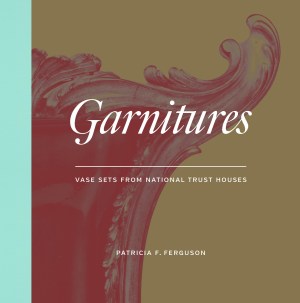 This exquisite book brings together some of the National Trust’s most important sets of garnitures, showing them in their historic context and drawing on their rich narratives. Following an introductory essay, the catalogue records the 15 garnitures in the display borrowed from 13 National Trust properties: Blickling, Norfolk; Dunham Massey and Tatton Park, Cheshire; Nostell Priory, Yorkshire; Ickworth, Suffolk; Kingston Lacy, Dorset, Stourhead, Wiltshire, Saltram, Devon, Clandon Park, Surrey, Scotney Castle and Knole, Kent; Petworth, West Sussex; and Upton House, Warwickshire (with more information here). The entries are richly supported by engraved sources, paintings and photographs of vase sets and garnitures in situ. As many have never been published before, the publication will be an important souvenir of a unique exhibition.
Patricia F. Ferguson, an adviser on ceramics to the National Trust, has been researching their ceramics collection for a publication on elite ceramic patronage in Britain. She has an MA in Chinese ceramics from the School of Oriental and African Studies and works as a curatorial consultant in the Asian department of the V&A.
◊ ◊ ◊ ◊ ◊
This 4-minute film showcases rare surviving examples of vase sets and ceramic ornaments from National Trust houses being displayed on furniture and in period rooms at the V&A that would have been typical at the time of their manufacture. Reino Leifkes, curator of ceramics at the V&A, discusses this ceramic phenomenon and its rise to the height of fashion.
Exhibition | 1,000 m2 of Desire: Architecture and Sexuality

From the Centre de Cultura Contemporània de Barcelona:
1,000 m2 of Desire: Architecture and Sexuality
1.000 m2 de Desig: Arquitectura i Sexualitat / 1.000 m2 de Deseo: Arquitectura y Sexualidad
Centre de Cultura Contemporània de Barcelona, 25 October 2016 — 19 March 2017
Curated by Adélaïde de Caters and Rosa Ferré
The exhibition looks at the way Western society has planned, built, and imagined spaces for sex from the 18th century to the present day. With some 250 exhibits, including drawings and architectural models, art installations, audiovisuals, books, and other materials, the exhibition explores the power of spaces as the driving force of desire and shows how architecture has been a tool that controls behaviour and creates gender stereotypes in our patriarchal society.
 It presents some of the projects that have subverted traditional models and advocated utopias of sexual cohabitation or private spaces designed solely for pleasure. It looks afresh at the proposals of Claude-Nicolas Ledoux, Charles Fourier, De Sadeand Guy Debord, the radical architecture of the 1960s and 1970s, Carlo Mollino, Adolf Loos, Nicolas Schöffer, Wilhelm Reich, Playboy architecture, and works by contemporary architects and artists.
1000m2 of Desire underpins the need to reappraise, for contemporary times, the validity and interest of some of the radical, speculative projects that seem to speak directly to us today, even though some of them date back more than 200 years. It invite us to consider how sexualities are constructed in accordance with specific cultural codes subject to norms that govern bodies and discourses and the nature of the space of desire and pleasure in our society. The exhibition highlights the way certain forms of resistance to established norms have largely originated from informal architecture and the appropriation of places. It shows how architectural practice has been dominated by men until very recently and, as a result, how spaces designed for pleasure have been imagined from male desires and fantasies. Architecture as the physical design of a space and setting makes up a substantial part of our sexual fantasies. Many of the exhibits have never been created before and are constructed through language or the projected image.
The exhibition is divided into three thematic sections—sexual utopias, libertine refuges, and sexographs—and includes several independent spaces that act as ‘mini exhibitions’, each one curated by different specialists: a recreation of Nicolas Schöffer’s Centre for Sexual Leisure (Eléonore de Lanvandeyra Schöfferand Guillaume Richard), a reading room containing libertine novels (Marie-Françoise Quignard), an installation dedicated to Playboy Magazine and its architecture (Beatriz Colomina and Pep Avilés), and an archetypal 1970s’ porn cinema (Esther Fernández). It also presents William Kentridge’s new installation Right into Her Arms, which the South African artist created for his production of Alban Berg’s Lulu.
Sexual Utopias (18th–20th Centuries)
The exhibition begins with some of the speculative projects by architects, thinkers, artists and communities who have sought to have an impact on sexual behaviour by monitoring spaces. It examines the sexual utopias of the 18th century such as the temple of pleasure, the Oikema, imagined by the architect Claude-Nicolas Ledoux; the Parthenions, which Restif de la Bretonne organised according to detailed rules in his treatise on prostitution, Le Pornographe; and Charles Fourier’s settings for erotic and gastronomic orgies. Fourier’s proposal reveals an imagination, a radicalism and extreme relevance with the phalanstery as the engine of a utopian community governed solely by its inhabitants’ desires. The exhibition also features one of the Marquis de Sade’s cabinets which reveals how he constructed his narrative utopia of excess through his passion for architecture and the performing arts.
Reformist or subversive, these sexual architectures of the 18th and early 19th centuries are contrasted and establish a certain continuity with more contemporary utopias from the modus vivendi of hippy communities to the radical architecture of the 20th century: Ettore Sottsass, the Archigram and Superstudio groups, Rem Koolhaas/OMA, Haus-Rucker-Co and Ricardo Bofill’s Taller de Arquitectura.
The exhibition also seeks to put the spotlight on the visionary work of Nicolas Schöffer who was closely associated with the Situationists and part of the French radical architecture movement in the 1960s. He designed a utopian city, the Ville Cybernétique (1955–69), which contained its own Centre for Sexual Leisure. A vast installation recreates this space made up of sex, volts, dancing cybernetic sculptures, and perfume.
Libertine Refuges (18th–20th Centuries)
This section explores the power wielded by spaces as driving forces of desire and analyses the nature of private realms conceived entirely as settings for pleasure, from the French aristocracy’s petites maisons of the 18th century, with their rooms, décor, and specialist furnishings, to the bachelor pads suggested by Playboy Magazine. It shows the role of architecture as a sensorial experience in seduction strategies and how sophistication in the design of constructional and mechanical devices can fire the erotic imagination.
Architecture and storytelling worked osmotically during the 18th century in a game of mutual fascination. The exhibition presents the architecture of two iconic novels in this regard, La Petite Maison (1758) by Jean-François de Bastide and Point de Lendemain (1777) by Vivant Denon.
The reading room containing libertine novels is presented in this section of the exhibition. Devised by the specialist Marie-Françoise Quignard, it features novels by Nerciat, Crébillon, Servigné, Choderlos de Laclos, and De Sade, among others. The libertine novel, related to the materialistic philosophy of the day, has a single objective: to celebrate desire and the enjoyment of the body. Entering the libertine’s chamber is like entering an imaginary world where the characters are subjected to all the fantasies of desire. It is also like stepping into the atmosphere of enclosed places: into boudoirs, convent cells or brothels where we follow the narrator, the clandestine observer, while the story unfolds.
The exhibition devotes a whole section to Playboy, curated by Beatriz Colomina. The magazine defined a new identity for men that included how they should dress, what they should listen to, drink and read, as well as the environment they ought to live in as well as the furnishings and interior décor. From Frank Lloyd Wright to Mies van der Rohe and including John Lautner and Ant Farm, alongside designs by the Eames, George Nelson, Eero Saarinen and Harry Bertoia, architecture and design are presented as tools capable of altering a code of conduct. As a media machine that had an enormous impact by treating women and buildings as objects of fantasy and desire, Playboy made a significant contribution to the transformation of ‘intimacy’ into a public spectacle. This section reproduces Hugh Hefner’s legendary bed (in contrast to the traditional double bed invented in the 18th century which remains the dominant setting for our sex lives today). According to another of the leading specialists in the Playboy phenomenon, Beatriz Preciado: “The round, revolving bed, connected to a radio-cum-phone-cum-hi-fi system, was used as a place for orgies as well as an office for Hefner who ran his business for years in his pyjamas and without leaving the house. The bed has become a true multimedia platform, the direct predecessor of our laptop computer and a media extension of our libido, as well as a new centre of production and consumption.”
The exhibition also reveals that the architecture of the Modern Movement is a project based on masculinity, which underplays its erotic dimension. Beatriz Colomina sums it up by saying “women are the ghosts of modern architecture.” Adolf Loos designed a bedroom for his wife, Lina, as if it were a fur-lined case and dreamt up a Parisian house for Joséphine Baker. The exhibition also presents the enigmatic and sensualised home interiors designed by Carlo Mollino, and, as a counterpoint to these intimate spaces, the home of Rudolph Schindler in California, which features an experimental programme for two couples living together, with outdoor beds/sleeping baskets.
Sexographs (20th–21st Centuries)
Following in the wake of Guy Debord’s Situationism, the exhibition presents a number of maps of contemporary passions through pieces by architects and artists (such as Bernard Tschumi, ecoLogicStudio [Claudia Pasquero and Marco Poletto], Jean-Didier Bergilez, Danli Wang, Pol Esteve, Marc Navarro and Ania Soliman). It reveals public spaces coded for sex, among them parks, streets, and public toilets. The exhibits in this section include two impressive series of photographs: The Valley by Larry Sultan and The Park by Kohei Yoshiyuki.
The screening room was one of the spaces transformed by the discourses of the sexual revolution of the late 1960s. It was a space that embraced an increasing sexualisation until the advent of the first legal porn films. The so-called ‘porn chic’ that emerged in the United States in the 1970s opened up spaces for the consumption of pornography to the female gaze and envisaged an experience of collective viewing that continued until the mid-1980s, when video technology moved porn into people’s homes. The exhibition features an archetypal porn cinema of the 1970s, where clips from legendary X-rated films will be shown, curated by Esther Fernández,
We will see how venues for sexual encounters (from luxury resorts to brothels, whorehouses-cum-hotels on highways, bathhouses and gay dark rooms, discotheques and bars, oubliettes and BDSM spaces, as well as sex shops) are all highly ritualised social systems. They are domains in which initiation and transgression act as the driving force of desire: a particular type of lighting, smells and music are part of this informal architecture. They are designed for and, at the same time, govern particular practices. They are all spaces of representation that reflect group mythologies.
But what are the spaces for sex today? Undoubtedly cyberspace, with internet porn and encounters apps for every taste, is growing in importance. Now that we are fully steeped in the technological utopia, artists, such as Yann Mihn, are engaged in a search for telepathic ecstasy. Mihn is working on the prototype of a machine that will enable total immersion in virtual reality and stimulation (teledildonics), his “NooScaphe-X1 Cybersex immersion engine”.
In Hacer el amor en abstracto: la arquitectura de la cultura de baile, the architect and artist Pol Esteve examines the spatial experience of discotheques and raves and the way in which a combination of technologies such as stroboscopic lights, music and drugs can produce orgasmic effects and a displaced sexuality.
Ingo Niermann proposes a community of sex volunteers with his platform of an army of love, thearmyoflove.net, who will create situations and spaces of satisfaction for those who are ‘usually excluded’, people with physical problems or with a body that does not match conventions of attractiveness.
Desire in the 21st century is the desire of others expressed through recognition and in the competition for representation. From the selfie to Instagram, we are compelled to look sexy and happy; the internet makes the laborious construction of the image of our private lives compulsory. Do sexual images on the web represent or replace relationships by sublimating them? Is the hypersexualisation of society, as it is represented by the media, substituting actual sexual life? Society seems to have plunged into a narcissistic depression in which the internet functions as a masturbatory machine. In the Western context, in which permissiveness is no longer transgression but the norm, what role does space play in reviving transgressive eroticism, in re-eroticising society?
This project explores the interstices of freedom in certain non-normative spaces for desire, such as the queer movement, and the way these constitute revolutionary resistance to commodified scenarios and to the control of increasingly all-encompassing social structures.
Adélaïde de Caters, Rosa Ferré, Beatriz Colomina, Marie-Françoise Quignard, Pol Esteve, Ester Fernández Cifuentes, Ingo Niermann, Fulvio Ferrari, and Rem Koolhaas, 1,000 m2 of Desire: Architecture and Sexuality / 1.000 m2 de Desig: Arquitectura i Sexualitat / 1.000 m2 de Deseo: Arquitectura y Sexualidad (Barcelona: CCCB and Direcció de Comunicació de la Diputació de Barcelona, 2016), 200 pages, ISBN: 978-8498037500 (Català / English), ISBN: 978-8498037517 (Castellano / English), 20€.
S E L E C T E D O B J E C T S
The exhibition has received loans from prestigious international institutions, including FracTurbulence Orleans, the MoMA Architecture Department New York, the Bibliothèque Nationale de France (BNF), the Biblioteca Nacional de España (BNE), and from the collections of the architects who have taken part in the project and given generously of their time.
Architectural Originals
• Drawings by Jeremy Bentham and his Panopticon
• The Campo Marzio by Giovanni Battista Piranesi
• Drawings by Jean-Jacques Lequeu, Pierre-Adrien Pâris, Charles Fourier, Ettore Sottsass, Superstudio, Archigram, Madelon Vriesendorp, Ant farm, Douglas Darden, Coop Himmelb(l)au, and Haus-Rucker-Co, among others
Original Photographs
• Polaroids by Carlo Mollino
• The Valley series by Larry Sultan
• The Park series by Kohei Yoshiyuki
Installations
• Centre for Sexual Leisure (CLS) with original works by Nicolas Schöffer
• METAfolly Pavilion by ecoLogicStudio
• Right into Her Arms, a new work by William Kentridge for the exhibition
• In front of the Green Door by Johannes Wohnseifer
• Hacer el amor en abstracto: la arquitectura de la cultura de baile by Pol Esteve
• Army of Love, Ania Soliman
• Playboy installation with a reproduction of Hugh Hefner’s bed
• Reproduction of Wilhelm Reich’s Orgone
Maquettes and Models
• Reproduction of the city of the Royal Saltworks at Arc-et-Senans and the Oikema Temple of Pleasure
• Reproduction of the room in the Château de Silling where stories are told in The 120 Days of Sodom by the Marquis de Sade
• Models of the Playboy Townhouse and of Hugh Hefner’s private jet Big Bunny
• Model of the Villa Rosa by the Coop Himmelb(l)au
Treatises on Architecture
• Fransesco Colonna, Hypnerotomachia Poliphili ou Le Songe de Poliphile (first edition published in Venice in 1499)
• Jacques-François Blondel, De la distribution des maisons de plaisance et de la décoration en général (1737–38), 2 volumes
• Claude-Nicolas Ledoux, L’architecture considérée sous le rapport de l’art, des mœurs et de la législation (1804), 2 volumes
• Nicolas Le Camus de Mézières, Le génie de l’architecture, ou L’analogie de cet art avec nos sensations (1780)
Libertine Books
• Crébillon, Le Sofa, 1742
• Boyer d’Argens, Thérèse philosophe, 1748
• Julian Offray de la Mettrie, L’art de jouir, 1751
• Jean-Baptiste-Marie Guillard de Servigné, Les sonnettes ou Mémoires du marquis D**, 1751
• Marquis de Sade, La philosophie dans le boudoir, 1795
• Marquis de Sade, Histoire de Juliette, 1797
Prints from the 18th and 19th Centuries
• Rebus sur l’Amour by Stefano Della Bella (18th century)
• Le Phallus phénoménal and Le Roi Phallus malade et défait reçoit la visite de ses médecins by Dominique Vivant Denon, 1793–94
• Works by unknown artists and printmakers, such as Portes et fenêtres (19th century)
• Le verrou and Les heureux hasards de l’escarpolette by Jean-Honoré Fragonard
Audio-Visual Materials
• Documentaries on Bentham’s Panopticon and hippie communes by Andrés Hispano and Félix Pérez Hita
• Virtual 3D reproduction of the house designed by Adolf Loos for Joséphine Baker
• Playboy’s Progress, an animated work by Olivier Otten
• Documentaries by Ant Farm, Haus-Rucker-Co and Superstudio
• Films such as Un chant d’amour by Jean Genet and Army of Love by Ingo Niermann










 Enfilade
leave a comment