Exhibition | Thomas Frye: An Irish Artist in London
From Ireland’s Office of Public Works:
Neglected Genius — Thomas Frye: An Irish Artist in London
Dublin Castle, 1 December 2023 — 19 March 2024
Curated by William Laffan
The Office of Public Works is pleased to announce the opening of a major exhibition dedicated to Ireland’s most successful design-entrepreneur of the eighteenth century, Thomas Frye (1710–1762).
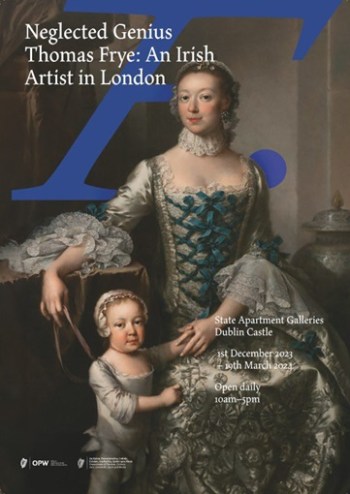 Born in 1710, most likely in Edenderry, County Offaly, Thomas Frye moved to London as a young man, where he quickly established himself as a successful portrait painter. From the mid-1740s, he ran a factory in Bow, just east of the City of London, set up to recreate Chinese porcelain, which had been admired in Europe for centuries. Under Frye’s management the Bow factory thrived, producing inexpensive ceramics both decorative and utilitarian in a variety of designs.
Frye was among the earliest European artists to collapse the distinction between ‘high’ art and factory-produced design. In an age of increasing specialisation, the manner in which he ranged freely across multiple techniques and media was unique. Although his name is scarcely known today outside specialist circles, Frye has a strong claim to the title of Ireland’s most successful printmaker, industrial artist, and design entrepreneur. At the same time, Frye’s career in London illustrates the incipient globalization of the period. Frye attempted to emulate Chinese technology with raw materials from north America.
This exhibition sets side-by-side Frye’s portraiture in oil, his enamel miniatures, his mezzotints, and the production of the Bow porcelain factory under his management. For the first time equal emphasis is afforded to each facet of this supremely gifted and highly innovative Irish artist. Included are loans from the Victoria and Albert Museum; The Foundling Museum, London; the Holburne Museum, Bath; and the National Gallery of Ireland, along with leading private collections.
William Laffan, the curator of the exhibition states: “Frye must be acknowledged as a pioneering figure in portraiture, porcelain and printmaking, and as one of the most inventive and ‘ingenious’ artists of the Georgian era.”
The Burlington Magazine, December 2023
The eighteenth century in the December issue of The Burlington, which focuses on Spain:
The Burlington Magazine 165 (December 2023)

Francisco de Goya, Self-Portrait with Dr Arrieta, 1820, oil on canvas, 115 × 77 cm (Minneapolis Institute of Art, 52.14).
a r t i c l e
• Mercedes Cerón Peña, “Goya’s Self-Portrait with Dr Arrieta,” pp. 1300–04.
In 1820 Goya painted a portrait of himself as he had appeared during his serious illness of the year before, attended by his doctor, Eugenio García Arrieta. Newly discovered biographical information about Arrieta suggests that the painting’s red and and green colour scheme may allude to the political views he shared with Goya.
r e v i e w s
• Michael Hall, Review of the new Galería de las Colecciones Reales (Royal Collections Gallery) in Madrid (opened 28 June 2023), pp. 1339–43.
• Stephen Lloyd, Review of the exhibition Return of the Gods (World Museum, Liverpool, (April 2023 — February 2024), pp. 1343–45. “Britain’s largest assemblage of Classical sculpture outside London belongs to National Museums Liverpool . . . In 1959 Liverpool City Council and its museums were gifted the entirety of the Ince Blundell collection—approximately six hundred heavily restored Roman marbles . . . collected by . . . Henry Blundell (1724–1810), a wealthy Catholic landowner, between 1776 and 1809.”
• Humphrey Wine, Review of the catalogue raisonné by Joseph Assémat-Tessandier, Louis Lagrenée, dit l’Aîné (1725–1805) (Arthena, 2022), pp. 1364–65.
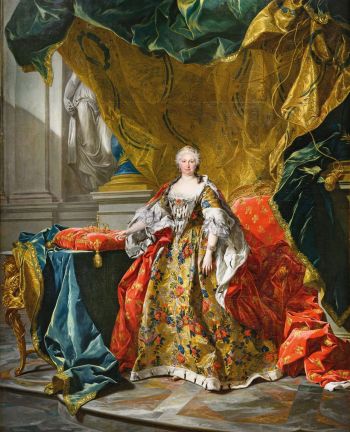
Louis-Michel van Loo, Portrait of Isabel Farnese, 1737, oil on canvas, 341 × 264 cm (Madrid: Galería de las Colecciones Reales).
• Rebeka Hodgkinson, Review of Stephanie Barczewski, How the Country House Became English (Reaktion, 2023), pp. 1370–71.
• Peter Humfrey, Review of Eveline Baseggio, Tiziana Franco, and Luca Molà, eds., La chiesa di Santa Maria dei Servi e la comunità veneziana dei Servi di Maria, secoli XIV–XIX (Viella, 2023), pp. 1374–75. “The demolition of the great fourteenth-century church of the Servi in about 1812–13 represents one of the most grievous of the many losses suffered by Venice’s artistic heritage during the Napoleonic period.”
o b i t u a r y
• Saloni Mathur, Obituary for Kavita Singh (1964–2023), pp. 1379–80.
Professor of art history and Dean of the School of Arts and Aesthetics at Jawaharlal Nehru University, Kavita Singh became internationally known for her publications on the history and politics of museums and the pre-modern art of South Asia. An authority on Indian court paintings, she was an inspiring colleague and teacher who publicly championed both her university and the study of Mughal art in the subcontinent.
Exhibition | Part of the Furniture: The Library of John Bedford
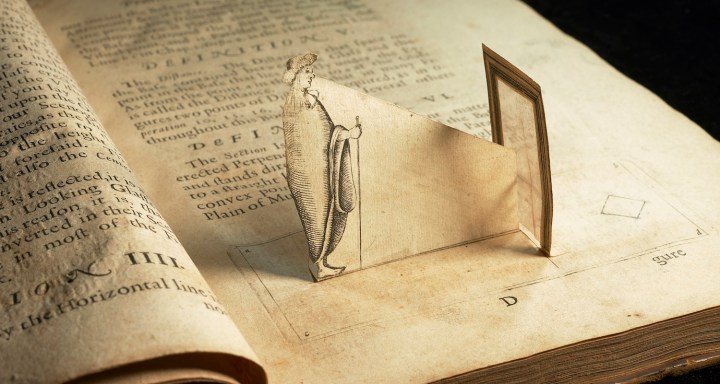
Joseph Moxon, Practical Perspective; or Perspective Made Easie (London, 1670)
(University of Leeds)
◊ ◊ ◊ ◊ ◊
Now on view at the University of Leeds, with additional information at the Antique Collecting Magazine. Also, see this posting at Antique Dealers Blog by one of the show’s curators, Mark Westgarth.
Part of the Furniture: The Library of John Bedford
Brotherton Gallery, University of Leeds, 9 January — 21 December 2024
Curated by Mark Westgarth, Rachel Eckersley, and Rhiannon Lawrence-Francis
Rare and beautiful books chart the evolution of furniture design over the centuries and the journey from drawing board, to workshop, to home
Selected from the world-leading library of antiques dealer John Bedford (1941–2019), ornate patterns by a renaissance pioneer, designs by Chippendale, Sheraton, Pugin, and Morris, elaborate trade cards, colourful catalogues, drawings, and manuals show how ideas and trends took shape, gained influence, and were eventually revived as fashions came full circle.
Upholsterer and furniture dealer Daniel Thorn might be less of a household name, but his personal sketchbook of designs for drapery, curtains, and furniture is a lively working record of the looks of the late-18th and early-19th centuries. Other highlights include the only complete coloured copy of The Ladies Amusement, an 18th-century book of decorative designs made to cut out and paste. Henry Lawford’s gloriously garish 1855 fold-out sofa catalogue sweeps away clichés of dismal Victoriana in a colour-lithographed riot of puce, lavender, and pea-green.
The exhibition also celebrates Bedford’s life, his vast knowledge, and his generous legacy to the University of Leeds, which enabled the extension and refurbishment of The Brotherton Research Centre and the establishment of The John Bedford Fellowship, in addition to the donation of his dazzling library.
Part of the Furniture: The Library of John Bedford is curated by Mark Westgarth, Associate Professor of Art History and Museum Studies and Director of the Centre for the Study of the Art & Antiques Market; Rachel Eckersley, Rare Book Specialist; and Rhiannon Lawrence-Francis, Special Collections Curator.
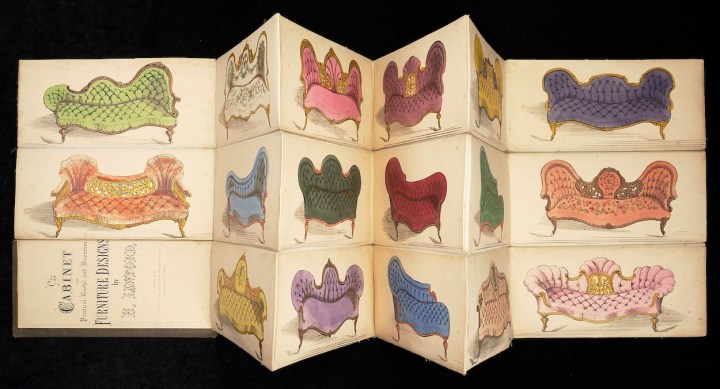
Henry Lawford, The Cabinet of Practical, Useful, and Decorative Furniture Designs (J. S. Virtue & Co., 1855)
(University of Leeds)
Exhibition | Gods, Heroes, and Traitors
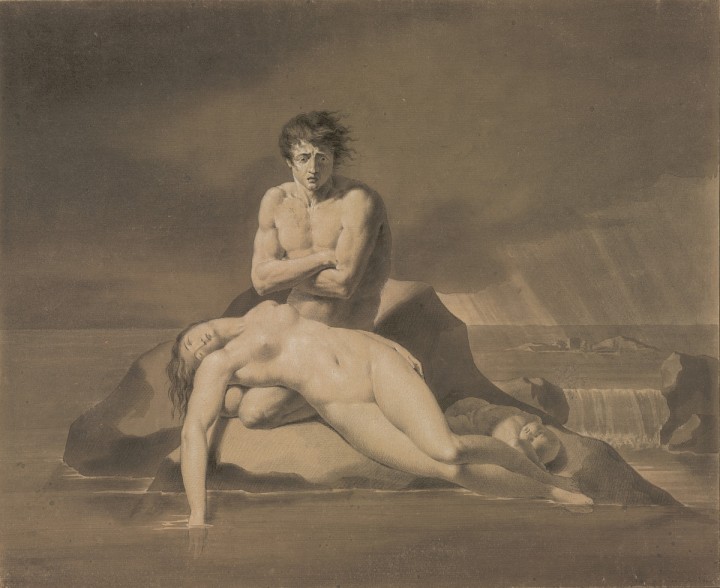
Robert von Langer, The Human Race Threatened by the Element of Water (Das Menschengeschlecht vom Element des Wassers bedroht), 1804
(Vienna: Albertina)
◊ ◊ ◊ ◊ ◊
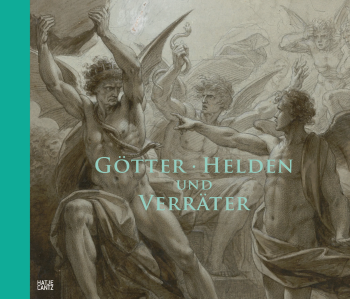
The show was on view at the Albertina last summer; the catalogue (in German) is still available from Hatje Cantz Verlag:
Gods, Heroes, and Traitors: The History Image around 1800
Albertina, Vienna, 2 June — 27 August 2023
Borne up by sentiment, historical painting was considered the most elevated genre of art well into the early nineteenth century. Staking a claim to morality as Schiller saw it—in the sense of having the ability to affect the spirit and intellect didactically—the drawings condense significant moments of religious, mythological material. Human emotions and deeds were turned into an artistic image of history, in the truest sense of the word.
 With the pictures assembled here, the Albertina unites outstanding works of art that mark the origins of what is today the most important collection of prints worldwide. Its founder, Prince Albert Casimir of Saxony, Duke of Teschen, was a collector with his finger on the pulse of the times. He was especially interested in drawings, studies, sketches, and large-format works on paper, acquiring the artworks directly, and often personally, from the studios of artists such as Jacques-Louis David, Anton Raphael Mengs, Antonio Canova, Angelika Kauffmann, Heinrich Friedrich Füger, and Johann Heinrich Füssli, or from the big Academy exhibitions of his era.
Christof Metzger and Julia Zaunbauer, eds., with a foreword by Klaus Albrecht Schröder, Götter, Helden und Verräter: Das Historienbild um 1800 (Berlin: Hatje Cantz Verlag, 2023), 216 pages, ISBN: 978-3775754521, $62.
Exhibition | The Botanical Library of Benjamin Delessert
Delessert assembled a massive herbarium and botanical library (along with a large shell collection). At his death, his 300,00 plant specimens went to Geneva’s Conservatoire botanique and his books to the Institut de France. A selection is now on view at the Bibliothèque Mazarine.
◊ ◊ ◊ ◊ ◊
Un herbier-monde: La bibliothèque botanique de Benjamin Delessert (1773–1847)
Bibliothèque Mazarine, Paris, 8 December 2023 — 2 March 2024
Curated by Sabrina Castandet-Le Bris with Dominique Drouin and Olivier Thomas
 La botanique gagna d’abord Benjamin Delessert comme une passion familiale. Né en 1773 à Lyon dans un milieu protestant d’origine genevoise acquis aux idées philanthropiques et progressistes, il fut appelé à présider, tout jeune homme encore, aux destinées de l’établissement bancaire paternel, puis de ses propres entreprises, et réunit une importante fortune personnelle qu’il consacra à l’oeuvre de sa vie : rassembler l’une des plus importantes collections botaniques au monde, et en faire bénéficier l’ensemble de la communauté des savants.
Alors que son herbier personnel s’enrichissait de pièces historiques provenant des pères fondateurs de la botanique (Linné, Plumier ou Hermann), son esprit curieux le portait dans le même temps vers l’innovation scientifique et le soutien aux disciplines nouvelles préfigurant l’écologie. Une adhésion enthousiaste aux recherches sur la classification naturelle développées par son ami Augustin-Pyramus de Candolle, et la place faite dans sa vaste bibliothèque à la géographie botanique naissante, l’engagent à soutenir des expéditions naturalistes et à contribuer à des entreprises majeures de l’édition botanique du XIXe siècle. L’intuition visionnaire de l’impérieuse nécessité de réunir les savoirs sur le monde végétal, explique à la fois sa pratique altruiste de la collection, ses engagements éditoriaux, et son intervention déterminante dans la communauté scientifique.
Léguée à l’Académie des sciences en 1869 et conservée depuis à la bibliothèque de l’Institut, cette collection de 8500 titres permet de retracer les contours et les usages d’un « musée botanique » exceptionnel, et d’interroger les fonctions de l’herbier—qu’il soit naturel ou figuré—à la lumière des enjeux actuels de préservation de la biodiversité.
Exhibition | Pastels, between Line and Color
Now on view at the Cognacq-Jay:
Pastels, entre ligne et couleur
Musée Cognacq-Jay, Paris, 12 October 2023 — 11 February 2024
Curated by Pascal Faracci and Sixtine de Saint-Léger
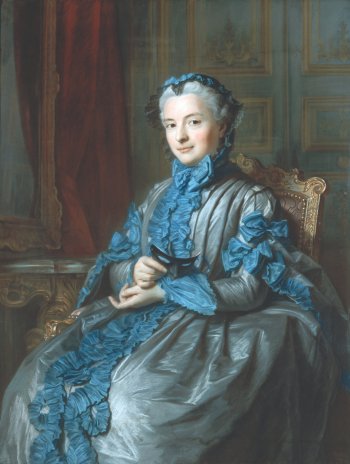
Maurice Quentin de La Tour, Portrait de Madame la présidente de Rieux, en habit de bal, tenant un masque, 1742 (Musée Cognacq-Jay).
Siècle d’or du pastel, le XVIIIe voit s’épanouir la virtuosité de dessinateurs tels que Maurice-Quentin de La Tour, le « prince des pastellistes », et son rival talentueux Jean-Baptiste Perronneau. Ils sont à l’honneur dans la collection Cognacq-Jay, avec des portraits qui comptent parmi leurs chefs-d’œuvre, comme celui de Madame la présidente de Rieux, en habit de bal, tenant un masque, aux dimensions monumentales. À ces œuvres françaises s’ajoutent celles de trois pastellistes anglais : Hugh Douglas Hamilton, John Russel et Daniel Gardner, témoins des échanges artistiques entre les deux pays autant que du goût singulier d’Ernest Cognacq pour l’école britannique.
La facture moelleuse, l’éclatante fraîcheur des coloris et l’expressivité des modèles de ces portraits témoignent du talent des artistes à manier le pastel, cette poudre de couleur aux nuances et aux dégradés variant à l’infini. À la fois ligne et couleur, le pastel offre une rapidité d’écriture, une transcription sensible de l’émotion et une intensité qui reste intacte au fil du temps.
Aux côtés des œuvres de la collection Cognacq-Jay, une sélection de pastels d’artistes du XVIIIe, tels que François Boucher ou Élisabeth Vigée Le Brun issus d’autres institutions de Paris Musées, complète ce panorama.
L’accrochage exceptionnel de ces œuvres fragiles, accompagné d’une médiation spécifique, permettra d’éclairer le goût pour le portrait intime, caractéristique du siècle des Lumières, et sera également l’occasion de dévoiler les dernières acquisitions du musée en arts graphiques.
Exhibition | Canops: Extraordinary Furniture for Charles III of Spain
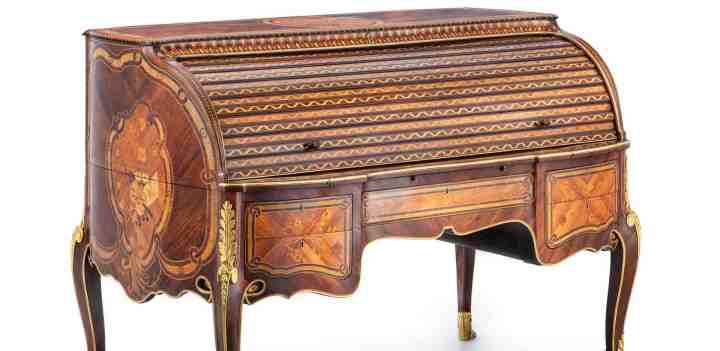
Madrid court workshop of Charles III under the direction of José Canops, Writing bureau with exotic marquetry decoration, ca. 1772–73
(Staatliche Museen zu Berlin, Kunstgewerbemuseum; photo by Stephan Klonk)
◊ ◊ ◊ ◊ ◊
Now on view at Berlin’s Museum of Decorative Arts, from the Staatliche Museen zu Berlin, with a related conference taking place 25–27 January:
Canops: Extraordinary Furniture for Charles III of Spain, 1759–1788
Kunstgewerbemuseum, Schloss Köpenick, Berlin, 12 October 2023 — 11 February 2024
Curated by Achim Stiegel
Although largely unknown today, the work of José Canops (1733–1814), an ébéniste of German descent born Joseph Cnops, and his Madrid workshop is one of the crowning achievements of European furniture-making.
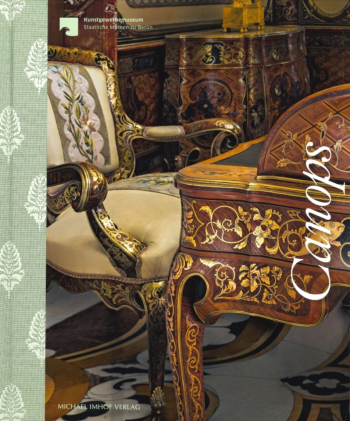 The furniture and boiseries are from the apartments of Charles III of Spain (r. 1759–1788), a Gesamtkunstwerk in exuberant rococo style conceived by the court painter and stuccoist Mattia Gasparini—a truly European creation inspired by Italian traditions, a taste for Parisian opulence, and the exotic worlds of Asia. Such elements combine in Canops’s work with the precision of German cabinetmaking and the riches of the Spanish colonies.
The starting point for the exhibition and publication was the acquisition for the Kunstgewerbemuseum of a magnificent roll-top desk by José Canops. With lavish new photography and never previously exhibited loans from the Patrimonio Nacional (the Spanish royal collections in Madrid), German and international audiences are afforded a glimpse into a hitherto hidden world.
In conjunction with the Spanish Embassy, the Ibero-Amerikanisches Institut of the Preußischer Kulturbesitz and Instituto Cervantes Berlin, the exhibition is accompanied by a programme of supporting events within the context of the 2023 Spanish presidency of the Council of the European Union.
Daniela Heinze, Achim Stiegel, et al., Canops: Möbel von Welt für Karl III. von Spanien (1759–1788), with photographs by Stephan Klonk (Petersberg: Michael Imhof Verlag, 2023), 288 pages, ISBN: 978-3731913689, €50.
Exhibition | Ornament

Installation view of Ornament (Yale University Art Gallery, 2023), with a harpsichord by Andreas Ruckers (1640) from the Yale School of Music’s Morris Steinert Collection of Musical Instruments.
◊ ◊ ◊ ◊ ◊
Press release for the exhibition:
Ornament
Yale University Art Gallery, New Haven, 26 September 2023 — 18 February 2024
Organized by Freyda Spira and Laurence Kanter
Ornament marks the Yale University Art Gallery’s latest collaboration with the Yale School of Music, occasioned by the restoration of its historic building housing the Morris Steinert Collection of Musical Instruments. During the closure necessitated by the renovation project, three important and elaborately ornamented early keyboard instruments are on loan to the Gallery.

Gilles-Marie Oppenord (formerly attributed to Jean Bérain), Ornamental Panel with Father Time , ca. 1700, pen and brown ink and gray wash, sheet: 41 × 29 cm (New Haven: Yale University Art Gallery).
A 1640 harpsichord by the Antwerp-based craftsman Andreas Ruckers, with its intricately decorated soundboard and lid, exemplifies the Flemish school of harpsichord making at its height. Also featured in the installation is a smaller instrument called a spinetta, made by Francesco Poggio of Florence in 1620, with a lid painted by an accomplished atelier in the Tuscan city. On view alongside these two harpsichords is an early 19th-century Austrian pyramid piano, a stylish Neoclassical ancestor to the upright pianos that would become popular in 19th- and 20th-century homes. These three objects are accompanied by a selection of around 40 European drawings and prints from the 16th through the 18th century that demonstrate how ornament offers an arena for artistic license. The display of musical instruments and works on paper emphasizes how patterns and forms have been imitated, adapted, and translated across media by artists and craftspeople alike.
This installation is a continuation of the Gallery’s collaborations with other Yale collections, following most recently on the exhibition Crafting Worldviews: Art and Science in Europe, 1500–1800, which assembled objects and artworks from the Yale Peabody Museum, the Yale University Library, and the Yale Center for British Art (YCBA), as well as the current exhibition In a New Light, showcasing painted masterpieces from the YCBA.
Exhibition made possible by the Wolfe Family Exhibition and Publication Fund. Organized by Freyda Spira, the Robert L. Solley Curator of Prints and Drawings, and Laurence Kanter, Chief Curator and the Lionel Goldfrank III Curator of European Art.
New Book | Tischbein the Elder (1722–1789)
An exhibition from 2022 that I missed, though the catalogue is still available from Michael Imhof:
Tischbein: Meisterwerke des Hofmalers, Porträts und Landschaften von Johann Heinrich Tischbein d. Ä. (1722–1789) (Petersberg : Michael Imhof Verlag, 2022), 160 pages, ISBN: 978-3731912675, €35.
 Ausstellung im Schloss Fasanerie in Eichenzell/Fulda: 11. Juni bis 9. Oktober 2022
Am 3. Oktober 2022 jährt sich der Geburtstag Johann Heinrich Tischbeins des Älteren (1722–1789) zum 300. Mal. Den runden Geburtstag des bedeutendsten Vertreters der berühmten hessischen Malerdynastie Tischbein nimmt die Kulturstiftung des Hauses Hessen zum Anlass, dem landgräflich-hessischen Hofmaler im Museum Schloss Fasanerie bei Fulda eine monografische Ausstellung zu widmen. Ein Schwerpunkt der Ausstellung stellt die Rolle Tischbeins als Hofmaler dreier hessischer Landgrafen in Kassel dar. Im Jahr 1753 wurde Johann Heinrich d. Ä. von Landgraf Wilhelm VIII. von Hessen-Kassel zum Hofmaler ernannt und blieb es auch während der gesamten Regierungszeit Friedrichs II. (1760–1785). Obwohl Tischbein bei Regierungsantritt Wilhelms IX. bereits krank war, blieb er auch unter ihm Hofmaler, und der Landgraf richtete auf Schloss Wilhelmshöhe eine ihm posthum gewidmete Gemäldegalerie ein. Aufträge erhielt der Maler jedoch nicht allein von Mitgliedern des Kasseler Hofs, er schuf auch zahlreiche Porträts für Fürst Karl August von Waldeck und Pyrmont und stattete dessen Residenz in Bad Arolsen mit Gemälden aus. Darüber hinaus porträtierte Tischbein seine eigene Familie und war auch bei bürgerlichen Auftraggebern jenseits von Hof und Residenz gefragt. Neben Porträts zeigt der Katalog Landschaftsgemälde von Johann Heinrich Tischbein d. Ä. Darunter befinden sich wichtige Ansichten des Schlosses auf dem Weißenstein (dem Vorgängerbau von Schloss Wilhelmshöhe in Kassel) und der das Schloss umgebenden Parkanlagen des 18. Jahrhunderts.
i n h a l t
Zum Geleit Donatus Landgraf von Hessen
1 Johann Heinrich Tischbein d. Ä.: Selbstbildnisse als Inszenierungdes sich wandelnden Künstlertums — Justus Lange
Katalog
2 Die Porträts Landgraf Friedrichs II. von Hessen-Kassel — Andreas Dobler
Katalog
3 Landgräfin Philippine von Hessen-Kassel (1745–1800) im Porträt — Malena Rotter
Katalog
4 Denker und Dichterinnen: Johann Heinrich Tischbeins d. Ä. Porträtmalerei jenseits von Hof und Residenz — Andrea Linnebach
Katalog
5 Landschaftsgemälde von Johann Heinrich Tischbein d. Ä.— Markus Miller
Katalog
Literaturverzeichnis
Exhibition | Unnamed Figures: Black Presence and Absence
 Rufus Hathaway, A View of Mr. Joshua Winsor’s House &c., Duxbury, Massachusetts, ca. 1793–95, oil on canvas (New York: American Folk Art Museum, gift of Ralph Esmerian, 2013.1.19). From the museum’s Instagram account, “This iconic folk painting has typically been interpreted as its eighteenth-century patron, Joshua Winsor, would have expected: as a chronicle of his wealth and property as a merchant and shipbuilder in Duxbury, Massachusetts. Usually unremarked upon is the figure of a Black woman in the lower left-hand corner of the scene. With her back to the viewer, the woman is faceless, evoking the limited details known about early African American lives. Census records provide small clues. Was she the one free person of color recorded in the Winsor household in 1790, a few years before this painting was made? Likely attending to many aspects of the Winsors’ domestic lives, this enigmatic figure was one of the many unnamed Black residents of New England whose underrecognized labor paved the way for their employers’ or enslavers’ prosperity.”
◊ ◊ ◊ ◊ ◊
Karen Rosenberg’s review of the exhibition recently appeared in The New York Times (21 December 2023) . . . .
Unnamed Figures: Black Presence and Absence in the Early American North
American Folk Art Museum, New York, 15 November 2023 — 24 March 2024
Flynt Center of Early New England Life, Deerfield, Massachusetts, 1 May — 4 August 2024
Curated by Emelie Gevalt, RL Watson, and Sadé Ayorinde
Unnamed Figures: Black Presence and Absence in the Early American North is on view at the American Folk Art Museum until 24 March 2024. As a corrective to histories that define slavery and anti-Black racism as a largely Southern issue, this exhibition offers a new window onto Black representation in a region that is often overlooked in narratives of early African American history.
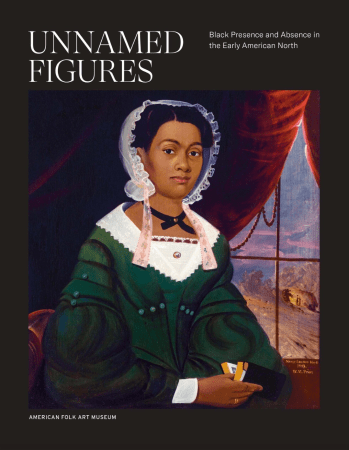 Through 125 remarkable works including paintings, needlework, and photographs, this exhibition invites visitors to focus on figures who appear in—or are omitted from—early American images and will challenge conventional narratives that have minimized early Black histories in the North, revealing the complexities and contradictions of the region’s history between the late 1600s and early 1800s. A 300-page scholarly book with contributions from Gwendolyn DuBois Shaw, Jennifer Van Horn, and several other authors, is available for purchase.
The exhibition is co-curated by Emelie Gevalt, Curatorial Chair for Collections and Curator of Folk Art, AFAM; RL Watson, Assistant Professor of English and African American Studies, Lake Forest College; and Sadé Ayorinde, Terra Foundation Predoctoral Fellow in American Art at the Smithsonian American Art Museum. A free digital guide on Bloomberg Connects is available here.
Please be advised that this exhibition contains complex, challenging, and racist imagery.
Unnamed Figures: Black Presence and Absence in the Early American North (New York: American Folk Art Museum, 2023), 300 pages, $75.
Catalogue contributors are scholars and researchers with expertise in American art history, material culture, African American history and literature, and other related topics. The book includes a foreword by Gwendolyn DuBois Shaw and Jason Busch. Contributors include the exhibition’s curators as well as Virginia Anderson, Kelli Racine Barnes, Michael Bramwell, Christy Clark-Pujara, Anne Strachan Cross, Jill Vaum Rothschild, Jonathan Michael Square, Lea Stephenson, Jennifer Van Horn, and Gordon Wilkins.
r e l a t e d p r o g r a m m i n g
7 December 2023
Virtual Insights: Reasserting Black Presence in the Early American North
11 January 2024
BlackMass Responds to Unnamed Figures: Tour with Yusuf Hassan and Kwamé Sorrell
14 February 2024
Notes on Style: A Discussion with BlackMass on Portraiture and Personhood
23 February and 28 March 2024
‘The Picture Is Still Out There’: Reframing Black Presence in the Collections of Early American Art and Material Culture | 2024 Elizabeth and Irwin Warren Folk Art Symposium
18 March 2024
Autobiographical Landscapes: Gary Tyler in Conversation with Allison Glenn
◊ ◊ ◊ ◊ ◊
Note (added 4 January 2024) — The posting was updated to include Historic Deerfield as a venue.










 Enfilade
leave a comment