One Small Step, One Giant Leap
Scaramouche: “You must know, Madam, your Father (my Master, the Doctor) is a little Whimsical, Romantick, or Don Quick-sottish . . . Lunatick we may call him without breaking the Decorum of good Manners; for he is always travelling to the moon.”
-Aphra Behn, The Emperor of the Moon (1687)
On the 40th anniversary of Neil Armstrong’s moon walk, a selection of lunar images from the eighteenth century seems in order. And as often is the case with this crucial century, we see important foundations established (and some from the sixteenth century reinforced). From Aphra Behn’s use of the moon as a potent source of satire for the Royal Society – recently explored by Al Coppola in “Retraining the Virtuoso’s Gaze: Behn’s Emperor of the Moon, the Royal Society, and the Spectacles of Science and Politics,” Eighteenth-Century Studies 41 (Summer 2008) – to William Hogarth’s Principal Inhabitants of the Moon, the celestial orb proved a useful foil for assessing life as experienced in more local terms.
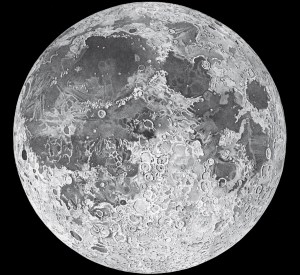
 By the end of the century, however, John Russell (Royal Academician and Painter to George III) would fix his entirely serious and scrupulous gaze to the heavens. Along with a series of drawings, he produced a handsome lunar globe and a striking pastel, measuring 5ft across. Both are now found at the Museum of the History of Science in Oxford, which possesses the major collection of work relating to Russell’s lunar observations. For details, see the museum’s website, which contains especially useful information from a 2007 exhibition dedicated to the subject, “Moonscope.”
Others that come to mind?
Call for Papers: Colonial Built Environment at SAH
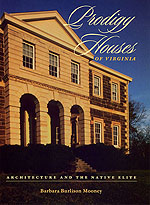 Barbara Burlison Mooney, author most recently of Prodigy Houses of Virginia: Architecture and the Native Elite – which, I should note, received a glowing review earlier this year from the Virginia Magazine of History and Biography – is chairing a session at next year’s meeting of the Society of Architectural Historians in Chicago (21-25 April 2010). She sends the following call for papers:
◊ ◊ ◊ ◊ ◊
Proposals are due 15 August 2009
Taking the Measure of New Colonial Architectural History
Arguably, the article “Impermanent Architecture in the Southern American Colonies,” the result of collaboration among architectural historians, archaeologists, and historians and published in 1981, stands as the most important work of scholarship on the built environment of America’s colonial period appearing in the last half century. By exploiting archaeological practices, the interdisciplinary authors of this article demonstrated the pervasive presence of hole-set, or earthfast, construction technology in Tidewater Virginia and Maryland and undermined the stereotyped image of extant genteel mansions that was well known through the scholarship of S. Fiske Kimball and Thomas T. Waterman, among others. Combined with critical concepts from the Annales School, the Civil Rights Movement, Feminism, and post-Formalist literary theory, “Impermanent Architecture” heralded a new, productive era of research in the field of Colonial American architectural history, which is open to diverse and challenging interpretations.
Subsequently, architectural historians and their cohorts in other disciplines have created a more nuanced image of the colonial built environment that includes African Americans, women, the so-called “middling sort,” and a greater sensitivity to discerning regional and international practices operative in early America. Scholars of the period also have become more attuned to the importance of non-British building traditions. Researchers continue to marshal new methodologies, as well as interdisciplinary and trans-Atlantic approaches, to expand our understanding of the era and its elastic boundaries. This session aims to take the current measure of the New Colonial Architectural History by inviting paper proposals demonstrating how both innovative and traditional research strategies and theoretical perspectives continue to inform the history of the early North American built envinronment. Paper proposals are invited that address new archaeological, archival, analytical, or methodological investigations in the field. Research in French, Spanish, Dutch, German, and Caribbean as well as British colonial architecture is welcome.
Send proposals by August 15, 2009 to Barbara Burlison Mooney, School of Art and Art History, W619 Seashore Hall, University of Iowa, Iowa City, IA 52242 Email: barbara-mooney@uiowa.edu Phone 319-335-1785 Fax 319-335-1774. For proposal length and other requirements, please consult the Society of Architectural Historians website.










 Enfilade
1 comment