Adam the Romantic
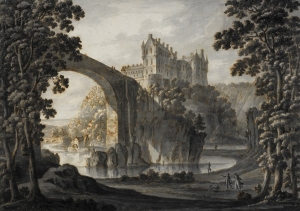
Robert Adam, "Cullen Castle, Banffshire," ca. 1770s (Edinburgh: National Gallery)
25 April – 2 August 2009
Robert Adam’s Landscape Fantasies:
Watercolors and Drawings from the Permanent Collection
National Gallery of Scotland, Edinburgh
This is the final week for an exhibition in Edinburgh that explores a less familiar dimension of Robert Adam’s oeuvre. As noted from The Magazine Antiques:
The Scottish architect, interior designer, and furniture designer, who designed such neoclassical masterpieces as Kenwood House, Osterley Park, and Stowe, created the landscape watercolors and drawings on view toward the end of his life for his own private enjoyment. While some, such as this detailed depiction of Cullen Castle in Banffshire, painted about 1770 to 1780, portray real sites, the majority depict picturesque fantasies, evoking in an entirely Scottish guise the capricci of Giovanni Battista Piranesi, with whom Adam had studied while in Rome on an extended grand tour in the 1750s.
The more than thirty watercolors by Adam on view are accompanied by drawings by his sketching partners: his brother-in-law, John Clerk of Eldin, and Paul Sandby, an English landscape artist who traveled extensively through Scotland. These brooding, atmospheric renderings of steep cliffs, ancient castles, and gushing waterfalls offer up a cooling tonic to summer’s heat.
 The show stands as a fine complement to an exhibition from 2000 mounted by the John Soane Museum, Robert Adam’s Castles, which included a catalogue by Stephen Astley. As described in the archives seciton of the museum’s website, the London show sought to
cast Robert Adam, Scotland’s most celebrated architect, in a dramatic new light, reassessing an important but much neglected element of his architectural portfolio, his designs in ‘the castle style’. Robust and sublime, Adam’s castles make a startling contrast to the refined and delicate decorative schemes for which the architect is principally known, and comprise over 10 percent of his career output. Of the realised castle projects, many have now gone and others lie in ruins – an unjust fate for a group of buildings representing the most personal expression of Adam’s art.
Encompassing over 60 drawings taken from the unrivalled collection of Adam work held by the Soane Museum, and including a number of loans from public and private collections in Scotland, this exhibition revealed, for the first time, the extraordinary range of Adam’s castle designs. These are of all sizes from small garden buildings to vast castellated palaces. The former category includes the unbuilt ruined castle for the gardens at Osterley Park, and the latter is represented by impressive examples at Barnbougle and Beaufort. A distinctive feature of Adam’s domestic castles is their ingenious and striking geometrical planning such as at Airthrey Castle near Stirling (1790).
Also included in the exhibition were a selection of Adam’s stunning watercolour views of castles in landscapes. Pure fantasy, these developed from an almost obsessional exploration of the castle picturesquely situated in dramatic scenery with mountains and waterfalls. He produced huge numbers of these watercolours during the 1770s and 80s and valued them so highly that he gave over 1,000 to his sisters as security when the failure of the Adelphi project threatened to ruin the family firm.
This show marks a long overdue reappraisal of Adam’s castle designs and demonstrate that far from being mere containers for classical interiors, his castles were deeply individual, meticulously wrought, and highly successful, representing a personal achievement unparalleled by any other 18th-century British architect.










 Enfilade
leave a comment