Summer Seascapes
28 May — 18 October, 2009
“An Allegory of Empire,” — Benjamin Genocchio, New York Times (26 June 2009)
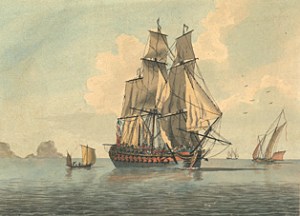
Samuel Atkins (fl. 1787-1808), "H.M.S. Bounty Setting Sail," pen, ink and watercolor painting (New Haven: YCBA)
A small exhibition of marine paintings and watercolors from the Dutch ‘Golden Age’ and by noted British artists — including scenes of famous naval battles, warships, privateers and historical vessels — is featured in a summer exhibition at the Yale Center for British Art.
Seascapes: Marine Paintings and Watercolors from the U Collection includes works attesting to Great Britain’s maritime capabilities, interest in scientific exploration and imperial expansion. On view through October 18, the exhibition features approximately 20 works from a recent major gift to the Yale Center for British Art that span the seventeenth to nineteenth centuries and attest to the visual and cultural significance of the sea in Britain and the Netherlands. The center is the only venue for the exhibition. (more…)
The Eighteenth Century, Today & Tomorrow
With topics ranging from the colonial Enlightenment (Gabrillea De la Rosa) to eighteenth-century China (Yun-Chiu Mei), art history dissertations completed in Canada and the United States in 2008 offer an array of intriguing titles. The College Art Association’s tally at caa.reviews lists eight completed dissertations in the eighteenth century, including:
- Anne-Louise Fonseca, “Pedro Alexandrino de Carvalho (1729–1810) et la peinture d’histoire à Lisbonne: cycles religieux et cycles profanes” (Université de Montréal, L. de Moura Sobral)
- Hope Saska, “Staging the Page: Graphic Satire and Caricature in Eighteenth-Century England” (Brown, K. D. Kriz)
- Kristel Smentek, “Art, Commerce, and Scholarship in the Age of Enlightenment: Pierre-Jean Mariette and the Making of Art History” (Delaware, N. Athanassoglou-Kallmyer)
- Pamela Whedon, “Sensing Watteau: The Artist’s Musical Images as Preludes to the Age of Sensibility” (UNC Chapel Hill, M. Sheriff)
CAA likewise, provides an account of dissertations in progress. For 2008 there were twelve, including:
- Amber Ludwig, “‘She is all Nature, and yet all Art’: Portraits of Emma Hamilton” (Boston, B. Redford)
- Molly Medakovich, “Between Friends: Representations of Female Intimacies in French Genre Paintings and Prints, 1770–1830” (UNC Chapel Hill, M. Sheriff)
For the full lists, see the caa.reviews site.
Lunar Landscapes, Part II
In connection with the previous lunar posting, Michael Yonan notes the fascinating series of paintings in the Vatican Collection by Donato Creti. Commissioned by Luigi Marsili in 1711, the eight pictures depict landscapes by Creti with heavenly bodies rendered by the miniaturist Manzini — largely as the forms would have appeared with the aid of eighteenth-century telescopes. In a 1992 article Christopher Johns addresses the paintings “as a cultural bribe to Clement XI, works of art that give unique testimony to the significance of Newtonianism to astronomical observation in Italy and to the intimate relationship between early eighteenth-century art and science.” See Johns, “Art and Science in Eighteenth-Century Bologna: Donato Creti’s Astronomical Landscape Paintings,” Zeitschrift für Kunstgeschichte 55 (1992): 578-89. The article also includes the lovely drawing by Creti, “The Astronomers,” now in the collection of the Art Institute of Chicago.
One Small Step, One Giant Leap
Scaramouche: “You must know, Madam, your Father (my Master, the Doctor) is a little Whimsical, Romantick, or Don Quick-sottish . . . Lunatick we may call him without breaking the Decorum of good Manners; for he is always travelling to the moon.”
-Aphra Behn, The Emperor of the Moon (1687)
On the 40th anniversary of Neil Armstrong’s moon walk, a selection of lunar images from the eighteenth century seems in order. And as often is the case with this crucial century, we see important foundations established (and some from the sixteenth century reinforced). From Aphra Behn’s use of the moon as a potent source of satire for the Royal Society – recently explored by Al Coppola in “Retraining the Virtuoso’s Gaze: Behn’s Emperor of the Moon, the Royal Society, and the Spectacles of Science and Politics,” Eighteenth-Century Studies 41 (Summer 2008) – to William Hogarth’s Principal Inhabitants of the Moon, the celestial orb proved a useful foil for assessing life as experienced in more local terms.
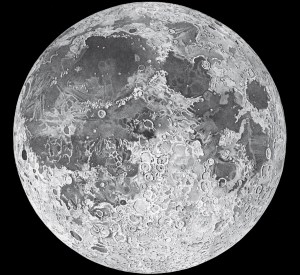
 By the end of the century, however, John Russell (Royal Academician and Painter to George III) would fix his entirely serious and scrupulous gaze to the heavens. Along with a series of drawings, he produced a handsome lunar globe and a striking pastel, measuring 5ft across. Both are now found at the Museum of the History of Science in Oxford, which possesses the major collection of work relating to Russell’s lunar observations. For details, see the museum’s website, which contains especially useful information from a 2007 exhibition dedicated to the subject, “Moonscope.”
Others that come to mind?
Call for Papers: Colonial Built Environment at SAH
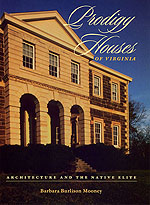 Barbara Burlison Mooney, author most recently of Prodigy Houses of Virginia: Architecture and the Native Elite – which, I should note, received a glowing review earlier this year from the Virginia Magazine of History and Biography – is chairing a session at next year’s meeting of the Society of Architectural Historians in Chicago (21-25 April 2010). She sends the following call for papers:
◊ ◊ ◊ ◊ ◊
Proposals are due 15 August 2009
Taking the Measure of New Colonial Architectural History
Arguably, the article “Impermanent Architecture in the Southern American Colonies,” the result of collaboration among architectural historians, archaeologists, and historians and published in 1981, stands as the most important work of scholarship on the built environment of America’s colonial period appearing in the last half century. By exploiting archaeological practices, the interdisciplinary authors of this article demonstrated the pervasive presence of hole-set, or earthfast, construction technology in Tidewater Virginia and Maryland and undermined the stereotyped image of extant genteel mansions that was well known through the scholarship of S. Fiske Kimball and Thomas T. Waterman, among others. Combined with critical concepts from the Annales School, the Civil Rights Movement, Feminism, and post-Formalist literary theory, “Impermanent Architecture” heralded a new, productive era of research in the field of Colonial American architectural history, which is open to diverse and challenging interpretations.
Subsequently, architectural historians and their cohorts in other disciplines have created a more nuanced image of the colonial built environment that includes African Americans, women, the so-called “middling sort,” and a greater sensitivity to discerning regional and international practices operative in early America. Scholars of the period also have become more attuned to the importance of non-British building traditions. Researchers continue to marshal new methodologies, as well as interdisciplinary and trans-Atlantic approaches, to expand our understanding of the era and its elastic boundaries. This session aims to take the current measure of the New Colonial Architectural History by inviting paper proposals demonstrating how both innovative and traditional research strategies and theoretical perspectives continue to inform the history of the early North American built envinronment. Paper proposals are invited that address new archaeological, archival, analytical, or methodological investigations in the field. Research in French, Spanish, Dutch, German, and Caribbean as well as British colonial architecture is welcome.
Send proposals by August 15, 2009 to Barbara Burlison Mooney, School of Art and Art History, W619 Seashore Hall, University of Iowa, Iowa City, IA 52242 Email: barbara-mooney@uiowa.edu Phone 319-335-1785 Fax 319-335-1774. For proposal length and other requirements, please consult the Society of Architectural Historians website.
HBA Now Accepting Nominations for Book Prizes
The Historians of British Art annually award prizes to outstanding books on the history of British art and visual culture in three categories: Pre-1800, Post-1800, and multi-authored volume. The committee welcomes nominations for its 2009 prize (for books published in 2008). There is no limit on the number of books from a single publisher that may be considered in each category. For further information on how to nominate books, please contact the committee chair at the email address below. Winners will be announced before the annual meeting of the College Art Association in February, 2010.

Anne Nellis Richter
Committee Chair
HBAbookprize@hotmail.com
Here, incidentally, are the 2008 winners (for books published in 2007)
- Single Author before ca.1800: Thomas P. Campbell, Henry VIII and the Art of Majesty: Tapestries at the Tudor Court (Yale University Press, 2007)
- Single Author after ca.1800: Elizabeth Prettejohn, Art for Art’s Sake: Aestheticism in Victorian Painting (Yale University Press, 2007)
- Multiauthored: Tim Barringer, Geoff Quilley, and Douglas Fordham, eds., Art and the British Empire (Manchester University Press, 2007)
Spanish Still Life in D.C. — then L.A. and Boston
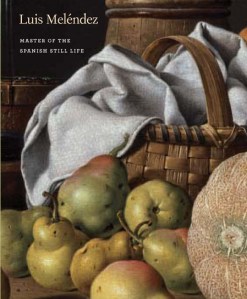
Catalogue by Gretchen Hirschauer and Catherine Metzger with Peter Cherry and Natacha Seseña

Luis Meléndez, Self-Portrait, 1746, oil on canvas, 38 x 32 inches (Paris: Louvre)
May 17 — August 23, 2009
Delights of the Spanish table depicted by the eighteenth-century painter Luis Meléndez (1715-1780) are presented to American audiences for the first time in nearly twenty-five years at the National Gallery of Art, Washington, May 17 through August 23, 2009. In a rare opportunity to explore the artist’s working method, the exhibition Luis Meléndez: Master of the Spanish Still Life showcases 31 paintings, some of which have never been shown publicly, and nine examples of eighteenth-century kitchenware similar to those used as studio props by Meléndez.
Organized by the National Gallery of Art, Washington, the exhibition will travel to the Los Angeles County Museum of Art, on view September 23, 2009, through January 3, 2010, and to the Museum of Fine Arts, Boston, on view February 1 through May 9, 2010. Fourteen of Meléndez’s still-life paintings now in American collections will be shown with 17 relevant works by him from collections abroad, exploring the artist’s creative process and celebrating his compelling artistic achievements. Loans of paintings come from major museums such as the Museo Nacional del Prado, Museé du Louvre, and the Museum of Fine Arts, Boston.
[Press release from the National Gallery]
Housekeeping
First, thanks so much to all of you who’ve visited within the last few days! Julie Plax and I have received numerous messages full of kind expressions of encouragement. We really appreciate them all.
I should also say that I have been delighted with WordPress while getting Enfilade up and running. It’s been extremely user friendly. In the site’s current manifestion, it’s also free – which means HECAA funds can go toward other sorts of projects. Still, depending upon what we want from the site, at some point, a few inexpensive upgrades may be in order.
WordPress.com notes under Premium Featueres that “from time to time, we display text ads on your blog to logged-out users who aren’t regular visitors.”
I’ve no idea how frequently “from time to time” is nor what counts as a “regular” visitor (and I probaly will not since I likely won’t fall in either category). So this is really a request to Enfilade readers: in the event you do experience this site with ads, please let me know. To ensure that no visitor ever sees an ad, we can pay a modest annual fee. I would rather not, but I’m also averse to the ads. The site remains a work in progress. I appreciate your patience and feedback.
-C.A.H.
Diplomacy in 1762
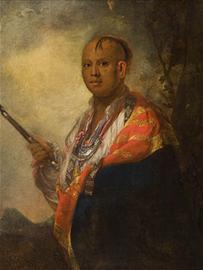
Joshua Reynolds, Syacust Ukah, 1762
Gilcrease Museum of the Americas – Tulsa, Oklahoma
July 4, 2009 – January 10, 2010
Emissaries of Peace: The 1762 Cherokee and British Delegations recounts the story of British and Cherokee diplomatic missions to each other’s capitals in 1762. The exhibition takes a look at British and Cherokee societies through the eyes of first-time observers. Two of the most important works related to this story, portraits of Ostenaco by Sir Joshua Reynolds and Cunne Shote by Francis Parsons painted in June and July 1762, are reunited with the ethnographic and archaeological material that provide their historical context.
In the mid-eighteenth century, the Cherokee were considered by Great Britain to be strong allies and trading partners. The alliance was broken in 1758 and a destructive three-year war followed. The Cherokee and British peace delegations in 1762 attempted to re-establish the military and economic alliance.
Providing insights into how British and Cherokee societies viewed each other during the pre-Revolutionary war era, Emissaries of Peace relies heavily on the memoirs of Lt. Henry Timberlake, a British officer sent to the Cherokee capital of Chota after a peace treaty was concluded in November 1761. His memoirs provide one of the best accounts of Cherokee life and society in the late-eighteenth century and were published about the time of his death in 1765. An original copy, considered to be one of the rarest books in America is part of the Gilcrease Museum archives.
Archaeological materials excavated from eighteenth-century Cherokee sites, historical documents, and British artifacts from the period are matched with illustrations and artwork (including a portrait of George III by Allan Ramsay on loan from the Indianapolis Museum of Art) to tell the story of these two nations and their representatives who made diplomatic missions to each other’s capitals in 1762. (more…)
Spring in Albuquerque
Abstracts due by September 15
At the 2009 ASECS conference in Albuquerque, March 18-21, HECAA will host two sessions, chaired by Wendy Wassying Roworth and Adrienne Childs:
HECAA New Scholars Session (Historians of Eighteenth-Century Art and Architecture) Wendy Wassyng Roworth, U. Rhode Island; (home) 112 Slater Avenue, providence, RI 02906; Tel: (401) 351-6448 (home); Fax: (401) 874-2729; E-mail: wroworth@uri.edu
This session will feature papers by graduate students and recent recipients of the doctoral degree on new research in the history of art and architecture. Papers are welcome on all aspects of art history including studies of art collecting, patronage, exhibitions, and art production in all media.
Theorizing the Decorative in Eighteenth-Century Art (Historians of Eighteenth-Century Art and Architecture) Adrienne Childs, David C. Driskell Center, 1214 Cole Student Activities Center, U. of Maryland, College Park, MD, 20742 (ATTN: ASECS Session Submission); Tel: (301) 314–2615; E-mail: alchilds@umd.edu
“Decorative” is a term that has been consistently used to describe the arts of the eighteenth century. Applied to painting, sculpture, material culture, interior design, architecture, and more, decoration evokes a feeling of luxury and abundance. In recent years scholars of eighteenth-century art have attempted to look beyond the profusion of floral motifs and arabesque lines to investigate how these seemingly innocuous motifs are part of larger social, economic, political, and cultural systems at work in the period. This paper seeks papers that engage critical and theoretical perspectives that investigate and decode the “decorative.”
In addition, there are numerous other panels that should prove interesting for art and architectural historians. You can, of course, check the ASECS website for details and a full listing, but a couple of dozen are included here: (more…)










 Enfilade
leave a comment