Keats House in London Restored
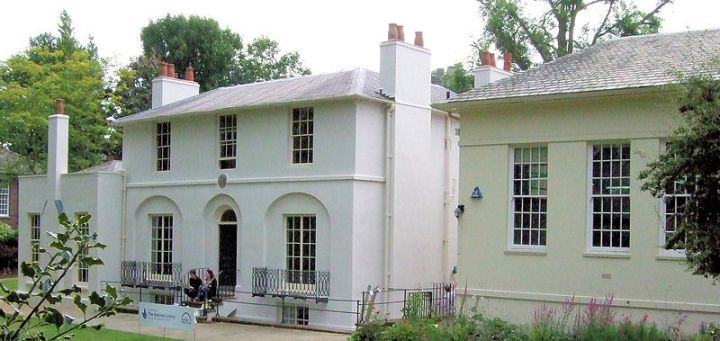 As noted in the London Times, the Guardian, the New York Times, and the Wall Street Journal (among others), the Keats House in London (Hampstead to be precise) has just reopened after a four-year restoration program. Work on the Grade I Listed building was funded by a Heritage Lottery Grant of £424,000. John Keats lived in the house from 1818 to 1820, just before his departure to Rome (you can also visit the house where he lived – and died – there, just five months into his Italian sojourn, by the Piazza di Spagna; it’s now the Keats-Shelley House Museum). It was in the garden of the Hampstead house that Keats wrote “Ode to a Nightingale.”
ISECS Junior Scholar Seminar to Convene in Belfast, August 2010
The International Society for Eighteenth-Century Studies (ISECS) holds a seminar every year for junior scholars, which they define as those within six years of receiving their PhD. Below is the CFP for the next seminar, on the topic of Cultural Intermediaries, which will take place at Queen’s University, Belfast, Northern Ireland, from 16–20 August 2010.
I would strongly encourage HECAA’s younger members to submit proposals, and if not this year, then in the future. I took part in the 2008 seminar, held at the University of Pardubice in the Czech Republic, and had one of the very best scholarly experiences of my entire career. I made great friends, heard terrific papers, and spent a week in a gorgeous part of the world.
-Michael Yonan
◊ ◊ ◊ ◊ ◊

Charles Lanyon, Lanyon Building, ca. 1850 (Belfast: Queen's University)
Proposals are due 30 September 2009
The International Society for Eighteenth-Century Studies (ISECS) invites applications from scholars in all fields of eighteenth-century studies to an interdisciplinary seminar in 2010. It will be hosted by Queen’s University’s Centre for Eighteenth-Century Studies (CECS) with the support of the University’s Research and Regional Services Office. CECS is an interdisciplinary Centre dedicated to fostering research and academic exchange across the Arts and Social Sciences. The event will be organised by Professor Simon Davies and other members of CECS.
The theme proposed is Cultural Intermediaries. The theme will be interpreted as widely as possible but could include scholarly investigations of travellers, adventurers, diplomats, slave narratives, reports of colonial administrators as well as books, translations/adaptations, newspapers, periodicals, scientific reports, correspondences. Needless to say, other topics which can be shown to be relevant will be very welcome.
Accommodation, Subsistence, Travel – Accommodation and meals will be provided by CECS. Participants will be requested to pay for their own travel arrangements although some limited funds will be available from ISECS for those unable to obtain any financial support.
Submission of Proposals – The seminar will be limited to 12-15 participants. The proposals (approx. 2 pages, single-spaced) should be based on an original research project (eg. a doctoral thesis or equivalent) that deals with one of the aspects mentioned above. Because this is a seminar rather than a conference, each participant will be given one hour to present a paper which will then form the basis of a group discussion. Preference will be given to scholars at the beginning of their academic careers (doctorate or equivalent for less than six years). The official languages of the seminar are English and French. (more…)
Conservation Costs or Savings?
In the midst of the latest budget cuts, conservation professionals face numerous challenges, and at least the near future looks turbulent. In addition to reductions in museum departments, the Art Newspaper reported on 23 July 2009 that London’s V&A and the Royal College of Art are ending their jointly operated conservation program – this just several months after the Textile Conservation Centre at the University of Southampton announced its upcoming fall closure. It looked as though Conservation Online (CoOL) had also met its end, as Stanford announced earlier this summer that it could no longer support the digital forum (after 22 years). In the past few weeks, however, the American Institute for Conservation has agreed to take over responsibility for the forum used by thousands of conservators around the world (particularly its “DistList”). The AIC is the national membership organization for conservation professionals in the U.S. with members in over twenty countries. The institute’s website offers useful information not only for conservators but also individuals wanting to know more about the field.
With over a quarter of American collecting institutions lacking environmental controls and fewer than a third possessed of a current survey of the condition of their collections, it is presumably only a matter of time before we appreciate how costly ignoring conservation can be.
[Statistics, from the AIC website, come from A Public Trust at Risk: The Heritage Health Index Report on the State of America’s Collections © 2005 Heritage Preservation, Inc.]
Conservation on Display in St. Louis
For this series on conservation issues, our first stop is the St. Louis Art Museum, which is incidentally celebrating a century of free admission! (the achievement is especially impressive as museums across the country are raising prices). From the musuem’s website:
Reviving Antiquity:
Restoring Hubert Robert’s Views of Ancient Ruin
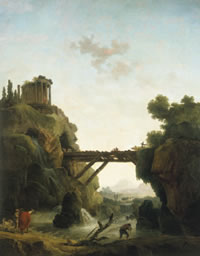
Hubert Robert, "Fantastic View of Tivoli," 1789; oil on canvas; 95 x 75"
This summer, one of the Museum’s main level galleries will become a painting conservation lab, where conservator Mark Bockrath of Philadelphia will clean and restore three large 18th-century landscapes by the French painter Hubert Robert (1733–1808). The three paintings—The Obelisk, The Ruin, and Fantastic View of Tivoli—are part of four landscapes commissioned during the 1780s by unknown Russian clients. Museum visitors may recall that the group of four Robert paintings hung for many years in the corners of Grigg Gallery. Ever since the reinstallation of Grigg Gallery in 2006, the paintings have been in storage, awaiting conservation.
In 1996, Museum Paintings Conservator Paul Haner cleaned and inpainted one of the four (The Column). The Column is currently on loan to the Pulitzer Foundation for the Arts, where it is on view as part of the Pulitzer’s current exhibition, Ideal (Dis-) Placements: Old Masters at the Pulitzer.

Paul Haner at work on "The Column"
Curated by Judith Mann, curator of European Art to 1800, Reviving Antiquity: Restoring Hubert Robert’s Views of Ancient Ruins, supported by a grant from the Samuel H. Kress Foundation, will be on view in gallery 205.
◊ ◊ ◊ ◊ ◊
Bockrath will be at work in the museum from August 25th until September 6th. He’s available for visitors’ questions on Fridays, Saturday, and Sundays from 2:30 until 3:00. A brief interview with Paul Haner can be found here.
Conservation Week
Note from the Editor
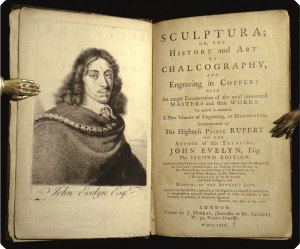
John Evelyn, Sculptura (London, 1769), reissue of the second edition from 1755. Image from the Philadelphia Rare Books & Manuscripts Company.
For me, one of the benefits of teaching comes from the fact that students’ interests tend to be contagious. I often find myself hoping that I can pass along my enthusiasm for a given topic during a lecture or class discussion, but it certainly works the other direction, too. This summer I’ve been working with a terrific research assistant, Ali Kopseng, on a project related to John Evelyn’s Sculptura (1662), a text that’s often described as the earliest history of European prints (it was reprinted in 1755). I like to think that Ali learned a lot from the experience, but she also made me care much more about the locus of her ambitions for the future: conservation. And so, several of the postings for this week address the topic. Feel free to share other eighteenth-century examples that come to mind. And thanks, Ali.
-Craig Hanson
CAA Session Proposals for 2011 Due September 1
As noted on CAA News blog:

Photo by Danielle Lupkin (Wikimedia Commons)
Individual CAA members may submit a session proposal for the centennial Annual Conference, taking place February 9–12, 2011, in New York. Proposals should cover the breadth of current thought and research in art, art and architectural history, theory and criticism, pedagogical issues, museum and curatorial practice, conservation, and developments in technology.
The Annual Conference Committee welcomes session proposals that include the work of established artists and scholars, along with that of younger scholars, emerging and midcareer artists, and graduate students. Particularly welcome are those sessions that highlight interdisciplinary work. Artists are especially encouraged to propose sessions appropriate to dialogue and information exchange relevant to artists.
Session proposals are only accepted online; paper forms and postal mailings are not required. To set up an account, please email Lauren Stark, CAA manager of programs, who will register your email address and provide you with a password. For full details on the submission process, please visit Chair a Conference Session.
Proposals are due September 1, 2009
Wanted: Essays on Women & Fashion
The following Call for Essay Proposals went out to C-18L on 6 August:
Women of Fashion: Popular Culture in the Eighteenth Century and the Eighteenth Century in Popular Culture, Edited by Tiffany Potter (University of British Columbia)
Proposals are invited for an edited collection of original essays that examine women’s popular culture in eighteenth-century England and representations of eighteenth-century England in modern popular culture. The volume will be published by the University of Toronto Press in 2011.
Women of Fashion will have three sections:
1) women and eighteenth-century arts (theatre, literature, music, painting)
2) women and eighteenth-century life (fashion, games, courtship, weddings, politics)
3) modern engagements of eighteenth-century women’s culture (in films, historical fiction, art exhibits, web communities, fan groups).
Please send a 500-word abstract or completed essay (4,000-6,000 words), plus a brief biographical statement (or c.v.), as e-mail attachments (in Word or RTF) to Tiffany Potter (tpotter@interchange.ubc.ca). The deadline for abstract submission is 28 August 2009. (more…)
Speaking of Eighteenth-Century Rome . . .
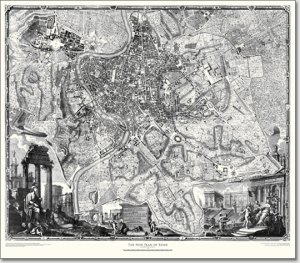
From the Interactive Nolli Map Website, University of Oregon
Under the direction of Jim Tice and Erik Steiner, the University of Oregon has constructed a stunning interactive version of Giambattista Nolli’s Map of Rome from 1748. The digital version, available online for free, is user-friendly, searchable, and comes with several essays that introduce Roman geography, social history, and eighteenth-century cartography. There’s also a fine bibliography. The map can be overlaid with a variety of layers: Gardens, the Tiber River, Rioni, Fountains, City Gates, Walls of Rome, Pathways, Map Icons, and Satellite Images. In addition to exploring (and now modelling) standards that we should expect of scholarly digital projects, the Nolli Map could offer immediately practical uses for teaching assignments. And if you find that the virtual map just makes you want a paper version all the more, the project organizers have teamed up with Raven Maps to produce a new edition available for $95 (in 2005, around the time of the launch of the Nolli wesbsite, one of the original maps sold at Christie’s for £7800, or just over $13,000). The University of Oregon website makes the Raven edition sound irresistible:
At approximately two-thirds the original size, it measures 45 inches by 52.6 inches (114cm x 133cm). It is printed at a scale of 1:4,500, where 1 inch equals 375 feet. Produced to the highest standards in mind, the edition is printed with stochastic screening on 100 lb Finch Fine paper. Stochastic screening is recognized for its superior representation of fine lines and tonal values, and is commonly used for printing high quality black and white photography. The process (in which printed dots are spread randomly throughout the image area instead of in a grid pattern) yields a warmer, less mechanical result perfect for a map of this vintage. A process black ink was used for the printed area and an antique tint lends the map an elegant look and feel.
Gender on the Grand Tour
Member News
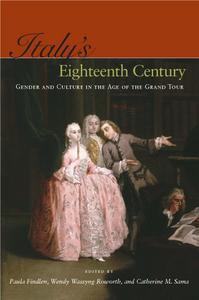
Italy's Eighteenth Century: Gender and Culture in the Age of the Grand Tour (Stanford University Press, 2009), ISBN 978-0804759045, 504 pages, 51 illustrations, $65
A new collection of essays co-edited by Wendy Wassyng Roworth recently was published by Stanford University Press. Italy’s Eighteenth-Century: Gender and Culture in the Age of the Grand Tour, edited by Roworth, Paula Findlen, and Catherine Sama, “illuminates the social and cultural landscape of eighteenth-century Italy by exploring how questions of gender in music, art, literature, science, and medicine shaped perceptions of Italy in the age of the Grand Tour.” The essays grew out of a 2002 conference held in conjunction with the Getty’s trio of exhibitions on the Grand Tour (and co-sponsored by UCLA’s Center for Seventeenth-Century Studies).
Among the thirteen essays appears Roworth’s own contribution, “‘The Residence of the Arts’: Angelica Kauffman’s Place in Rome” (fellow HECAA member Christopher Johns is also represented with “Gender and Genre in the Religious Art of the Catholic Enlightenment”).
In January, Roworth spoke at a conference in Rome on Salvator Rosa, co-sponsored by Università di Roma and Bibliotheca Hertziana; an expanded version of the paper is scheduled to appear later in the fall in Salvator Rosa e il suo tempo, 1615-1673. At the annual ASECS meeting this past spring in Richmond, Roworth presented “A ‘Tour of Painters’: Visits to Artists’ Studios
and Galleries in London.”
Size Matters in Omaha
Midwest Art History Society Call for Session Proposals (due 23 August)
8-10 April 2010 – Omaha, Nebraska
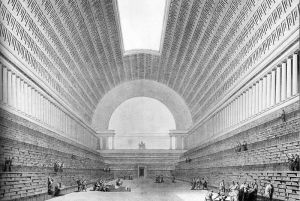
Étienne-Louis Boullée, "Projet de Bibliothèque Royale," 1785
The Midwest Art History Society is currently accepting session proposals for its annual conference, to be held next spring in Omaha. The meeting’s timely theme – Exploring Monumentality: Re-Thinking Scale Relationships in Art – comes on the heels of the remarkable 2008-09 exhibition, Grand Scale: Monumental Prints in the Age of Dürer and Titian (organized by Larry Silver with Elizabeth Wyckoff), and precedes an exhibition at the Getty that will pursue the subject into the seventeenth century; Grand Manner: Charles Le Brun and the Monumental Prints of the Ancien Régime (organized by Louis Marchesano) opens May 18 and runs through October 17.
The MAHS conference might provide an ideal venue for asking how oversize scale functioned in the eighteenth century (one thinks perhaps of Vanbrugh, Boullée, or Piranesi). Conference organizers will include some topics not related to the theme of monumentality, so other session ideas are welcome, too. Here’s the official call for proposals:
◊ ◊ ◊ ◊ ◊
For its 37th annual conference in Omaha, Nebraska (April 8-10, 2010), the Midwest Art History Society will devote the majority of sessions to a central topic–Monumentality. All cultures and periods have generated works of large relative scale. Well-known examples include the Colossus of Rhodes, the monumental heads of Easter Island, Mount Rushmore, the enormous statuary at Buddhist temple complexes throughout Asia, Michelangelo’s David, and the oversized creations of contemporary artist Jeff Koons. We invite session proposals devoted to the impact and meaning of size; logistical considerations for large and small-scale works; famous and/or important monumental works; and other issues related to scale. Because we will still offer open sessions for conference papers that do not address the central issue, we also invite proposals for sessions on other topics apart from that of our central theme. (more…)










 Enfilade
leave a comment