Birthday Surprises — Watteau Turns 325 Today
On this, the 325th birthday of Jean-Antoine Watteau (1684-1721), it’s worth recalling the circumstances surrounding the recent discovery and sale of La Surprise, which is, incidentally, included in the Watteau, Music, and Theater exhibition now on at the Metropolitan Museum of Art in New York. From ArtDaily.org, 9 July 2008:

Jean-Antoine Watteau, “La Surprise,” oil on panel, 14.1/2 x 11.1/2 inches, ca. 1718
LONDON — A recently rediscovered masterpiece by Jean-Antoine Watteau (1684-1721) sold at Christie’s auction of Important Old Master and British Pictures this evening for £12,361,250 / $24,376,385 / €15,513,369, a world record price for any French Old Master painting sold at auction. La Surprise had been missing for almost 200 years, presumed to have been destroyed, and was previously known only by a copy in the Royal Collection at Buckingham Palace and through a contemporary engraving. It was found in the corner of a drawing room in a British country house during a Christie’s valuation last year.
Richard Knight, International Director of Christie’s Old Master Department and Paul Raison, Director and Head of Old Master Pictures at Christie’s, London: “We are thrilled to have realised a record price for La Surprise by Jean-Antoine Watteau, who is recognised as one of the most influential artists in the history of European art. It was extremely exciting to have rediscovered the painting last year, its whereabouts having been a mystery for almost 200 years, and it has been a great honour to have shown the picture to the public for the first time in over two centuries during pre-sale exhibitions in London, Paris, New York and St Petersburg. This is not only one of the most extraordinary rediscoveries of recent years, but also the most expensive French Old Master painting ever sold at auction, and we are pleased to have welcomed international interest from a number of collectors and institutions at this evening’s sale” . . .
La Surprise by Jean-Antoine Watteau (1684-1721) was painted circa 1718 and was first owned by Nicolas Henin (1691-1724), an Advisor to the French King who was one of Watteau’s best and most constant friends. It is likely that the work was painted for Henin together with its pendant L’Accord Parfait, now in the Los Angeles Museum of Art. The legendary connoisseur and collector Pierre-Jean Mariette (1694-1774) noted in his Abecedario of 1746 that La Surprise is “one of [Watteau’s] most beautiful paintings.” On Nicolas Henin’s death in 1724, the two paintings went to the artist’s friend and biographer Jean de Jullienne (1686–1766) who had them engraved and published in the Recueil Jullienne, and who seems to have split the pair and sold them before 1756. La Surprise next appears in the celebrated collection of Ange-Laurent de La Live de Jully (1725-1779), who is recognised as assembling the first serious art collection dedicated to the encyclopedic display of French painting. The catalogue of his collection was published in 1764 and describes La Surprise as executed “with a piquant touch and richly tinted with the color of Rubens.” The picture had left the collection by 1770 and amidst the turmoil of the French Revolution, it is not recorded until it appears in a Lady Murray’s probate valuation of 1848, by whom it was bequeathed to the family of the vendors at this evening’s auction. The painting’s attribution and significance had remained lost until its rediscovery last year. . .
Jean-Antoine Watteau (1684-1721) was born in the Flemish town of Valenciennes, which had passed to France from Spanish rule just six years earlier, and left for Paris in about 1702. He was to be influenced by Flemish art throughout his career, and was often considered a Flemish painter by his contemporaries. In Paris, he worked with Claude Gillot (1673-1722) and became fascinated by theatre costume and stage design, before moving to the workshop of Claude Audran III, curator of the Palais du Luxembourg where Watteau was introduced to Rubens’s magnificent and inspirational canvases painted for Queen Marie de Medici. The work of Rubens was to influence Watteau throughout his career as he revitalised the Baroque style and became a pioneer of Rococo art. Watteau was frail and subject to ill health throughout his life and in 1720, he travelled to London to visit Dr. Richard Mead, a celebrated physician, in the hope of medical relief. Unfortunately, the climate and air quality in the city hindered any progress and he returned to France where he died in 1721 at the age of 37.
Market News: Porcelain Still Prized
From the Art Newspaper, 29 September 2009:
Porcelain Sales Unharmed by Economic Crisis: Shortage of Pieces Keeps Demand High
By Bettina Krogemann
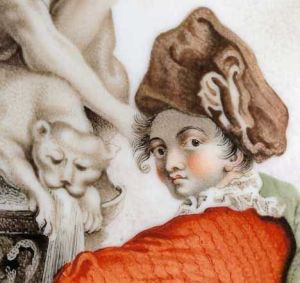
Small gold-mounted Meissen snuff box (detail), 1738, inspired by Watteau
MUNICH — Some sectors of the art market have been largely unaffected by the economic downturn, delegates were told at the annual conference of Confédération Internationale des Négociants en Oeuvres d’Art (Cinoa) held in Munich from 25-27 June.
According to Friedel Kirsch of the Elfriede Langeloh gallery in Weinheim, who specialises in early German porcelain: “Certain areas of collection are reacting in quite a different way to the economic crisis. Demand for 18th-century German porcelain, especially Meissen, remains unchanged.” Kirsch adds: “In fact, prices for finest-quality porcelain have been increasing for years and have risen even faster since the beginning of the recession. We have seen this happen with tableware, figurines and groups.”
Herbert van Mierlo, director and expert in works of art, furniture and porcelain at Sotheby’s in London, explains: “The market is dominated by a relatively small group of specialised, devoted collectors looking for exquisite pieces. Because of this, the market for porcelain has remained practically immune from the negative effects of the financial crisis, especially in comparison to the general art market.” According to Van Mierlo, “the price tendency for good porcelain is clearly upward as long as the collectors remain eager. The big and difficult challenge for the auction houses is to find the right pieces.” His view is shared by Rodney Woolley of Christie’s in London where, on 2 June 2009, bidding rose to £121,250 for a small gold-mounted Meissen snuff box dating from 1738, decorated on the inside with a delicately painted scene inspired by Watteau.
For the full article, click here»
Conference on Sexuality and Gender Identity
Before Sex
Rutgers University, New Brunswick, NJ, 23 October 2009
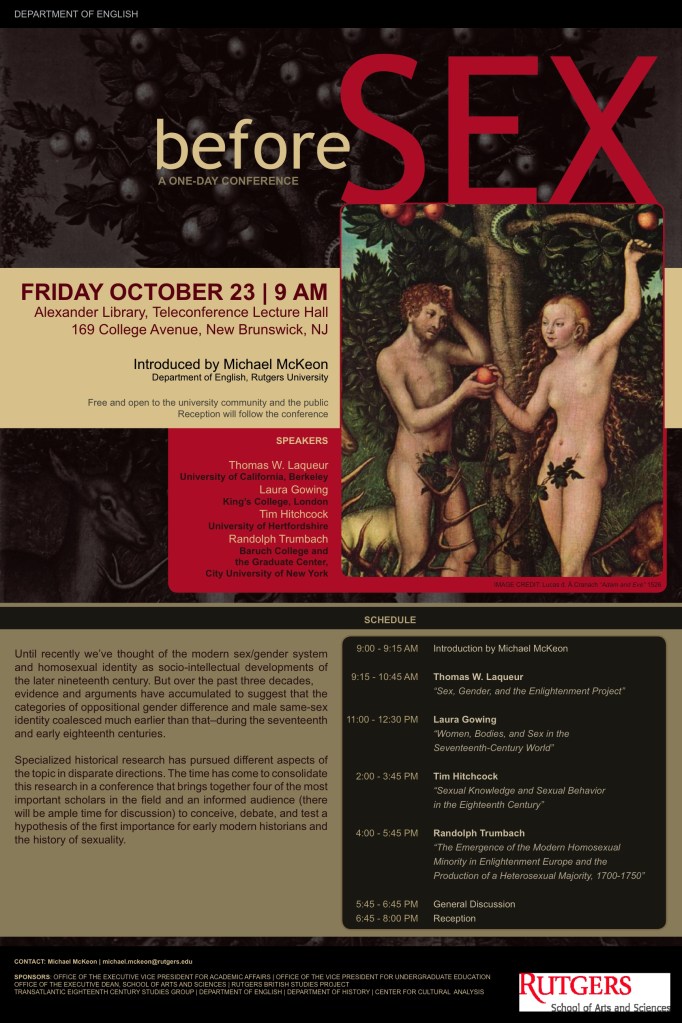 Until recently we’ve thought of the modern sex/gender system and homosexual identity as socio-intellectual developments of the later nineteenth century. But over the past three decades, evidence and arguments have accumulated to suggest that the categories of oppositional gender difference and male same-sex identity coalesced much earlier than that–during the seventeenth and early eighteenth centuries. Specialized historical research has pursued different aspects of the topic in disparate directions. The time has come to consolidate this research in a conference that brings together four of the most important scholars in the field and an informed audience (there will be ample time for discussion) to conceive, debate, and test a hypothesis of the first importance for early modern historians and the history of sexuality.
Thomas Laqueur (University of California-Berkeley), “Sex, Gender, and the Enlightenment Project”
Laura Gowing (King’s College, London), “Women, Bodies, and Sex in the Seventeenth-Century World.”
Tim Hitchcock (University of Hertfordshire), “Sexual Knowledge and Sexual Behavior in the Eighteenth Century.”
Randolph Trumbach (Baruch College and the Graduate Center, City University of NY), “The Emergence of the Modern Homosexual Minority in Enlightenment Europe and the Production of a Heterosexual Majority, 1700-1750.”
The conference begins at 8:30am and last throughout the day in the Teleconference Room of the Alexander Library (4th floor), 169 College Avenue. For more information contact Michael McKeon, michael.mckeon@rutgers.edu
Conference on Scottish Craftsmanship in the Americas
As noted by The Magazine Antiques in its ‘Guide to Fall Symposiums’:
Transatlantic Craftsmanship: Scotland and the Americas in the 18th and 19th Centuries
Winterthur Museum & Country Estate, Winterthur, DE, 7-10 October 2009
 The decorative and applied arts in colonial and early 19th-century America are deeply infused with Scottish influence. This major international conference will examine, for the first time, the transatlantic relationships of Scottish craftsmanship and Scottish immigrant craftsmen in the 18th and 19th centuries. From Edinburgh to Charleston, Aberdeen to Philadelphia, and Kilmarnock to New York, we will examine architecture, weaponry, furniture, silver, jewelry, ceramics, textiles, and glass to promote a greater understanding of the trade and influence of Scottish artists and manufacturers in America.
The Society of Antiquaries of Scotland and National Museums Scotland, in partnership with Winterthur, and with additional support from the Center for American Art at the Philadelphia Museum of Art, will bring together scholars from both sides of the Atlantic to study Scotland’s role in the development of American material culture.
A full list of speakers and topics can be found through the Winterthur website»
Book Prize for Biography
Biennial Annibel Jenkins Biography Prize
Due 15 November
The biennial Annibel Jenkins Prize is given to the author of the best book-length biography of a late seventeenth-century or eighteenth-century subject and carries an award of $1,000. The prize is named in honor of Annibel Jenkins, Professor of English (Emerita) at the Georgia Institute of Technology. A founding member of the Southeastern American Society for Eighteenth-Century Studies, she is an outstanding teacher and scholar who has been for many years one of the most active and encouraging members of the academic community in America.
Rules:
- To be eligible for this year’s competition, a book must have a copyright date between November 2007 and October 2009.
- The author must be a member of ASECS at the time of submission.
- Submission must be made by the publisher, and six copies must be received by 15 November 2009.
Send all submissions and inquires for to: ASECS, Annibel Jenkins Book Prize, 2598 Reynolda Rd., Suite C, Winston-Salem, NC 27106; E-mail: asecs@wfu.edu
Fellowships in Cartography
J.B. Harley Research Fellowships in the History of Cartography
Applications due by November 1
Funded by the J. B. Harley Research Trust, the Harley Fellowships provide support of up to four weeks (normally at GBP 400 per week) for those, from any discipline, doing the equivalent of post-graduate level work in the historical map collections of the United Kingdom.
Harley-Delmas Fellowships in the History of Cartography
Applications due by November 1
For the period 2007-2011, in addition to the normal J. B. Harley Fellowships, there are also Harley-Delmas Fellowships funded by the Gladys Krieble Delmas Foundation. Successful applicants researching the history of cartography during the European Renaissance to the Enlightenment c.1400-c.1800 will be eligible for a Harley-Delmas Fellowship. All applicants, however, should apply for a J. B. Harley Fellowship. Eligibility for a Harley-Delmas award will be decided by the Selection Committee of the Trustees.
The Fellowship website includes an Application page that should provide all the necessary information as well as answering many frequently asked questions. It would be helpful if you could say where you saw this notice.
Weekly Apollo Competition
Each week, Apollo Magazine gives away a book to a lucky reader who sends in an email in response to a simple question and is then selected from a pool of respondents with the correct answer. This week’s contest seems worth noting both for the book on offer and the query, which is closely related to the painting pictured below (hint, hint!). From the Apollo website:

Emily Cole (Yale University Press, 2009) ISBN: 978-0300148718, $85
This week we are offering you the chance to win Lived In London: Blue Plaques and the Stories Behind Them, edited by Emily Cole (Yale; £40). This superb book charts the fascinating history of London’s Blue Plaques while telling the story of the city’s most famous residents and the buildings in which they lived. Arranged geographically, by borough and area, this book is the first published guide for over half a century to be compiled with the aid of local government and English Heritage files. It includes new research and findings on the people and buildings commemorated, as varied as Winston Churchill, Virginia Woolf, Mahatma Gandhi and Charlie Chaplin. In the book’s foreword Stephen Fry writes, “Part of the sport of Plaque Spotting is to encounter remarkable men and women of whom one has not heard, but whose claim to greatness one can discover. . . The presence of their plaques tells us much about them but also about the London they chose to stay in and which offered them refuge and hospitality. This invaluable book, written with insight and exemplary scholarship, is a perfect companion for anyone who has ever looked up and wondered. . .”
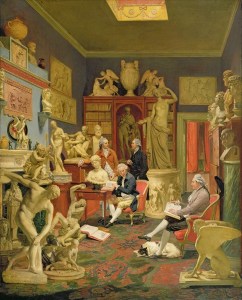 For your chance to win, simply answer the following question:
Which antiquary and collector lived at Number 14 Queen Anne’s Gate (originally called 7 Park Street)?
Clue: Most of the collection of antiquities amassed by this person was acquired by the British Museum.
Email your answers ot offers@apollomag.com using ‘Blue Plaques’ as the subject of your email. Only answers received before midday on 9 October will be entered into the competition draw.
Recapping the Récamier Exhibition and Colloquium in Lyon
By HEATHER BELNAP JENSEN
Juliette Récamier, muse et mécène
Musée des Beaux-Arts de Lyon, 27 March – 29 June 2009
Colloquium: Historiennes et critiques d’art à l’époque de Juliette Récamier, international colloquium organised by the Institut national d’histoire de l’art, Musée des Beaux-Arts, Lyon, 26 June 2009
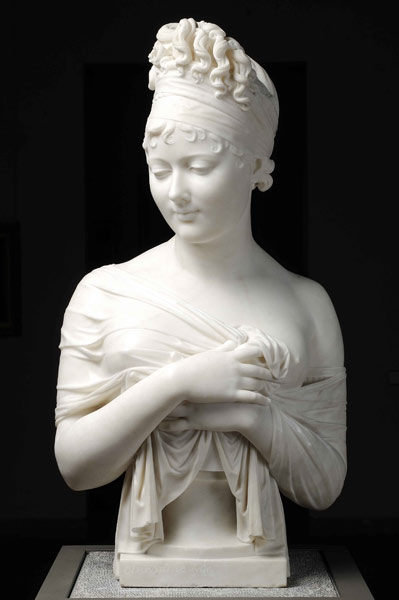
J. Chinard, "Portrait of Juliette Récamier," 1805-06 (Lyon: Musée de Beaux-Arts)
Juliette Récamier: Muse et mécène, recently mounted by the Musée de Beaux-Arts in Lyon, was surely one of the highlights of this past summer’s exhibition season. Thoughtfully conceived and beautifully executed, this show did much to restore Récamier to her rightful place as a key arbiter of taste in post-Revolutionary France. Upon entering the foyer, one was immediately transported to the refined and graceful realm of this cultural luminary. Art, fashion, and furnishings were disposed so as to emphasize her various powers. This exhibition compellingly argued that Récamier not only inspired some of the most enchanting art of the period (one thinks immediately of the portraits of this figure by Jacques-Louis David and François Gérard—neither of which were able to travel, unfortunately), but that she also figured as a formidable patron of the arts. The most exquisite space in this show was the re-creation of Récamier’s salon, as detailed in François Louis Dejuinne’s painting of 1826. To see in conversation some of the most iconic paintings of the age, including Anne-Louis Girodet’s Portrait of Chateaubriand, Elisabeth Vigée-Lebrun’s Portrait of Mme de Staël as Corinne, and Gérard’s Corinne at Cape Miseno, was a truly captivating experience. Attesting to the enduring interest in the figure of Recamier was the 1928 film of Gaston Ravel that played in an adjacent room, along with the twentieth-century works by René Magritte that paid homage to ‘la dame au sofa’. The accompanying catalogue (available here via Amazon.ca) was as exquisitely crafted as the exhibition, with contributions by the curator, Stéphane Paccoud, as well as other notable French and American scholars including Laura Auricchio. The essays attest to the complexities of Récamier’s roles as muse and patron and point to the need to reconsider conventional characterizations of such well-positioned women in the fashioning of artistic sensibilities. In sum, I must concur with Didier Rykner’s assessment of the exhibition made in La Tribune de l’Art: it did indeed approach perfection.

Robert Smirke, "Chambre de Juliette Récamier,” 1802 (London: Royal Institute of British Architects Library)
In conjunction with the exhibition, Historiennes et critiques d’art à l’époque de Juliette Récamier, a colloquium dedicated to the women writing about the arts in France, c. 1800, was held on June 26 in Lyon. This international colloquium was sponsored by the Institut national d’histoire de l’art and convened by Mechthild Fend (University College, London), Melissa Hyde (University of Florida), Anne Lafont (INHA), and Stéphane Paccoud (MBA-Lyon). Many of the presenters discussed the place of individual figures in the construction of the post-Revolutionary art world. American scholars were well represented. Mary Sheriff (University of North Carolina) argued for Vigée-Lebrun’s position as an art historian and addressed her Souvenirs as a critical historical enterprise. Susan Siegfried (University of Michigan) gave careful consideration to the role of la presse féminine in the formation of female subjectivity, and Sarah Betzer (University of Virginia) engaged Marie d’Agoult’s critical work. In my own paper, I discussed the significance of Julie Candeille’s activities as critic and agent in the career of Anne-Louis Girodet. That no one treated the contributions made to art writing by the uncontested doyenne of the era, Germaine de Staël, was much commented upon. The lively discussion that ensued after the presentations testified to the need for a continued dialogue regarding women as art historians and critics at this historical juncture. There are plans to publish the proceedings.
Heather Belnap Jensen received her Ph.D. in 2007 from the University of Kansas. She is currently assistant professor of art history at Brigham Young University. For more information about her recent scholarly activities, click here». Images are drawn from the exhibition website; other HECAA members who participated in the exhibition or colloquium are indicated with bold type.
Latest Count
Thanks so much to all of you for getting Enfilade off to such a fine start! During the first four months, the reader count has continued to grow. September saw over 2500 visits! For readers new to the Historians of Eighteenth-Century Art & Architecture, let me stress that anyone with interests in the period is most welcome to join. Annual dues are entirely reasonable, and it’s easy to pay via PayPal (click here for more information).
In light of the numbers, I hope HECAA members will continue to send news items, personal updates, and larger contributions. Your colleagues are genuinely interested in what you’re doing, and there are readers out there! Please feel free to share suggestions, too. The site is still certainly a work in progress. Thanks, in particular, to Heather Jensen, whose account of the Juliette Récamier exhibition and colloquium will appear in tomorrow’s posting, and thanks again to all of you for reading.
-Craig Hanson
Charlotte Vignon Takes up Curatorship at the Frick
The Frick’s first curator of decorative arts officially starts this month in her new position. As described in a press release from the museum:

Charlotte Vignon, Associate Curator of Decorative Arts, The Frick Collection (Photo: Michael Bodycomb)
The Frick Collection announces the appointment of Charlotte Vignon to the first curatorship dedicated to the museum’s impressive decorative arts collection. Vignon takes up the newly created post of Associate Curator of Decorative Arts in October 2009, a development that sets the stage for a deeper understanding of and focus on the institution’s holdings in this area. Comments Director Anne Poulet, “It has long been our desire to make our decorative arts holdings better known through improved displays, temporary exhibitions, publications, and educational programs. We were able to endow this position with the assistance of a generous challenge grant offered in 2007 by the National Endowment for the Humanities that has been matched three to one by a group of individuals and foundations. It is a pleasure to welcome Charlotte Vignon to this new post.” Adds Associate Director and Chief Curator Colin Bailey, “This is an extremely exciting moment for the Frick, as the addition of this significant position, which followed a competitive, international search, will allow us to interpret and present our collections more fully. Vignon brings a depth of knowledge of the decorative arts that is combined with a keen interest in American collectors, among them Henry Clay Frick and J. P. Morgan, as well as the dealer Joseph Duveen—a topic that is compelling in its own right and particularly so at the Frick. The post also represents a new collaboration with New York’s Bard Graduate Center, where Vignon will teach an annual seminar on the decorative arts, one of many ways in which this new curatorship is designed to contribute to the academic community.”

Pair of deep blue Chinese porcelain jars with French gilt-bronze mounts, 1700–49 (NY: Frick Collection)
A native of France, where she received her education and spent several fruitful years early in her career working as a researcher in the field of European decorative arts, Vignon comes to the position having also held three highly regarded fellowships at American museums, The Metropolitan Museum of Art, The Cleveland Museum of Art, and currently, The Frick Collection, where she is an Andrew W. Mellon Curatorial Fellow. In Cleveland, she held Andrew W. Mellon and Peter Krueger Christie Fellowships, and she worked on the first catalogue of that museum’s eighteenth-century decorative arts collection under the direction of Curator Henry Hawley. Her research resulted in the discovery of significant information about the provenance of objects and, in several cases, new identification and attributions. Vignon’s involvement in the activities of the department deepened over the course of four years, especially with Hawley’s retirement. Holding an Annette Kade Fellowship at The Metropolitan Museum of Art, she worked with curator Danielle Kisluk-Grosheide on a variety of projects, contributed to acquisition reports, and was engaged in research on the permanent collection, also resulting in new identifications.
For The Frick Collection, Vignon is currently developing a fall 2009 exhibition, Exuberant Grotesques: Renaissance Maiolica from the Fontana Workshop, for which she is also writing the catalogue. This project focuses on an important recent gift to the institution and follows the model of other critically acclaimed Cabinet presentations by examining an object in the context of important related works of art. She has also been working closely with Conservator Joseph Godla to present seminars on aspects of the Frick’s furniture collection and, while at all three museums, has frequently lectured and written articles on topics in the decorative arts and collecting.
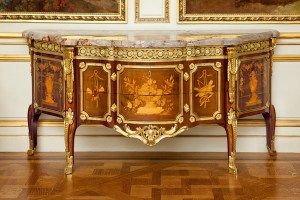
Commode with pictorial marquetry, made by Roger Lacroix under the direction of Gilles Joubert, Paris, 1769 (NY: Frick Collection)
This fall, she will complete her Ph.D. dissertation for the Sorbonne, Paris, on the dealings of the Duveen Brothers in European decorative arts and Chinese porcelains between 1880 and 1940. This is a topic of great relevance to the museum, as many of Henry Clay Frick’s purchases came through Duveen’s firm. The subject also relates to the focus of interest at the Frick’s recently established Center for the History of Collecting in America, based at its Art Reference Library.
Comments Vignon, “It is a privilege to join the Frick staff in this important new role, undoubtedly an opportunity of great possibilities. Today, the Frick is known for its Old Master paintings and sculpture, and I look forward to expanding the public’s understanding and appreciation of its superb collection of decorative arts through exhibitions and education programs. At the same time, I hope to bring the Frick into the forefront of scholarly research in the field through ground-breaking publications and creative courses at the Bard Graduate Center.”
◊ ◊ ◊ ◊ ◊
In The Magazine Antiques (30 June 2009), Vignon shares a selection of her favorite objects from the Frick Collection, including the jars and commode pictured above. Click here for the article»










 Enfilade
leave a comment