One More Thing for the Chicago Itinerary
Sites to Behold: Travels in Eighteenth-Century Rome
Smart Museum of Art, University of Chicago, 3 November 2009 — 11 April 2010
Curated by Anne Leonard
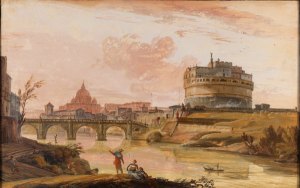
Jean-Baptiste Lallemand, "View of Rome: The Tiber River with the Castel Sant’Angelo and St. Peter’s Basilica in the Distance," n.d., Gouache on paper. Smart Museum of Art, University of Chicago, Gift of Lucia Woods Lindley, 2006.96.
Rome has long been a leading tourist destination. Many of the “must-see” sites were codified centuries ago as part of the Grand Tour, a journey undertaken by young aristocrats to complete their education and give them experience of the world. But by the late eighteenth century, the once-exclusive Grand Tour was giving way to more modern, democratic notions of travel. No longer the preserve of a privileged elite, travel to Italy and other places came within the reach of a wider public, who were eager for tangible souvenirs of what they saw and experienced. This exhibition presents etchings by Giovanni Battista Piranesi, gouache drawings by Frenchman Jean-Baptiste Lallemand, and other works depicting Rome and nearby Tivoli. These eighteenth-century artists, with their different temperaments, techniques, and styles, produced a breathtaking variety of art. A far cry from the monotony of the picture-postcard aesthetic, the works on view appealed to a wide array of tastes and allowed travelers of the period to marvel at the splendor and ruin of an ancient world long after they returned home.
◊ ◊ ◊ ◊ ◊
Right about now, those of you attending CAA in Chicago are probably beginning to cringe at just how tight your schedule already looks. But in the event you can find a few hours to get away from the conference hotel, I would whole-heartedly recommend a morning or afternoon in Hyde Park. In addition to this exhibition at the Smart Museum, the campus of the University of Chicago offers the Oriental Institute Museum, Frank Lloyd Wright’s Robie House, and the Renaissance Society (for ancient, modern, and contemporary aesthetic experiences). The Renaissance Society is currently showing the photographs of Anna Shteynshleyger. No visit is complete without a stop at the Seminary Co-Op Bookstore (one of the best academic bookstores in the world), and La petite folie makes for a lovely quiet lunch or dinner. Hyde Park is easily reached via the Metra commuter train system, available just a few blocks from the Hyatt at Millennium Station. –C.H.
Call for Papers: Graduate Conference on ‘New Formalisms’
Politics, Ethics, and the New Formalisms (Graduate Student Conference)
University of Illinois at Urbana-Champaign, 23-24 April 2010
Abstracts due by 10 March 2010
The British Modernities Group, in conjunction with the Unit for Criticism and Interpretive Theory and the departments of English, Philosophy, and Art History, and with support from the Illinois Program for Research in the Humanities, invites submissions from diverse disciplinary backgrounds and methodological orientations for our annual graduate student conference, this year themed “Politics, Ethics, and the New Formalisms.”
The conference will open with a keynote address by Marjorie Levinson, professor at University of Michigan, Ann Arbor, who specializes in the areas of critical theory, and in poetry and poetics. She not only theorizes the rise of the “New Formalist” movement, but enacts these tensions in her own scholarship, including a contribution to a collection of essays entitled Rethinking Historicism: Critical Readings in Romantic History in 1989, and a recent publication in Studies in Romanticism entitled “A Motion and a Spirit: Romancing Spinoza.”
New Formalism is a recent trend—a “movement,” according to Marjorie Levinson’s 2007 essay “What is New Formalism?” in the PMLA—in critical theory, cultural studies, and literary scholarship that challenges some of academia’s established methods and critical approaches. The term “New Formalism” seemingly implies a “return” to formal qualities such as genre or aesthetics in approaching literary and cultural studies. New Formalism itself is hardly a unitary concept, hence the plural reference in our title to New Formalisms; the term itself is open to debate and definition. The graduate conference will engage this critical trend by exploring the ways in which New Formalism reflects attentiveness to political and ethical issues. What does a turn or ‘return’ to formalism in the first decade of the twenty-first century mean? How does New Formalism impact disciplinary, pedagogical, or theoretical positions or methodologies? How can form be political? How can form be ethical? (more…)










 Enfilade
leave a comment