Bon Mardi Gras
From the website of the Réunion des musées nationaux (RMN):
Josephine’s Wine Cellar at Malmaison during the Empire
Châteaux de Malmaison and de Bois-Préau Museum, 18 November 2009 — 8 March 2010
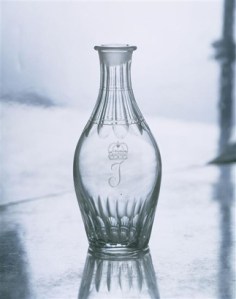
Carafe with Josephine’s monogram, First Empire (1804-1814), crystal, Musée National des Châteaux de Malmaison et Bois-Préau © Rmn / André Martin
The idea for this exhibition came from the inventory drawn up after the death of the Empress Josephine which listed the contents of the cellar at Malmaison – over thirteen thousand bottles. The list of wines served to guests in the house is striking for the number of crus mentioned and the variety of the regions they came from. The best crus from Bordeaux and Burgundy stand alongside Mediterranean wine, in the sweet, syrupy taste of the eighteenth century, the most famous names in Champagne, wines from Languedoc-Roussillon, Côtes du Rhône and the Rhineland. Rum and liqueurs from the West Indies are a reminder of the Empress’ origins.
The exhibition attempts to show the evolution of wine production and marketing during the Empire. It was boosted by progress in the glassmaking industry, which was particularly noticeable in the shape of the bottles. Iconographic documents and account books kept by Josephine’s suppliers reveal the variety and quantity of the empress’ orders.
Elegant ice buckets, glass coolers, crystal and metal punch bowls illustrate the refinement and prestige of the tableware at Malmaison and stand alongside the most brilliant pieces of glassware, some bearing the monograms the sovereigns from Josephine to Louis-Philippe. The latter demonstrate the technical progress made in French glassmaking, which facilitated the search for new forms, and bear witness to the evolution of table manners in the years after the revolution. Objects made after the Consulate and the Empire complement this rich overview and show the changes in the production of glassmaking, bottling and labelling in the first half of the nineteenth century up until the beginning of the Second Empire.
With the classification of the grands vins of Bordeaux in 1855 and developments in transportation, this was a period of deep change. A final section is dedicated to the representation of wine in the Napoleonic legend.
The exhibition brings together more than two hundred objets d’art and iconographic documents not only from the Musée de Malmaison but from the collections of the museums of the Château de Fontainebleau, the Château de Compiègne, the Château d’Eu (Musée Louis-Philippe), the Musée Carnavalet, the Musée des Arts Décoratifs, the Musée National de Céramique de Sèvres, the Archives Nationales, the Fondation Napoléon, the musée Napoléon Thurgovie, château et parc d’Arenenberg, (canton of Thurgovia, Switzerland) and the Museo Napoleonico, Rome. Other items are on loan from industrial or commercial firms such as Moët et Chandon, or from private collections. Taking an artistic and historical angle, the exhibition shows that Josephine’s cellar is a precious testimony to the gracious entertaining which long made the charm and reputation of Malmaison. (more…)










 Enfilade
leave a comment