Private Collection of Decorative Arts in San Francisco
In its January 2010 issue, The Magazine Antiques profiles a remarkable collection of eighteenth-century decorative arts. It’s notable both for the quality of the objects–including a looking glass from Spencer House–and the fact that the Met’s Wrightsman Galleries (just recently reinstalled) provided the design inspiration. As Martin Chapman writes:
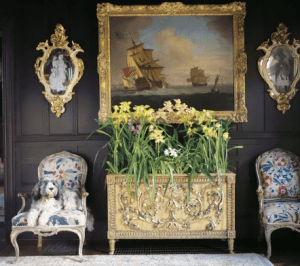
View of the entrance hall, with a grouping of objects around a large gilded wood jardiniere attributed to Giuseppe Maria Bonzanigo (1749-1820) of Turin. Photo by Aya Brackett.
One of California’s finest collections of eighteenth-century English and European decorative arts is to be found in San Francisco in a large Queen Anne revival house in Pacific Heights. Carefully chosen to evoke the atmosphere of an English country house or a French château, these objects shine brilliantly against the dark brown paneling in the main rooms. When the eminent San Francisco decorator Michael Taylor (1927-1986) worked here in the 1960s, the first thing he wanted to do was bleach the paneling to off-white tones, but the owners persisted with their original idea of preserving the dark character of the walls to act as a foil for their collections. The results are extremely effective. These rich and jewellike interiors were achieved with the services of another notable San Francisco decorator, Anthony Hail (1925-2006). They work most beautifully at night when warm subtle lighting provides an entrancing background for the objects.
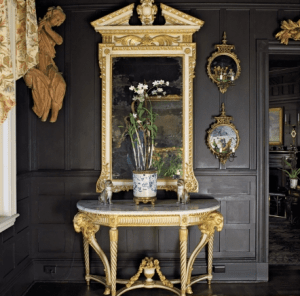
On the opposite wall of the entrance hall is an English Palladian looking glass attributed to John Vardy (1718-1765), ca. 1755-1758, one of a pair from Spencer House, London. The neoclassical console table, also one of a pair, is stamped by Georges Jacob (1739-1814, m. 1765), the Chinese porcelain cachepot has French mounts of the 1840s, and the chinoiserie mirrored wall sconces were formerly in Government House in Cape Town, South Africa. Photo by Aya Brackett.
What strikes the visitor most about the main rooms is the owners’ extraordinary facility for choosing fine objects and putting them together in striking groupings. This singular talent was found most famously in the work of John Fowler (1906-1977), the English designer who did so much to create English country house taste after World War II. Almost as famous, and certainly as influential on the Continent, were the interiors of the amateur Carlos de Beistegui (1895-1970). Beistegui’s Proustian evocations of the past at the Château de Groussay outside Paris beginning in the 1940s were more formal than Fowler’s, although they retained the relaxed ambience of the English country house. But it was the Wrightsman Galleries at the Metropolitan Museum of Art in New York that most directly influenced these collectors. They were so impressed by the installation of those galleries in the 1960s that they asked Hail to use them for inspiration in their house. In the last ten years the owners have made a series of acquisitions that have added another dimension to the interiors. The main rooms all combine comfort with a measure of formality, but it is the arrangements of objects that give
them scale and richness. . . .
For the full article and lots more photos, click here»
Free Access to ‘Early English Books Online’ until March 12
Anna Battigelli, of Early Modern Online Bibliography, sends the following announcement:
 Thanks to the generosity of Proquest, readers of EMOB will have free access to Early English Books Online from February 22 to March 12. We are hoping that this temporary access will generate discussion about EEBO, as it is used both in scholarship and the classroom.
◊ ◊ ◊ ◊ ◊
According to the ProQuest website:
Early English Books Online contains digital facsimile page images of virtually every work printed in England, Ireland, Scotland, Wales and British North America and works in English printed elsewhere from 1473-1700 — from the first book printed in English by William Caxton, through the age of Spenser and Shakespeare and the tumult of the English Civil War.
Details regarding access can be found here»










 Enfilade
leave a comment