Exhibition on Cook’s Voyages
James Cook and the Exploration of the Pacific / James Cook und die Entdeckung der Südsee
Art and Exhibition Hall of the Federal Republic of Germany, Bonn, 28 August 2009 — 28 February 2010
Kunsthistorisches Museum (Museum of Ethnology), Vienna, 10 May — 13 September 2010
Historisches Museum, Bern, 7 October 2010 — 13 February 2011
The British navigator and explorer James Cook (1728–1779) is famous for having led three expeditions into the vast and uncharted waters of the Pacific Ocean. He was the first to survey and map New Zealand, Australia and the South Pacific islands, completing our modern image of the world and refuting once and for all the existence of a mythical Southern Continent.
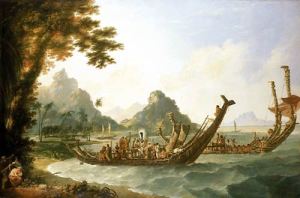
William Hodges, The War-Boats of the Island of Otaheite, Tahiti, 1777, © National Maritime Museum, Greenwich, London, Ministry of Defence Art Collection
An interdisciplinary presentation of the Age of Enlightenment
The exhibition focuses on the European perspective on the newly discovered worlds. In the spirit of the Age of Enlightenment, it seeks to bring together and crosslink for the first time research results from a wide range of disciplines, such as natural history, maritime history, art history and early ethnology. Cook’s expeditions into the South Seas brought about a fundamental change in the way Europe saw the world and ushered in the dawn of modern Europe under the auspices of the Enlightenment belief in the power of progress.
It is to Cook and the naturalists, scholars and draughtsmen who took part in his three expeditions that Europeans owe the first systematic, reliable maps and the earliest comprehensive surveys of the geological structures and the flora and fauna of the Pacific islands. Similarly, the encounters with the people ‘on the other side of the world’ were described and documented in a degree of detail never before attempted.
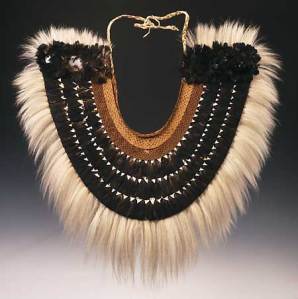
A breast ornament from the Society Islands. © The Cook/Forster Collection, University of Göttingen
Objects from all over the world recount Cook’s expeditions
A fascinating selection of some 550 objects and artefacts recount the pioneering voyages of James Cook and his international team of scientists. By the end of the 18th century the ethnographic and natural history objects collected from many different Pacific cultures during the three Cook voyages had been dispersed among collections all over Europe. The exhibition in Bonn brings them back together for the first time in over two hundred years. Another important first is the cooperation between the leading British ethnographic collections in Oxford, London and Cambridge and their counterparts on the Continent – above all the collections of Göttingen, Vienna and Bern – as well as other museums worldwide.
Many of the exquisite feather ornaments, wooden sculptures and other Oceanic artefacts are of incalculable value to art historians, since comparable objects have all but disappeared from the Pacific region. Made before the fateful encounter with the Europeans, these objects allow present-day Pacific cultures to assert or rediscover their own identity in today’s globalised world.
The ethnographic items are complemented by magnificent paintings and drawings by the artists accompanying Cook on his voyages. These works capture the unique mix of euphoria and inquisitiveness that characterised the explorers’ encounter with the exotic world of the South Seas. Ship models, original sea charts and navigation instruments bring to life James Cook’s daring voyages into the unknown. Alongside spectacular loans from the National Maritime Museum, the Natural History Museum and the British Library in London, the Art and Exhibition Hall is delighted to have secured the loan of items of Cook’s personal property from Australia. (more…)










 Enfilade
leave a comment