The Eighteenth Century in the Current Issue of ‘Art History’
Kate Retford, “A Death in the Family: Posthumous Portraiture in Eighteenth-Century England,” Art History 33 (February 2010): 74-97.
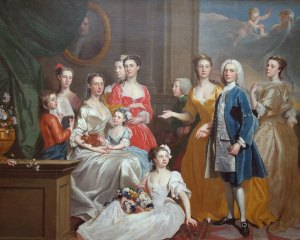
Joseph Highmore, "The Lee Family," 1736. Oil on canvas, 243.8 × 289.6 cm. (Wolverhampton Art Gallery)
Abstract: This article explores a number of unusual portraits produced in eighteenth-century England in which the realms of the posthumous and the living were mingled. In some cases, the dead were brought ‘back to life’ and restored to their rightful place in the family unit. In others, such as Joseph Highmore’s portrait of The Lee Family (1736), Thomas Gainsborough’s The Sloper Family (1787–88) or The Knatchbull Family by John Singleton Copley (1800–03), they were included in spiritualized form, hovering in a supernatural realm above the relatives they had left behind on terra firma. The article unpicks the particular circumstances that prompted these extraordinary commissions, exploring the personal and emotional histories of the sitters and artists. It also draws conclusions about the broader social, cultural, religious and artistic contexts that made these relatively rare, and frequently problematic images.
Kate Retford is Lecturer in History of Art at Birkbeck College, University of London. Her book, The Art of Domestic Life: Family Portraiture in Eighteenth-Century England, was published by Yale University Press in 2006. In addition, she has written a number of articles on topics relating to eighteenth-century portraiture, gender, and the country house art collection.
◊ ◊ ◊ ◊ ◊
Review of Ephemeral Bodies: Wax Sculpture and the Human Figure, with a translation of Julius von Schlosser’s “History of Portraiture in Wax,” edited by Roberta Panzanelli (Los Angeles: Getty Research Institute for the History of Art and the Humanities, 2008), pp. 170-72.
Reviewed by Matthew Bowman (lecturer at the University of Essex and co-founding editor of Rebus: Journal of Art History and Theory)
Most of the eight contributions in “Ephemeral Bodies” were originally presented in a workshop held at the Getty Research Institute in 2004. The texts examine the utilization of wax to depict the human body (in whole and in part, internally and externally) from a variety of methodological perspectives in accordance with the very different uses to which wax has been put. This includes considerations of wax sculpture from medical, anatomical, art-historical, philosophical, anthropological and political standpoints. From an art historian’s viewpoint, wax has not really figured in the discipline of art history. Indeed, it is curious that Julius von Schlosser’s stimulating “Geschichte der Porträtbildnerei in Wachs” (“History of Portraiture in Wax”), which originally came out in 1911 and which is published here for the first time in English, remains the central art-historical text on the production of wax sculptural objects. Ephemeral Bodies is, therefore, not only a useful scholarly collection on a neglected topic but also an opportunity to gauge and expand the theoretical presuppositions of art history as a discipline. . .
For additional contents, click here»










 Enfilade
leave a comment