Ship Models from the Permanent Collection of the AGO
Ship Models: Thomson Collection
Art Gallery of Ontario, Toronto

Two-decker Warship rigged with original sails Prisoner of War Model, 1794-1815 Great Britain, probably by French sailors Bone, brass, silk (9½ x 11 x 3½ ins)
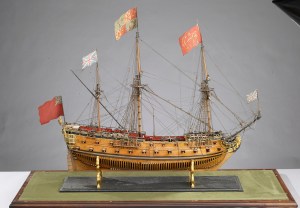
British Two-decker 50/54-Gun Warship Navy Board Model, Great Britain, c. 1703 Wood, paper, paint, gilding, glass (32½ x 40½ x 15¼ ins)
The Thomson Collection at the AGO spans some 350 years and contains examples of exquisite workmanship and some of the masterpieces of the genre.
Foremost are rare late 17th- and 18th-century British dockyard models, made to scale for the Royal Navy and wealthy individuals. There is also a large number of models made by some of the 120,000 prisoners of the Napoleonic Wars. These models, made from wood and bone, with rigging of silk and human hair, were produced by teams of skilled craftsmen and sold to local British collectors who gathered at the prison gates. The shipbuilders’ models extend from the mid 19th century to the Second World War, representing a diversity of both model style and ship type ranging from tugs, dredgers and trawlers to cargo vessels, passenger steamers, private yachts, corvettes, battleships, cruisers, torpedo boats, destroyers and two aircraft carriers.
Call for Papers: Nervous Aesthetics
The Stimulated Body and the Arts:
The Nervous System and Nervousness in the History of Aesthetics
Centre for the History of Medicine and Disease, Durham University, 17-18 February 2011
Proposals due by 31 July 2010
This conference will discuss the history of the relationship between aesthetics and medical understandings of the body. Today’s vogue for neurological accounts of artistic emotions has a long pedigree. Since G.S. Rousseau’s pioneering work underlined the importance of models of the nervous system in eighteenth-century aesthetics, the examination of physiological explanations in aesthetics has become a highly productive field of interdisciplinary research. Drawing on this background, the conference aims to illuminate the influence that different medical models of physiology and the nervous system have had on theories of aesthetic experience. How have aesthetic concepts (for instance, imagination or genius) be grounded medically? What effect did the shift from animal spirits to modern neurophysiology have on aesthetics?
The medical effects of culture were not always regarded as positive. The second focus of the conference will be the supposed ability of excessive reading, music and so on to ‘over-stimulate’ nerves and cause nervousness, mental and physical illness, homosexuality and even death. It will consider questions regarding the effects of various theories of neuropathology and psychopathology on the concept of pathological culture. What kinds of culture could lead to such over-stimulation? How was this medical critique of culture related to moral objections and changes in gender relations, politics and society? How was it linked to medical concern about lack of attention and willpower?
This interdisciplinary conference brings together scholars working in a wide range of fields, including not only the history of medicine but also in subjects such as art history, languages and musicology. Abstracts for 20-minute papers (maximum 250 words) should be submitted electronically to the organisers by 31 July 2010 at the following address: James.kennaway@durham.ac.uk
Organisers: Dr James Kennaway, Professor Holger Maehle, Dr Lutz Sauerteig.
The Social Life of an Object
The Material Life of Things Project
Courtauld Institute of Art, London, 2010-2011
Applications due by the 12 March 2010
Project coordinated by Dr Francesco Lucchini
In recent years, the evidence of technical and material analysis has become increasingly important to art-historical interpretation. Beyond their traditional role in informing the restoration of artefacts, technical investigations have greatly contributed to our understanding of how works of art were made. Yet, less critical attention has been paid to the ‘use-life’ of artefacts – that is, to the manipulation, exchange and consumption of artefacts throughout their life histories. Drawing together researchers from different areas of expertise including curators and conservators, this research project aims to explore the material lives of artefacts in a variety of media, encouraging object-based, methodological and theoretical discussions relating to the shifting relationship between artefacts, people and environments throughout the life history of particular objects or classes of objects. Emphasis is placed on works of art as material objects considering the ways in which they are manipulated, re-made and unmade by different individuals, at different times, manifesting different social and cultural practices
Aims, Issues and Themes
The aim of project is to draw together scholars working across the dicipline in order to research and discuss aspects of the material life of works of art from different periods, claryfying theoretical and methodological issues and advancing our understanding of the subject. Among issues that can be raised are the following:
- Temporality, authenticity and change
- Fragmentation and reconstruction
- Aggregation of artefacts and the status of the object
- Ritual damage/reparation and pre-modern restorations
- Material history and conservation of new media
- Durability, ephemerality and material residuals
- Recontextualisation/decontextualisation, artefacts in consonant and dissonant environments
- Confiscation, displacement and repatriation
- Individual vs. corporate attitudes towards materiality of art
- Commoditisation and decommoditisation
- Ownership, market and the value of materiality
- Historiographic and methodological approaches to the materiality of art
- The concept of ‘object biography’ and its implications/limitations (more…)
A Blog about Georgian London

Think you know what it is? Click above to see.
Any idea what this might be?
This curious bucket was recently included as a ‘Mystery Object’ on the blog, Georgian London. Written by Lucy Inglis, it’s a terrific site that’s received various awards including ‘History Website of 2009’ from the online readers of History Today Magazine and the 2009 Cliopatria Award for ‘Best Individual Blog’ and ‘Best New Blog’. Inglis is, in her own words, particularly interested in “the immigrant population and the artisan communities of London during the 18th century, as well as day to day trivia and the more bizarre aspects of London life three centuries ago.” Topics range from Huguenots in London, to counterfeit coins, to menstruation, to fan etiquette. I found Georgian London through Dr. Crystal Lake’s blog, a fine example incidentally of an individual scholar’s website. –C.H.
Call for Papers: Watteau and the ‘Character’ of Dance
An interesting-looking conference that comes on the heels of the Met’s exhibition, Watteau, Music, and Theater — as listed at Fabula: la recherche en littérature:
Watteau au confluent des arts: Caractères de la danse
Université de Valenciennes, 9-10 December 2010
Proposals due by 15 April 2010
Le dessin – aujourd’hui disparu, mais connu par de bonnes reproductions – du compositeur Jean-Féry Rebel (1666-1747) par Antoine Watteau montre un artiste sûr de son art et des principes qui le gouvernent. L’homme était petit mais trapu et doté, si l’on en croit le dessin (la gravure qu’en a tirée Moyreau gomme quelque peu cet aspect), d’une énergie et d’une détermination peu communes. Le regard dominateur tourné vers le spectateur, il compose : la main gauche posée sur les touches du clavecin, la main droite, qui, dirait-on, connaît peu l’hésitation, en train de noter sa composition. En 1715, au moment où Watteau a pu lui être présenté, Rebel publie les Caractères de la Danse, tentative de distillation et de codification de ce qui, dans la musique de chacune des danses les plus répandues de son temps, en constitue l’élément le plus déterminant. La polysémie du terme saute aux yeux : les ” caractères “, c’est à la fois les notes mêmes, compris dans le sens typographique que leur attribuait encore Rousseau dans le Dictionnaire de musique ; la quintessence sonore, les caractéristiques rythmiques des différentes danses ; et les caractérisations psychologiques et typologiques qui s’en dégagent, et qui font qu’une danse a entre autres vocations celle de proposer le portrait d’un être ou d’un sentiment. La création de cette oeuvre, dont le succès fut grand et durable, coincide avec la maturité artistique de Watteau et avec l’élaboration de l’esthétique qui anime ses fêtes galantes. On y danse souvent, et la danse y est encore présente quand on ne fait que marcher, bouger, avancer, se mouvoir : on ne cesse d’évoluer sur scène. Il est vrai qu’on ignore le plus souvent le sens exact de ces mouvements chez Watteau, qui refuse de les inscrire dans une narration intelligible ou du moins vérifiable. Mais si leur signification demeure vague, leur caractère ne l’est pas. Rebel ne procède pas autrement. Il entreprend la séparation de la danse d’avec les chorégraphies qui la liaient au théâtre, et qui la faisaient dépendre des histoires présentées dans les comédies-ballets, les opéras-ballets et les tragédies en musique. Là où Lully, Molière et Quinault avaient poussé la danse à s’intégrer dans des actions où elle était à la fois indispensable et secondaire, Rebel lui rend sa primauté en la rendant abstraite. Il est possible que le même phénomène se produise, en ce qui concerne un mouvement qui tend sans cesse vers la danse, dans les fêtes galantes de Watteau, ces jouissances d’autant plus jouées et irréelles qu’elles sont, à leur tour, abstraites, et déliées des attaches de la linéarité. (more…)
Call for Papers: Midwest Conference on British Studies
Midwest Conference on British Studies 56th Annual Meeting
Cleveland, OH, 8-10 October 2010
Proposals due by 15 April 2010
The Midwest Conference on British Studies is proud to announce that its fifty-sixth annual meeting will be hosted by Baldwin-Wallace College at the Renaissance Cleveland Hotel. The MWCBS seeks papers from scholars in all fields of British Studies, broadly defined to include those who study England, Scotland, Wales, Ireland, and Britain’s empire. We welcome scholars from the broad spectrum of disciplines, including but not limited to history, literature, political science, gender studies and art history. Proposals for complete sessions are preferred, although proposals for individual papers will be considered. Especially welcome are roundtables and panels that:
- offer cross-disciplinary perspectives on topics in British Studies
- discuss collaborative or innovative learning techniques in the British Studies classroom
- situate the arts, letters, and sciences in a British cultural context
- examine representations of British and imperial/Commonwealth national identities
- consider Anglo-American relations, past and present
- examine new trends in British Studies
- assess a major work or body of work by a scholar
The MWCBS welcomes papers presented by advanced graduate students and will award the Walter L. Arnstein Prize at its plenary luncheon for the best graduate student paper(s) given at the conference. Proposals should include a 200-word abstract for each paper and a brief, 1-page c.v. for each participant, including chairs and commentators. For full panels, please include a brief 200-word preview of the panel as a whole. In addition, please place the panel proposal, and its accompanying paper proposals and vitas in one file. Please make certain that all contact information, particularly email addresses are correct and current. All proposals should be submitted online by April 15, 2010, to the Program Committee Chair, Rick Incorvati, at rincorvati@wittenberg.edu.
Anthony Gerbino Speaks on Drawing
In conjunction with the exhibition opening in New Haven this week, Compass and Rule: Architecture as Mathematical Practice in England, 1500-1750, the YCBA will host the following lecture on Wednesday, 24 February 2010 at 5:30pm:
Anthony Gerbino (architectural historian, Worcester College, University of Oxford)
The Paper Revolution: Drawing in English Architectural Practice 1500-1750
State Bed at Calke Abbey
 Yesterday’s posting at Style Court includes exceptionally good photos of the Calke State Bed. I’ve included one here, but for the much larger images, you’ll have to visit Courtney Barnes’s stimulating site:
For a long time now I’ve been contrasting grand centuries-old canopied beds with some of the more lavish beds that occasionally pop up in the pages of Elle Decor. After my recent post about Marla Mallett’s Chinese textiles, a very kind person from the National Trust shared these colorful, wonderfully detailed images of the silk-laden 18th-century Calke State Bed. . . .
Homecoming for Reynolds
From the City of Plymouth’s exhibition website:
Sir Joshua Reynolds: The Acquisition of Genius
Plymouth City Museum and Art Gallery, 21 November 2009 — 20 February 2010

Exhibition catalogue edited by Sam Smiles, ISBN: 9781906593407
Sir Joshua Reynolds: The Acquisition of Genius is a major art exhibition that celebrates the life and work of a man who was born in Plympton in 1723 and went on to become one of Britain’s finest and most fashionable portrait painters. This, the largest exhibition on Reynolds ever held outside London, showcases new research by the University of Plymouth as well as works of art from Plymouth City Museum and Art Gallery’s own collections, major loan items from regional, national, public and private collections and fascinating personal objects.
Learn about Reynolds’s career from his earliest commissions in and around Plymouth to his pre-eminence in the London art world of the late 18th century. Re-discover his significance to Plymouth and the South West. Find out about his
achievements as both an artist and a collector.
◊ ◊ ◊ ◊ ◊
Hugh Belsey reviews the exhibition for Apollo Magazine (February 2010). Coverage can also be found at the BBC.
Peering into the Peer Review Process
At The Long Eighteenth, Laura Rosenthal (Professor of English at the University of Maryland) reviews Michèle Lamont’s How Professors Think: Inside the Curious World of Academic Judgment, which studies how grants in multi-disciplinary committees are assessed:
In this well-written and relentlessly object study (in the sense that Lamont has no ax to grind as far as I can tell and treats her subjects with respect), the author mainly I think is offering a counterpoint to Pierre Bourdieu’s argument that academic awards constitute a system of self-reproduction. Instead, Lamont finds that even though evaluators certainly see the application through particular lenses, they nevertheless in general make a sincere effort to discover quality. This process, however, takes place contextually through a series of negotiations in which a variety of factors shape decisions. . .
For Rosenthal’s full review, click here»










 Enfilade
leave a comment