Call for Papers: British Books and Print Culture
Print Networks Conference 2010: The Book Trade in Early Modern Britain
Shakespeare Institute, Stratford-upon-Avon, 6-7 July 2010
Proposals due by 28 February 2010
Guest speakers: Bernard Capp (Professor of History, University of Warwick) and Giles Mandelbrote (Curator, British Collections 1501-1800, The British Library)
The conference theme is broadly defined and papers are invited on any aspect of the production, distribution and reception of print and manuscript in late medieval and early modern Britain, up to c.1750, and on aspects of book-trade relations within the Anglophone world. Papers should be of up to 30 minutes’ duration. A brief CV (c. 50 words) and an abstract (of c.300 words) should be submitted by 28 February 2010 to John Hinks: jh241@le.ac.uk. Selected papers will be published as part of the Print Networks series, edited by John Hinks and Matthew Day, published by Oak Knoll Press and the British Library.
We can offer up to two Conference Fellowships to postgraduate students who wish to present a paper. Fellowships cover the cost of attending the conference and assistance towards costs of travel. An outline of the research being undertaken, together with a letter of recommendation from a tutor or supervisor, should be sent by 28 February 2010 to John Hinks: jh241@le.ac.uk. For the latest information on the conference visit the British Book Trade Index website.
The conference (earlier in July than usual) will be held over two full days. We shall meet in the attractive surroundings of the Shakespeare Institute, Stratford-upon-Avon. Delegates will need to book their own overnight accommodation, of which there is a wide choice in Stratford.
Bon Mardi Gras
From the website of the Réunion des musées nationaux (RMN):
Josephine’s Wine Cellar at Malmaison during the Empire
Châteaux de Malmaison and de Bois-Préau Museum, 18 November 2009 — 8 March 2010
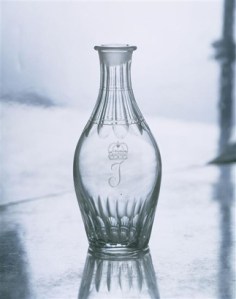
Carafe with Josephine’s monogram, First Empire (1804-1814), crystal, Musée National des Châteaux de Malmaison et Bois-Préau © Rmn / André Martin
The idea for this exhibition came from the inventory drawn up after the death of the Empress Josephine which listed the contents of the cellar at Malmaison – over thirteen thousand bottles. The list of wines served to guests in the house is striking for the number of crus mentioned and the variety of the regions they came from. The best crus from Bordeaux and Burgundy stand alongside Mediterranean wine, in the sweet, syrupy taste of the eighteenth century, the most famous names in Champagne, wines from Languedoc-Roussillon, Côtes du Rhône and the Rhineland. Rum and liqueurs from the West Indies are a reminder of the Empress’ origins.
The exhibition attempts to show the evolution of wine production and marketing during the Empire. It was boosted by progress in the glassmaking industry, which was particularly noticeable in the shape of the bottles. Iconographic documents and account books kept by Josephine’s suppliers reveal the variety and quantity of the empress’ orders.
Elegant ice buckets, glass coolers, crystal and metal punch bowls illustrate the refinement and prestige of the tableware at Malmaison and stand alongside the most brilliant pieces of glassware, some bearing the monograms the sovereigns from Josephine to Louis-Philippe. The latter demonstrate the technical progress made in French glassmaking, which facilitated the search for new forms, and bear witness to the evolution of table manners in the years after the revolution. Objects made after the Consulate and the Empire complement this rich overview and show the changes in the production of glassmaking, bottling and labelling in the first half of the nineteenth century up until the beginning of the Second Empire.
With the classification of the grands vins of Bordeaux in 1855 and developments in transportation, this was a period of deep change. A final section is dedicated to the representation of wine in the Napoleonic legend.
The exhibition brings together more than two hundred objets d’art and iconographic documents not only from the Musée de Malmaison but from the collections of the museums of the Château de Fontainebleau, the Château de Compiègne, the Château d’Eu (Musée Louis-Philippe), the Musée Carnavalet, the Musée des Arts Décoratifs, the Musée National de Céramique de Sèvres, the Archives Nationales, the Fondation Napoléon, the musée Napoléon Thurgovie, château et parc d’Arenenberg, (canton of Thurgovia, Switzerland) and the Museo Napoleonico, Rome. Other items are on loan from industrial or commercial firms such as Moët et Chandon, or from private collections. Taking an artistic and historical angle, the exhibition shows that Josephine’s cellar is a precious testimony to the gracious entertaining which long made the charm and reputation of Malmaison. (more…)
Call for Papers: David Hume Conference in 2011
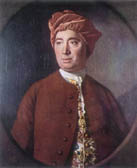
38th International Hume Society Conference: Hume after 300 Years
The Old College, Edinburgh, 18-23 July 2011
 Proposals due by 31 October 2010
Keynote speakers include Annette Baier, David Fergusson, Don Garrett, John Pocock, and Amartya Sen. Papers are invited on any aspect of Hume studies. Papers should be prepared for blind review and sent to: submissions@humesociety.org.
This year’s conference will be held in Antwerp, 6-10 July 2010. See the Hume Society webpage for more information.
Call for Papers: Skin since 1700
Scratching the Surface: The History of Skin, Its Diseases, and Their Treatment
History of Medicine Unit, University of Birmingham (UK), 29-30 October 2010
Proposals due by 30 April 2010
An international conference hosted by the History of Medicine Unit, University of Birmingham, and sponsored by the Wellcome Trust and the Society for the Social History of Medicine.
Skin and skin disease is a central focus of many sub-fields in the history of medicine, including the history of venereal disease, cancer, leprosy, TB and industrial medicine. This conference seeks to address the subject of skin, its diseases and their treatment broadly since 1700. In the process, it aims to bring together individuals working in very different sub-fields in medical and cultural history over the past three centuries. It further aims to promote discussion of the subject in the context of the history of specialisation more generally, as well as the history of senses, sight, smell and touch being central to understandings of skin disease and the way in which such diseases are experienced by practitioners, patients and the public historically. The history of skin ailments also invites exploration of the historical relationship between professional medicine and wider cultural endeavours such as aesthetics, probing realms where health and beauty converge. The conference might similarly offer an opportunity to examine how medical understandings of the skin may have influenced or been influenced by the politics of race.
The organisers wish to invite proposals for 20-30 minute papers on any aspect of the history of skin and its diseases since 1700. Abstracts should be between 200-300 words in length and will be received until 30 April. A programme, featuring a keynote address by Professor Philip Wilson (Penn State, USA), will be advertised in June 2010.
Contact:
Dr Jonathan Reinarz, University of Birmingham, UK (j.reinarz@bham.ac.uk)
Professor Kevin Siena, Trent University, Canada (ksiena@trentu.ca)
Collecting in Eighteenth-Century Italy
Reviewed by Graham Perry in the February issue of Apollo Magazine:
Cinzia Sicca, ed., John Talman: An Early Eighteenth-Century Connoisseur (New Haven: Yale University Press/Paul Mellon Centre, 2009), ISBN: 978-0300123357 ($75).
Misfortune hangs over the Talman family like a cloud. William Talman the architect had a flourishing practice in the time of William III, but most of his work has perished. His son John formed one of the greatest collections of drawings ever seen in Britain, but was forced by financial necessity to begin dispersing it before he died. He designed architectural schemes for All Souls, Oxford, and for a new Whitehall Palace, all of which remained unbuilt. He knew more about contemporary Italian art than any man in England, and was mentor to William Kent, whom he took with him to Italy in 1709; yet his name remains virtually unknown. Only recently has his significance begun to be recognised, with an Italian team of scholars, headed by Cinzia Sicca, taking the lead in producing an on-line reconstruction of his dismembered collections, and now producing a volume that clearly illustrates his position in the early-18th-century art world. . .
For the full review, click here»
Music and the History of Art
La musique face au système des Beaux-Arts ou les vicissitudes de l’imitation (1690-1803)
Paris, Organisé par le Centre allemand d’histoire de l’art et l’INHA, 17-19 February 2010
Si les littératures artistiques et musicales sont le plus souvent étudiées distinctement et différemment par l’historien de l’art, l’historien des idées et le musicologue, ce colloque propose de les réunir et de les apprécier dans une double perspective, sciemment pluridisciplinaire : rétablir d’une part l’esprit de système qui oriente bien souvent la pensée artistique du XVIIIe siècle, et éclairer d’autre part, à côté de la théorie de l’ut pictura poesis, l’existence d’un autre parti pris de la littérature artistique des Lumières : la possibilité de déduire, du phénomène musical, une théorie des arts au sens large.
For details, including a full program, click here»
Amber Exhibition in Scotland
As noted at Artdaily.org:
Amber: Treasures from Poland
Hunterian Art Gallery, University of Glasgow, 5 February — 17 April 2010
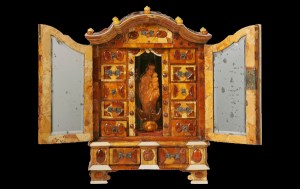
Amber cabinet of King Stanisław August Poniatowski (the last king of Poland). Made in Gdańsk after 1771. Donated by Lady Barbara Carmont of Edinburgh to the Malbork Castle Museum collections in 1979. © Malbork Castle Museum.
From the earliest times, the southern shores of the Baltic Sea have been associated with the gathering, trading and working of amber – a natural substance which has been long valued by man. Featuring some of the finest items from the Polish national collection, this new exhibition, Amber: Treasures from Poland offers a unique chance to see some fascinating and beautiful artefacts which represent both natural history and northern European craftsmanship. This is the first time that these items have been exhibited in the UK.
Most are from the famous Malbork Castle collection in Poland which has an important national collection of Baltic amber artefacts. Also included is the famous Gierłowska lizard from the Gdańsk Amber Museum, as well as a collection of insects trapped in amber and some historical amber artefacts from the Hunterian collection.
 Amber is found in many varieties of colours and forms and amber from the Baltic region of Europe is one of the most abundant in the world. It is used around the world for medical or spiritual wellbeing, for adornment or decoration, and for scientific reasons.
This exhibition introduces amber from prehistory to natural history; it looks at how people related to amber from the Stone Age onwards and at the incredible techniques and skill of the amber craftsmen who created some of the finest examples of amber art ever seen.
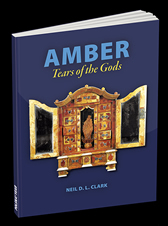
The launch of a new book Amber: Tears of the Gods (Dunedin Academic Press) will coincide with the opening of the exhibition. It has been written by Dr Neil DL Clark, Curator of Palaeontology at the Hunterian.
Call for Papers: Quakers and Slavery
Quakers and Slavery, 1657-1865: An International Interdisciplinary Conference
Philadelphia, 4-6 November 2010
 Proposals due by 30 April 2010
Keynote Speakers: Gary Nash (UCLA), Jerry Frost (Swarthmore), and James Walvin (York)
In 1657, George Fox wrote “To Friends beyond sea, that have Blacks and Indian Slaves” to remind them that Quakers who owned slaves should be merciful and should remember that God “hath made all Nations of one Blood.” His argument may seem far from radical today, but it initiated three centuries of Quaker debate and activism over the problem of slavery that would ultimately see Friends taking key roles in abolition and emancipation movements on both sides of the Atlantic, and beyond. It was, however, by no means inevitable that Quakers would embrace antislavery. In the seventeenth century, and most of the eighteenth century, Quakers were divided on the issue, particularly in the British American colonies, with some denouncing slavery, and others owning slaves. In the following century, Quakers were more unified in their opposition to slavery, but encountered a range of spiritual, political, and personal challenges while taking their antislavery message to a wider world. This interdisciplinary conference aims to examine the history, literature, and culture of the Quaker relationship with slavery, from the society’s origins in the English Civil War up to the end of the American Civil War, with a focus on what David Brion Davis has called “The Quaker Antislavery International.”
We welcome proposals for pre-circulated papers from scholars in all relevant disciplines; in particular, from historians, literary scholars, art historians, and scholars studying Quakers and slavery beyond the English-speaking world. Topics to be discussed may include but are not confined to: (more…)
Call for Papers: CSECS in October
36th Annual CSECS Conference: Charting the 18th Century: Encircling Land & Sea
St. John’s, Newfoundland & Labrador, Canada, 14-16 October 2010
Proposals due by 28 February 2010
 Plenary Speakers:
- Isobel Grundy (Professor Emeritus, English & Film Studies, University of Alberta)
- Jean-François Palomino (Bibliothèque et archives nationales du Québec, Montréal)
- Pat Rogers (Distinguished University Professor and DeBartolo Chair in the Liberal Arts, University of South Florida)
The planning committee for the 36th annual CSECS conference welcomes papers on any aspect of the long eighteenth century. Selected papers will be published in Lumen. 2010 marks the 300th anniversary of the birth of Sarah Fielding, the Copyright Act, Swift’s Description of a City Shower and the 250th anniversary of the reign of George III, Diderot’s La religieuse, Sterne’s Tristram Shandy, Voltaire’s Tancrède . . . (more…)
European Romanticism on Paper
Varieties of Romantic Experience: Drawings from the Collection of Charles Ryskamp
New Haven, Yale Center for British Art, 4 February — 25 April 2010

ISBN: 0300152922 (Yale University Press), $75
In 1824, the Scottish painter David Wilkie wrote to the director of the French Royal Museums, “It is time to show that the arts are cosmopolitan and that all national prejudice is foreign to them.” In spite of Wilkie’s fine sentiment, drawings by British artists from the Romantic period have rarely been considered alongside those produced across the Channel. In response, this remarkable exhibition will take up the challenge of treating Romanticism as an international phenomenon by bringing together nearly two hundred British, French, German, Danish, and Dutch drawings from the outstanding collection of Charles Ryskamp (MA ’51, PhD ’56), Professor Emeritus, Princeton University, and Director Emeritus of the Pierpont Morgan Library and The Frick Collection in New York. The first exhibition of this scope dedicated to northern European drawings, it will consider the place of British art in a European milieu.
Varieties of Romantic Experience: Drawings from the Collection of Charles Ryskamp will explore the direct relationship between British and Continental artists during the Romantic period (here defined as the period between the French Revolution in 1789 and the revolutions of 1848). Despite the very different circumstances in which artists across Europe were working, and the diverse modes of representation they employed, they shared common concerns and frequently explored similar themes. The exhibition and accompanying book will focus on Romanticism’s novel exploration of two worlds in particular: nature and the imagination. (more…)










 Enfilade
leave a comment