New Books
Spring titles from the Paul Mellon Centre
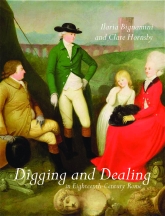
Ilaria Bignamini and Clare Hornsby, Digging and Dealing in Eighteenth-century Rome (New Haven: Yale University Press and the Paul Mellon Centre, 2010), ISBN: 9780300160437, $85.
This important and long-awaited book offers first overview of all British-led excavation sites in and around Rome in the Golden Age of the Grand Tour in the eighteenth century. Based on work carried out by the late Ilaria Bignamini, the authors have undertaken the monumental task of tracing sculptures and other works of art that are currently in public collections around the world from their original find sites via the dealers and entrepreneurs to the private collectors in Britain. In the first of two extensively illustrated volumes, approximately fifty sites, each located by maps, are analysed in historical and topographical detail, supported by fifty newly written and researched biographies of the major names in the Anglo-Italian world of dealing and collecting. Essays by Bignamini and Hornsby introduce the field of study and elucidate the complex bureaucracy of the relevant departments of the Papal courts. The second volume of the books is a collection of hundreds of letters from the dealers and excavators abroad to collectors in England, offering a rich source of information about all aspects of the art market at the time. The book is an invaluable resource for scholars working in a rapidly expanding area where European art and cultural history meets archaeology.
◊ ◊ ◊ ◊ ◊
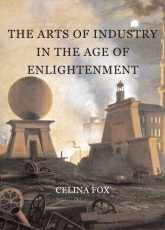
Celina Fox, The Arts of Industry in the Age of Enlightenment (New Haven: Yale University Press and the Paul Mellon Centre, 2010), ISBN: 9780300160420, $95.
This book is about the people who did the work. The arts of industry encompassed both liberal and mechanical realms – not simply the representation of work in the liberal or fine art of painting, but the mechanical arts or skills involved in the processes of industry itself. Drawing on a wealth of primary sources, Celina Fox argues that mechanics and artisans used four principal means to describe and rationalize their work: drawing, model-making, societies and publications. These four channels – which form the four central themes of this engrossing book – provided the basis for experimentation and invention, for explanation and classification, for validation and authorization, promotion and celebration, thus bringing them into the public domain and achieving progress as a true part of the Enlightenment. The book also examines the status of the mechanical arts from the medieval period to the seventeenth century and explains the motives behind and means by which entrepreneurs, mechanics and artisans sought to present themselves to the world in portraits, and the manner in which industry was depicted in landscape and genre painting, informed by the mechanical skills of close observation and accurate draughtsmanship. The book concludes with a look at the early nineteenth century when, despite the drive by gentlemen of science and fine artists towards specialization and exclusivity, not to mention the rise of the profession of engineers, the broad sweep of the mechanical arts retained a distinct identity within a somewhat chaotic world of knowledge for far longer than has generally been recognized. The debates their presence provoked concerning the relationship of theory to practice and the problematic nature of art and technical education are still with us today.
You’re Invited . . .
Please join us for the HECAA reception at CAA, Thursday February 12, 5:30-7:00 pm, Ogden West Tower, Silver Level. If you plan on attending, please let me know so I can provide a rough head count for the Hyatt reception service. And don’t forget our HECAA sessions!
New Scholars: Transforming Traditions in Eighteenth-Century Art
Thursday, February ll, 12:30-2:00 pm
Grand CD South, Gold Level, East Tower, Hyatt Regency Chicago
Chair: Laura Auricchio, Parsons The New School for Design
Representing the Psyche in Eighteenth-Century Art
Thursday, February 11, 2:30-5:00 pm
Grand A, Gold Level, East Tower, Hyatt Regency Chicago
Chair: Michael Yonan, University of Missouri, Columbia
See you there!
Dr. Julie-Anne Plax
HECAA President
jplax@email.arizona.edu (R.S.V.P.)
One More Thing for the Chicago Itinerary
Sites to Behold: Travels in Eighteenth-Century Rome
Smart Museum of Art, University of Chicago, 3 November 2009 — 11 April 2010
Curated by Anne Leonard
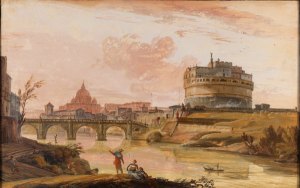
Jean-Baptiste Lallemand, "View of Rome: The Tiber River with the Castel Sant’Angelo and St. Peter’s Basilica in the Distance," n.d., Gouache on paper. Smart Museum of Art, University of Chicago, Gift of Lucia Woods Lindley, 2006.96.
Rome has long been a leading tourist destination. Many of the “must-see” sites were codified centuries ago as part of the Grand Tour, a journey undertaken by young aristocrats to complete their education and give them experience of the world. But by the late eighteenth century, the once-exclusive Grand Tour was giving way to more modern, democratic notions of travel. No longer the preserve of a privileged elite, travel to Italy and other places came within the reach of a wider public, who were eager for tangible souvenirs of what they saw and experienced. This exhibition presents etchings by Giovanni Battista Piranesi, gouache drawings by Frenchman Jean-Baptiste Lallemand, and other works depicting Rome and nearby Tivoli. These eighteenth-century artists, with their different temperaments, techniques, and styles, produced a breathtaking variety of art. A far cry from the monotony of the picture-postcard aesthetic, the works on view appealed to a wide array of tastes and allowed travelers of the period to marvel at the splendor and ruin of an ancient world long after they returned home.
◊ ◊ ◊ ◊ ◊
Right about now, those of you attending CAA in Chicago are probably beginning to cringe at just how tight your schedule already looks. But in the event you can find a few hours to get away from the conference hotel, I would whole-heartedly recommend a morning or afternoon in Hyde Park. In addition to this exhibition at the Smart Museum, the campus of the University of Chicago offers the Oriental Institute Museum, Frank Lloyd Wright’s Robie House, and the Renaissance Society (for ancient, modern, and contemporary aesthetic experiences). The Renaissance Society is currently showing the photographs of Anna Shteynshleyger. No visit is complete without a stop at the Seminary Co-Op Bookstore (one of the best academic bookstores in the world), and La petite folie makes for a lovely quiet lunch or dinner. Hyde Park is easily reached via the Metra commuter train system, available just a few blocks from the Hyatt at Millennium Station. –C.H.
Call for Papers: Graduate Conference on ‘New Formalisms’
Politics, Ethics, and the New Formalisms (Graduate Student Conference)
University of Illinois at Urbana-Champaign, 23-24 April 2010
Abstracts due by 10 March 2010
The British Modernities Group, in conjunction with the Unit for Criticism and Interpretive Theory and the departments of English, Philosophy, and Art History, and with support from the Illinois Program for Research in the Humanities, invites submissions from diverse disciplinary backgrounds and methodological orientations for our annual graduate student conference, this year themed “Politics, Ethics, and the New Formalisms.”
The conference will open with a keynote address by Marjorie Levinson, professor at University of Michigan, Ann Arbor, who specializes in the areas of critical theory, and in poetry and poetics. She not only theorizes the rise of the “New Formalist” movement, but enacts these tensions in her own scholarship, including a contribution to a collection of essays entitled Rethinking Historicism: Critical Readings in Romantic History in 1989, and a recent publication in Studies in Romanticism entitled “A Motion and a Spirit: Romancing Spinoza.”
New Formalism is a recent trend—a “movement,” according to Marjorie Levinson’s 2007 essay “What is New Formalism?” in the PMLA—in critical theory, cultural studies, and literary scholarship that challenges some of academia’s established methods and critical approaches. The term “New Formalism” seemingly implies a “return” to formal qualities such as genre or aesthetics in approaching literary and cultural studies. New Formalism itself is hardly a unitary concept, hence the plural reference in our title to New Formalisms; the term itself is open to debate and definition. The graduate conference will engage this critical trend by exploring the ways in which New Formalism reflects attentiveness to political and ethical issues. What does a turn or ‘return’ to formalism in the first decade of the twenty-first century mean? How does New Formalism impact disciplinary, pedagogical, or theoretical positions or methodologies? How can form be political? How can form be ethical? (more…)
Academics and the F-Word
One might imagine any number of interesting permutations on that F-word, but here I’m thinking of an even more fraught notion for academics: fashion. Nearly two decades ago, Valerie Steele made the point in her 1991 Lingua Franca essay, “The ‘F’ Word”:
Valerie Steele, Director and Chief Curator of the Museum at the Fashion Institute of Technology in New York
Once, when I was a graduate student at Yale, a history professor asked me about my dissertation. “I’m writing about fashion,” I said.
“That’s interesting. Italian or German?”
It took me a couple of minutes, as thoughts of Armani flashed through my mind, but finally I realized what he meant. “Not fascism,” I said. “Fashion. As in Paris.”
“Oh.” There was a long silence, and then, without another word, he turned and walked away.
The F-word still has the power to reduce many academics to embarrassed or indignant silence. Some of those to whom I spoke while preparing this article requested anonymity or even refused to address the subject; those who did talk explained that many of their colleagues found it “shameful to think about fashion.” One professor explained the “denial” of fashion this way: “People say that they don’t care about fashion, but that may be because they aren’t self-conscious enough to envision a personal style. Style is what most academics don’t have.”
Academics may be the worst-dressed middle-class occupational group in the United States. But they do wear clothes. So I set out to discover what professors choose to wear (the clothes don’t grow in their closets), what they think about fashion (even when they claim not to think about it), and, well, why they tend to dress so badly. . .
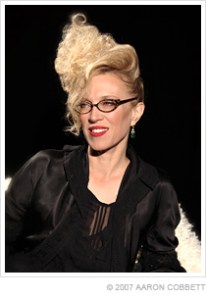
For the full essay, click here»
◊ ◊ ◊ ◊ ◊
With the spring conference season here once more, many of us will soon find ourselves rummaging in the closet with an open suitcase on the floor, asking ourselves what an art historian should look like now (I recall one CAA several years ago in which the hotel was also hosting a cheerleading conference: lots of black clothing, scarves, and serious eyewear on the one side with plenty of exuberant hair-styling, makeup, and shiny sportswear on the other — quite the contrast).
The Sartorialist has brilliantly demonstrated how the intersection of high fashion, street fashion, and engaging photography can make for an internationally successful blog (and now book). In a more targeted manner, Academic Chic offers a fascinating glimpse at the unique challenges professors and college instructors face. In the site’s own words: “Three feminist PhD candidates at a Midwest university, on a crusade against the ill-fitting polyester suit of academic yore.” They continue:
We are three Ph.D. candidates in the humanities, who believe that academia and fashion are not at odds. When beginning graduate school we each had an existential wardrobe crisis. What does one wear in grad school anyway? We recognized that our undergraduate hoodies and jeans were no longer appropriate but were unwilling to accept the shoulder-padded khaki polyester suit that was ubiquitous among our female professors. As feminist scholars, we were also forced to reconcile the perceived-superficiality of our interest in style with our academic commitment to questioning gender and class essentialisms.
Today, in the face of all our eye-rolling colleagues, we defiantly wear dresses, fitted jackets, and pointy toe shoes. To teach in. And sometimes just to the library!
But don’t worry. We’ve done our research on this one too. Cultural critic Fred Davis calls fashion “a visual language, with its own distinctive grammar, syntax, and vocabulary.” Theorist Judith Butler, in Gender Trouble, points to the power of clothing to create and constantly recreate identity. And even philosopher Charles Baudelaire praised cosmetics and garments for creating beauty where nature fails. In short, fashion is a powerful tool for creating identity, subverting class or gender norms, performing self, and appreciating aesthetic beauty.
This won’t be our dissertation, but it might keep us sane in the mean time. With this project we hope to inspire other academics to embrace their love of clothes, to create unique and beautiful outfits, and to engage in a metadialogue about the art, literature, and garments that can move us all.
A site like Academic Chic suggests that a lot has changed since 1991 when Steele surveyed the American college campus (imagine trying to explain the blogosphere to anyone in 1991). And yet . . . many of her observations still seem remarkably familiar. . . –C.H.
Eighteenth-Century at the Newberry
The Eighteenth-Century Seminar at the Newberry Library is designed to foster research and inquiry across the scholarly disciplines. It aims to provide a methodologically diverse forum for work that engages our ongoing discussions and debates along this historical and critical terrain. The spring program includes the following presentations:
Saturday, 6 March 2010, 2-4 pm
Bernadette Fort (Northwestern University)
“Female Royalty and Women Painters in the Late Ancien Régime”
Focusing on reviews of the exhibitions of the Royal Academy in the late 1780s and in particular on portraits of female royal figures by E. Vigée Le Brun and A. Labille-Guiard, this talk examines the intersection of gender, aesthetics, and politics in the cultural realm on the eve of the French Revolution. It argues that art criticism of the period represents an important discursive site in which the issue of female representation in the political and visual fields was fiercely debated.
Saturday, 17 April 2010, 2-4 pm
Misty Anderson (University of Tennessee, Knoxville)
“Methodistical Sisters and The New Man: Fielding Among the Methodists”
The tabloid-ready tale of “Mrs. Mary, otherwise Mr. George Hamilton,” who married several women while passing as a man, appeared in Boddley’s Bath Journal of November 8, 1746, and in a slew of London and regional newspapers shortly thereafter. This work-in-progress paper examines Henry Fielding’s use of Methodism in The Female Husband to explain the origin of Hamilton’s same sex desire. Instead of standing in the place of religious law, Methodism (to its critics) functioned as a sexuality, a set of practices that excited and transformed the individual into the “new man” through an experience of divine intimacy. Focusing on the Hamilton case, this talk considers the relationship between evangelicalism and gender scripts as they were written into mid-eighteenth century discourses of sex and spirituality.
Attendance at all events is free and open to the public, but participants are asked to register in advance by contacting the Center for Renaissance Studies at: renaissance@newberry.org. A reception will follow each presentation.
National Gallery of Ireland Restores Scagliola Table Top
Press release from the National Gallery of Ireland:

Richard Castle, Russborough House, Wicklow, Ireland, 1740s
In 1902, Lady Geraldine Dowager Countess of Milltown gifted to the National Gallery of Ireland the contents of Russborough, Co. Wicklow, in memory of her husband, Edward Nugent, 6th Earl of Milltown (1835-1890). The gift was so extensive and varied – it included paintings, furniture, sculpture, mirrors, silver and objets d’art – that it was necessary to construct a new building (The Milltown Wing) to accommodate the collection.
Included in the Milltown Gift were three eighteenth-century scagliola console table-tops, the largest of which is currently on loan to Russborough, and now in need of conservation. To this end the National Gallery of Ireland has commissioned two conservators, Chiara Martinelli and Francesca Toso of the Opificio delle Pietre Dure in Florence, who have the specialist expertise in the restoration of this medium.

Don Pietro Belloni, Scagliola table-top (detail) Photo © 2010 National Gallery of Ireland
Scagliola is an artificial ornamental marble. Used as a substitute for real marble it is created by way of a complex process which uses pulverized selenite, mixed with glue and pigments. The technique was refined in the mid-eighteenth century by Enrico Hugford, Abbot of the Vallombrosan Monastery of Santa Reparata, near Florence.
The large scagliola table top at Russborough is one of three commissioned from Hugford’s pupil at the monastery, Don Pietro Belloni, for Russborough, by Joseph Leeson 1st Earl of Milltown during his Grand Tour to Italy in 1744. The design of the table is intricate and highly colourful with a rich pattern of decorations framing pastoral scenes in each corner and a large
landscape in the centre.

Scagliola console base (detail) Photo © 2010 National Gallery of Ireland
Given the size (107 x 211.5 x 6cm) and fragility of the piece, conservation on the table top is being carried out in situ at Russborough until the end of January 2010. It is also being reunited with the recently recovered gilded Rococo console base that Joseph Leeson had made for it when it first arrived in Russborough. The scagliola table-top and its original base will return to public view when the house reopens in the spring.
Scagliola is a plaster made of pulverised selenite (gypsum), mixed with glue and pigments. In the Russborough tables, a coperta layer of black scagliola, composed of gypsum, natural glues and charcoal pigment was thinly spread on a stone support. After an initial polish using pumice and oil the craftsman carefully etched out the design, just a few millimetres deep, using a burin, or a similar tool. These shallow areas were filled with liquid gypsum plaster, glues and pigments, and this process was repeated as necessary to add layers of additional detail to the decoration. Finally the finished top was polished using oils, waxes and shellac. The refinement and sophistication of detail thus achieved is remarkable. While Belloni may have been criticised by Mann as being ‘inferior’ to Enrico Hugford, and for his slowness, the table tops he produced for Leeson and his friends are examples of the scagliola technique at its finest. (more…)
Zoffany Biography Just Published
Penelope Treadwell, Johan Zoffany: Artist and Adventurer (London: Paul Holberton, 2010), ISBN: 9781903470930, $50.
 This beautifully designed and illustrated publication is the first comprehensive biography of the portrait painter Johan Zoffany (1733-1810), one of the leading figures of eighteenth-century British art. The German-born artist shot to fame with his charming conversation pieces and portraits of London celebrities, and he soon became the painter of choice of King George III, depicting the royal family with rare informality, and subsequently a founder-member of the Royal Academy of Arts. His pictures have earned him the right to stand alongside Hogarth, Gainsborough and Reynolds as one of the most important founding artists of the British School.
Following ten years of detailed research, the author traces Zoffany’s remarkable life from his upbringing in Bavaria and apprenticeship in Rome to his subsequent success in Britain and adventures working in India. He is a figure who is ripe for reassessment, as a commentator on eighteenth-century politics and history as well as a painter. This timely and entertaining biography — reproducing many images that have never been previously published — looks beneath the often deceptively smooth surfaces of his art to discover the intelligence, curiosity and subversive humour that made his work and life so distinctive.
January’s Numbers
I’m delighted to report that Enfilade continues to grow. January was another record month with 3,300 individual visitors and 330 return readers. It’s exciting to see increases in both numbers. So thanks very much to all of you — whether you’re new to the site or a regular reader by now!
We intend to discuss ideas for the site with HECAA members at the annual ASECS meeting in Albuquerque (including the addition of several new editors). I certainly welcome any feedback you may have before then as well. Next week, I shall be in Chicago for the annual CAA conference and would be delighted to hear any concerns, suggestions, or ideas you may have about the site. And by all means, please continue to send announcements and news items you would like to see posted. Thanks so much!
-Craig Hanson
Wiebenson Prize Deadline Just Around the Corner
Each year HECAA awards the Wiebenson Prize for an outstanding graduate student paper presented during the previous calendar year at a scholarly conference or as a sponsored lecture. Announced at HECAA’s annual luncheon (each spring at ASECS), the prize includes modest remuneration.
The prize is named for Dr. Wiebenson, Professor Emerita at the University of Virginia School of Architecture.
By 15 February 2010, students should submit three copies of their papers, as read, without notes, but with illustrations, to Julie Plax, who will then forward the submissions to an ad hoc committee responsible for selecting the winner. Honorable mention is also an option for papers of distinction not chosen for the prize. Recipients must be HECAA members in good standing.










 Enfilade
leave a comment