Back to the Classroom — Tuesday
Our first response to Julie-Anne Plax’s syllabus for an undergraduate course on eighteenth-century art . . .
◊ ◊ ◊ ◊ ◊
Georgina Cole is a part-time lecturer and researcher at the University of Sydney. She has just been awarded her Ph.D. from the same university for her thesis “Painting the Threshold: Doors, Space and Representation in Eighteenth-Century Genre Painting,” which examines the role of doors in the work of Watteau, Chardin, Hogarth, and Gainsborough alongside a new theory of genre painting. Georgina has taught and contributed to a number of art history courses at the University of Sydney, the University of Technology, and the Art Gallery of New South Wales.
◊ ◊ ◊ ◊ ◊
Overshadowed by the looming edifices of the baroque and the nineteenth century, the eighteenth century is often an unfamiliar period for art history students, and prone to be written off as a frivolous century lacking any real achievements. Faced with these prejudices, a good course needs to show students that there is a lot to be gained from taking this playfulness seriously and that ultimately, the eighteenth century is a crucial turning point for many ‘modern’ ideas about representation, science, and private life. Julie Plax’s syllabus tackles both of these issues, and it does so by focusing on the intersections of eighteenth-century art and cultural identity, politics, travel and scientific discovery. The range of seminar topics here is impressive, as is the attention to things that aren’t paintings, such as monuments, buildings and gardens. This approach accurately emphasizes the ‘artfulness’ of the period and its fluid relationships between painting, sculpture, architecture and decoration. Her pan-European focus is particularly refreshing, and includes English, Spanish, German, Russian and Swedish art and contexts. The thematic and chronological organization of the course is well devised and should help students engage with the themes, forms and contexts of eighteenth-century art rather than just its stylistic affiliations.
While I liked the breadth and diversity of the course content, I was really impressed by the forms of examination and their focus on student learning. The numerous assessments – multiple exams, an article critique and a final research paper – provide the student with continual feedback to aid in the development of writing skills and critical analysis. As a teacher, I have found that students need and want constant feedback on their academic performance. This can sometimes be a heavy burden, but it is vital for their academic development. The ongoing opportunities for assessment in this course, especially the submission of multiple drafts of the research paper, will certainly help students improve their writing, research and interpretive skills. Spreading the assessment loading across multiple tasks also keeps students engaged throughout the semester.
Also on the topic of examination, I was intrigued by the lottery for the allocation of research topics. This is an ingenious solution to an often difficult and time-consuming problem, and admirably avoids “Fragonard fatigue”, a condition experienced after marking 97 papers on Happy Hazards of the Swing. It means a good spread of topics for marking, and forces students to study works they would not have chosen for themselves. Although we generally introduce more critical articles and essays into the reading list at the University of Sydney, I think that the way Julie has controlled access to more difficult material by turning it into a form of assessment is a great way of ensuring that it is comprehended and critically analyzed. The article critique assessment is an excellent way of developing reading and interpretive skills and the emphasis on discussion improves communication and argumentation. All in all, this is a comprehensive and in-depth approach to the major concerns of eighteenth-century art that emphasizes its interaction with social, cultural and political contexts, and effectively promotes student learning.
Back to the Classroom — Syllabus for the Eighteenth Century
As many of us prepare to return to the classroom this fall, it seems an appropriate time to think about teaching as a vital component of the life of HECAA. The vast majority of postings here at Enfilade point to exhibitions, conferences, and scholarly opportunities. Yet in addition to the hats we wear as researchers and writers, many of us spend a huge portion of our professional careers trying to communicate our understanding and love of art history to students. In acknowledgment of this crucial responsibility, our fearless leader, Julie-Anne Plax has graciously agreed to share a syllabus from one of her past undergraduate courses. It’s posted below, and for the next three days, HECAA members will weigh in with their own responses to it (of course, all members are invited to leave comments along the way as well). To wrap up the week, Julie is also providing a syllabus for a graduate seminar on the French Rococo. Special thanks to Professor Plax for her generosity!
N.B. — The syllabus has here been modified slightly for formatting reasons. It is also available for download as a Word Document.
◊ ◊ ◊ ◊ ◊
ARH 316B — SURVEY OF EIGHTEENTH-CENTURY ART
Professor Julie-Anne Plax
Art Building, Room 312
Spring 2008, MW 2:00-3:15
Office Hours: MW 12:30-1:30, or by appointment
Art Building 294 / 626-4864 / jplax@email.arizona.edu
Course Description
ARH 316B is a one-semester lecture course which can be taken for three units of credit under ‘General Education Tier II: Traditions and Cultures’. This course presents a thematic survey of European art and architecture from the beginning of the eighteenth century to the French Revolution; or, in stylistic terms, from Rococo to Neo-Classicism. The lectures will examine the major artists, artistic monuments, and movements of the eighteenth century and address, more specifically, some of the critical issues in the study of eighteenth-century art.
Required Text
There is no required text for this class. The required readings will be available as PDFs at the course’s electronic reserve library site.
Course Requirements
The grade for the course will be based the following requirements.
- Exam 1 15% Feb 25
- Exam 2 15% April 7
- Final Exam 20% May 9, Friday, 2:00-4:00
- Article Critique 15% various dates
- Participation 5%
- Research Paper 30%
- Paper prospectus and bibliography, February 18
- 1st rough draft, March 10
- Penultimate draft, April 14
- Final paper, May 7
Examinations: Bluebooks required. Each examination will consist of a combination of short answer, slide identification/comparison and an essay question.
Article Critique: You will write a critique of one article. There are four articles to chose from which are indicated with *** in the syllabus course calendar. Due dates for each of the article critiques are also indicated in the course calendar below. The critique should be 3-4 typewritten pages. The critique should include a brief summation of the article, a discussion of what the article was about (the larger questions addressed as opposed to a recapitulation of the argument) and your own evaluation and opinion of the article.
Research Paper: You will be assigned a particular artwork or monument as the topic for your research paper during the research paper lottery on January 28. (See the end of the syllabus for the list of artworks). The finished research paper will be between 7 and 9 typewritten double-spaced pages of text, not including the required endnotes, bibliography and illustrations. The paper will be graded according to three categories: 1) evidence of research; 2) content and organization; 3) writing skill and scholarly form; (correct form and usage of notes, bibliography and illustrations) There is a research paper guideline on e-res for correct form and usage. To ensure steady progress on the paper there are several requirements: 1) a prospectus and preliminary bibliography 2) 1st rough draft 3) penultimate draft 4) final paper. Failure to meet these requirements will result in a 10% reduction of your final grade for each of the requirements not met.
Discussion/participation: Discussion and participation is evidence of engagement with the material. We will be discussing all the readings informally and the four article critique readings in a more formal manner.
Grading
Students will receive a score for each requirement based on the following scale. The final grade will be calculated according to the percentage weights assigned to each requirement above.
Grading scale:
90-100% -A
80-89%-B
70-79%-C
60-69% -D
0-59% -E
The School of Art follows the University of Arizona Grading System. A, B, C, D, and E constitute the regular grades used at the University of Arizona.
The University of Arizona Grading System
A* Excellent
B* Good
C* Satisfactory
D* Poor
E* Failure
P Passing (Special S/P and P/F grade)
F Failure (Special P/F grade)
S Superior (Special S/P grade)
O Audit
Late Work
Late work will be accepted with a 5% deduction per day.
Absence Policy
Students are expected to attend class and roll will be taken at each class meeting. More than three absences will affect your grade at the rate of 5% per each additional absence subtracted from your final total score.
Classroom Behavior and Academic Integrity
Student Code of Conduct: “The aim of education is the intellectual, personal, social, and ethical development of the individual. The educational process is ideally conducted in an environment that encourages reasoned discourse, intellectual honesty, openness to constructive change and respect for the rights of individuals. Self-discipline and a respect for the rights of others in the university community are necessary for the fulfillment of such goals.”
Code of Academic Integrity: “Integrity is expected of every student in all academic work. The guiding principle of academic integrity is that a student’s submitted work must be the student’s own. This principle is furthered by the student Code of Conduct and disciplinary procedures established by ABOR Policies 5-308/5-403, all provisions of which apply to University of Arizona students.”
Both the Code of Conduct and Code of Academic Integrity can be found online.
◊ ◊ ◊ ◊ ◊
READING ASSIGNMENTS AND COURSE CALENDAR
January 16: Introduction to the Course and Background to the Eighteenth Century
Chu, Nineteenth-Century European Art, 19-33
January 21: Martin Luther King Holiday
No class
January 23: The Art Academy
Chu, Nineteenth-Century European Art, 33-39
January 28: Watteau and the Fête Galante — RESEARCH PAPER LOTTERY
Wakefield, Eighteenth-Century French Painting, 22-41
January 30: Rococo and Pompadour
Wakefield, Eighteenth-Century French Painting, 78-91
February 4: Architecture of Private Life
***ARTICLE CRITIQUE READING: Mimi Hellman, “Furniture, Sociability, and the Work of Leisure in Eighteenth-Century France” in Eighteenth-Century Studies 32 (Summer 1999): 415-45
February 6: Grand Tour I
Ford, “The Grand Tour,” Apollo 114 (December 1981): 390-400
February 11: Grand Tour II
DISCUSSION of Hellman READING and Critique due
February 13: The British Country House
Tavernor, Palladio and Palladianism, 151-80
February 18: Nature and the Great Outdoors
Berrall, The Garden: An Illustrated History, 263-80
Paper Prospectus and Bibliography due
February 20: Guest Speaker!
February 25: Exam I
February 27: Hogarth and Humor
Vaughan, British Painting, 24-37
March 3: Portraiture
Vaughan, British Painting, 68-97
March 5: Baroque Tradition and Religious Art
March 10: Germany
1st Rough Draft of Paper due
***ARTICLE CRITIQUE READING: Hart and Stevenson, “The Body and Ascension in the Sacred Rococo Art of Southern Germany and Austria,” in Heaven and the Flesh, 127-47
March 12: Neo-Classical I
Chu, Nineteenth-Century European Art, 41-53
March 17 & 19: Spring Break
No Class
March 24: Neo-Classical II
DISCUSSION of Hart and Stevenson READING and Critique due
Chu, Nineteenth-Century European Art, 53-69
March 26: Great Men, Great Monuments and Great Museums
March 31: The Cult of Sensibilité
Brookner, Greuze: The Rise and Fall of an Eighteenth-Century Phenomenon, “Sensibilité,” 1-18
April 2: Mothers and Children
***ARTICLE CRITIQUE READING: Duncan, “Happy Mothers and Other New Ideas in French Art,” Art Bulletin 55 (December 1973): 570-83
April 7: Exam II
April 9: Women Artists
DISCUSSION of Duncan READING and Critique due
Slotkin, Women Artists in History, 110-27
April 14: Diderot: Art Criticism and the Encyclopédie0
Penultimate draft of Paper due
Diderot, Salon of 1765 “Greuze,” 96-100
Diderot, Salon of 1767 “Robert,” 190-200
April 16: Russia and Sweden
April 21: Science and Industry
***ARTICLE CRITIQUE READING: Boime, Art in an Age of Revolution 1750-1800, “Joseph Wright of Derby,” 233-60
April 23: Animals and Art
Vaughan, British Painting: The Golden Age, 162-73
April 28: Exoticisms
DISCUSSION of Boime READING and Critique due
April 30: Colonial America
May 5: Revolution and Art
Chu, Nineteenth-Century European Art, 93-107
May 7: The Sleep of Reason
Final and perfected Paper due
Last day of class, no reading, Hooray!
◊ ◊ ◊ ◊ ◊
Paper Lottery Choices
For Images see IMAGEN Portfolio: 316 Paper Images
1. Johann Zoffany, Royal Academicians in General Assembly
2. Antoine Watteau, Pilgrimage to Cythera
3. François Boucher, Portrait of Mme de Pompadour
4. Pompeo Batoni, The Honorable Colonel William Gordon
5. Canaletto, Rio dei Mendicanti
6. Lord Burlington and William Kent, Chiswick House
7. Stowe Garden
8. William Hogarth, Gin Lane and Beer Street
9. Joshua Reynolds, Mrs. Sarah Siddons as a Tragic Muse
10. Christopher Wren, St. Paul’s, London
11. Giambatistta Tiepolo’s fresco painting at the Wurzburg Palace
12. Jacques-Louis David, Oath of the Horatii
13. Fuseli, The Nightmare
14. Mengs, Portrait of Winckelmann
15. Antonio Canova, Statue of Napoleon
16. Elisabeth Vigée-Lebrun, Marie Antoinette and her Children
17. Angelica Kaufmann, Cornelia, Mother of the Gracchi
18. Joseph Wright of Derby, Experiment on a Bird in an Airpump
19. Etienne Falconet, Monument to Peter the Great
20. George Stubbs, Mares and Foals in a River Landscape
21. François Boucher, Sultaness Drinking Coffee
22. Benjamin West, The Death of General Wolfe
23. Jacques-Louis David, Marat
24. Francisco Goya, The Duchess of Alba
Call for Papers: Walpole and Strawberry Hill, Once More
Horace Walpole’s Strawberry Hill has become quite the scholarly stimulus. With the restoration almost completed, this symposium (apparently a bit less art historical than much of the recent attention) will celebrate the building’s reopening . . .
Romantic Adaptations: A Strawberry Hill Symposium
St Mary’s University College, Twickenham (London), 25-26 March 2011
Proposals due by 31 October 2010
This two-day conference, hosted jointly by the Departments of English and Film and Popular Culture at St Mary’s University College, will mark the re-opening of Horace Walpole’s Gothic mansion at Strawberry Hill. Despite Blake’s often-quoted contention that he had to ‘create a system or be enslaved by another man’s’, the investment in originality during the Romantic period disguises a pervasive culture of adaptation. The diverse afterlives of Romanticism can also best be described as a history of adaptation. This conference, itself hosted in a highly adapted Gothic space, seeks to consider both romantic-period adaptation, and subsequent adaptations of ‘romanticism’ and ‘the romantics’. The organisers invite abstracts for papers engaging with any aspect of this history of adaptation. Topics might include, but are not limited to:
- Antiquarianism, imitations and forgeries
- Histories and myths of romantic lives
- Gothic appropriations in print and on screen
- Iterations of poetic genres
- Classicism in art and politics
- Romantic intertexts
- Romantic drama and music
- Popular appropriations of romanticism
- ‘Genre’ and interdisciplinarity
- Eco-adaptations of romanticism
Keynote speakers are: Prof Andrew Bennett (Bristol); Dr Ian Hunter (De Montfort); Prof Peter Kitson (Dundee); and Prof Nigel Leask (Glasgow). The conference will include a tour of Horace Walpole’s newly-adapted house. Enquiries and / or abstracts, of no more than 300 words, for papers of approximately 20 minutes, should be sent to Dr Caroline Ruddell (ruddellc@smuc.ac.uk) or Dr Cian Duffy (duffyc@smuc.ac.uk). Abstracts should be received by 31st October 2010.
Communion Silver Acquired for Birmingham
Press release from the Art Fund (10 August 2010) . . .
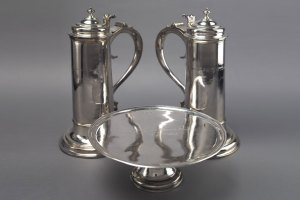 A rare collection of communion silver – with some pieces dating back over 500 years – has just been bought for Birmingham with the help of a £27,000 grant from the Art Fund. The collection consists of a rare pre-Reformation silver parcel-gilt paten engraved with the Manus Dei (‘Hand of God’) c.1450; a silver communion cup (1634) and a pair of silver flagons and standing paten by London silversmith Anthony Nelme. The flagons are engraved with the inscription: ‘A Gift to Castle Bromwich Chapple in the Year 1723’. The silver will initially go on display at Aston Hall, until the end of October, and will then move to its permanent home at Birmingham Museums & Art Gallery.
Stephen Deuchar, Director of the Art Fund, said: “This historic Anglican Communion highlights the history of the local Church and also shows off the work of a leading silversmith. We’re really pleased that Birmingham Museums & Art Gallery will now be its permanent home, so people can admire it for years to come.”
The other funding partners who helped reach the full £54,000 asking price were the MLA/V&A Purchase Grant Fund (£17,000), City of Birmingham Museums & Art Galleries Development Trust (£10,000) and Friends of Birmingham Museums & Art Gallery (£2,000).
Call for Papers: Graduate Conference on Imagining Europe
LUICD Graduate Conference 2011
Imagining Europe: Perspectives, Perceptions and Representations from Antiquity to the Present
Leiden University Institute for Cultural Disciplines, 27-28 January 2011
Proposals due by 1 November 2010
Confirmed key note speakers:
Professor Edith Hall, Royal Holloway, University of London
Professor Jonathan Israel, Institute for Advanced Study, Princeton University
‘Qui parle Europe a tort. Notion géographique’. Otto von Bismarck’s elliptic remark, scribbled in the margin of a letter from Alexander Gorchakov in 1876, would go on to become one of the most often-quoted statements about Europe. But was Bismarck right? Is Europe nothing but a geographical notion? Even the briefest glance at history shows that more often than not perceptions and definitions of Europe go beyond the mere geographical demarcation of a continent. In 1919, for instance, Paul Valéry imagined Europe as a living creature, with ‘a consciousness acquired through centuries of bearable calamities, by thousands of men of the first rank, from innumerable geographical, ethnic and historical coincidences’. Of course this is only one of a multitude of different representations. Europe has always signified different things to different people in different places – inside Europe as well as outside. Europe meant, for instance, something different to Voltaire, l’aubergiste d’Europe, at Ferney in the 1760s than to Athanasius Kircher in Rome a century earlier or to Barack Obama in Washington today. (more…)
Grasmair Exhibition: Religious Painting in South Tyrol
From Südtirol.online:
Johann Georg Grasmair (1691–1751), Barockmaler in Tirol
Diözesanmuseum, Brixen, Italy 12 June — 31 October 2010

Johann Georg Grasmair, "König aus dem Aufsatzbild der Heiligen Drei Könige," 1729, (Brixen: Diözesanmuseum Hofburg)
Die Ausstellung in der Hofburg Brixen bietet erstmals einen repräsentativen Querschnitt durch die verschiedenen Werkgruppen von Johann Georg Grasmair, einem hervorragenden, aber wenig beachteten Meister der Tiroler Barockmalerei. Grasmair wurde 1691 als Sohn des Glockengießers Jörg Grasmair und seiner Ehefrau Anna Maria Maurer in Brixen geboren. Er erlernte zwar das Glockengießerhandwerk, widmete sich in weiterer Folge aber ganz der Malerei. Nach einer ersten Lehre bei Giuseppe Alberti in Cavalese begab er sich zunächst nach Venedig und dann weiter nach Rom, wo er von der Malerei Carlo Marattas und dessen Schule seine wichtigste künstlerische Prägung erhielt. Dem streng klassisch ausgerichteten römischen Barockstil in der Tradition Marattas blieb Grasmair zeitlebens verpflichtet.
Um 1721 kehrte er von seinem mehrjährigen Aufenthalt in Italien zurück, vermählte sich mit Anna Katharina Hueber aus Mauls und schuf erste Werke in Brixen, Klausen und Niederdorf. Von 1722–1724 war er als Hofmaler der Familie Fürstenberg in Donaueschigen (Baden-Württemberg) tätig.

ISBN: 9788888570143
1724 kehrte Grasmair nach Tirol zurück und ließ sich in Wilten bei Innsbruck nieder. Dort soll er, zeitgenössischen Berichten zufolge, still und anspruchslos bis zu seinem Tode am 28. Oktober 1751 gelebt haben, obwohl er mit den besten Künstlern seiner Zeit wetteifern konnte. Zu den wichtigsten Auftraggebern für Grasmair zählen die Klöster der Serviten und Jesuiten in Innsbruck sowie die Kirche im Allgemeinen, weshalb sein Werk vorwiegend religiöse Themen umfasst. Bekannt sind vor allem seine Altarbilder für renommierte Nordtiroler Kirchen wie den Dom von Innsbruck, die Basilika von Wilten, die Innsbrucker Landhauskapelle oder die Pfarrkirchen von Axams, Fulpmes und Schwaz. Auch in Südtirols Kirchen ist eine Reihe von Werken Grasmairs vorhanden, so etwa in Brixen in der Hofburgkapelle und in der Schutzengelkirche in Stufels, in Neustift, Bruneck, Sterzing, Klausen, Lajen, Lana, Untermais, Naturns und Montan. Einzelne Werke schuf Grasmair auch für das Trentino.
Neben sakralen Werken zeigt die Ausstellung auch wenig bekannte Landschaftsbilder und Darstellungen von allegorischen und mythologischen Themen, die Grasmair für adelige Auftraggeber schuf. Auch seine Ölskizzen und zahlreichen Zeichenstudien, die bisher kaum beachtet wurden, werden in der Ausstellung erstmals gewürdigt. Anders als viele Maler seiner Zeit widmete sich Grasmair ausschließlich der Ölmalerei und nicht auch der prestigeträchtigeren Freskomalerei. Trotzdem galt er bei seinen Zeitgenossen als hoch geschätzter Maler. Seine heute geringe Bekanntheit ist wohl hauptsächlich auf den begrenzten Schaffensraum (Tirol und Trentino) zurückzuführen. Von der künstlerischen Qualität seines Schaffens her ist Grasmair durchaus mit Paul Troger und Michael Angelo Unterberger zu vergleichen, auch wenn er deren überregionale Karriere nicht mitgemacht hat. Im Katalog zur Ausstellung ist erstmals das gesamte Schaffen des Künstlers berücksichtigt und mit einem umfassenden Werkverzeichnis dokumentiert.
Join a CAA Committee
Applications due by 15 October 2010
CAA invites you to join one of its nine diverse, active Professional Interests, Practices, and Standards Committees. These committees address crucial issues in the fields of art and art history and help to shape CAA’s activities and goals. Committees initiate projects to explore or improve professional practices, advocate on matters of interest to members by means of formal statements or positions, and develop and assemble professional guidelines that, once approved by the CAA Board of Directors, become authoritative documents for all art-related disciplines. Joining a committee is also an excellent way to network with other members and to provide service to the field.
Committee members serve three-year terms (2011–14), with at least one new member rotating onto a committee each year. Candidates must possess expertise appropriate to the committee’s work and be current CAA members. Members of all committees volunteer their services to CAA without compensation. CAA’s president and vice president for committees will review all candidates in late November and make appointments in early December, prior to the 2011 Centennial Conference in New York. All new members are introduced to their committees at their respective business meetings at the conference.
The following vacancies will be filled for terms beginning February 2011:
- Committee on Diversity Practices: 4 members
- Committee on Intellectual Property: 1–2 members
- Committee on Women in the Arts: 4 members
- Education Committee: 4–5 members
- International Committee: 5–6 members
- Museum Committee: 3–4 members
- Professional Practices Committee: 3–4 members
- Services to Artists Committee: 4 members
- Student and Emerging Professionals Committee: 4 members
Nominations and self-nominations for committee membership should include a brief statement (no more than 150 words) describing the individual’s qualifications and experience and an abbreviated CV (no more than two pages). Please send all materials to: Vice President for Committees, c/o Vanessa Jalet, Executive Assistant, CAA, 275 Seventh Ave., 18th Floor, New York, NY 10001. Materials may also be sent to vjalet@collegeart.org; email submissions must be sent as Word attachments. Deadline: October 15, 2010.
Wilton House Takes Restoration Award
From Art Daily (10 August 2010) . . .
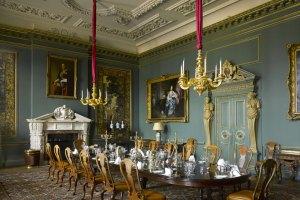 The Historic Houses Association (HHA) and Sotheby’s announced that the winning entry of their Restoration Award for 2010 — an award now in its third year — is Wilton House near Salisbury in Wiltshire. Wilton’s winning project is its spectacular private Dining Room, which is the centerpiece of an extensive programme of exceptional restoration projects at the house in recent years, which has also seen the Library, North Ante Library, Smoking Rooms, Cloisters, Gothic Hall, Inner Courtyard and North Forecourt brought back to their former glory. Three commendations are also announced by the HHA and Sotheby’s: Ballywalter Park in Newtownards, Northern Ireland; Thorpe Hall in Wycliffe, County Durham; and The Stables at Penpont in Brecon, Wales. The previous winners of the award were Markenfield Hall in Yorkshire and Chillington Hall in Staffordshire. . . .
William Herbert, the 18th Earl of Pembroke, inherited the title and the Wilton estate in 2005, since when – with the assistance of the Wilton House Trustees and the interior designer David Mlinaric – he has initiated an extensive programme of restoration projects. The overriding aim of all these projects has been to restore the parts of the house that it was felt had lost their historical integrity or which had been neglected during previous structural repairs. Both traditional and modern methods of restoration have been used and, wherever possible, the work has been undertaken by estate and local craftsmen.* Renovations undertaken, so far, include the Cloisters, the Gothic Hall, the Eastern and Western Cloister Oriel windows, the Courtyard, the Smoking Room, the Library and the North Forecourt, and works are still ongoing in other parts of the house. The sensitive revival of the spectacular private Dining Room forms the centerpiece of the extensive renovations on the estate to date.
For many years the Dining Room was used as a games room and general storage room but in 2008 the 18th Earl commenced the major restoration efforts to return it to its former glory. This work has taken local craftsmen many months to complete. The work undertaken:
- The walls were painted in a dark blueish green to match an existing paint sample and the ceiling and paneling mouldings in a stone colour, which were subsequently part-gilded by Hare & Humphreys.
- Two new caryatids were created from those in the Library by Coade Ltd, to stand either side of the doorway.
- Antiqued-looking glass panels were set between the windows on the north wall, and new metal radiator covers were made.
- The furnishings underwent major conservation work – two giltwood torcheres, three tapestries, the table, two large Reynolds portraits. Two new chandeliers were also made by Coade Ltd and subsequently gilded by Lord Pemboke’s sister.
- The walls were painted in a dark blueish green to match an existing paint sample
Discussing Wilton House’s winning entry, Edward Harley, President of the Historic Houses Association, states: ‘‘Lord Pembroke is to be congratulated on the superb restoration of these fine rooms, as well as the courtyards which form part of the setting of this great house, home of his family for over 450 years. Sensitively but dramatically restored, Wilton House has entered a new chapter in its long history. This great restoration project also reflects more widely the work being carried out by private owners throughout the country to preserve their historic properties. By attracting increasing numbers of visitors historic houses make a critical contribution to the economies of fragile rural areas.’’ . . .
Sino-French Relations in the Eighteenth & Ninteenth Centuries
From the museum’s website:
La Soie & le Canon, France-Chine (1700-1860)
Musée d’Histoire de Nantes, 26 June — 7 November 2010
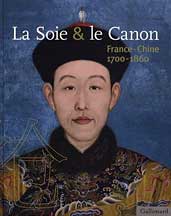
Catalogue ed. by Bertrand Guillet, ISBN: 9782070129492, $72.50
En octobre 1700, L’Amphitrite, premier navire français à commercer avec la Chine, revient en France et c’est à Nantes, grand port de commerce colonial, qu’il vend sa cargaison : thé, soie, porcelaine, nacre, ivoire, panneaux laqués… Cette première arrivée massive d’objets et produits nourrit une véritable fascination pour la culture chinoise. C’est ainsi que se développe en France « un goût pour la Chine » dont on a oublié l’ampleur. Il est alimenté par les Jésuites présents à la cour de Chine. L’Europe devient sinophile. Artistes et artisans produisent dans le goût chinois. Jusqu’à la fin du 18e siècle, ce commerce au volume marginal mais dont l’influence se révèle marquante, est dominé par les Chinois qui dictent leurs conditions aux Occidentaux. Ces derniers n’arrivent cependant pas à introduire en retour leurs produits commerciaux. La Chine attire de plus en plus les convoitises et peu à peu, « le mythe » s’écorne. Les guerres de l’Opium au 19e siècle, avec en point d’orgue le sac du Palais d’été à Pékin en 1860, achèvent la bascule du rapport économique au profit des Européens et participent au déclin de l’Empire du Milieu.
L’exposition La Soie & le Canon met en lumière les relations franco-chinoises entre ces deux dates – 1700/1860 – et montre l’évolution du regard porté sur cet Extrême-Orient lointain qui suscita tour à tour fascination et rejet, en s’appuyant sur la présentation d’objets et documents prestigieux prêtés par de grands musées dont le musée national des arts asiatiques Guimet, partenaire associé au projet. Avec cette exposition d’histoire, le musée d’histoire de Nantes propose une démarche inédite en montrant les différentes phases qui ont caractérisé dès l’origine les relations entre la France et la Chine. Plus largement, l’exposition contribue à faire mieux comprendre notre rapport à la Chine d’aujourd’hui, toujours fascinante, souvent critiquée, alors que s’amorce un nouvel équilibre mondial dans lequel ce géant qui rassemble un cinquième de l’humanité joue un rôle de premier plan.
Resource: ‘Treasure Hunt’ and the National Trust
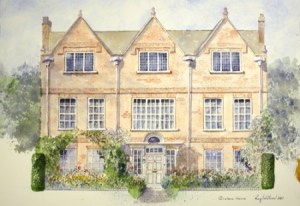
Quebec House, by Roy Willard. ©Estate of Roy Willard
As noted in previous postings, the blog format seems to lend itself nicely to acquisition news. Emile de Bruijn of the National Trust edits a terrific site for just such a purpose. Treasure Hunt regularly includes fascinating postings, often with information that one would be hard-pressed to find elsewhere (or at least hard-pressed to know one should look for such things anywhere). A recent posting, for instance, addresses Quebec House, in Westerham, Kent, “the childhood home of James Wolfe, who was born there in 1727 and spent the first 11 years of his life there.” As is often the case with historic properties, one faces the vexing dilemma of choosing a particular period to present over others: in this case, should the Trust go with the a newly-discovered 1630s scheme for the main bedroom or maintain the mid-eighteenth-century presentation that prevails throughout the rest of the house?
A number of recent postings also address Emile’s experience at this year’s Ashridge Garden History Summer School (30 July — 4 August). It looks like an amazing program.










 Enfilade
leave a comment