Exhibition: ‘Beyond Oberlin’
This collaborative installation at the Cleveland Museum of Art points to possibilities for cooperation between museums, technological opportunities for presenting works of art (not only is the website quite smart looking but the podcasts are wonderful), and — maybe most of all — remarkable pedagogical strategies. . .

Louis Jean François Lagrenée, "Sunset" (detail), 1772, Allen Memorial Art Museum, Oberlin College, Oberlin, Ohio
Beyond Oberlin: AMAM Paintings, Sculptures, and Miniatures at the Cleveland Museum of Art
January 2010–February 2011
Until early 2011, 14 works of art from the Allen Memorial Art Museum at Oberlin College will be integrated into the permanent collection galleries of the Cleveland Museum of Art on the upper level of the 1916 building. Surrounded by related works from the museum, the objects from Oberlin—European works of art from the late Renaissance to the early 1800s—are reinterpreted in a new context. The combinations sometimes build on strengths of the Cleveland collections and in other cases exemplify works not represented here, therefore broadening the story told in the museum’s galleries.
The interpretation stemmed from a spring 2010 course at Oberlin College taught by the installation’s co-organizers: Andria Derstine, the Allen Museum’s Curator of Collections and Curator of European & American Art; and Jon L. Seydl, the museum’s Paul J. and Edith Ingalls Vignos Jr. Curator of European Painting and Sculpture, 1500–1800.
The Oberlin students visited the museum to study the history and display of European art and to learn about the behind-the-scenes aspects of museum work, such as storage, conservation, art handling, installation, exhibition design, and publication. The students wrote the gallery labels, and they created podcasts and longer texts for the web sites of both museums.
Works included in the show, together with the student-generated texts and podcasts are available here»
From the June Issue of ‘Art History’
Camilla Smith, “Between Fantasy and Angst: Assessing the Subject and Meaning of Henry Fuseli’s Late Pornographic Drawings, 1800-25,” Art History 33 (June 2010): 420-47.
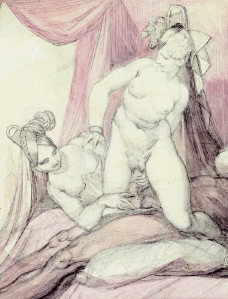 Abstract: This article examines four sexually violent drawing by Henry Fuseli, assessing how they functioned as personal fantasies and vehicles for institutional criticism It relates Fuseli’s images to the libertine fiction of Sade and London’s illicit underworld, arguing that the artist’s works can be located alongside growing libertine tendencies in a pan-European market. The exquisite dress, nudity, and physical power displayed by his protagonists, combined with pseudo-religious rituals of circumcision, reveal a complex relationship with institutional modes of control and regulation, developed during his ministerial training in Zurich. The restraints as a Royal Academician appear tantamount to the severity of Zurich’s seminary thirty years earlier, and both prove to be factors in shaping his illicit material. Fuseli’s pornographic drawings were not a public, rebellious descent into Sadean nihilism; rather, they exemplify a type of ‘revolt without revolt’ as remote, experimental products of a privileged individual only discovered after
his death in 1825.
Interdisciplinary MA Program in London
The following notice was recently submitted for the attention of Enfilade readers; there’s also a link to the King’s College program in the sidebar to the right, along with links to other useful eighteenth-century studies programs:

 A new MA in 18th-Century Studies, offered under the joint auspices of King’s and the British Museum, is proving very successful, drawing upon the skills of scholars from eight departments in the School of Humanities, alongside those of senior staff at the Museum. The eighteenth century is a vital component of the School of Humanities’ research and teaching.
The new MA consists of a core module, a dissertation and four modules chosen from a wide range of options, including ones taught by the Departments of English Language & Literature, History, Music, American Studies, Philosophy and German. The core module is taught in part by experts from the British Museum, and enables students to engage with the unique, diverse and rich collections of cultural institutions in central London, including the British Museum, the National Portrait Gallery, the Royal Society and the Hunterian Museum.
The core module explores constructions of the Enlightenment, then and now, through frameworks such as race, gender, class, intellectual networks and material culture, and invites students to analyse ideas, objects, texts and arts of the eighteenth century. We particularly welcome applicants who may continue to a PhD, and those looking to deepen their understanding of the eighteenth century through creative interdisciplinarity.
This degree is offered jointly with the British Museum; do visit the museum’s Enlightenment Gallery website.
What’s to Become of the Hôtel de la Marine?
With a 6.3€ million restoration completed, the question of the future of the Hôtel de la Marine in Paris has been brewing for over a year now (see, for instance, this March 2009 story in Le Figaro or this February 2009 piece in The Art Tribune). On Friday, The New York Times chimed in with the following report:
“Navy Buildings’s Next Tenant Has Paris Guessing,” by Steven Erlanger and Maïa de la Baume, The New York Times (6 August 2010)
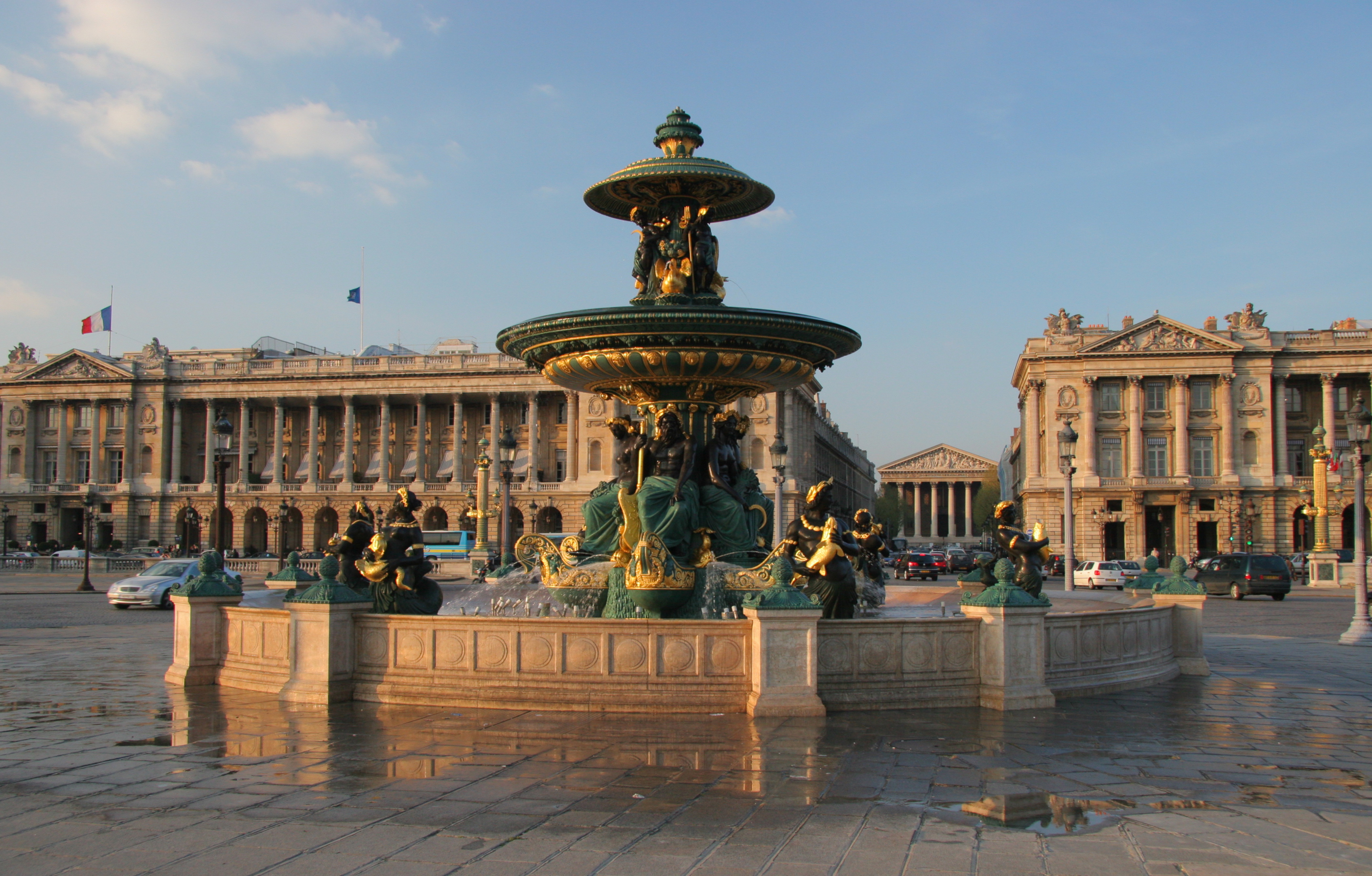
Place de la Concorde, Paris, Hôtel de la Marine to the right, photo by Tristan Nitot (Wikimedia Commons)
The building where Marie Antoinette’s death certificate was signed, and from whose balcony her execution by guillotine was witnessed, may soon be up for grabs. The building, the massive Hôtel de la Marine, sits on what is now the Place de la Concorde, one of the choicest and most expensive bits of land in Paris. It has been the operational headquarters of the French Navy and its top command since 1789, when revolutionary mobs pushed King Louis XVI from Versailles and forced him to Paris.
But France is building a modern military headquarters in southwest Paris, and the navy is expected to leave the Hôtel de la Marine by 2015. The old building’s fate has not been decided, and it has become something of a parlor game here to suggest uses for its 215,000 square feet and 553 rooms. “The navy has been here for 220 years,” said Olivier Laurens, 63, a vice admiral now working in the Department of Naval Heritage, escorting a reporter on a rare visit to the building. “There is nostalgia, of course. But we are greatly attached to this building and wish to see it preserved.”
The navy mattered even more in the 18th century than it does now, and Louis XVI’s minister of the navy found space in the building, which was then being used to store royal furnishings near the king’s Tuileries Palace. Designed by the royal architect Jacques-Ange Gabriel and constructed between 1757 and 1774 at the request of Louis XV, possibly for the dauphin, the Hôtel de la Marine is one of the jewels of 18th-century Paris. Much of it is largely untouched. Its splendid ceremonial rooms were recently restored for $9.5 million by the French industrial and construction group Bouygues. The work, which took more than two years and was finished in May 2009, included renovation of the columns of the facade, known widely as the Balcony of History, from which the executions of Marie Antoinette and Louis XVI were viewed. . . .
In an era of tight budgets, many plans and rumors of plans have been floated: for a museum of French history, a museum of decorative arts, a branch of the national library, an annex of the Louvre, a reception area for foreign dignitaries or even a center for human-rights organizations. . . .
For the full story, click here»
German Drawings in Washington
Press release from the National Gallery:
German Master Drawings from the Wolfgang Ratjen Collection, 1580-1900
National Gallery of Art, Washington D.C., 16 May — 28 November 2010
Curated by Andrew Robison, Senior Curator of Prints and Drawings, National Gallery of Art
 The National Gallery of Art, Washington, will present for the first time worldwide 120 stunning German watercolors and drawings from the Wolfgang Ratjen Collection—one of the finest private European holdings of old master drawings. On view in the Gallery’s West Building from May 16 to November 28, 2010, German Master Drawings from the Wolfgang Ratjen Collection, 1580–1900 will include rare and influential examples of German works on paper encompassing 16th-century mannerism, the 17th-century baroque, the 18th-century rococo, early 19th-century romanticism, and late 19th-century realism.
In 2007, the National Gallery of Art acquired 185 German and Italian works from the Ratjen Collection with the help of a dozen generous private donors as well as the Paul Mellon Fund and the Patrons’ Permanent Fund. Works included in the exhibition are by artists from Germany and German-speaking areas of Europe, German-born artists practicing abroad, and artists born in other areas who spent time working in Germany and adapting to German culture.
Organized chronologically throughout five rooms, the exhibition begins with outstanding early works by three of the most notable German mannerists: Friedrich Sustris (c. 1540–1599), living primarily in Munich; Hans von Aachen (1552–1615), working at the court of the Holy Roman Emperor Rudolf II in Prague; and Hans Rottenhammer (1564/1565–1625), living in Venice and Augsburg. Sustris’ sophisticated drawing An Elaborate Altar with the Resurrection of Christ and the Martyrdom of Saint Andrew (1570/1580) is one of the earliest Bavarian responses to Italian mannerist altars. Von Aachen’s The Madonna Enthroned with Saint John the Baptist and Saint John the Evangelist (1589), a sacra conversazione (devotional scene) produced soon after his return from Venice, was a favored Venetian motif at the time. Rottenhammer’s colorful watercolor Minerva and the Muses (c. 1610) is directly inspired by Tintoretto, whose work he studied in Venice.
From the baroque period, Adam Elsheimer (1578–1610), a favorite artist of both Rubens and Rembrandt, is represented by an extremely rare atmospheric gouache—Ceres Changes Stellio into a Lizard (1605/1608)—perhaps his finest work in the United States.
Ratjen especially pursued watercolors from the 18th century by the great painters—including Cosmas Damian Asam (1686–1739), Matthäus Günther (1705–1788), and Johann Baptist Enderle (1725–1798)—who filled Bavarian churches and palaces with elaborate rococo altarpieces and stunning ceiling frescoes. A remarkable series of Augsburg rococo drawings includes Johann Elias Ridinger’s (1698–1767) charming portrait of the first rhinoceros to come to northern Europe, endearingly nicknamed “Miss Clara” (1748).
Around the turn of the 18th century, German artists developed a particular fondness for nature, as represented here by an extensive series of luminous drawings and watercolors. Highlights include five evocative landscape watercolors by Johann Georg von Dillis (1759–1841) as well as Caspar David Friedrich’s (1774–1840) romantic masterpiece New Moon above the Riesengebirge Mountains (1810 or 1828/1835). (more…)
Anatomy and Art Theory in Washington
The Body Inside and Out: Anatomical Literature and Art Theory
Selections from the National Gallery of Art Library
National Gallery of Art, Washington D.C., July 24, 2010 — January 23, 2011
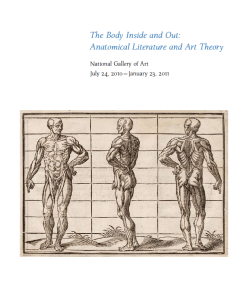
A PDF file of the exhibition brochure is available for download (click on the link at the left)
The humanist movement of the Renaissance introduced new realms of possibility in the arts and the sciences, including the study of anatomy. Many artists witnessed or participated in dissections to gain a better understanding of the proportions and systems of the body. Artists and physicians also worked together and formed partnerships—Leonardo and Marcantonio della Torre, Michelangelo and Realdo Columbo, and perhaps most famously, Titian and Andreas Vesalius—where the artist’s renderings of the anatomist’s findings were reproduced and dispersed to a scattered audience through the relatively recent innovation of print.
This exhibition, featuring outstanding examples of anatomy-related material from the collection of rare books in the National Gallery of Art Library, offers a glimpse into the ways anatomical studies were made available to and used by artists from the 16th to the early 19th century. On view are detailed treatises on human proportion and beauty by artists and scholars including Albrecht Dürer and Juan de Arfe y Villafane; drawing and painting manuals by Leonardo, Jean Cousin, and others, which include chapters on proportion and anatomy; and adaptations of anatomical treatises tailored to the needs of working artists by Roger de Piles and Johann Daniel Preissler, among others.
The exhibition brochure is available here»
Print Collecting in the Eighteenth Century: Richard Fitzwilliam
The founder of the Fitzwilliam Museum in Cambridge, Richard Fitzwilliam, 7th Viscount Fitzwilliam of Merrion (1745-1816) is the subject, or at least part of the subject, of this small exhibition of prints after Elsheimer:
Prized Possession: Lord Fitzwilliam’s Album of Prints after Adam Elsheimer
Fitzwilliam Museum, Cambridge, England, 25 May — 26 September 2010
 The second in the Hidden Depths exhibition series, this display will focus on one of Lord Fitzwilliam’s print albums, devoted entirely to prints made after paintings by Adam Elsheimer (1578-1610). The album, one of 198 bequeathed by Lord Fitzwilliam to Cambridge University in 1816, reveals the varied response by printmakers captivated by Elsheimer’s deployment of light and atmospheric rendering of nature. This exhibition will reconstruct the arrangement of the album, which was taken apart some time during the last century, and explore the allure of Elsheimer not only for printmakers, but for print collectors, in particular Lord Fitzwilliam himself.
German Enlightenment Portraiture: Art and Culture
Information on the following exhibition comes from the Gleimhaus Museum. For a scholarly point of entry into Wilhelm Ludwig Gleim’s “Temple of Friendship,” see Leah Hochman, “The Ugly Made Beautiful: Mendelssohn as Icon,” Journal of Modern Jewish Studies 5 (July 2006): 137–161. The museum itself is described here in a brochure describing the use of “EU Structural Funds for the City of Halberstadt”:
With the Enlightenment in the 18th century, Halberstadt experienced years of great intellectual activity. In 1747 the poet Johann Wilhelm Ludwig Gleim was appointed as cathedral secretary in Halberstadt, after years in the service of the Prussian King. Gleim knew all the important German-speaking authors of his time, and his house, his “temple of friendship” near the cathedral, was a meeting place for literary greats such as Johann Wolfgang von Goethe, Gotthold Ephraim Lessing, Johann Gottfried Herder, Johann Heinrich Voß, Friedrich Gottlieb Klopstock and Jean Paul. Today, Gleim’s house is Germany’s second-oldest museum of literature, and the poet’s extensive estate comprising letters, books and portraits makes it a cultural site of remembrance of national significance. . . .
◊ ◊ ◊ ◊ ◊
Von Mensch zu Mensch: Porträtkunst und Porträtkultur der Aufklärung
Gleimhaus Museum, Halberstadt, Germany, 29 August — 20 November 2010
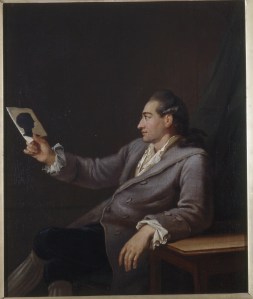 Jahrhunderte lang war das Porträt innerhalb der Kunst gering geschätzt worden, denn es strebte nicht nach Schönheit, sondern nur nach Ähnlichkeit. Diese Geringschätzung wandelte sich im Zeitalter der Aufklärung in ihr Gegenteil. Das Bildnis erlebte nun eine hohe Blüte, die gekennzeichnet war nicht etwa durch Prachtentfaltung, sondern durch die Konzentration auf das Gesicht. Der Mensch wurde als der nobelste Bildgegenstand bestimmt, das Gesicht konsequenter als je zuvor als Membran aufgefasst. Damit galt das Porträt nunmehr als Darstellung der Seele. Der Mensch zeigte sich nicht mehr nach seiner sozialen Geltung, sondern als Verstandes- und Gefühlsmensch. Das Bildnis war nicht mehr auf Autorität, sondern auf Sympathie angelegt. Bezeichnend hierfür ist, dass den meisten Porträts ein Lächeln ins Gesicht geschrieben steht.
Die Ausstellung Von Mensch zu Mensch. Porträtkunst und Porträtkultur der Aufklärung verzichtet auf das repräsentative und effektvolle Bildnis und beschränkt sich stattdessen weitgehend auf das Brustbild – wie bereits der Dichter und Sammler Johann Wilhelm Ludwig Gleim, der erklärte, nur Ritter lassen sich mit Sporen malen, bei Denkern genüge der Kopf. Gleim hat in seinem so genannten ‘Freundschaftstempel’ Bildnisse seiner Freunde und verdienter Zeitgenossen versammelt. Diese Sammlung – die größte Porträtsammlung der deutschen Geisteswelt des 18. Jahrhunderts – bietet ein Panorama der Porträtkunst der zweiten Hälfte des 18. Jahrhunderts. Zugleich steht mit der Person ein Exponat des innigen Umgangs des 18. Jahrhunderts mit dem Bildnis vor Augen – der Zwiesprache mit dem Porträt, des Küssens, Bekränzens und Sammelns des Bildnisses. Beides will die Ausstellung zeigen: Porträtkunst und Poträtkultur im Zeitalter der Aufklärung.
Der ‘Freundschaftstempel’ Gleims, dessen Wände mit Bildnissen dicht behängt sind, stellt selbst das zentrale Exponat der Ausstellung dar, die daher an keinem anderen Ort möglich wäre. Dieser Bestand wird ergänzt durch Meisterwerke der Porträtkunst aus bedeutenden Museen und Privatsammlungen.
Die Ausstellung lässt das Bildnis als allgegenwärtiges Medium der empfindsamen Kommunikation erkennbar werden, an das sich das ausgeprägte “sittlich-gesellige Interesse” dieser Epoche am Menschen (Goethe) knüpfte. Die Porträtkunst der Aufklärung weist mit ihren Qualitäten von Menschlichkeit und Zwischenmenschlichkeit allgemeingültige Werte auf, mit denen ihr heute noch – und gerade heute – besondere Geltung zukommt.
Zur Ausstellung erscheint ein Katalog mit Beiträgen von Helmut Börsch-Supan, Reimar F. Lacher und Doris Schumacher im Wallstein-Verlag, Göttingen. Die Ausstellung ist einer der zentralen Beiträge zu dem Themenjahr Menschenbilder des Museumsnetzwerkes Sachsen-Anhalt und das 18. Jahrhundert. Sie wird unterstützt vom Land Sachsen-Anhalt, von Lotto-Toto Sachsen-Anhalt und den ÖSA Versicherungen. Die Schau ist bis zum 20. November zu sehen.
Visiting London
From The New York Times Book Review (30 July 2010) . . .
Julie Flavell, When London Was Capital of America (New Haven: Yale University Press, 2010), ISBN: 9780300137392, $32.50.
Reviewed by Andrea Wulf
In the decades before the Declaration of Independence, thousands of American colonists visited London. Wealthy Southern plantation owners and New England merchants, husbands and wives, children and slaves all arrived in what was thought to be the most exciting city in the world. Some went shopping for exquisite silver, fashionable furniture and the latest books; others traded their goods and engaged in political arguments in noisy coffee houses. A sojourn in London was part of the education of the sons (and sometimes daughters) of wealthy colonial families because, as one contemporary observed, “more is learnt of mankind here in a month than can be in a year in any other part of the world.”
Julie Flavell’s “When London Was Capital of America” illuminates this fascinating chapter of London’s — and North America’s — past, showing how the metropolis functioned as a magnet for colonists from across the Atlantic (including the West Indies) who sought accomplishment, opportunity and commerce. An American-born scholar who is a fellow of the Royal Historical Society, Flavell has unearthed a host of stories that bring alive a previously neglected aspect of the colonial experience. . . .
The full review is available here»
Claremont Garden Lecture
Claremont Garden Lecture by Timothy Mowl
Claremont House, Esher (just outside of London), 5 September 2010

Timothy Mowl at Iford Manor (Photo by Jason Ingram)
Claremont Fan Court School is pleased to announce the inauguration of its Claremont Garden Lecture Series beginning with the opening lecture on Sunday afternoon, 5 September, in the School’s Mansion. Timothy Mowl, author and Professor of Architecture and Designed Landscapes at the University of Bristol, has accepted the invitation to deliver the opening address. This annual lecture series will provide access to the school’s portion of Claremont with Brown’s picturesque and sweeping park and to provide an historical context for this viewing through Prof. Mowl’s lecture. The Claremont Garden History Lecture series is being established as a forum for the discussion and promoting of garden history scholarship. Its goals include the presentation of the latest in academic research as well as the sharing of the private portion of the park and garden with the general public. The long term goal is to increase the public’s appreciation of designed landscapes and to better understand their original cultural context. The Open Day will start at 1 p.m. with the grounds and mansion open to the public. At 4:30 p.m. Prof. Mowl will present the inaugural lecture, followed by a question and answer session and book signing. Admission will be 10.00 GBP which includes access to the grounds,mansion and lecture.
Professor Timothy Mowl is a popular and prolific author and speaker, well known to both garden history scholars and the public. His ongoing project, Historic Gardens of England, supported by grants from the Leverhulme Trust, is modeled after Sir Nicolaus Pevsner’s Buildings of England. Upon completion, the nationwide project will present historic landscapes and gardens in separate texts, county by county. Ten books have been published to date. Prof. Mowl is an engaging speaker with a long-standing interest in the cultural context of designed landscapes – the people who designed and lived in what are now considered historic buildings and gardens.
Claremont Fan Court School is situated on grounds originally purchased by Sir John Vanbrugh for his own house and then developed by him for Thomas Pelham-Holles, the Duke of Newcastle. The Duke of Newcastle used Claremont as one of his principle residences from 1769 to 1774. He expanded the extent of the park and developed it extensively with Charles Bridgeman and William Kent. It was subsequently reshaped by Lancelot “Capability” Brown for Clive of India. During the 19th century, Claremont was the home of Princess Charlotte, Prince Leopold and Princess Victoria before she became Queen. Claremont remained a royal residence during most of the 19th century as a favorite of Queen Victoria’s. A portion of the original garden has been open to the public and owned by the National Trust since 1949, but the portion owned by the school has only occasionally been open to the public. Having a Grade 1 listed landscape that exhibits the successive work of Vanbrugh, Bridgeman, Kent and Brown is a resource that students of garden history, cultural geography and, in Claremont’s case, British royal history will find endlessly fascinating and informative.










 Enfilade
leave a comment