Exhibition: Secret Life of Drawings at The Getty
Of the thirty drawings included in the exhibition, six come from the eighteenth century. The show also addresses eighteenth-century restoration techniques. Press release from The Getty:
The Secret Life of Drawings
The Getty Center, Los Angeles, 23 November 2010 — 13 February 2011
Curated by Stephanie Schrader with Nancy Yocco
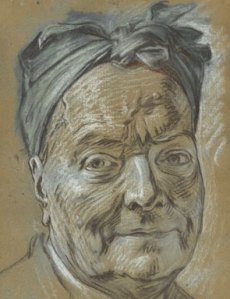
Maurice-Quentin de La Tour, "Portrait of Louis de Silvestre," black and white chalk, blue and rose pastel on faded blue paper, ca. 1753 (Los Angeles: The J. Paul Getty Museum)
Works on paper are inherently more fragile—in terms of sensitivity to light and handling—than mediums such as canvas, panel, bronze, or clay, and often show the passage of time more acutely than their counterparts. Frequent handling by artists in their workshops and later by collectors, combined with poor storage and display conditions, often leads to distracting damage. As a result of their fragility, drawings in the Getty Museum’s collection spend much of their life inside solander boxes in climate-controlled storage areas, where they’re protected from light, mold, insects, and other threats to their preservation; and, the fascinating “secrets”—of how they were made and displayed, damages they sustained, and treatments they were given—often go untold.
The Secret Life of Drawings brings together 30 drawings from the Getty’s stellar collection to explore the role played by paper conservators in reducing the effects of handling and the passage of time with treatments such as filling losses, reducing stains and mold, repairing tears, and treating white highlights that have turned black. The exhibition also reveals the secrets conservators discover, such as unknown drawings
hidden beneath mounts or watermarks that help authenticate the date of
the paper.
The Getty Museum has four conservation departments charged with the oversight and care of the collection: antiquities, paintings, paper, and sculpture & decorative arts. The Paper Conservation department cares specifically for the Getty’s collections of drawings, manuscripts, and photographs, whose materials share a common vulnerability to the environment: they are all highly reactive to changes in humidity, and tend to be light sensitive. In addition to examining and treating works on paper, the conservators also monitor how frequently the objects are on exhibition, and the light levels to which they’re exposed.
Nancy Yocco, associate curator of Paper Conservation, is responsible for the care of the drawings collection, which was begun in the early 1980s and consists of approximately 800 European drawings, ranging from preparatory sketches to highly-finished independent works of art. Yocco’s responsibilities include advising on the condition of potential acquisitions, examining loan objects, and preparing drawings for display. As such, she develops an intimate relationship with each of the objects and learns their “secrets” firsthand. Her wealth of knowledge acquired over the course of more than 70 treatments is the impetus and foundation for the Secret Life of Drawings exhibition.
Spanning the 15th to the 19th centuries, the 30 sheets in The Secret Life of Drawings will be showcased alongside pre-conservation photographs to convey the often-subtle differences that can be achieved with treatment. Present-day paper conservation differs from restoration of the 18th and 19th centuries; in general, today’s conservators work in subtler, less-invasive ways, using methods that are reversible. Rather than providing explicit information about conservation treatments, the exhibition demonstrates how a conservator’s respect for the original intent of the artist allows viewers to focus on the beauty of the design—not the damage.
Conservation is a fundamental responsibility of the J. Paul Getty Museum and an essential element of the Museum’s mission, which includes acquiring, conserving, exhibiting, and interpreting works of art. The 25 conservation professionals in the Museum’s four conservation departments support the Museum’s effort to exhibit and interpret the collections and to preserve them for the enjoyment and education of future generations.
Not only do Museum conservators preserve the collection, they help make works of art readable to visitors so that they see the art rather than any damage to it. As a result, most restorations are designed to be invisible to the naked eye. In some complicated instances, however, this may involve a balancing act, employing suggestive measures to make the work appear complete while not obscuring the visual difference between original work and restoration.
While no treatment is 100 percent reversible, Museum conservation staff come as close as possible to that standard. Since methods for cleaning, reassembly, and restoration are subject to periodic reevaluation because of technical innovations and changing values, it is important that work be reversible so as not to impede the efforts of future conservators.
◊ ◊ ◊ ◊ ◊
Course — Removing the Veil: Drawing Conservation at the Getty
Getty Research Institute Lecture Hall, 22 January 2011
Discuss conservation practices, get a behind-the-scenes tour of the Getty’s drawings conservation lab, and explore the exhibition The Secret Life of Drawings in this course. Nancy Yocco, associate conservator of drawings, the J. Paul Getty Museum and educator Alice C. Jackel will highlight the materials that form works of art and how they evolve over time. Course fee $20. Open to 25 participants.










 Enfilade
leave a comment