Research Grant Program for Using Princeton’s Library
Friends of the Princeton University Library Research Grant Program
Applications due by 15 January 2011
Each year, the Friends of the Princeton University Library offer short-term Library Research Grants to promote scholarly use of the library’s research collections. Up to $3,500 is available per award and last year the Friends made 22 awards totaling over $50,000. Applications will be considered for scholarly use of archives, manuscripts, rare books, and other rare and unique holdings of the Department of Rare Books and Special Collections, including Mudd Library; as well as rare books in Marquand Library of Art and Archaeology, and in the East Asian Library (Gest Collection). Special grants are awarded in several areas:
- the Program in Hellenic Studies supports a limited number of library fellowships in Hellenic studies
- the Cotsen Children’s Library supports research in its collection on aspects of children’s books
- the Maxwell Fund supports research on materials dealing with Portuguese-speaking cultures
- the Sid Lapidus ’59 Research Fund for Studies of the Age of Revolution and the Enlightenment in the Atlantic World covers work using materials pertinent to this topic.
For more information, or to apply, please visit the library’s website: www.princeton.edu/rbsc/fellowships/f_ships.html. The deadline to apply is January 15, 2011.
ASECS Graduate Student Paper Award
ASECS Graduate Student Research Paper Award for 2010
Submissions due by 1 January 2011
Highlighting pioneering research contributions of the next generation of scholars of eighteenth-century studies, this $200 award will recognize an outstanding research essay of 15-30 pages, which has not been previously published. Four (4) copies of the submission as well as a letter of endorsement from a mentoring professor, which outlines the originality and contributions that the essay makes to the field of eighteenth-century studies should be sent to: Byron R. Wells, Executive Director, ASECS, PO Box 7867, Wake Forest University, Winston-Salem, NC 27109. The deadline for applications is January 1, 2011 and the announcement of the winner will be made at the annual meeting.
We would also like to remind faculty members to encourage applications from their most gifted students for both the Graduate Student Research Paper Award and the Graduate Student Annual Conference Paper Award.
Exhibition: Secret Life of Drawings at The Getty
Of the thirty drawings included in the exhibition, six come from the eighteenth century. The show also addresses eighteenth-century restoration techniques. Press release from The Getty:
The Secret Life of Drawings
The Getty Center, Los Angeles, 23 November 2010 — 13 February 2011
Curated by Stephanie Schrader with Nancy Yocco
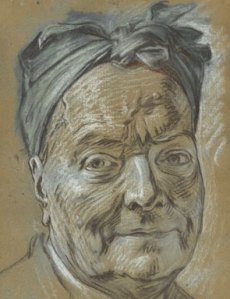
Maurice-Quentin de La Tour, "Portrait of Louis de Silvestre," black and white chalk, blue and rose pastel on faded blue paper, ca. 1753 (Los Angeles: The J. Paul Getty Museum)
Works on paper are inherently more fragile—in terms of sensitivity to light and handling—than mediums such as canvas, panel, bronze, or clay, and often show the passage of time more acutely than their counterparts. Frequent handling by artists in their workshops and later by collectors, combined with poor storage and display conditions, often leads to distracting damage. As a result of their fragility, drawings in the Getty Museum’s collection spend much of their life inside solander boxes in climate-controlled storage areas, where they’re protected from light, mold, insects, and other threats to their preservation; and, the fascinating “secrets”—of how they were made and displayed, damages they sustained, and treatments they were given—often go untold.
The Secret Life of Drawings brings together 30 drawings from the Getty’s stellar collection to explore the role played by paper conservators in reducing the effects of handling and the passage of time with treatments such as filling losses, reducing stains and mold, repairing tears, and treating white highlights that have turned black. The exhibition also reveals the secrets conservators discover, such as unknown drawings
hidden beneath mounts or watermarks that help authenticate the date of
the paper. (more…)
Fellowships at The Walpole Library
The Lewis Walpole Library Fellowships and Travel Grants for 2011-2012
The Lewis Walpole Library, Farmington, CT
Applications due by 18 January 2010
The Lewis Walpole Library, a department of Yale University Library, invites applications to its 2011-2012 fellowship and travel grant program. Located in Farmington, Connecticut, the Library offers short-term residential fellowships and travel grants to support research in the Library’s rich collections of eighteenth century—mainly British—materials, including important holdings of prints, drawings, manuscripts, rare books, and paintings, as well as a growing collection of sources for the study of New England Native Americans.
Scholars undertaking postdoctoral or equivalent research, and doctoral candidates at work on a dissertation, are encouraged to apply. Recipients are expected to be in residence at the Library, to be free of other significant professional obligations during their stay, and to focus their research on the Lewis Walpole Library’s collections. Fellows also have access to additional resources at Yale, including those in the Sterling Memorial Library, the Beinecke Rare Book and Manuscript Library, and the Yale Center for British Art. (more…)
CAA Registration — Last Week for Best Rates
Early Registration for CAA ends December 10.
The upcoming conference, taking place February 9–12, 2011, at the Hilton New York in midtown Manhattan, begins the celebration of CAA’s one-hundredth anniversary. Online registration is now open, and hotel reservations can be made. Register before the early deadline, December 10, to get the lowest rate and to ensure your place in the Directory of Attendees. You may also purchase tickets for special events, such as the reception at the Metropolitan Museum of Art following the presentation of the annual Awards for Distinction, as well as for professional-development workshops on a variety of topics for artists and scholars.
The CAA Annual Conference is the world’s largest international forum for professionals in the visual arts, offering more than two hundred stimulating sessions, panel discussions, roundtables, and meetings. CAA anticipates more than five thousand artists, art historians, students, curators, critics, educators, art administrators, and museum professionals to attend the Centennial event.
Call for Articles: ‘Hispanic Research Journal’
Hispanic Research Journal—Annual Visual Arts Issue
Submissions due by 15 January 2011
 Hispanic Research Journal promotes and disseminates research into the cultures of the Iberian Peninsula and Latin America, from the Middle Ages to the present day. The fields covered include literature and literary theory, cultural history and cultural studies, language and linguistics, and film and theatre studies. As of 2007, the journal was expanded to include one issue per year devoted to the visual arts of Iberia and Latin America, co-edited by ASHAHS and ARTES (Iberian and Latin American Visual Culture Group). Hispanic Research Journal publishes articles in four languages; Spanish, Portuguese, Catalan, and English, and encourages, especially through its features section, debate and interaction between researchers all over the world who are working in these fields.
The visual arts issue co-editors invite submissions for scholarly, refereed articles (up to 8,000 words) covering art, architecture, and design from the medieval period to the present in Iberia, and from the colonial era to the present in Latin America. Consult the Notes for Contributors guidelines at www.maney.co.uk/journals/notes/hispanic. For submissions and questions, please contact Kelly Donahue-Wallace (kwallace@unt.edu).
Dr. Kelly Donahue-Wallace
Associate Professor of Art History
Interdisciplinary Art and Design Studies Program Coordinator
University of North Texas
Ryskamp Collection to be Auctioned at Sotheby’s
Press release from Sotheby’s (23 November 2010) . . .
Property from the Collection of Charles Ryskamp
Old Masters Week at Sotheby’s, New York, 25 January 2011
 Sotheby’s will offer drawings, furniture and decorations from the private residences of museum director and art collector Charles Ryskamp on 25 January 2011, as a highlight of Old Masters Week in New York. Mr. Ryskamp served as Director of The Pierpont Morgan Library, now The Morgan Library & Museum, and the Frick Collection for a combined total of nearly 30 years, helping to make both institutions among the most prestigious museums in New York City. He began buying drawings at auction at age 13, and his collection has since been the subject of exhibitions at The Morgan Library & Museum and the Yale Center for British Art. Works from the sale will be on exhibition beginning 20 January, and are being sold for the primary benefit of Princeton University, where Mr. Ryskamp began his academic career.
Charles Ryskamp had an extraordinary impact on both the arts and society in New York City. He began teaching 18th-century British literature at Princeton in 1955, and simultaneously served as curator of English and American literature at the university’s library. These skills proved valuable when Mr. Ryskamp was appointed Director of The Pierpont Morgan Library in 1969. There, he oversaw several major donations and acquisitions that have helped make the Library one of New York’s most distinguished museums. Mr. Ryskamp was appointed Director of the Frick Collection in 1987, notably heading the institution’s first capital campaign that saved it from a potential closing.
Charles Ryskamp began collecting early, and quickly became enamored with drawings. A true intellectual, he educated himself in the print rooms of his favorite museums, with curators who would become his close friends. In his essay ‘‘Why I Collect,’’ Mr. Ryskamp notes: ‘‘As much as possible I have devoted my life to the appreciation, study, and teaching of art and literature; to those pursuits I must add, and with equal conviction, collecting . . . Collecting became a way of extending my knowledge. I bought works by uncommon artists and also uncommon works by celebrated draftsmen.”
Charles Ryksamp’s personal collections have been the subject of celebrated exhibitions: The Morgan Library & Museum exhibited The World Observed: Five Centuries of Drawings from the Collection of Charles Ryskamp in 2001, and the Yale Center for British Art presented Varieties of Romantic Experience: Drawings from the Collection of Charles Ryskamp in February 2010, a month before his death.
Sotheby’s New York sale of Property from the Collection of Charles Ryskamp features drawings from the 16th through mid-20th centuries that demonstrate his eye for both quality and aesthetic appeal. The works include a significant collection of English drawings, an extension of his expertise in British literature. The auction also includes furniture and decorations from Mr. Ryskamp’s private residences in both New York City and Princeton, New Jersey.
◊ ◊ ◊ ◊ ◊
Ryskamp’s essay “Why I Collect” is included in the catalogue for Varieties of Romantic Experience. A digital copy is accessible here»
Portrait Exhibition at The Clark
From The Clark:
Eye to Eye: European Portraits, 1450-1850
The Sterling and Francine Clark Art Institute, Williamstown, MA, 16 January — 27 March 2011
For centuries, portraiture has captured the imagination of artists and viewers, not to say the sitters themselves. What makes a successful portrait? An accurate likeness, an indication of the sitter’s character or social status, or simply a fabulously made work of art?
Eye to Eye explores these questions through the presentation of an extraordinary collection of master portraits, dating from the late fifteenth century to the early nineteenth century, and featuring little-known paintings by Memling, Cranach, Parmigianino, Ribera, Rubens, Van Dyck, Greuze, and David, among others. This exhibition will be shown exclusively at the Clark.
Fall of 2011: Stubbs at The Neue Pinakothek
From the museum’s website:
George Stubbs
Neue Pinakothek, Munich, 15 October 2011 — 15 January 2012
The English animal painter George Stubbs (1724-1806) is the most prominent representative of so-called ‘sporting art’ that reached its peak in the 18th century as a result of the growing enthusiasm for horse breeding, racing and hunting, as an occupation for the prosperous upper classes. His work largely comprises portraits of thoroughbreds and their jockeys, of dogs and hunting scenes. With his subtly balanced and sometimes bold compositions Stubbs developed a classical style using subjects derived entirely from contemporary life.
In the Anglo-Saxon world, George Stubbs has long been regarded as one of the greatest artists of his time and, alongside William Hogarth and Thomas Gainsborough, as the most important artist of the 18th century. The Neue Pinakothek, which has a first-rate collection of English painting from the 18th and 19th centuries and boasts the only painting by George Stubbs in Germany, is staging the first exhibition on this artist to be held on the Continent. A selection of thirty paintings, mostly from collections in England, will be complemented by drawings and prints that underline the artist’s far-reaching influence in the field of animal painting in France and Germany.
Major Painting by Stubbs at Auction on December 8
Brood Mares and Foals goes on view in London on December 3. From a Sotheby’s press release (4 October 2010)
Old Master & British Paintings Evening Sale (L10036)
Sotheby’s, London, 8 December 2010
Lot 45 (fully entry available as a PDF file here)
Of all Stubbs’ groups of Mares and Foals, this is the noblest composition, its grandeur owing much to the towering rocky formation which seems to lend an air of hardiness to the animals, as well as acting as counterweight to the most spectacular figure in the group, the grey Arabian mare with her flowing tail.
-Judy Egerton, George Stubbs: Painter, Catalogue Raisonné (Paul Mellon Centre for Studies in British Art, 2007)
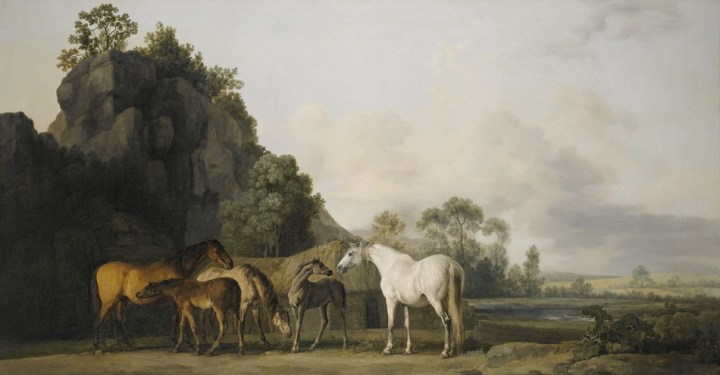
George Stubbs, Brood Mares and Foals, oil on canvas, estimate: £10-15 million, 100 x 187cm. Photo: Sotheby’s
On Wednesday, December 8, 2010, Sotheby’s London will present for sale arguably the finest painting by the British master George Stubbs (1724-1806) ever to come to the market: Brood Mares and Foals, estimated at £10-15 million. Painted in 1767, at the height of the artist’s career, the mares and foals scene is a superlative example of Stubbs’s talents as both a horse and landscape painter. Never before offered for sale, the painting has remained in a distinguished family collection for all of its life to date and its appearance at auction therefore represents an exceptionally rare opportunity for both equestrian and British art collectors alike.
The painting was probably commissioned by Colonel George Lane Parker, the second son of George Parker — the second Earl of Macclesfield of Shirburn Castle, Oxfordshire — and an important owner of Stubbs’s work. It then passed to Thomas Parker, the third Earl of Macclesfield, whose descendant now offers it for sale. Stubbs produced the distinctive group of compositions of mares and foals exclusively for his most important patrons during the early part of the 1760s; they all admired the exquisite accuracy and attention to detail of his work. These leading aristocratic patrons included Frederick St John, 2nd Viscount Bolingbroke; Charles Watson-Wentworth, 2nd Marquess of Rockingham; Augustus Henry Fitzroy, 3rd Duke of Grafton; George Brodrick, 3rd Viscount Midleton MP; Lord Grosvenor and the Duke of Cumberland.
A relatively unknown and unseen painting, Brood Mares and Foals has only been exhibited once since the eighteenth century. It was first shown at the Society of Artists in the Spring of 1768 and then again in the autumn of that year in a special exhibition to honour a visit by the King of Denmark. The painting was then carefully and privately preserved in the Earl of Macclefield’s family collection for the next 237 years, until it was part of the celebrated Stubbs and the Horse exhibition at the National Gallery in London in 2005, which also travelled to the Kimbell Museum in Texas. (more…)










 Enfilade
leave a comment