Exhibition: Baroque Ivory at the Court of Vienna
From the Liebieghaus Skulpturensammlung:
Ivory: Baroque Splendor at the Viennese Court / Elfenbein: Barocke Pracht am Wiener Hof
Liebieghaus Skulpturensammlung, Frankfurt am Main, 3 February — 26 June 2011
Curated by Maraike Bückling and Sabine Haag

Ignaz Bendl (1682–1730) "Medaillon commemorating the erection of the mercy columm," ca. 1692
Ivory has been one of the most popular materials since ancient times. Its origins in unknown faraway lands and its rarity account for its costliness. It was particularly the Baroque era that had an extraordinarily high demand for ivory. In the seventeenth century, ivory work reached its culmination in Vienna in the days of Prince Karl Eusebius of Liechtenstein and Emperor Leopold I. The shimmering appearance of the polished material served princely-imperial claims to prestige, as its possession testified to its owners’ power and wealth. The exhibition Ivory: Baroque Splendor at the Court of Vienna, presented in the Liebieghaus Skulpturensammlung from February 3 to June 26, 2011, will focus on this heyday of ivory art. It will feature thirty-six splendid, virtuoso carvings impressively documenting the artisans’ great skill, among them masterly executed statuettes, pitchers, goblets, tankards, and bowls of ivory, objects created for display in so-called cabinets of curiosities and not intended for any practical use. The show comprises works by the most famous ivory artists of the Baroque period, such as Adam Lenckhardt, Johann Caspar Schenck, and Matthias Steinl. It was prepared together with the Kunsthistorisches Museum in Vienna, whose world-renowned Cabinet of Wonders is closed for the time being because of comprehensive restoration measures. This presented the Liebieghaus with the unique opportunity to show a high-caliber selection of masterpieces from the Kunstkammer of the Kunsthistorisches Museum in Frankfurt before the items will be on display again on a permanent basis in Vienna after the Cabinet’s reopening in late 2012. Eight additional high-carat loans come from the Reiner Winkler Collection.

Matthias Steinl (1643/44–1727) "Allegory of the Elements of Water and Air," ca. 1688
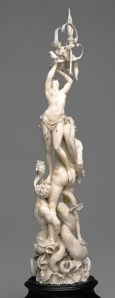
Matthias Steinl (1643/44–1727) "Allegory of the Elements of Water and Air," ca. 1688
In Ancient Greece, Phidias already created large statues of gods whose skin was executed in ivory, and the Bible describes Solomon’s throne as made up of ivory parts. It was above all in the Middle Ages and in the Baroque era that ivory was held in high esteem as a material. The great demand finally resulted in the emergence of new ports of entry in the seventeenth century; both the East India Company and the West India Company furthered the transport of African ivory in particular. The concentration on necessarily small-format ivory works fit in well with the fact that there were hardly any or no commissions at all conferred for large-size church or palace interiors during the Thirty Years’ War and the plague epidemics. Sculptors and their clients increasingly or entirely dedicated themselves to small mobile sculptures.
In the Renaissance and Mannerist periods, bronze was preferred for small sculptures. Yet, ivory outstripped the material in the course of the seventeenth century. People appreciated its combination of elasticity and hardness, as well as its gleaming transparency and delicate veining resembling the tone of flesh. The heyday of the production of ivory works in the seventeenth century was based on sixteenthcentury ivory turnery, on such early examples as those by the Master of the Furies. Besides the major bourgeois towns, the secular and ecclesiastical capitals became centers of ivory production from about 1650 on – a development that did not come to an end before the early eighteenth century. Ivory carvers were to be found mainly in Munich and Augsburg, but also in Schwäbisch Hall, Ulm, Mechlin, Amsterdam, Dresden, and Düsseldorf. (more…)










 Enfilade
leave a comment