Exhibition: Bronze Sculpture in Minneapolis
Notwithstanding the show’s title, there are significant eighteenth-century works included (the ‘long Baroque’). Press release from the MIA:
Beauty and Power: Renaissance and Baroque Bronzes from the Peter Marino Collection
The Wallace Collection, London, 29 April — 25 July 2010
The Huntington Library, San Marino, CA, 9 October 2010 — 24 January 2011
Minneapolis Institute of Arts, 6 February — 15 May 2011
Curated by Jeremy Warren
 An important international exhibition, Beauty and Power: Renaissance and Baroque Bronzes from the Peter Marino Collection opens at the Minneapolis Institute of Arts (MIA) February 6 and runs through May 15. Additionally, the MIA is presenting Lost Wax, Found Sculpture, an exhibition that explains the technique of making bronze sculpture according to the historically popular technique of lost-wax casting.
Beauty and Power is selected from Marino’s unparalleled private collection of 16th- to 18th-century Italian and French bronzes, and contains many pieces never publicly displayed before the show debuted in early 2010 at the Wallace Collection in London. It comes to the MIA from its only other U.S. venue, the Huntington Library, Art Collections and Botanical Gardens in San Marino, California.
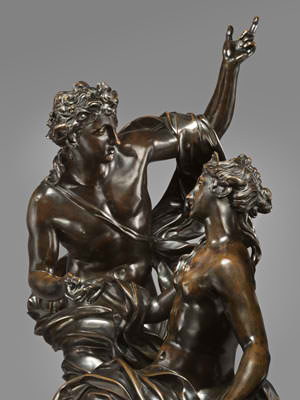
Corneille van Clève (1646-1732), "Bacchus and Ariadne," bronze, ca. 1703-04
“The MIA is fortunate to be able to show more about thirty bronzes statuettes from Mr. Marino’s exemplary collection that spans the golden age of the art form,” said Eike Schmidt, the James Ford Bell curator of Decorative Art and Sculpture at the MIA. “For three-and-a-half months we are the beneficiaries of his two-decade quest to assemble one of the strongest compilations of Renaissance and Baroque small bronzes in the nation.”
Beauty and Power coincides with and complements three other important MIA exhibitions from the same time period: Titian and the Golden Age of Venetian Paintings: Masterpieces from the National Galleries of Scotland, Venice on Paper, and The Mourners: Tomb Sculptures form the Court of Burgundy. . . .
Bronze statuettes became a serious art form in Renaissance Italy when interest in ancient Rome and Roman bronze-casting was revived, often using themes inspired by Greek and Roman mythology. Bronze has always been valued for its surface and molten qualities, which create complex and satisfying sculptural forms full of sensuality and emotion. Created on a scale that made them easy to collect and display, these bronzes were in demand, and sculptors across Europe created them to showcase their abilities. Included in the show are such works as the powerfully violent Samson and the Philistine (c. 1550–60), attributed to Baccio Bandinelli; the atypical depiction of an at-peace Diana (c. 1720–40) by Antonio Montauti; and Corneille van Cleve’s masterpiece Bacchus and Ariadne (c. 1703–4), showing the romantic encounter between the abandoned goddess and her rescuer. It also includes Florentine sculptor Giovanni Battista Foggini’s heroic David and Goliath (c. 1722), Ferdinando Tacca’s touching Hercules and Iole (c. 1640–50), and Robert Le Lorrain’s symbolically portrayed Andromeda (c. 1695–1700). (more…)










 Enfilade
leave a comment