Exhibition: Four Hundred Years of French Drawings
Press release from The Frick in Pittsburgh:
Storied Past: Four Centuries of French Drawings from the Blanton Museum of Art
The Frick Art & Historical Center, Pittsburgh, 5 February — 17 April 2011
Blanton Museum of Art, The University of Texas, Austin, 18 September — 31 December 2011
Iris and B. Gerald Cantor Center for Visual Arts, Stanford University, 28 May — 24 August 2014
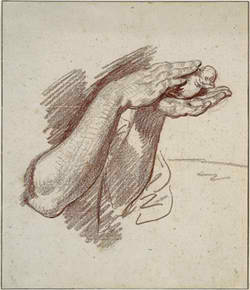
Jean-Baptiste Greuze, "The Arms of a Girl Holding a Bird," red chalk on cream paper, ca. 1765 (Austin: Blanton Museum of Art, The University of Texas)
Composed of 56 drawings made between 1500 and 1900, this exhibition chronicles the full range of artistic uses of the medium, from quick sketches to finished compositional studies, to drawing as an end in itself. The Blanton Museum at the University of Texas at Austin has organized the exhibition from their permanent collection, which was supplemented a bit more than a decade ago by a large gift of drawings. The French drawings from this gift had not received systematic academic study, nor had most of them been published. Especially rich in 17th- and 18th-century drawings, the exhibition illustrates the rise to dominance of the Académie royale de peinture et de sculpture as one of the most dominant cultural and political institutions in Europe. The exhibition includes works by François Boucher (1703–1770), Jean-Baptiste Greuze (1725–1805), and Nicolas Lancret (1690–1743), among others, with the nineteenth century represented by choice sheets from François-Marius Granet (1777–1849), Théodore Rousseau (1812–1867), Jean Forain (1852–1931), Théophile-Alexandre Steinlen (1859–1923), and others who reflect shifts in the approach to drawing
in the modern era.

Exhibition catalogue, ISBN: 9781555953560, $65
At the Frick, the exhibition will find a perfect counterpart in the museum’s permanent collection, which visitors will enter as they exit the traveling drawings show. Paintings by Jean-Marc Nattier (1685–1766), Lancret (1690–1743), Jean-Baptiste Pater (1695–1736), Boucher, Hubert Robert (1733–1808), and Nicolas-Bernard Lepicié (1735–1784), will be displayed with examples of decorative arts from the period, which will provide for a richer understanding of the 18th century in particular. . . .
The exhibition begins in a period of transition from the mannerism of the late Renaissance to the Baroque period. Two sheets showing designs for a powder flask made by an artist associated with the School of Fontainebleau show the sophisticated sense of decoration that prevailed among artists working around the court of Francis I. Two drawings attributed to seminal printmaker Jacques Callot (1592–1635) and his circle date to the period he spent in Florence, and show his interest in melding his observations of life around him into his expressive and inventive finished compositions. The fluid chalk Study of a Man with a Turban, c. 1617, attributed to Callot, is characteristic of his elegant figures and displays a masterful ability at controlling light and shade and swiftly capturing the spirit of a figure, as well as its contours. (more…)










 Enfilade
1 comment