New Blog for French Art History
A warm welcome to a new digital resource detailing art history books, news, and opportunities, especially in the francophone world: Le Blog de l’APAHAU (Association des Professeurs d’Archéologie et d’Histoire de l’Art des Universités). The site launched late last year and is already brimming with useful information. As announced in a posting from December 2:

Bienvenue sur le nouveau blog de l’APAHAU, un forum d’information, de discussion et de réflexion sur l’enseignement et la recherche en histoire de l’art et archéologie. Ce blog est encore en cours de constitution, et certains points doivent être perfectionnés, aussi en bénéficiant de vos conseils. Mais vous êtes invités à réagir et proposer des articles. Un tutoriel vous indiquant comment y proposer des articles est mis en ligne, et son fonctionnement est très simple. . . Bonne lecture, en vous souhaitant une active participation.
Exhibition: Bronze Sculpture in Minneapolis
Notwithstanding the show’s title, there are significant eighteenth-century works included (the ‘long Baroque’). Press release from the MIA:
Beauty and Power: Renaissance and Baroque Bronzes from the Peter Marino Collection
The Wallace Collection, London, 29 April — 25 July 2010
The Huntington Library, San Marino, CA, 9 October 2010 — 24 January 2011
Minneapolis Institute of Arts, 6 February — 15 May 2011
Curated by Jeremy Warren
 An important international exhibition, Beauty and Power: Renaissance and Baroque Bronzes from the Peter Marino Collection opens at the Minneapolis Institute of Arts (MIA) February 6 and runs through May 15. Additionally, the MIA is presenting Lost Wax, Found Sculpture, an exhibition that explains the technique of making bronze sculpture according to the historically popular technique of lost-wax casting.
Beauty and Power is selected from Marino’s unparalleled private collection of 16th- to 18th-century Italian and French bronzes, and contains many pieces never publicly displayed before the show debuted in early 2010 at the Wallace Collection in London. It comes to the MIA from its only other U.S. venue, the Huntington Library, Art Collections and Botanical Gardens in San Marino, California.
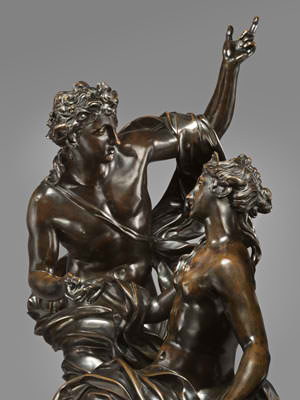
Corneille van Clève (1646-1732), "Bacchus and Ariadne," bronze, ca. 1703-04
“The MIA is fortunate to be able to show more about thirty bronzes statuettes from Mr. Marino’s exemplary collection that spans the golden age of the art form,” said Eike Schmidt, the James Ford Bell curator of Decorative Art and Sculpture at the MIA. “For three-and-a-half months we are the beneficiaries of his two-decade quest to assemble one of the strongest compilations of Renaissance and Baroque small bronzes in the nation.”
Beauty and Power coincides with and complements three other important MIA exhibitions from the same time period: Titian and the Golden Age of Venetian Paintings: Masterpieces from the National Galleries of Scotland, Venice on Paper, and The Mourners: Tomb Sculptures form the Court of Burgundy. . . .
Bronze statuettes became a serious art form in Renaissance Italy when interest in ancient Rome and Roman bronze-casting was revived, often using themes inspired by Greek and Roman mythology. Bronze has always been valued for its surface and molten qualities, which create complex and satisfying sculptural forms full of sensuality and emotion. Created on a scale that made them easy to collect and display, these bronzes were in demand, and sculptors across Europe created them to showcase their abilities. Included in the show are such works as the powerfully violent Samson and the Philistine (c. 1550–60), attributed to Baccio Bandinelli; the atypical depiction of an at-peace Diana (c. 1720–40) by Antonio Montauti; and Corneille van Cleve’s masterpiece Bacchus and Ariadne (c. 1703–4), showing the romantic encounter between the abandoned goddess and her rescuer. It also includes Florentine sculptor Giovanni Battista Foggini’s heroic David and Goliath (c. 1722), Ferdinando Tacca’s touching Hercules and Iole (c. 1640–50), and Robert Le Lorrain’s symbolically portrayed Andromeda (c. 1695–1700). (more…)
New Title: Michael Yonan on Empress Maria Theresa
From Penn State UP:
Michael Yonan, Empress Maria Theresa and the Politics of Habsburg Imperial Art (University Park, PA: Penn State University Press, 2011), 240 pages, ISBN 9780271037226, $89.95.
 Between 1740 and 1780, Empress Maria Theresa governed the Habsburg Empire, a multilingual conglomeration of states centered on Austria. Although recent historical scholarship has addressed Maria Theresa’s legacy, she remains entirely absent from art history despite her notable role in shaping eighteenth-century European diplomatic, artistic, and cultural developments. In Empress Maria Theresa and the Politics of Habsburg Imperial Art, Michael Yonan explores the role that material culture—paintings, architecture, porcelain, garden sculpture, and decorative objects—played in forming the monarchical identity of this historically prominent woman ruler.
Maria Theresa never obtained her power from men, but rather inherited it directly through birthright. In the art and architecture she commissioned, as well as the objects she incorporated into court life, she redefined visually the idea of a sovereign monarch to make strong claims for her divine right to rule and for hereditary continuity, but also allowed for flexibility among multiple and conflicting social roles. Through an examination of Maria Theresa’s patronage, Michael Yonan demonstrates how women, art, and power interrelated in an unusual historical situation in which power was legitimated in women’s terms.
Addition information is available here»
Exhibition: The Farnese Palace
Crucial for Roman culture in the sixteenth and seventeenth centuries, the Farnese Palace and its collections were also important for eighteenth-century artists and connoisseurs. Upon the death of Antonio Farnese in 1731, the family line came to an end, and the building passed to the Bourbons (hence the subsequent relocation of the collection to Naples). The current exhibition provides an extraordinary opportunity to view the building’s interior and some of the most important objects from the Farnese collection in their early modern setting. From www.france.fr . . .
The Farnese Palace: From the Renaissance to the French Embassy
Farnese Palace, Rome, 17 December 2010 — 27 April 2011

Giuseppe Vasi,"Palazzo Farnese," mid-eighteenth century
For this exhibition, the Farnese collection (the “Museum Farnesianum”) will return to its original premises. For the first time in centuries, the historic rooms of the emperors and philosophers will be recreated and the famous Dacian Prisoners will resume their place beside the door of the Grand Salon. The return of these exceptional works to “their” palace was made possible by the generous loan from the National Archaeological Museum in Naples. The Palace courtyard will be home to the monumental statue of Apollo Citharoedus made of porphyry and marble, known as Roma triumphans at the time, and will be filled virtually with the imposing silhouettes of the Farnese Hercules and the Latin Hercules, but also the Farnese Bull. Among the most important pieces of furniture are the Farnese cabinet from Ecouen Museum, a precious item of furniture from the Renaissance made by Flaminio Boulanger to contain the collection of coins, intaglios and meats of the Farneses. Tapestries from Quirinal, on loan from the President of the Republic of Italy and Chambord Castle, will be returned to the salons of the “noble floor,” as will Renaissance ceramics.
The collection of preparatory drawings by Annibale Carracci, coming from the Louvre Museum in particular, and the frescoes of the Fava Palace in Bologna will illustrate the creation of the famous Carracci Gallery. The opulent collection of paintings will return to the Northeast Gallery. The Portrait of Pope Paul III by Titian, Christ and the Canaanite Woman painted by Annibale Carracci for the private chapel of Cardinal Odoardo Farnese, works by Sebastiano del Piombo, the Carracci and Greco will all testify to the quality of the spectacular Farnese collection. Most of the aforementioned paintings come from the Capodimonte National Museum in Naples along with the galleries in Parma and Bologna.
This exceptional exhibition is a unique occasion for the public to rediscover the splendours of the Pomp of the Farneses. It will enable them to relive the intertwined histories of the popes, cardinals, kings, ambassadors and artists who, for five centuries, lived and came together at the Farnese Palace, helping to make it an exceptional place.
New Title: ‘Jean de Jullienne’
Isabelle Tillerot, Jean de Jullienne et les collectionneurs de son temps (Paris: Editions Maison des Sciences de L’homme, 2011), 510 pages, ISBN: 9782735112531, €48.
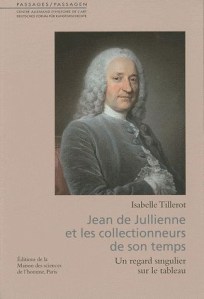 Fils d’un marchand de draps que rien ne prédisposait à devenir l’une des figures emblématiques de son époque, Jean de Jullienne (1686-1766) occupe une place à part dans le monde des collectionneurs au XVIIIe siècle. Si sa collection, riche de près de cinq cents tableaux, rassemble, parmi des peintres des écoles nordique, française et italienne, des noms comme ceux de Poussin, Rembrandt ou Titien, elle se distingue de celles de la comtesse de Verrue, du prince de Carignan ou d’autres grands collectionneurs de son temps par le fait qu’elle accorde aux peintres vivants un statut nouveau. Selon Mariette, Jullienne posséda un temps presque tous les tableaux de Watteau. Entreprise unique au XVIIIe siècle, il fait graver son œuvre peint et dessiné. Au-delà du choix des tableaux, Jullienne apporte un soin tout particulier à l’accrochage. Tournant le dos à la mode des galeries richement décorées où les peintures ne sont que des ornements parmi d’autres, il fait construire dans sa mai son des Gobelins une galerie aux murs nus où le tableau règne en maître. Le catalogue illustré de son cabinet, document
inédit, témoigne de ce nouveau regard et permet de récuser l’idée d’une collection
immuable.
L’histoire de Jullienne est en effet celle d’un homme qui, s’il ne cesse d’aimer Watteau, continue d’aimer la peinture après lui et fait entrer jusqu’à la fin de sa vie de nouvelles œuvres dans sa collection, privilégiant les beautés des tableaux par rapport à leur ancienneté. Fait sans précédent, sa collection est dispersée au Louvre après sa mort. Amateur? Connaisseur? Isabelle Tillerot interroge ces notions essentielles au XVIIIe siècle et montre comment Jullienne, au travers d’un savoir acquis et ressenti, parvient au statut de paradigme du collectionneur.
◊ ◊ ◊ ◊ ◊
Note (added 8 August 2011): A review of the book by David Pullins for Enfilade is available here»
Exhibition: ‘Caring for William Hunter’s Prints’
From the Hunterian:
Past, Present and Future: Caring for William Hunter’s Prints
Hunterian Art Gallery, Glasgow, 2 October 2010 — 21 June 2011

"Portraits de Nanteuil" volumes 1 & 2
This new display highlights a current Hunterian project on the Hunter volumes of prints. They consist largely of portraits of past celebrities and prints of paintings and drawings by Old Masters, including Leonardo da Vinci, Raphael and Rembrandt. An award from Museums Galleries Scotland has enabled conservation of some of the volumes, the cataloguing and digitizing of all and a research program carried out in collaboration with the University’s History of Art department.
Joanne Orr, CEO of Museums Galleries Scotland, said: “Museums Galleries Scotland investment to Scotland’s Recognised Collections of National Significance aims to enhance the overall visitor experience. Providing new opportunities to explore and enjoy Scotland’s top collections is a key focus and this exhibition is a excellent example of how this is happening. What goes on behind the scenes is as important as what visitors see ‘on stage’ when they arrive – this is a rare chance to get up close and personal to the fascinating work of curators.”
This work has provided valuable new information on Hunter’s motivations for collecting such volumes and on his close relationships with leading contemporary artists.
Call for Papers: Feminist Art History Conference in DC
Second Annual Feminist Art History Conference
American University, Washington D.C., 4-5 November 2011
Proposals due by 15 May 2011
Keynote: Mary Sheriff, Professor, Art History, University of North Carolina-Chapel Hill
Please submit one-page single-spaced proposals on any topic of feminist interest in art history and/or visual studies with a 2-page curriculum vita by May 15, 2011. Accepted proposals will be notified by June 15, 2011. Please email proposals and CVs to bellow@american.edu; nbroude@american.edu; butler@american.edu; mgarrar@american.edu; kunimoto@american.edu; hlanga@american.edu.
Sponsored by the Art History Program, Department of Art, College of Arts and Sciences at American University
Organizing committee: Kathe Albrecht, Juliet Bellow, Norma Broude, Kim Butler, Mary D. Garrard, Namiko Kunimoto, and Helen Langa
Exhibition: Canaletto in Washington
Venice: Canaletto and His Rivals
National Gallery, London, 13 October 2010 — 16 January 2011
National Gallery, Washington D.C., 20 February — 30 May 2011

Canaletto, "The Square of Saint Mark's, Venice," 1742/1744 (DC: National Gallery, Gift of Mrs. Barbara Hutton 1945.15.3)
As the Canaletto exhibition opens in Washington, it will be introduced with a lecture by Charles Beddington (guest curator) and David Alan Brown (curator of Italian and Spanish paintings, National Gallery of Art). The show runs through the end of May.
Additional information is available here»
Book Review: ‘Thomas Roberts’ Catalogue
From the February issue of Apollo Magazine:
William Laffa and Brendan Rooney, Thomas Roberts (1748-1777): Landscape and Patronage in Eighteenth-Century Ireland, exhibition catalogue (Tralee: Churchill House Press for the National Gallery of Ireland, 2009), 416 pages, ISBN: 9780955024634, $110.
Reviewed by Toby Barnard, Hertford College, Oxford University; posted 1 February 2011.
Thomas Roberts (1748–77) blazed briefly across the Irish skies in the 1770s. Little in Irish painting before that decade prepared for his sudden appearance on the scene. At that time in 18th-century Ireland, the techniques and subjects of Claude, Poussin and Salvator Rosa appealed to artists and collectors alike. A succession of painters – Willem van der Hagen, Robert Carver, John Lewis and Joseph Tudor – assimilated the conventions and demands of pastoral landscape painting, and created decorative but generalised images. Roberts, in contrast, applied these classical dressings to recognisable Irish scenes. The results, seen in a revelatory exhibition at the National Gallery in Dublin in 2009, encompass the mansions and demesnes of Protestant grandees and remoter views of the west, notably the modest townships of Ballyshannon and Belleek. . . .
The full review is available here»
Exhibition: ‘Georgian Faces’ of Dorset Couny
Press release from the Dorset County Museum:
Georgian Faces: Portrait of a County
Dorset County Museum, Dorchester, 15 January — 30 April 2011
Curated by Gwen Yarker

William Hogarth, "Portrait of Thomas Coombes, a Dorset Boatman Aged 108," 1742
Georgian Faces: Portrait of a County includes over sixty, mostly previously unseen, portraits of the people who shaped Dorset during the eighteenth century. The catalyst for the exhibition was provided by the Museum’s recent acquisition of George Romney’s Portrait of the Reverend Thomas Rackett as a Young Boy, a purchase made possible by the generosity of the Art Fund, HLF South West and local support. For the past year, curator Gwen Yarker (formerly of the National Maritime Museum) has been selecting portraits for the exhibition from all over Dorset and further afield. Some paintings are on loan from national institutions, but the majority have come from private collections. The exhibition shows portraits by many of the important portrait artists of the eighteenth century, including Sir Joshua Reynolds, George Romney, Thomas Gainsborough and Allan Ramsay. The exhibition also throws a spotlight on Thomas Beach, who was born at Milton Abbas, Dorset, trained with Reynolds and worked as a portrait painter in London, Bath and the West Country. The exhibition will provide the first opportunity for William Hogarth’s Portrait of Thomas Coombes, a Dorset Boatman Aged 108 to be exhibited for over 100 years. Hogarth’s father-in-law, the famous decorative painter Sir James Thornhill, was a native of the county who retired to Dorset in the 1720s.
George III visited Weymouth for his health following his first attack of porphyria. From 1789 to 1805 he regularly stayed in the town essentially requiring the court to relocate to the Dorset coast every year. From the 1790s the threat of invasion meant a local volunteer force was created. Portraits of several of its officers painted by Dorset-born Thomas Beach, feature in the exhibition. Georgian Faces also includes a series of cut-out silhouettes produced by George III’s daughter, Princess Elizabeth, during her friendship with local diarist and botanist Mary Frampton.
Portraits of Poole’s merchant princes reveal the riches gained from cod fishing and fur trading with Newfoundland. A highlight is Thomas Frye’s unpublished Portrait of Sir Peter Thompson, now in Poole Museum. The portrait of this rich merchant came to light when Gwen Yarker was cataloguing in Dorset for the Public Catalogue Foundation.
The exhibition shows that Dorset was not an isolated rural county, but that many of its residents, especially the Reverend Thomas Rackett and his circle, brought the latest thinking, ideas and intellectual developments in London to rural centres such as Blandford. They in turn returned to the capital with their local discourses in natural philosophy, antiquarianism and archaeology.










 Enfilade
leave a comment