This Year’s Seminar Series at the BGC
The Bard Graduate Center’s 2011-2012 Seminar Series looks especially promising. The following is a selection of eighteenth-century topics, while the full program is available here
◊ ◊ ◊ ◊ ◊
Bard Graduate Center Seminar Series
New York, 2011-2012

Bard Graduate Center, West 86 Street, New York, NY. Photo: Wikimedia Commons
October 11
Florian Knothe (Curator of European Glass, Corning Museum of Glass)
Beyond the Old Silk Road: International Influences in Glassmaking in the 18th and 19th Centuries
October 25
Sylvain Cordier (Independent Scholar)
Bellangé, Ebénistes à Paris: A History of Taste in Early Nineteenth-Century France
February 22
Robert Stein (Museum Information Systems, Indianapolis Museum of Art)
Conversation and Collaboration: Strategies to Cultivate Meaningful Engagement with Cultural Audiences
February 28
Kristel Smentek (Architecture, MIT)
Encountering Asia in Eighteenth-Century France
March 13
Sussan Babaie (Art History, Ludwig-Maximilians University, Munich)
Nadir Shah’s Delhi Loot and the Eighteenth-Century Exotics of Empire
April 3
Kimberly Chrisman-Campbell (Independent Curator)
When Fashion Set Sail: Maritime Modes in Pre-Revolutionary France
New Titles from The Getty
Elena Phipps, Looking at Textiles: A Guide to Technical Terms (Los Angeles: Getty Publications, January 2012), 112 pages, ISBN: 9781606060803, $18.95.
 Textiles have been made and used by every culture throughout history. However diverse—whether an ancient Egyptian mummy wrapping, a Turkish carpet, an Italian velvet, or an American quilt—all textiles have basic elements in common. They are made of fibers, constructed into forms, and patterned and colored in ways that follow certain principles.
Looking at Textiles serves as a guide to the fundamentals of the materials and techniques used to create textiles. The selected technical terms explain what textiles are, how they are made, and what they are made of, and include definitions of terms relating to fibers, dyes, looms and weaving, and patterning processes. The many illustrations, including macro- and microscale photographs of a range of ancient and historic museum textiles, demonstrate the features described in the text.
Elena Phipps was a textile conservator at the Metropolitan Museum of Art for over thirty years. She has published numerous scholarly works on textile materials, techniques, and culture, including The Colonial Andes: Tapestries and Silverwork, 1530–1830 (Metropolitan Museum of Art, 2004), which was awarded both the Alfred H. Barr, Jr., Award (College Art Association) and the Mitchell Prize for best exhibition catalogue.
◊ ◊ ◊ ◊ ◊
Johann Joachim Winckelmann, introduction, translation, and commentary by Carol C. Mattusch, Letter and Report on the Discoveries at Herculaneum (Los Angeles: Getty Publications, January 2011), 240 pages, ISBN: 9781606060896, $50.
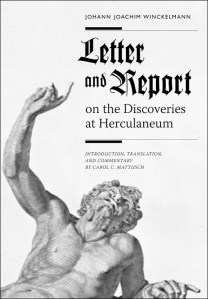 This new translation brings to light early scientific archaeology and the study of Herculaneum and Pompeii as observed by the erudite and acerbic art historian Johann Joachim Winckelmann (1717–1768). His Letter, published in German in 1762, displays his knowledge of geology, ancient literature, and art while offering a scathing critique of the Spanish Bourbon excavations around the Bay of Naples and of the officials involved. He further discusses these topics in his equally controversial Report of 1764.
The introduction describes the context in which these texts were written, identifies various politicians, academics, and collectors, and elucidates topics of particular interest to Winckelmann, from artifacts to local customs to the contents of ancient papyri. The illustrations, particularly those from the Bourbon publication—Le Antichità di Ercolano (1757–92)—illuminate how these monuments influenced contemporary perceptions of the ancient world.
Johann Joachim Winckelmann was a groundbreaking Prussian art historian and author of History of Ancient Art (1764). Carol C. Mattusch is Mathy Professor of Art History at George Mason University in Fairfax, Virginia, and author of The Villa dei Papiri at Herculaneum: Life and Afterlife of a Sculpture Collection (Getty Publications, 2005), which won the Charles Rufus Morey Book Award.
◊ ◊ ◊ ◊ ◊
Lance Mayer and Gay Myers, American Painters on Technique: The Colonial Period to 1860 (Los Angeles: Getty Publications, October 2011), 260 pages, ISBN: 9781606060773, $50.00
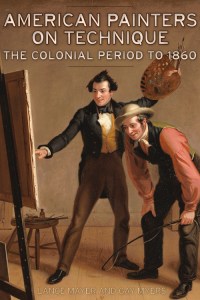 This is the first comprehensive study of an important but largely unknown part of the history of American art: the materials and techniques used by American painters. Based on extensive research, including artists’ recipe books, letters, journals, and painting manuals, much previously unpublished, the authors have also drawn on their many years as conservators of paintings for museums and collectors.
Information is provided on the methods of painters such as Benjamin West, Gilbert Stuart, Washington Allston, Thomas Sully, Thomas Cole, and William Sidney Mount. Topics include the quest for the “secrets” of the Old Masters; how artists saw their paintings changing over time; the application of “toning” layers; and the evolving self-confidence of American experimenters and innovators.
The book will be of interest to curators, art historians, painters, and conservators and will form the basis for future research on American painting techniques. At a time of discovering new approaches to art history, the story of how paintings were made parallels the better known histories about how styles changed and how paintings were commissioned, exhibited, and sold.
Lance Mayer and Gay Myers work at the Lyman Allyn Art Museum in New London, Connecticut, and as independent conservators.
Exhibition: ‘Luminous Paper, British Watercolors and Drawings’
From a Getty press release:
Luminous Paper: British Watercolors and Drawings
At the J. Paul Getty Museum, Getty Center, Los Angeles, 19 July — 23 October 2011
Curated by Julian Brooks

Thomas Girtin, "Durham Cathedral and Castle," ca. 1800 watercolor over pencil heightened with gum Arabic (Los Angeles: The J. Paul Getty Museum)
Watercolor is one of the most challenging artistic techniques—capable of extraordinary luminosity but often resistant to control. Luminous Paper: British Watercolors and Drawings presents more than 25 works of the 1700s and 1800s by some of the greatest masters of the medium, many on view for the first time.
Featuring the work of some of the most famous British artists, including J.M.W. Turner, William Blake, and Samuel Palmer, this exhibition reveals their multifaceted innovations in the field of drawing and watercolor painting. From Turner’s use of his thumbprint to roughen the texture of wash in a whirling seascape, to the reflected and re-reflected light built in layers by John Sell Cotman, the medium of watercolor was transformed beyond recognition. Other artists experimented with novel subject matter or new modes of representation, playing important roles in the development of European drawing and watercolor painting.
“Key works have been added to the Getty’s collection in the last few years as part of an ongoing initiative to build our holdings of British drawings and watercolors to better represent the wider European tradition,” said Associate Curator Julian Brooks, who curated the exhibition. “Many of these works have been recently acquired and we’re thrilled to be publicly displaying them for the first time in generations.”
Among the recent acquisitions is Durham Cathedral and Castle (about 1800) by Thomas Girtin, a dramatic view of a medieval cathedral and castle set on a rocky outcrop above the water, amid the moving light of a bright, cloudy sky. Girtin died of tuberculosis at the age of 27, two years after making this drawing. His rival J.M.W. Turner is reputed to have said “Had poor Tom lived, I would have starved.” Another is View of the Church of Our Lady of Hanswijk, Mechelen (1831) by Thomas Shotter Boys, a central figure in Anglo-French artistic exchange of the period, and one of the most sophisticated practitioners of watercolor. He excelled in capturing effects of atmosphere and mood. (more…)










 Enfilade
leave a comment