George Washington Life Mask
With Halloween around the corner, ’tis the season for masks: The Morgan Library and Museum in New York City features an online exhibition where virtual museum-goers can digitally examine the life mask of George Washington. The high- definition zoom technology allow viewers to inspect the details of the mask without having to travel to the brick-and-mortar museum. -AS
Excerpt from the online exhibition:
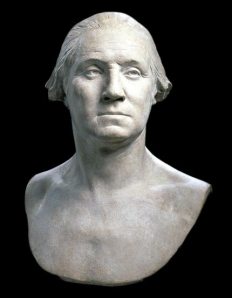
Jean-Antoine Houdon, "Bust of George Washington" clay (Mount Vernon, Virginia)
In 1785 the French sculptor Jean-Antoine Houdon visited George Washington (1732–1799) at his Mount Vernon residence. There he observed the general and made a plaster cast of his face—the Morgan’s life mask. He then used the mask to complete the face on his clay bust of Washington, which he left at Mount Vernon (Fig. 1). Houdon returned with the life mask to Paris, where he sculpted the final marble life-size sculpture of Washington now in the Richmond Capitol (Fig. 2). The statue was commissioned by the Virginia legislature and was erected in 1796, the year Washington issued his farewell address following his second term as president. The Morgan’s life mask of Washington is unique and represents the truest likeness of the country’s first president. Pierpont Morgan likely acquired the mask in Rome from the son of the American sculptor William Wetmore Story.
In order to make a mold of Washington’s face, Houdon had the general lie down. He prepared Washington’s face with a protective layer of grease and covered his eyes before adding a coat of wet plaster, inserting straws in the general’s nose so that he could breathe. Once the plaster hardened, Houdon removed the cast and poured plaster into the mold to make a positive model, destroying the mold in the process. It is this positive model that constitutes the Morgan’s life mask. Because Washington’s eyes were closed, in the final mask Houdon had to sculpt the open eyes based on caliper measurements, as well as retouch the nostrils, which were hampered by the breathing apparatus. The air bubbles in Washington’s cheeks were produced as the plaster settled in the mold.
The life mask recently served as a starting point for a team of forensic anthropologists working at Mount Vernon to re-create effigies of the “real” George Washington at three different moments in his life. Using the Morgan’s cast of the fifty-three-year-old Washington’s face, scientists were able to project the changes in his bone structure and appearance from his youth through old age. . . .
More information is available here»
Call for Papers: Women Artists in Italy, 1500-1750
Women Artists in Early Modern Italy
The Medici Archive Project, Florence, 3 March 2012
Proposals due 1 December 2011
 The Jane Fortune Research Program on Women Artists in the Age of the Medici at The Medici Archive Project is organizing a one-day conference (Florence, March 3, 2012) to highlight new documentary findings on the creative production of women in the visual arts (broadly defined) in the period 1500-1750.
Researchers have been exploiting historical archives to answer such questions as, What were the lives of women artists like in early modern Italy? Did their creative production take its cues from the social, cultural and professional circumstances that characterized their careers? Did they operate workshops similarly to male artists? Did their techniques for attracting patronage and setting prices follow the example of male artists? Where else besides the professional artist’s studio did women engage in the visual arts? Are there works of art by women artists that can be identified, dated or otherwise clarified by means of archival evidence? This conference offers an opportunity for comparing findings on early modern women artists and for examining a range of useful archival strategies and historiographic methodologies.
Although Italian women artists are of primary concern at this conference, papers on women artists of other countries are welcome particularly if they can be linked with the Medici or if their works were collected by any of the Medici (as in the case of Rachel Ruysch for instance). We are also particularly keen to include papers dealing with the collecting and display of works by women artists in the years 1500-1750, as well as papers that characterize the patronage enjoyed by women artists of this period.
To apply, please submit by December 1, 2012, a paper title, a one-page abstract either in English or Italian, and a curriculum vitae. Submissions should be sent via email to Dr. Sheila Barker: barker@medici.org










 Enfilade
leave a comment