George Washington Life Mask
With Halloween around the corner, ’tis the season for masks: The Morgan Library and Museum in New York City features an online exhibition where virtual museum-goers can digitally examine the life mask of George Washington. The high- definition zoom technology allow viewers to inspect the details of the mask without having to travel to the brick-and-mortar museum. -AS
Excerpt from the online exhibition:
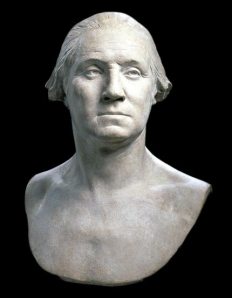
Jean-Antoine Houdon, "Bust of George Washington" clay (Mount Vernon, Virginia)
In 1785 the French sculptor Jean-Antoine Houdon visited George Washington (1732–1799) at his Mount Vernon residence. There he observed the general and made a plaster cast of his face—the Morgan’s life mask. He then used the mask to complete the face on his clay bust of Washington, which he left at Mount Vernon (Fig. 1). Houdon returned with the life mask to Paris, where he sculpted the final marble life-size sculpture of Washington now in the Richmond Capitol (Fig. 2). The statue was commissioned by the Virginia legislature and was erected in 1796, the year Washington issued his farewell address following his second term as president. The Morgan’s life mask of Washington is unique and represents the truest likeness of the country’s first president. Pierpont Morgan likely acquired the mask in Rome from the son of the American sculptor William Wetmore Story.
In order to make a mold of Washington’s face, Houdon had the general lie down. He prepared Washington’s face with a protective layer of grease and covered his eyes before adding a coat of wet plaster, inserting straws in the general’s nose so that he could breathe. Once the plaster hardened, Houdon removed the cast and poured plaster into the mold to make a positive model, destroying the mold in the process. It is this positive model that constitutes the Morgan’s life mask. Because Washington’s eyes were closed, in the final mask Houdon had to sculpt the open eyes based on caliper measurements, as well as retouch the nostrils, which were hampered by the breathing apparatus. The air bubbles in Washington’s cheeks were produced as the plaster settled in the mold.
The life mask recently served as a starting point for a team of forensic anthropologists working at Mount Vernon to re-create effigies of the “real” George Washington at three different moments in his life. Using the Morgan’s cast of the fifty-three-year-old Washington’s face, scientists were able to project the changes in his bone structure and appearance from his youth through old age. . . .
More information is available here»










 Enfilade
leave a comment