Call for Papers: Luxury Trade Conference
Call for Papers as noted at British Art Research:
The Trade in Luxury & Luxury in Trade: Production, Display, and Circulation
Musée Gadagne, Lyon, 22-23 November 2012
Proposals due by 1 January 2012
This Call for papers is for an international interdisciplinary conference, The Trade in Luxury & Luxury in Trade: The Production, Display, and Circulation of Precious Objects from the Middle Ages to the Present Day, organized by the Laboratoire de Recherche Historique Rhône-Alpes (UMR 5190) to take place at the musée Gadagne in Lyon, on Thursday 22 and Friday 23 November 2012.
How were luxury objects produced, displayed, disseminated and consumed? The aim of this conference is to return to the question of progressive specialization in a trade devoted to precious objects. The chronological, spatial and disciplinary boundaries are flexible, open in order to encourage the participation of specialists from different backgrounds – history, art and design history, economics, literature, sociology, etc. The conference’s objective is to reveal the richness and diversity of what the term ‘luxury’ embraced (and embraces) and to consider how specialist markets were gradually created and defined. Two specific approaches will be developed. On one hand, the focus will be on people and goods; on the other, it will be on points of sale and the material and symbolic power deriving from this particular sector of the economy.
The methods of production, display, circulation, and consumption of luxury goods will be the subject of this conference. The aim is to raise questions about growing specialization in a trade devoted to precious objects which are designed to make people and their surroundings more attractive. Specialists from different backgrounds will deal with these questions from many chronological, spatial and disciplinary perspectives. Diverse acadenic fields will thus be represented, among them history, art and design history, economics, literature, sociology, etc.
This interdisciplinary approach to the luxury market across a long period of time, from the Middle-Ages to the present day, will make it possible to contrast different experiences and underline continuities as well as changes. Luxury has often been discussed merely with reference to fine arts production. Here, in contrast, the objective is to reveal the richness and diversity of a phenomenon referred to as ‘luxury’, and the progressive emergence of specialized markets. Two specific approaches will thus be developed in the conference: on the one hand, a focus on people and goods, and on the other hand, a focus on points of sale and the material and symbolic power deriving from this particular sector of the economy. Indeed, luxury does not only derive from the methods and forms of the material economy; it is also a controversial value, a symbolically charged trade, a political argument, a religious controversy. These facets of luxury are either linked with or remote from the circuits of consumption, leading or following consumption practices. The papers, which may refer to French or foreign examples, should contribute to the following topics and perspectives: (more…)
Early Goya at the Prado
As noted at ArtDaily.com (5 October 2011) . . .

Francisco de Goya, "The Victorious Hannibal," 1771
◊ ◊ ◊ ◊ ◊
The display of The Victorious Hannibal at the Museo del Prado offers visitors an exceptional opportunity to see one of the most important and impressive works from Goya’s early career. Painted in the spring of 1771, it falls within a period not previously represented in the Prado’s rich and remarkable collection of the artist’s works. Through an agreement reached between the Museum and the Fundación Selgas-Fagalde to promote and disseminate their respective collections and the artistic heritage that these institutions house, Goya’s work is being shown at the Prado alongside his Italian Notebook, a sketchbook that he acquired during his time in Italy (1769-71). Among numerous other drawings and annotations, it contains sketches for the composition of The victorious Hannibal and its principal figures, namely Hannibal and the bull’s head of the allegorical figure of the River Po, which the Carthaginian general crossed.
The Victorious Hannibal is a work of clearly outstanding technical merit, evident in its harmonious composition, skilled treatment of light, and the deft, firm brushstrokes that model the figures through colour and light.
The painting was first presented as an undoubtedly autograph work by Goya in 1994, a year after it had been identified at the Prado and as part of one of the exhibitions organised to celebrate the Museum’s 175th anniversary. It now returns to the Prado for display in one of the Goya galleries for six years through the present agreement. In return, the Prado will carry out the technical study and restoration of five works in the Fundación Selgas-Fagalde collection and organise two exhibitions to be held at the Fundación in Cudillero (Asturias). . . .
The full article is available here»
Call for Papers: Second Fontainebleau Art History Festival
Call for Papers, noted by Hélène Bremer; from the festival website:
2e Festival de l’histoire de l’art: Voyages (with a focus on Germany)
Fontainebleau, 25-27 May 2012
Proposals due by 2 November 2011
Le Ministère de la Culture et de la Communication, l’Institut national d’histoire de l’art et le Château de Fontainebleau s’associent pour proposer la deuxième édition du Festival de l’histoire de l’art. Conçues comme un carrefour des publics et des savoirs, ces trois journées offrent conférences, débats, concerts, expositions, projections, lectures et rencontres dans le château et dans plusieurs sites de la ville de Fontainebleau.
Le Festival explore chaque année un thème, en 2012 « voyages », et propose trois rendez-vous annuels : le Forum de l’histoire de l’art, rendez-vous de toute l’actualité du monde des arts ; le Salon du livre et des revues d’art et Art & Caméra, panorama et perspectives sur le film et l’art. Le Festival est aussi l’occasion de propositions pédagogiques pour l’enseignement de l’histoire des arts à l’école, à travers une Université de printemps et des ateliers pédagogiques proposés et soutenus par le Ministère de l’Éducation nationale.
L’ensemble des manifestations est placé sous le regard privilégié d’un pays invité : en 2012, l’Allemagne. Les interventions intégrant des recherches allemandes ou concernant en tout ou partie le domaine allemand seront les bienvenues. L’appel à communication s’adresse à des chercheurs français et étrangers, de préférence francophones, confirmés ou débutants. Les propositions de jeunes chercheurs, conservateurs ou encore restaurateurs, seront examinées avec une attention particulière.
The full Call for Papers is available here»
Exhibition: Decoding Images of Maharaja
From the Asian Art Museum of San Francisco:
Decoding Images of Maharaja: The Splendor of India’s Royal Courts
Victoria & Albert Museum, London, 10 October 2009 — 17 January 2010
Art Gallery of Ontario, Toronto, 17 November 2010 — 3 April 2011
Asian Art Museum of San Francisco, 21 October 2011 — 8 April 2012
Virginia Museum of Fine Arts, Richmond, 21 May — 19 August 2012

Amar Singh II, ruler of the kingdom of Mewar, 1700–50. City of Udaipur. Opaque watercolor on cloth (London: V&A)
The word maharaja evokes for many an image of a bejeweled and turbaned ruler, whose authority is absolute, whose wealth is immense, who indulges in a lavish lifestyle. But that is only a part of the picture, and more applicable to a later chapter of history at that, after India became a colony of the British empire in the mid-nineteenth century. Although Hindu and Muslim rulers were also known by other titles — including maharana, maharao, nawab, and nizam — the word maharaja, which means “great king,” came to be used as a generic term to describe all of India’s kings.
An exhibition on the splendors of India’s royal courts initially aroused my skepticism. There should be more compelling reasons for an exhibition than merely to admire two hundred beautiful objects. Granted, admiring beautiful objects is something that we as art lovers, art historians, and curators love to do, but sometimes that is not enough. Especially not when the objects have more interesting stories to tell. Refreshingly, the Maharaja exhibition redresses commonly held perceptions and succeeds in adding greater depth and nuance to its subjects. Nearly every object included in the display has a great story and multiple layers of meaning behind it.
The two principal narrative arcs around which the exhibition is organized bring to life the complex and fascinating worlds of India’s great kings. They help us to understand the real people behind the objects that were made for them. The first goes behind the scenes to analyze the roles and qualities of kingship in India. The second traces the ways the institution of kingship shifted against a rapidly changing political and historical backdrop from the early eighteenth century through the 1930s, a period that saw a change in the maharajas’ status from independent rulers to “native princes” under British colonial rule. All of this is illustrated by a stunning range of objects from paintings and photographs to arms and armor, furniture, costumes, and jewelry.
The many paintings and photographs of the maharajas on display not only document the active presence of real people who lived real lives but also offer us a glimpse into the worlds inhabited by them. The modes of representation offer considerable information. Whether or not as deliberate design, the ways in which the subjects are depicted, their gestures and stances, the objects that have been included in or left out of their mages, and the overall settings tell us something about how they wished to be viewed both in their own time and in posterity. Looking closely at the representations of individual maharajas in the exhibition enables us as modern viewers to enter the now-distant world of these individuals and relate to them, and to realize that such portraits may not after all be that different in their intent and function from the single image that we choose to represent us on our Facebook profiles.
—Qamar Adamjee, assistant curator of South Asian Art at the Asian Art Museum of San Francisco
◊ ◊ ◊ ◊ ◊
Note: The Richmond venue was added to this posting on 21 May 2012; details are available here»
Call for Papers: 2012 Bloomington Workshop To Address Play
Call for Papers from The Center for Eighteenth-Century Studies at IU:
The 11th Bloomington Eighteenth-Century Workshop: Play
The Center for Eighteenth-Century Studies at Indiana University, Bloomington, 9-11 May 2012
Proposals due by 13 January 2012
The Center for Eighteenth-Century Studies at Indiana University is pleased to announce the eleventh Bloomington Eighteenth-Century Workshop, to be held on May 9-11, 2012. Our subject for 2012 is “Play.” From the aesthetics of Schiller to the card tables of socialites; from Pascal’s wager to Emile’s childhood (“which is or ought to be only games and frolicsome play”)—the long eighteenth century was a century of play. Dismayed at all this non-utilitarian behavior, Jeremy Bentham coined the phrase “deep play” to describe entirely irrational gambling, the making of bets that could reduce players “to indigence” in an instant. Writing in the twentieth century, Johan Huizinga still saw a “play-quality” penetrating all aspects of the era: “statecraft had never been so avowedly a game as in that age of secret cabals and intrigues.” Play, in other words, can look like pretty serious stuff in an eighteenth-century context. What can eighteenth-century developments tell us about the objects, forms, and occasions of play? Clifford Geertz applied Bentham’s words to the cock fights of Bali; Robert Darnton transposed that analysis to cat killing in eighteenth-century Paris: in both cases, the authors argued that grappling with such “opaque” activities allowed one to “grasp a foreign system of meaning in order to unravel it” (Darnton). But must all analyses of play culminate with the discovery of cultural work? What happens when we juxtapose different forms of play and different sets of players? Would we want to say that narrative or poetic fictions constitute kinds of play, or forms of absorption homologous to playing? Do the revolutionary dramas in the American colonies, France, or Haiti represent the fulfillment or the destruction of the notion that politics is a performance?
We invite papers that range across aesthetic, anthropological, historical, and philosophical registers, and that offer new ways to see the relation between these fields and disciplines. Possible topics include: games, toys, puppets, contests, riddles, and puzzles; play and the theory of fictions; making and breaking rules; theatricalization and mimesis as aesthetic, behavioral, and political tactic; the psychologization of play; the policing of the border between action and enactment, the “real” and the “make-believe,” play and non-play; transcultural impacts on conceptions of culture as a kind of play, game, or performance. (more…)
Exhibition and Colloquium: The Hôtels Particuliers of Paris
As noted by Hélène Bremer, from the museum’s website:
The Townhouse: A Parisian Ambition / L’hôtel particulier: Une ambition parisienne
Cité de l’Architecture & du Patrimoine, Palais de Chaillot, Paris, 6 October 2011 — 19 February 2012
Curated by Alexandre Gady
The townhouse is a key part of Paris’s architectural character, and we can trace the story of the capital by studying the development of the townhouse in different districts of the city.
 The Parisian townhouse made its first appearance in the Middle Ages and became more popular during the 16th century when, thanks to François I, Paris again became the political capital where the monarchic state assembled and settled. It was important to be at court, near the king, and, therefore, at Paris. This golden age continued throughout the 17th, 18th and 19th centuries. The last of the townhouses were built in the period between the two world wars, marking the end of a long history, but they still exist in today’s 21st-century Paris and are very much in use: (museums, embassies, ministries). This exhibition aims to explore this history and takes the visitor on three complementary and illuminating journeys, in a bid to discover the secret of the Parisian townhouse.
The first section features a small reconstructed townhouse, between garden and courtyard, with different authentically decorated rooms for the visitor to explore. In this way, each visitor can enjoy a sense of familiarity with, and ownership of, the building. The building is not an exact replica of an existing townhouse but aims rather to convey a general impression, an overall picture, with each “external” and internal space specifically designed for educational purposes.
In the second section of the exhibition, the visitor will take a journey through the history of the townhouse, this time organized chronologically, from the Middle Ages to the Belle Epoque. This part of the exhibition, displayed in a vast open space, presents a series of large models of townhouses, specifically chosen for their distinctive characteristics – hôtels de Cluny, Lambert, Thélusson and finally the Palais-Rose (these last two buildings no longer exist) – complete with an interactive terminal with wonderfully illustrated information on some 300 town houses.
The last section offers themed reading, examining the Parisian hotel as an architectural object. Three “alcoves” will be devoted to the relationship between the city and the townhouse – a relationship which was both passionate and destructive. A further three sections allow the visitor to explore the external architecture of the townhouse (façades overlooking gardens and courtyards), its interior décor, gardens and finally internal layout. To complete the display, there is a multi-touch screen on the layout and organization of the townhouse, presented in a fun way.
Alexandre Gady, L’hôtel particulier de Paris: Du Moyen Age à la belle époque, second edition (Paris: Parigramme, 2011), 320 pages, ISBN: 9782840967040, €49.
◊ ◊ ◊ ◊ ◊
Colloquium: L’hôtel particulier des capitales régionales, une ambition française
Cité de l’Architecture & du Patrimoine, Palais de Chaillot, Paris, 2-3 December 2011
Ce colloque placé sous la direction scientifique de Pascal Liévaux, conservateur en chef à la Direction générale des patrimoines et Alexandre Gady, professeur à l’université de Nantes, commissaire de l’exposition L’Hôtel particulier. Une ambition parisienne, fait écho à cette manifestation.
Il propose d’en élargir la thématique à l’ensemble du territoire national et donnera la parole à des chercheurs et à des professionnels du patrimoine. Ces spécialistes témoigneront des dernières avancées dans la connaissance, la conservation, la restauration et la mise en valeur de ces édifices complexes qui, associant au plus haut niveau d’excellence l’architecture, l’art des jardins et celui du décor, témoignent de trois siècles de vitalité et de diversité de l’architecture urbaine sur l’ensemble du territoire national.
Lecture: Amanda Vickery on Georgian Family Life
From The Lewis Walpole Library:
The Eighteenth Lewis Walpole Library Lecture by Amanda Vickery
Yale Center for British Art, New Haven, 21 October 2011
“Family Life Makes Tories of Us All”: Love and Power at Home in Georgian England
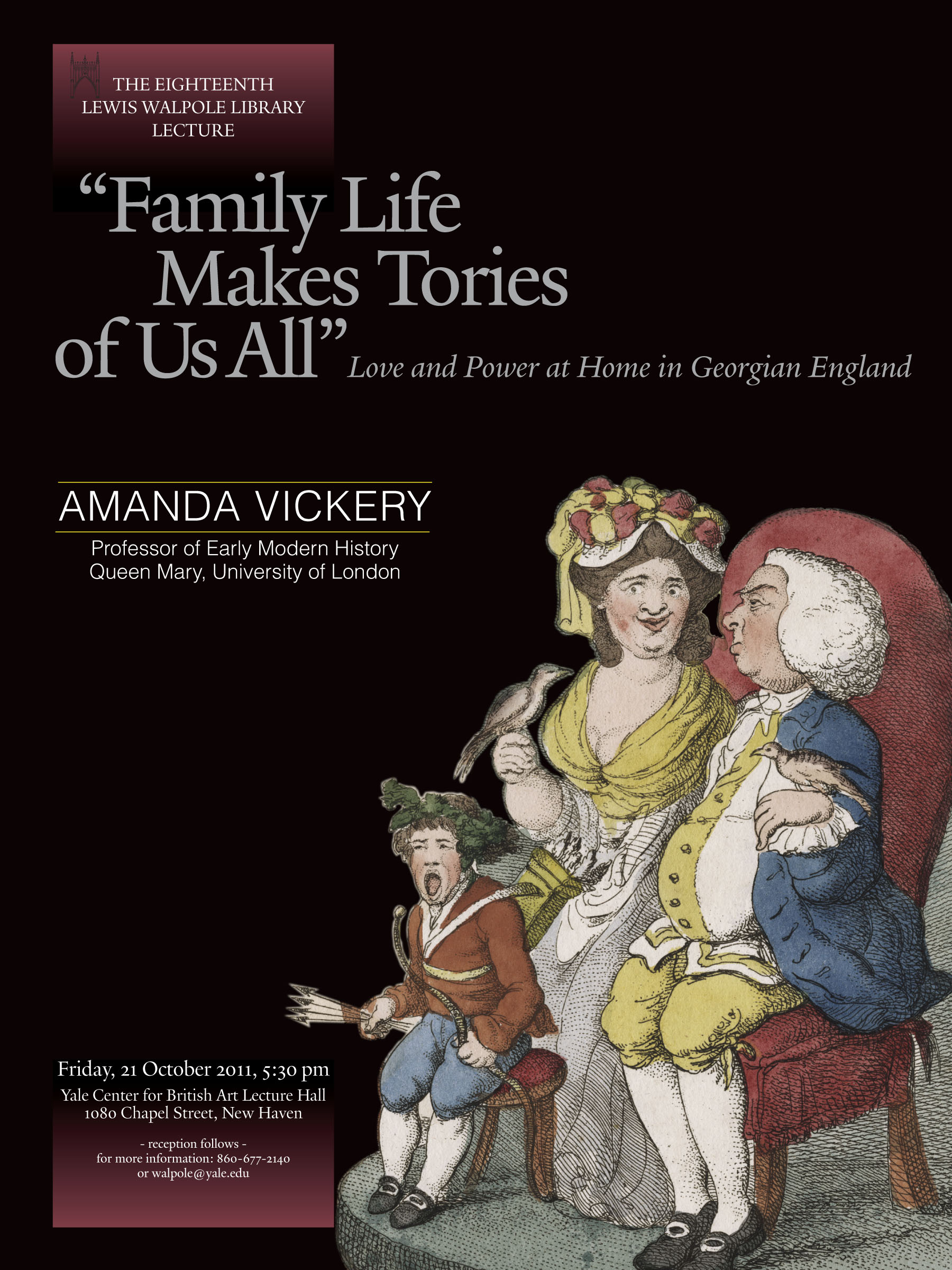 To see the state in miniature one need only go home. Husbands were to govern wives, masters and mistresses to rule servants, and parents to discipline children. The years after 1688 saw the acceptance of new ideas about political authority and social manners, but the household hierarchy endured regardless. Notoriously Hobbes, Locke and Rousseau did not include every adult individual in their democracy of consent, but rather every male head of household, who was seen to represent the interests of his patriarchal entourage. The British considered themselves enemies to tyranny, disparaging and caricaturing ‘oriental despotism’ in foreign families as confirmation of barbarity, but local servitude passed almost unnoticed by political ideas. I have yet to encounter a single gentleman musing on whether it might be possible to reconsider his domestic rule in the light of the new political ideas. ‘Family life’, it was observed in 1779, ‘makes Tories of us all… see if any Whig wishes to see the beautiful Utopian expansion of power within
his own walls’.
 The new political ideas which advocated government by consent did nothing to revolutionize the structures of domestic authority, but the content and meaning of domestic life was transformed over the eighteenth century. New ideals of politeness revolutionized domestic manners and interactions amongst the modestly propertied, while the vogue for sensibility in novels and paintings inflated expectations about affection and happiness at home. What then was the balance of love and power in eighteenth-century marriage and family life? And how did dependents live with the contradictions? ‘Do you not admire these lovers of liberty!’ snapped Elizabeth Montagu in 1765 ‘I am not sure that Cato did not kick his wife.’
◊ ◊ ◊ ◊ ◊
Amanda Vickery is Professor of Early Modern History at Queen Mary, University of London. She is the author of Behind Closed Doors: At Home in Georgian England (Yale, 2009) and The Gentleman’s Daughter: Women’s Lives in Georgian England (Yale, 1998) which won the Wolfson, the Whitfield and the Longman/History Today prize. She is the editor of Women, Privilege and Power: British Politics 1750 to the Present (Stanford, 1991) and Gender, Taste and Material Culture in Britain and North America (Yale, 2006). She writes and presents documentaries for BBC2 and BBC radio 4. In 2011, she judged the Samuel Johnson prize.
For the lecture’s calendar listing at the YCBA click here
Call for Papers: Graduate Student Conference
6th Annual Graduate Symposium, Department of Art, University of Toronto
Experimental Cultures: Mergers of Art and Science
University of Toronto, 27 January 2012
Proposals due by 15 November 2011
“All art should become science and all science art,” declared the German Romantic poet Friedrich Schlegel in one of his many philosophical fragments. Schlegel’s radical program of reform for the arts and sciences still has currency today. Art historians and other researchers are exploring the unique ways in which cultures of science and art intersect. Illustrations in anatomical atlases or manuals of natural history, for instance, hover somewhere ambivalently between the two. Even in the work of canonical artists, such as Leonardo da Vinci, what is art and what is scientific inquiry cannot be definitively distinguished. These junctions appear not only in the concerns of artists, but also in those of scientists. Developments in neuroscience are transforming our understanding of the experience and creation of art. Innovative technologies enable us to approach art and material culture, ancient and modern, from new angles. We invite proposals of graduate research across time and space that consider how science and technology have influenced the subjects of art, material culture, the practices of art-making, and aesthetic experience. Topics may include, but are not limited to:
– Applications of science and technology to art history and material culture
– How art and science have together generated new theoretical approaches
– Exchange between artists, anatomists, medical practitioners, and other scientists
– Neuroarthistory and its applications
– The use of psychology, physiognomy, or phrenology in portraiture
– Intersections between landscape painting or land art and the natural sciences
Please email abstracts of no more than 500 words for 20-minute papers, in addition to a short CV to gusta.symposium@gmail.com by November 15, 2011. Successful candidates will be contacted by December 1, 2011.
Organized by the Graduate Union of the Students of Art, University of Toronto
Call for Articles: Excess and Moderation for ‘Frame’
Excess/Moderation Theme for Next Issue of Frame: Journal of Visual and Material Culture
Manuscripts due by 15 November 2011
Frame invites scholarly submissions from a variety of disciplines that engage somehow with visual and/or material culture using unique methodologies. Possible areas of interest include art, architecture, film, visual culture, design, built environment, television, material culture, or other domains that engage with visual content from a variety of perspectives. We are particularly attracted to scholarly work that transverses traditional disciplinary borders and creates fresh approaches to the study of visual art and related areas.
This issue is themed “Excess/Moderation.” A mind-map that serves the function of suggesting topics is available on the Frame website (www.framejournal.org). Please see the website for the style-sheet as well. Papers should not exceed 10,000 words, unless for special exception. Manuscripts should be submitted electronically in .doc or .docx format. A separate document that includes a 200-word abstract, full name, email address, phone number, and institutional affiliation should accompany the article. Send all inquiries to the Managing Editor, Shawn Rice, at editor@framejournal.org.
◊ ◊ ◊ ◊ ◊
Frame is a scholarly, peer-reviewed online publication edited by graduate students of the City University of New York Graduate Center. This journal is a re-imagined, interdisciplinary continuation of PART: The Journal of the Ph.D. Program in Art History at the Graduate Center.
Exhibition: Master Drawings from the Crocker Art Museum
From The Frances Lehman Loeb Art Center at Vassar:
A Pioneering Collection: Master Drawings from the Crocker Art Museumm
Portland Art Museum, Oregon, 12 June — 19 September 2010
Crocker Art Museum, Sacramento, California, 10 October 2010 — 6 February 2011
Frances Lehman Loeb Art Center, Vassar College, Poughkeepsie, New York, 16 September — 11 December 2011

Hubert Robert, "Massacre of the Innocents," 1796, chalk, brown, and red, on paper, 8 1/4 in. x 7 1/4 in. (Sacramento: Crocker Art Museum)
A Pioneering Collection: Master Drawings from the Crocker Art Museum includes 57 rarely seen works by artists such as Albrecht Durer, Fra Bartolommeo, Anthonie van Dyck, Francois Boucher, and Jean-Auguste-Cominque Ingres. The exhibition is divided thematically into four sections of drawings from Italy, the Low Countries, France, and Central Europe.
These drawings date from the late 15th- to the mid-19th centuries and were purchased between 1869-71 by forward-thinking railroad magnate E. B. Crocker, forming the basis of the Crocker Museum’s master drawings collection. In total, the Crockers purchased 1344 master drawings and 700 paintings during their time in Europe and these formed the basis of their private art gallery, which opened in 1872, featuring visitors like the queen of Hawaii and former U.S. President Grant. Following the death of Edwin Crocker, his wife Margaret transferred the gallery to the California Museum Association, now the Crocker Art Museum. Their old master drawing collection was one of the first historically to be opened to the
public in 1885.
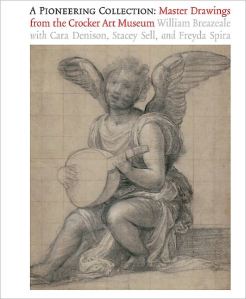 This exhibition was organized in celebration of the Crocker’s Anne and Malcolm McHenry Works on Paper Study Center and exhibition space, designed to significantly enhance public access to this collection of master drawings.
A catalogue by lead author and Crocker Art Museum curator Wiliam Breazeale; Cara Dufour Denison, curator at the Morgan Library and Museum; Stacey Sell, associate curator of Old Master drawings at the National Gallery of Art, and Freyda Spira, research associate at the Metropolitan Museum of Art, accompanies the exhibition and will be available at the Art Center gift shop (Paul Holberton Publishing, 2010, $35).
A full checklist for the exhibition is available here»










 Enfilade
leave a comment