Conference in The Hague: Dutch Emotions
From the Huizinga Instituut (as noted by Hélène Bremer) . . .
Cool, Calm, and Collected: The Dutch and Their Emotions in Pre-Modern Times
Koninklijke Bibliotheek, The Hague, 4 November 2011
Conference organizers: Wessel Krul, Herman Roodenburg, and Catrien Santing
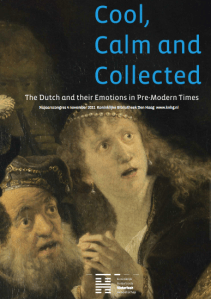 The conference Cool, Calm and Collected aims to enhance the burgeoning history of emotions in the Netherlands. Speakers at the conference will present their current research, integrating the study of emotional standards in advice literature with the study of actual emotional practices in ego documents, chronicles or archival sources. The fields covered will range from politics, philosophy and the urban feud to religion, the stage and the visual arts. The conference will not only be of interest to specialists in the history of emotions but also to the greater historical community.
Although the history of emotions was already suggested as an interesting topic by Lucien Febvre and Johan Huizinga it has been taken up seriously as a subject of historical study only fairly recently. Initially, historians limited themselves largely to the study of documents that prescribed emotional ideals and standards. Researchers are now going beyond such texts. They are currently identifying transformations in emotional ‘communities’ and ‘styles’ on the basis of letters, autobiographies and memoirs, as well as a variety of narrative, archival and visual sources. Historians are also emphasising performativity, what emotions actually do. At the institutional level, in Europe two important research centres have been started: in London the Queen Mary Centre for the History of the Emotions (Thomas Dixon, director); in Berlin the ‘Forschungsbereich Geschichte der Gefühle’ (Ute Frevert, director). This conference seeks to establish a more solid footing for the history of emotions in the Netherlands and join in with these international trends.
The speakers at the conference will discuss the emotional styles of the Modern Devouts and the cult of pugnacity in Late Medieval feuds. Focusing on the seventeenth century, they will reconsider the performativity accorded to the emotions in painting, the theater, and pietist religious movements. For the eighteenth century, speakers will analyse the Dutch ‘cult of sensibility’, the contemporary appreciation and navigation of the sentiments. The day will be closed with a lecture by Dorothee Sturkenboom. She is a pioneer in the study of emotions in the Netherlands and will relate the emotional history of the Dutch to contemporary and more recent views on their ‘national character’. The conference’s keynote lecturer, the well-known English historian Thomas Dixon, will discuss the latest developments in the field.
The conference fee is €30 (€25 for members of the KNHG and €15 for students and PhD students) and includes lunch. The conference fee should be transferred to account number 6934391 of Nederlands Historisch Genootschap in The Hague. Registration by way of an e-mail to: info@knhg.nl, or by telephone: +31 (0)70 3140363.
Exhibition: Goya’s Los Caprichos
From the Nassau County Museum of Art:
Francisco Goya: Los Caprichos
Nassau County Museum of Art, Roslyn Harbor, New York, 17 September — 27 November 2011
Curated by Robert Flynn Johnson

Francisco Jose de Goya. The Sleep of Reason Produces Monsters (Caprichos No. 43: El Sueño de la razon produce monstruos), 1796-97 Etching and aquatint, 1st Edition 1799 Plate dimensions 213 x 150 mm.
This exhibition features an early first edition of Los Caprichos, a set of 80 etchings by Spanish artist Francisco de Goya y Lucientes that was published in 1799. It is regarded as one of the most influential series of graphic images in the history of Western art. Francisco Goya: Los Caprichos was organized by Landau Traveling Exhibitions (Los Angeles), in association with Denenberg Fine Art (West Hollywood).
“Capricho” can be translated as a whim, a fantasy or an expression of imagination. In Goya’s use of the term, the meaning deepens, binding an ironical layer of humor over one of the most profound indictments of human vice ever set on paper. Enigmatic and controversial, Los Caprichos was created in a time of social repression and economic crisis in Spain. Influenced by Enlightenment thinking, Goya set out to analyze the human condition and denounce social abuses and superstitions. Los Caprichos was his passionate declaration that the chains of social backwardness had to be broken if humanity was to advance. The series attests to the artist’s political liberalism and to his revulsion at ignorance and intellectual oppression, mirroring his ambivalence toward authority and the church. Los Caprichos deals with personages populate a world on the margins of reason, where no clear boundaries distinguish reality from fantasy.
In his essay accompanying the exhibition, Robert Flynn Johnson, curator in charge, Achenbach Foundation for Graphic Arts, Fine Arts Museum of San Francisco, states:
Francisco Goya should be seen as the first modern artist–he chose to go beyond depictions of religion, mythology, and history, and even beyond observation of the visible world, turning instead toward the psychological demons that have always inhabited men’s souls. Until Goya, these demons had rarely been made artistically visible–Goya had the courage and the genius to depict them. Los Caprichos stands as the greatest single work of art created in Spain since the writings of Cervantes and the paintings of Velázquez over one hundred fifty years earlier.
Francisco Goya: Los Caprichos opens on Saturday, September 17 and remains on view through Sunday, November 27. The museum is offering several programs that will serve to enhance the viewer’s appreciation of the exhibition. Among these are daily screenings of Goya: Crazy Like a Genius, a film written by the prominent art commentator Robert Hughes, and lunchtime lectures followed by tours of the exhibition on October 13 and November 17. For details, visit the EVENTS section of the museum website.
Call for Book Proposals: British Art Global Contexts
As noted at British Art Research:
Book proposals are welcomed for Ashgate’s British Art: Global Contexts series, edited by Jason Edwards, University of York; Sarah Monks, University of East Anglia; and Sarah Victoria Turner, University of York. The series provides a forum for the study of British art, design, and visual culture in the global context from 1700 to the present. Books to be published will include monographs, thematic studies, and edited collections of essays, specializing in studies of British Art within comparative and interdisciplinary frameworks. For more information, please visit the series webpage at www.ashgate.com/Default.aspx?page=3503.
British Art: Global Contexts provides a forum for the study of British art, design and visual culture in the global context from 1700 to the present day. Focusing upon the transport, location and reception of British art across the world; the British reception and exhibition of art from around the globe; and transnational and cosmopolitan art containing significant British components; the series seeks to problematize, historicise and specify the idea of ‘British’ art across the period, as it intersects with local, regional, international and global issues, communities, materials, and environments. Books to be published will include monographs and thematic studies, single authored works and edited volumes of essays, specialising in studies of British art within comparative and interdisciplinary frameworks.
The series will publish research which deals with fine art objects and the broader visual and material cultural environment of Britain and its historical territories, as well as with the global diaspora of British artists, genres, artefacts, materials and styles, and the contribution to British art of other global diasporas. Proposals are welcomed which deal with aspects of art and design history and visual culture, from the perspective of the colonising, decolonising and post-colonial world, global history, and the circum-Atlantic.
Please send letters of inquiry or full proposals to Meredith Norwich, Commissioning Editor for Visual Studies, mnorwich@ashgate.com, AND Jason Edwards,je7@york.ac.uk; Sarah Monks, s.monks@uea.ac.uk; and Sarah Victoria Turner,svt500@york.ac.uk.
The Eighteenth Century in the October Issue of The Burlington
The Burlington Magazine 153 (October 2011)
◊ ◊ ◊ ◊ ◊
Editorial
• The Holburne Museum, Bath
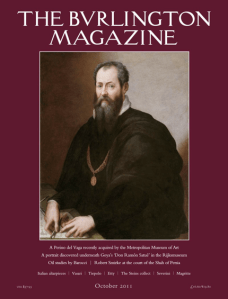 . . . Earlier this year, the Museum received extensive publicity when it re-opened after renovation and an extension carried out by Eric Parry Architects. This has included the daring and entirely successful moving of the central staircase of the house, to a few feet to the left, unblocking the vista through the ground-floor entrance to the gardens at the back; a beautiful full-height glass extension to the rear of the building that creates temporary exhibition rooms and a greater feeling of light and air; and the almost complete redisplay of the collections. While it has to be admitted that the Museum is distinctly eclectic and charmingly provincial (and in places still fussily crowded), in its renovated state its former shabby gentility has been vanquished. It now presents itself like Gainsborough’s Lord and Lady Byam, stepping out with the next generation, all in their finery, to greet the future.
The full editorial is available here»
◊ ◊ ◊ ◊ ◊
Articles
• Antonello Cesareo, “New Portraits of Thomas Jenkins, James Byres and Gavin Hamilton” — Two new portraits of Thomas Jenkins and James Byres by Anton von Maron and a self-portrait by Gavin Hamilton.
• Christopher Baker, “Robert Smirke and the Court of the Shah of Persia” — A watercolour study by Robert Smirke in the National Gallery of Scotland, Edinburgh, for a painting of the court of the Shah of Persia.
• Duncan Bull and Anna Krekeler, with Matthias Alfeld, Doris Jik, and Koen Janssens, “An Intrusive Portrait by Goya” — The discovery of an earlier three-quarter length portrait of a man by Goya beneath his Portrait of Ramón Satué (1823) in the Rijksmuseum, Amsterdam.
◊ ◊ ◊ ◊ ◊
Books
• Philip McEvansoneya, Review of N. Glendinning and H. Macartney, eds., Spanish Art in Britain and Ireland, 1750–1920: Studies in Reception in Memory of Enriqueta Harris Frankfort.
• Mark Stocker, Review of M. Kisler, Angels and Aristocrats: Early European Art in New Zealand Public Collections.
• Luke Herrmann, Review of M. and J. Payne, Regarding Thomas Rowlandson (1757–1827): His Life, Art & Acquaintance and P. Phagan, Thomas Rowlandson: Pleasures and Pursuits in Georgian England.
◊ ◊ ◊ ◊ ◊
Exhibitions
• Xavier F. Salomon, Young Tiepolo
Conference: Feminist Art History
What a lovely policy for conferences — free and open to the public!
The Second Annual Feminist Art History Conference
American University, Washington, D.C., 4-6 November 2011
Keynote Address:
Mary D. Sheriff, “The Future of Feminist Art History: Where Have We Come From, Where Are We Going?”
The Art History Program of American University (Department of Art, College of Arts and Sciences) presents our second annual Feminist Art History Conference which will take place from Friday November 4 to Sunday November 6, 2011. Corollary events begin on Friday afternoon (12:00-6:00 pm) at the National Portrait Gallery in Washington DC with a lunch, tour, and program in conjunction with the exhibition Seeing Gertrude Stein: Five Stories. Events continue on Friday evening at American University, with a reception and concert of choral music entitled “Gender Settings.” The conference sessions will take place on the American University (AU) campus in Northwest Washington, D.C. on Saturday (9:30 am to 5:30 pm) and Sunday (10:00 am until 12:30 pm). The keynote address will be presented on Saturday evening at 7:00 pm, following a reception.
This second annual Feminist Art History Conference (FAHC) continues to explore the legacy of two pioneering feminist art historians, Norma Broude and Mary D. Garrard, who are now professors emerita of art history at AU. This year’s conference had more than 90 proposal submissions and will include 51 papers in twelve sessions. The papers will span a broad range of topics and time periods, from the medieval era to contemporary art. Together they will demonstrate the myriad ways in which feminist research and interpretation have spread globally and across the spectrum of art historical analysis and scholarship.
The keynote address will be presented by Mary D. Sheriff, W.R. Kenan Jr. Distinguished Professor of Art History at the University of North Carolina, Chapel Hill. Her talk is entitled “The Future of Feminist Art History: Where Have We Come From, Where Are We Going?” In addition to her first book, Fragonard: Art and Eroticism (1990), Sheriff has published The Exceptional Woman: Elisabeth Vigee-Lebrun and the Cultural Politics of Art (1997), Moved by Love: Inspired Artists and Deviant Women in Eighteenth Century France (2008), edited the anthology Cultural Contact and the Making of European Art Since the Age of Exploration (2010), and written numerous articles and reviews. As a deeply engaged feminist art historian, Sheriff has motivated numerous graduate students at UNC-CH to develop feminist-focused dissertations and other research projects, and her publications have inspired feminist scholarship internationally.
At the first FAHC in 2010, participants found a lively forum in which to share views, debate issues, and network in an exciting synergy of feminist interchanges. The impressive number of proposals submitted for this second conference demonstrates the ongoing centrality of the issues raised by feminist art history—a testimony to the continuing vitality of research by feminist scholars developed over the past four decades. Given that Washington, D.C., is becoming a center for the nexus of gender and art, with the AU Art History Program’s longstanding emphasis on feminist methodologies, and the active presence of the National Museum of Women in the Arts, conference planners hope that the annual Feminist Art History Conference at American University will function as a worthy successor to the Barnard College Feminist Art History Conference in New York, which was an important forum for feminist scholarship throughout the 1990s.
The conference is free and open to the public. Advance registration (before 5 pm EST, Friday, October 28) is recommended. Please visit the conference website for more detailed information about the program, registration online, hotels, etc.
A full conference schedule is available here»
Milwaukee Art Museum Acquires Portrait by Copley
Press release from the Milwaukee Art Museum (12 September 2011) . . .

John Singleton Copley, "Portrait of Alice Hooper," ca. 1763 (Milwaukee Art Museum)
The Milwaukee Art Museum has acquired the portrait Alice Hooper, a major colonial American painting by John Singleton Copley (1738–1815). Copley is recognized as one of the great American artists of the day—and one of the first native-born painters to achieve success both at home and abroad. Alice Hooper, painted by Copley around 1763, depicts the seventeen-year-old daughter of the wealthiest man in Marblehead, Massachusetts, Robert “King” Hooper. Alice’s father commissioned this portrait to mark his daughter’s engagement to Jacob Fowle, Jr.
“Alice Hooper displays the traits that made Copley desirable in colonial Boston. Copley’s rendering of her fashionable sacque gown dazzles the eye, with its profusion of glinting blue satin and frothy lace spilling from its underdress,” said William Rudolph, curator of American art and decorative arts at the Milwaukee Art Museum. “The artist lingered on the highlights of Alice’s ruby earrings and choker, revealing the great wealth of her family. Yet her pensive gaze and half-shadowed face allude to her graciousness; she looks modest, rather than proud.”
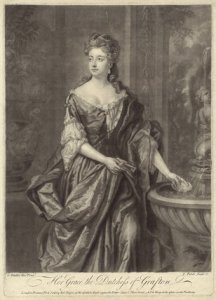
John Faber, after Sir Godfrey Kneller, "Isabella Fitzroy (née Bennet), Duchess of Grafton," (London: NPG #D30508)
According to Rudolph, Alice Hooper’s composition is one of a series of women depicted in fantasy garden settings, which all descend from John Faber’s 1691 engraving after Sir Godfrey Kneller’s Duchess of Grafton (ca. 1680).
The painting also provides vivid evidence of Copley’s working methods. Like many of his colleagues, the artist borrowed costumes and compositions from imported engravings of high-style British portraits. These appropriations were done with the full cooperation of his clients, who wanted to emulate the aristocrats of the mother country.
“The dress itself, although breathtakingly rendered, may not in fact be the property of Miss Hooper, given its remarkable similarity to that worn by several other sitters, and to the artist’s documented habit of copying elaborate gowns from mezzotints,” said Rudolph.
Copley’s work pleased the Hoopers and led to nine additional commissions for members of Alice’s immediate and extended families, securing Copley’s success.
“After winning the Hooper clan’s approval, Copley rocketed into the stratosphere as the go-to artist for fashionable New England—and for clients from as far away as Philadelphia and New York,” Rudolph said. (more…)
Exhibition: Chinoiserie
From the Milwaukee Art Museum:
Way of the Dragon: The Chinoiserie Style, 1710–1830
Milwaukee Art Museum, 30 June — 6 November 2011
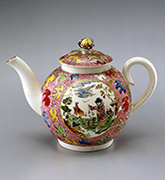
“Creamware Teapot”, ca. 1775, tin-glazed earthenware, London (Chipstone Foundation) Photo: Gavin Ashworth
Presented by the Chipstone Foundation, Way of the Dragon: The Chinoiserie Style, 1710–1830 explores how chinoiserie developed and subsequently degenerated in the eighteenth century. Chinoiserie objects represent Europe’s attempt to translate the arts and the ornament of China, Japan, and India, and was popular in all of Europe, but the English in particular were mesmerized by the allure of the exotic land and its people. Way of the Dragon investigates and questions European perceptions of China, as reflected in its decorative arts.
New Film: ‘Mozart’s Sister’
Mozart’s Sister, from French director René Féret, is now playing in select theaters. -AS
Reviewed by Manohla Dargis for The New York Times (18 August 2011) . . .

A 1779 portrait of the Mozarts: Nannerl, Wolfgang and their watchful father Leopold. Image Credit: Hulton Archive/Getty Images
Mozart’s Sister has just started when the French director René Féret makes the point that his fictional look at the early life and times of Wolfgang Amadeus isn’t interested in the pretty manners and nostalgia of many period movies. In truth, the film has little to do even with Wolfgang, a side note in a story focused on his only sister who’s first seen squatting on the side of a road taking care of business at a short distance from her similarly engaged father, mother and brother. This is the Family Mozart, Mr. Féret seems to declare with this scene, stripped down and at their most human.
That sister, Maria Anna Walburga Ignatia Mozart, born in 1751 and known as Nannerl, was said to posses a rare talent that, by some accounts, this film included, nearly rivaled that of her brother. Played by Marie Féret (the filmmaker’s daughter), Nannerl is an attractive, obedient and rather opaque 14-year-old going on 15, given to watchful silences and long looks at Wolfgang (David Moreau), who was younger by four and a half years. They were the only children out of the seven born to Leopold (Marc Barbé) and Anna-Maria (Delphine Chuillot) to survive childhood. If the calamity of those deaths weighed on the family it doesn’t register in “Mozart’s Sister,” which unfolds at the end of a long tour that began in 1763 when Wolfgang was 7.
Drawing on Leopold’s letters, among other sources, Mr. Féret paints a speculative, intimate portrait of a family bound by love, genius and ambition and almost undone by the same. . . .
For the entire review, visit The New York Times
◊ ◊ ◊ ◊ ◊
Furniture Restoration and Conservation: Stichting Ebeniste
This year’s event , as noted at Onderzoeckschool Kunstgeschiedenis, is held in Dutch (€85 / Students, €70), but next year it will be in English. For students of furniture, it might be a useful organization. As noted at the Stichting Ebeniste website:
The Ninth National Symposium for Wood and Furniture Restoration, Stichting Ebeniste
Amsterdam, 7 October 2011
The Stichting Ebenist is a non-profit organisation with the aim to provide a symposium about wood- and furniture conservation and restoration on a yearly basis. Each year alternating, the symposium is either national (in Dutch) or international (in English). After every symposium the lectures are gathered and published.
The aim of Stichting Ebenist is to learn and broaden our knowledge within the professional field. We want to be a platform where restorers and colleagues from neighbouring fields can meet to share information, experience and research. With these objectives we intend to promote discussion and new channels of communication. This will improve the standards of conservation and restoration, and thereby help us maintain our cultural heritage in the best possible way.
The symposium is attended by approximately 150 to 200 participants. The international symposium is usually spread across two days and includes excursions, while the national symposium lasts one day. The organisation is run by a group of 7 people, all from the restoration and conservation field. Several musea such as the Rijksmuseum and the Amsterdam Historical Museum have given us their support over the years. Also the Stedelijk Museum Amsterdam and the Van Gogh Museum have supported the symposium by providing accommodation. Other institutes such as the Technical University in Delft, the Gelders Oudheidkundig Contact, and auction houses such as Christie’s and Sotheby’s have enabled us to achieve our goals. The ICN and VeRes have helped us through the years to make the symposia possible up to this day. We look forward to seeing you at the next symposium.
Fashioning the Early Modern: Creativity and Innovation
◊ ◊ ◊ ◊ ◊
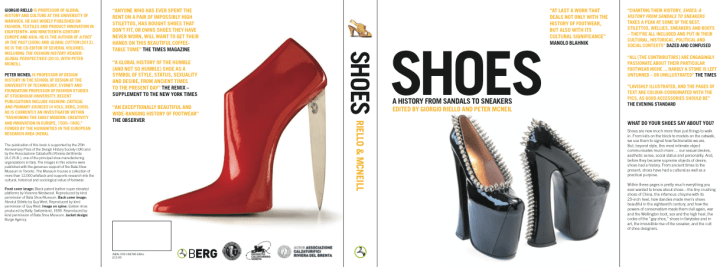
To judge from reactions to the Enfilade posting on the eighteenth-century shoe workshop, I would guess a number of you are quite keen on the topic. If so, you may be interested in this essay by Peter McNeil and Giorgio Riello, “Walking the Streets of London and Paris: Shoes in the Enlightenment,” in Shoes: A History from Sandals to Sneakers, edited by Giorgio Riello and Peter McNeil (London: Berg, 2006), which has just been released in paperback (448 pages for $30).
I learned of the book while perusing the ‘News’ section of the website, Fashioning the Early Modern: Creativity and Innovation in Europe, 1500-1800. The site is the public face of a multi-stage scholarly project. Workshops #3 and #4 are taking place in October and November in Copenhagen and Stockholm with a symposium to be held next year in London. -CH
◊ ◊ ◊ ◊ ◊
The following summary comes from the site:
Why did men from Spain to Sweden start to shave their heads and wear someone else’s hair in the mid-seventeenth century? Why did women decide that it was necessary to wear masks and other full-face coverings in public towards the end of the century? What was the economic and social impact of the sudden proliferation of ribbon-making machines?
Funded by the Humanities in the European Research Area (HERA), this project takes fashion seriously, asking the simple question: how and why did certain goods such as wigs, new textiles, ribbons, ruffs and lace become successful in early modern Europe while others failed? How far did these goods travel and how were they transmitted across linguistic, social and geographic borders? These are questions that remain relevant and our project demonstrates how a study of creativity and innovation as an economic and cultural force in the past can help our understanding of the same issues today.










 Enfilade
leave a comment