Frick Acquires Hard-Paste Sèvres Vase in Honor of Anne Poulet
Press release from The Frick, as noted at ArtDaily:
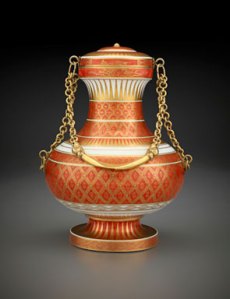
Vase Japon, 1774, Royal Manufactory of Sèvres, painted and gilded hard-paste porcelain with silver-gilt mounts, The Frick Collection; photo: Michael Bodycomb
The Frick’s Board of Trustees announces the acquisition of two objects that will enhance the museum’s holdings in areas that interested founder Henry Clay Frick at the end of his life: eighteenth-century French porcelain and Italian Renaissance drawings. A rare and beautiful vase created at the Royal Manufactory of Sèvres has been acquired in honor of Anne L. Poulet, who retired at the end of September after serving as Director for eight years. The vase, a partial purchase by the Frick and a partial gift from Alexis and Nicolas Kugel, is the first piece of hard-paste porcelain from the Royal Manufactory of Sèvres to enter the Collection. It complements the museum’s substantial Sèvres holdings made with the earlier soft-paste formula, objects obtained by Mr. Frick from the dealer Joseph Duveen. This latest acquisition is particularly appropriate given the interest of Director Emerita Anne Poulet in eighteenth-century French decorative arts. The vase will be displayed this winter alongside selections from a promised gift of hard-paste Meissen porcelain objects in the new Portico Gallery for Decorative Arts and Sculpture, which opens to the public on December 13. Also entering the collection is an important Italian Renaissance by drawing the Sienese artist Domenico Beccafumi (1486–1551), a two-sided sheet given to the Frick by Trustee Barbara G. Fleischman in honor of Deputy Director and Peter Jay Sharp Chief Curator Colin B. Bailey.
Despite its name, the Vase Japon is a French interpretation of a Chinese Yu (or Hu) vase from the Han Dynasty (206 B.C–A.D. 220). Examples of this type of baluster-shaped vessel survive in bronze and earthenware. Documents from the Sèvres archives indicate that the Frick vase was made in 1774 along with two others of the same size, shape, and decoration. Each bears the mark of the gilder-painter Jean-Armand Fallot, who was active at Sèvres between 1765 and 1790. Of the three, however, only the Frick vase is adorned with an elaborate silver-gilt handle and chain, which, like its shape and surface pattern, were directly inspired by the Chinese model. The mounts bear the mark of Charles Ouizille (1744–1830), who worked extensively for the French court throughout the 1770s and 1780s and became Marie-Antoinette’s favorite jeweler. He created exquisite gold mounts for the queen’s rare and precious collections of hard-stone vases and cups.
The shape and decoration of the Vase Japon derive from a woodblock print reproduced in a forty-volume catalogue of the vast Chinese imperial collections (a record compiled at the behest of the Qianlong Emperor who reigned 1735–1796). Included are entries for more than fifteen hundred ancient bronze objects—primarily ritual vessels, but also mirrors, lamps, and weapons—each accompanied by a brief description of its size and origin. Sometime during the 1770s, Father Joseph Amiot, a Jesuit missionary working in Peking, sent a copy of this catalogue to Henri Bertin in Paris. Bertin was France’s secretary of state and had recently been appointed the commissaire du roi at the Sèvres manufactory, an administrative position he held until 1780. In addition to being a politician and a businessman, Bertin was an art collector with a profound interest in China and Chinese art, and he likely played a key creative role in the production of this piece.
The Vase Japon is exceptional in that Sèvres did not typically produce objects based directly on antique prototypes. It differs markedly from the manufactory’s Chinoiserie production, the decorations of which evoke a fanciful vision of China and the Far East as imagined by artists such as François Boucher. The Vase Japon represents an early attempt by the Sèvres manufactory to produce something more authentic, patterned after an ancient Chinese model. Such a distinctly antiquarian approach was not widely adopted by makers of French ceramics until the early nineteenth century.
Adds Associate Curator of Decorative Arts Charlotte Vignon, “This unusual piece of recently discovered porcelain exemplifies the technical and artistic excellence reached at the Royal Manufactory of Sèvres in the third quarter of the eighteenth century. It not only complements the French porcelain purchased by Henry Clay Frick more than one hundred years ago, but it also creates an interesting dialogue with the important collection of porcelain from the German Meissen Factory that has been pledged to the Frick by Henry Arnhold. This group of objects includes many made explicitly after Japanese, Chinese, and Korean forms, and we look forward to presenting a selection of them together with the Vase Japon this winter in the new Portico Gallery for Decorative Arts and Sculpture.” . . .
The full press release is available here»










 Enfilade
leave a comment