Exhibition: Satire and Religion
From The Walpole Library:
Sacred Satire: Lampooning Religious Belief in Eighteenth-Century Britain
The Lewis Walpole Library, Farmington, Connecticut, 22 September 2011 — 2 March 2012
Curated by Misty Anderson and Cynthia Roman
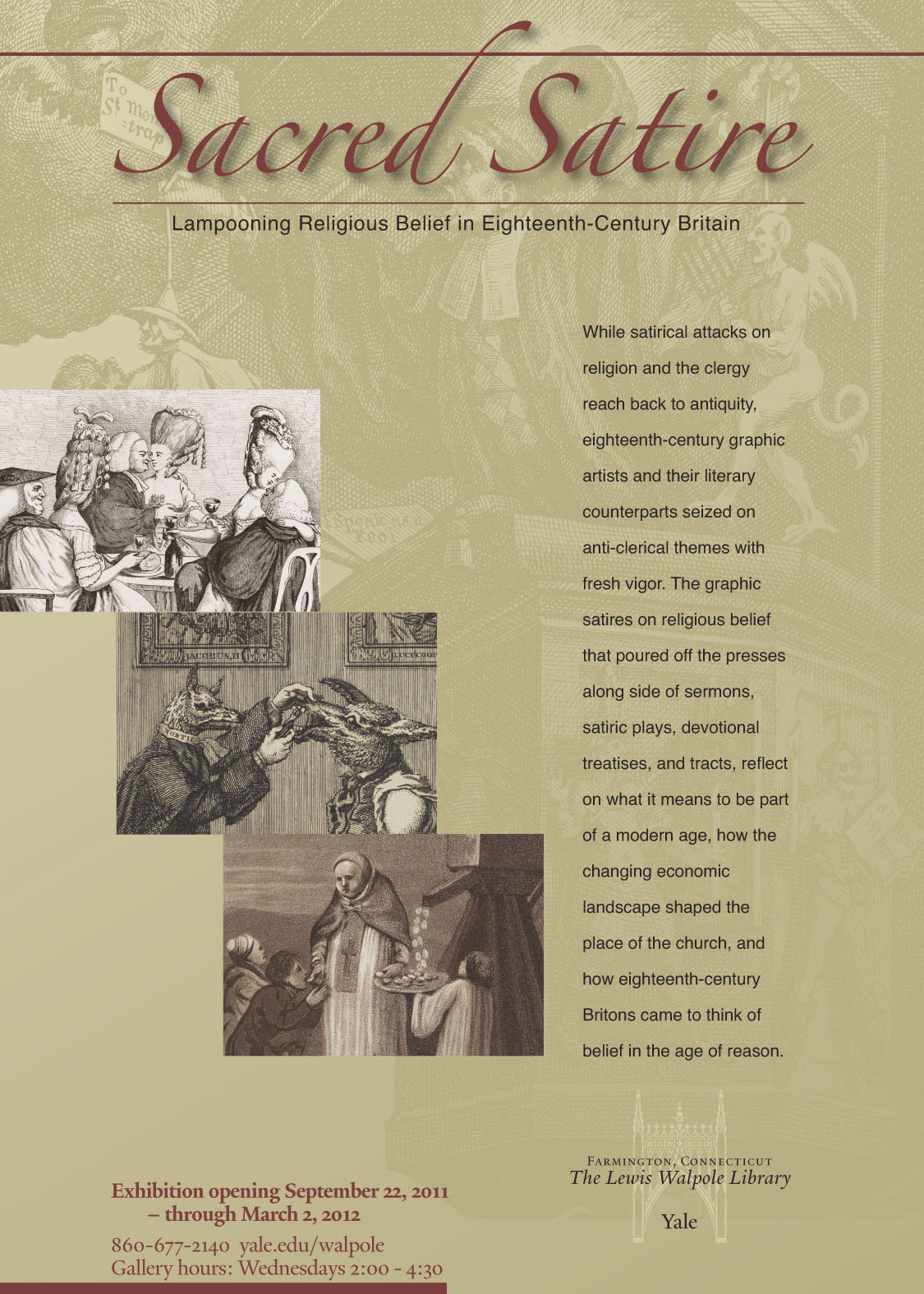 Religious beliefs and practices provided ample subject matter for the irreverent printmakers producing graphic satire in eighteenth-century Britain. While clerical satire is an ancient mode, eighteenth-century British artists seized on it with fresh vigor. Satirists appropriated centuries-old themes like corruption, hypocrisy, and greed, but updated them with contemporary concerns about the role of religion in the age of enlightenments. The visual rhetoric of these prints illustrates some of the ways in which eighteenth-century Britons were renegotiating their relationship to religious practice and belief.
The prints in this exhibition reflect a tension between a vision of religion as part of traditional life and the emergence of modern Christianity as a collection of new movements, practices, and ideas about belief. The eighteenth-century images on display preserve for us a moment in an ongoing conversation about the relationship of religion, representation, and modernity.
Call for Papers: London-Irish
The London-Irish in the Long Eighteenth Century, 1680-1830
University of Warwick, 13-14 April 2012
Proposals due by 31 January 2012
 The Irish became an intrinsic part of the London population through the course of the eighteenth century. Whether Catholic and Protestant, professional or plebeian, London provided opportunities for waves of Irish migrants. Irish migrants can of course be found throughout Britain (and Europe) at this time but London offered a burgeoning world capital that embraced all tiers of Irish society. The Irish, from both sides of the religious divide, could be found almost anywhere in London: in its kitchens, drawing rooms, legal chambers, banking houses, theatres, newspaper offices, and courts. Nevertheless robust systematic historical data on these migrants is scarce – such accounts that exist of the Irish diaspora in pre-1815 London (Denvir, Akenson, and Jackson) are useful but fragmentary and Irish historiography on the diaspora has generally tended to concentrate on the famine years.
There is work on Irish Catholics in Europe but only recently have more focused accounts of Irish networks operating in London in the eighteenth century begun to emerge. Yet despite the sparse accounts of their activities, there was certainly a strong Irish – Catholic as well as Protestant – presence in London throughout this period. Archbishop King warned that Irish visitors in London ‘converse only in a very sneaking private way with one another’ and this observation suggests a metropolitan space within which the Irish diaspora could form themselves into tight social and professional networks. The study of such networks would provide a fresh perspective on London in the long eighteenth century. How did such networks form? How did they evolve? To what degree were they inclusive/ exclusive? How did they represent ‘Irishness’ and/or Ireland to London? And how were they received?
This interdisciplinary conference is being organized by David O’Shaughnessy and will be hosted by the Department of English & Comparative Literature, University of Warwick. Plenary lectures will be given by Professor Toby Barnard (History, University of Oxford); Professor Claire Connolly (Literature, University of Cardiff; and Professor Mary Hickman (Sociology, London Metropolitan University). Papers will be welcomed in all disciplines and from scholars at all stages of their careers. The deadline for 300-word abstracts is 31 January 2011 (email: londonirish@warwick.ac.uk). Suggested topics might include but are not limited to:
- Quantifying the Irish diaspora (population, migration patterns/routes, births, deaths, baptisms, funerals)
- Defining an Irish community/network
- Catholic and Protestant communities/networks
- Professional Irish (lawyers, bankers, merchants, tutors, physicians, booksellers)
- Literary and artistic Irish (theatre, newspapers, literary clubs, artists, Society of Antiquaries, Royal Academy, bookshops)
- Labouring Irish (military, servants, sailors, shipwrights, builders)
- Religious Irish (places of worship, priests)
- Political Irish (clubs, societies, parliament, lobbyists, spies, petitioners, the Irish at court)
- Anti-Irish sentiment
- Irish language
- Riots
- Sport
- Irish societies and charitable organizations
- The Irish on trial (lawyers and criminals)
- The rise of the Irish pub (taverns/coffee houses patronised by the Irish)
- The Irish ‘ghetto’ (geography of the Irish in London)
- Irish elites and their circles (Burke, Goldsmith, Sheridan)










 Enfilade
leave a comment