On 11.11.11 at 11am . . .
On Friday, the much-anticipated Crystal Bridges Museum of American Art opens in Bentonville, Arkansas. We’re sure to hear a lot about it in the coming weeks. In the meantime, Julia Halperin’s short piece for ArtInfo (7 October 2011) highlights a few early responses (Rebecca Mead’s article for The New Yorker is especially good on the origins of the project) . . .
◊ ◊ ◊ ◊ ◊
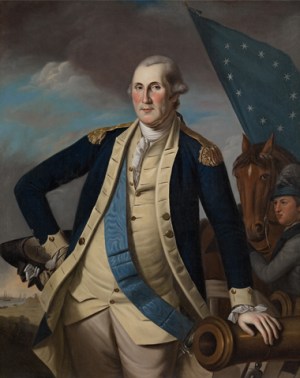
Charles Willson Peale, "George Washington," ca. 1780-82 (Crystal Bridges Museum of American Art)
Wal-Mart heiress Alice Walton’s mammoth Crystal Bridges Museum of American Art in Arkansas will soon be open for business, and The Washington Post’s Philip Kennicott snagged the coveted first look.
The $800 million museum has been subject to sharp skepticism in the art world (though not, it should be noted, in The New Yorker or The New York Times). Many art professionals believe the museum is “too rich, too conservative, and too reflexively American” to be a major player, according to Kennicott. So what’s his verdict? Apparently, money may not buy the art world’s happiness, but it can buy a pretty impressive museum.
“There’s no embarrassment about the immense fortune that made the museum possible, no old-fashioned cultural money-laundering in the manner of Carnegie or Mellon,” writes Kennicott of the museum, which will be free for everyone, forever thanks to a $20 million donation from Wal-Mart. “It is a mature, serious, relatively progressive museum launched at a
time when increasing numbers of people consider themselves
socially tolerant and fiscally conservative.”
◊ ◊ ◊ ◊ ◊
Writing for Architectural Record (17 October 2011), Fred Bernstein responds to Moshe Safdie’s building . . .
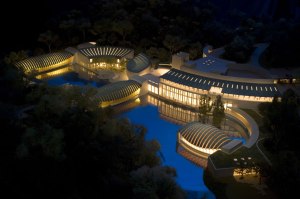
Model of Moshe Safdie's design for Crystal Bridges Museum of American Art (Photo: John Horner)
. . . Putting a museum containing many of the acknowledged masterpieces of American art above ponds fed by an active spring smacks of hubris. But a complex flood control system, approved by three separate consultants and monitored by the Army Corps of Engineers, has been designed to protect the building and its contents. Crystal Bridges’ executive director, Don Bacigalupi, said in an interview that the confluence of running water and precious artworks worried him when he first took the job—but now, having studied the plans, he believes, the museum is prepared for what he called “the next Noah flood.”
The high-water act pretty much sums up the paradox of Crystal Bridges. Alice Walton, the Walmart heir who founded, and largely funded, the museum, chose to build it in the town where her father opened his first five-and-dime. (Sam Walton’s original store, now operated as a cozy Walmart history museum, is a few blocks away.) But Sam’s daughter, who is famous for being unpretentious, let the project evolve into an architectural extravaganza, comparable to some of Safdie’s other recent projects, the curving Kauffman Center for the Performing Arts, in Kansas City, and the Marina Bay Sands resort complex in Singapore (with a park cantilevered off three 55-story towers), beautiful forms arranged for maximum impact. . . .
The full review is available here»
Call for Papers: Chicago Art Journal
From the Chicago Art Journal:
Chicago Art Journal: Historiographies of New Media
Proposals due by 28 November 2011
 The Chicago Art Journal, the annual publication of the University of Chicago Department of Art History, is seeking submissions of original work by graduate students and faculty for its 2011-2012 edition. This year’s issue asks how new media have affected not only the production of art, but also the production of knowledge about art. What is at stake in approaching art history through the concept of new media?
The term ‘new media’ has been applied to a range of formats (from photography to video to the internet) that have revolutionized the modes of transmission and reproduction of ‘old’ media of art at particular historical moments. Although the concept of new media seems to promise a mass media address, artists have often emphasized the limits of circulation—for instance, in closed circuit television, or zines that made use of Xerox processes and yet were distributed to small networks through the mail. Such a dialectical relation escapes media theory’s emphasis on mass distribution, and points instead toward misalignments and points of friction between the imaginative and material aspects of new media. Furthermore, from the double slide lecture to the publication of photographs in books, and from the use of facsimiles in the classroom to broadcasts of ‘art on television,’ the formation and performance of the art historical discipline has itself been contingent upon pivotal introductions of reproductive media. In turning our attention to new media, we consider art history’s rhetorics of description and display.
The importance of thinking through the art historical repercussions of new media has become paramount. Just as recent scholarship has addressed the nuances of ‘pre-modern’ and modern notions of mediality (including forms of mechanical reproducibility and audiovisual displays emergent in the middle ages), so might we aim to reframe more contemporary art historical categories of ‘lateness’ (such as Rosalind Krauss’s ‘post-medium condition’). Here we propose examining notions of new media within a long durée. How do such temporal categories foreground technologies that are positioned as obsolete? As Peter Weibel has proposed, “the intrinsic success of the new media resides less in the fact that they have developed new forms and possibilities of art than in the fact that they have enabled us to establish new approaches to the old media of art—and above all, have kept the latter alive by forcing them to undergo a process of radical transformation.” What conditions of possibility are embedded (or not) in the positioning of art as new media? How might we emphasize the aesthetic and pedagogical aspects of new media over notions that emerged out of communications theory, such as interactivity? We are especially interested in papers that address new media art histories that diverge from the well-known chronologies of Euro-American technological developments. Topics might include but are not limited to:
• performance and circulation of art history through facsimiles, photographs, slide projections, radio, and television
• responses and counter-responses to new media technologies within art criticism, critical theory, and film theory
• legacies of Friedrich Kittler and Miriam Hansen for theorizing new media
• analog and digital in art and art history
• historical modes of mechanical reproduction, imprinted coins, technologies of the book, seals, etc.
• ekphrasis
• transfers and transformations among media, media as reference for other media
• in what way are new media performative and public?
• materiality of new media, processes of materials
• new media and abstraction, issues of movement and circulation
• wider implications of artists’ practices in Xerox, zines, artists’ books, flip books, holograms, etc.
• relationship between art transmitted through media and art as media
• aesthetics of television in the context of capitalism and communism
• new media’s relevance for reframing art historical cycles and geographies of innovation
• challenges to medium specificity, from medium unspecificity to post-medium condition
• art and technology movements, including the role of dance and ‘new music’
• computerized models of art, computational ways of thinking
• collectivity and coalitions, notions of ‘social media’
• photography as new media
• historiographies of ‘video art,’ including the role of projection and the long durée of optical media
• queer aesthetics and new media
• painting after the advent of network theory
• theories of text as visual image and text as mediation
Submissions
Full papers must follow The Chicago Manual of Style, and should not exceed 4000 words. Each submission should include an abstract of approximately 500 words. If you would like to submit an abstract without a full paper, please contact the editors in advance. Both Word documents and PDFs are welcome. All contributors should include their name, address, telephone number, and email address. Authors are responsible for securing image reproduction rights and any associated fees. Please send submissions to the graduate student editors Solveig Nelson and Stephanie Su at UChicagoArtJournal@gmail.com by November 28, 2011.










 Enfilade
1 comment