Conference: Art Against the Wall
From The Courtauld:
Art against the Wall
The Courtauld Institute of Art, Somerset House, London, 19 November 2011
Organized by Thomas Balfe and Jocelyn Anderson
 Art against the Wall is the third symposium of The Courtauld’s Early Modern department. The symposium will provide an occasion for established and emerging scholars to present and discuss their research together. This one-day symposium will explore the relationship between walls and art in early modern visual culture. During the period 1550-1850 the interplay between work and wall became increasingly complex as art objects began to pull away from the walls which had previously defined them. The enduring association between artistic skill and craft production meant that many art works were often still regarded as elements in overarching decorative schemes; paintings installed in eighteenth-century English domestic interiors, for example, continue to be described as part of the ornamentation, even as the furniture, of a room. Conversely, walls now had the power to redefine art works, giving them a new meaning through a new context; thus, in late sixteenth-century debates on the status of the religious image, walls – which map the division between sacred and secular space – take on crucial importance. Yet the wall could also become art, as the numerous examples of trompe l’oeil wall illustration to be found in seventeenth-century architecture and garden design suggest. Taking as its point of departure Derrida’s insight that there can be no clear separation of ergon (work) from parergon (not-the-work, ‘wall’), the symposium will attempt to investigate the rich questions raised by the phenomenon of art against the wall.
To book a place: £15 (£10 students) Please send a cheque made payable to ‘Courtauld Institute of Art’ to: Research Forum Events Co-ordinator, Research Forum, The Courtauld Institute of Art , Somerset House, Strand, London WC2R 0RN, clearly stating that you wish to book for the ‘Art against the Wall’ symposium. For credit card bookings call 020 7848 2785 (9.30 – 18.00, weekdays only). For further information, send an email to ResearchForumEvents@courtauld.ac.uk
◊ ◊ ◊ ◊ ◊
P R O G R A M M E
9:30 Registration
10:00 Introduction – Jocelyn Anderson and Thomas Balfe (The Courtauld Institute of Art)
SESSION 1: Work, Wall and Space: How Does Art Fit In?
10:15 Rodrigo Cañete (The Courtauld Institute of Art), Velazquez’s Wall Hermeneutics or How Only His Role as Palace Superintendent Can Allow Us to Unlock The Meaning of His Paintings
10:35 Dario Donetti (Scuola Normale Superiore, Pisa), ‘Quattordici cappelle a canto al muro’: Some Architectural Issues Concerning Santa Croce in Florence under Cosimo I de’ Medici
10:55 Catherine McCormack (UCL), Caravaggio’s Madonna of the Pilgrims or Just Another Brick in the Wall?
11:15 Discussion
11:30 COFFEE/TEA BREAK
SESSION 2: Domestic Displays: Art in London Residences
12:00 Adriano Aymonino (Getty Research Institute), The Integration of the Arts in British Neoclassical Interiors: Aesthetics and Meaning
12:20 Susannah Brooke (Queens’ College, Cambridge), Issues of Display: a Private Picture Collection in London, c. 1795-1820
12:40 Gerry Abalone (Tate), Painting, Frame and Setting
13:00 Discussion
13:15 LUNCH (not provided)
SESSION 3: The Wall Transformed: Monumental Illusionism
15:15 Meriel May Geolot (independent scholar), Unravelling the Tapestries: The Gobelin’s Tentures de Boucher in the Late Georgian English Country Home
14:35 Marika T. Knowles (Yale University), Pierrot and the Wall-Mask, or How the Wall Became a Character
14:55 Kristina Kleutghen (Washington University, St Louis), Contradictions of Illusion and Immateriality: Psycho-Pictorial Disjunctions in Early Modern Chinese Wall Paintings
15:15 Discussion
15:30 COFFEE/TEA BREAK
SESSION 4: Ergon/Parergon: Grand Schemes in Palaces
16:00 Kevin Childs (British School at Rome), ‘…piena di grazia, di bellissime fantasie e di molte capricciose…’ Michelangelo’s Sistine Chapel Ceiling and the Wall that is no Wall in late sixteenth-century Roman Fresco Decoration
16:20 Francesco Freddolini (Getty Research Institute), The Eloquent Walls: Stucco Decoration and Display of Art in Seventeenth-Century Rome
16:40 Friederike Drinkuth (Stately Palaces and Gardens Mecklenburg) and Tobias Locker (Technische Universität, Berlin), Reconsidering the Frederican Rococo: The Discovery of Mirow Palace
17:00 Discussion and concluding remarks
17:30 RECEPTION
Abstracts of the talks are available as a PDF file here»
Call for Papers: Graduate Student Symposium in Vancouver
Graduate Student Symposium in Vancouver: The Unseen
University of British Columbia, Vancouver, 30-31 March 2012
Proposals due 6 January 2012
The Unseen proposes a blind engagement with the visual. While traditional art historical practice assumes the task of making the art object or artifact whole through observation, description, and interpretation, this symposium instead sets out to embrace a trace that may be fractured, destroyed, moved, translated, historicized, censored, extolled or ignored. The 31st annual University of British Columbia Art History, Visual Art and Theory Graduate Symposium will attend to a critical reassessment of what resists representation, description, articulation or documentation. We seek innovative submissions that investigate and conceptualize the notion of the unseen as it intersects with historical, perceptual, political and philosophical claims concerning the production and circulation of meanings and forms of knowledge.
Unseeing describes both a category of historical analysis and a critical action. Recent studies on visuality and visual culture have asserted the primacy of the visual as a “social fact” constituting historical and contemporary modes of perception and lived experience. By challenging what is or has once been at the boundaries of visuality and visibility, the unseen alternately aims to grasp the unseizable and its potentiality as a form of non-knowledge. This methodological reevaluation further underscores the historiographical problematic of the unwritten or the unwriteable, discerning what has been occluded from or has escaped being written into histories of the visual, or what has become embedded in and normative of others.
Current and recently graduated Master of Arts, Masters of Fine Arts, Doctoral and Post Doctoral scholars are encouraged to submit an abstract of no more than 300 words by January 6, 2011. Include your full name, affiliation and contact information and send your abstract to gradsymp@interchange.ubc.ca.
The 31st Annual AHVAT Graduate Symposium includes a two-day symposium on March 30 and 31, 2012, and a concurrent exhibition, dates to be confirmed. For more information please visit: http://www.ahva.ubc.ca.
Francesco Vezzoli Transforms Hip-Hop Star into Rococo Icons
From the November 2011 issue of W Magazine:
Agents Provocateurs: Nicki Minaj Transformed by Francesco Vezzoli
Klaus Biesenbach interviews Francesco Vezzoli

Francesco Vezzoli (styled by Edward Enninful), "Rococo Portrait of Nicki Minaj as Jeanne Antoinette Poisson, Marquise de Pompadour," 2011
In the space of two years, hip-hop star Nicki Minaj has made the leap from little known Lil Wayne protégée to object of national obsession, via a number-one album, seven singles simultaneously on the Billboard Hot 100—a first for any artist—and a series of scene-stealing cameos, including an epic verse on the Jay-Z and Kanye West track “Monster.” Along the way, she’s established a zany look (all neon, all the time), introduced countless alter egos, and become the first female rapper since Missy Elliott to be cast not as a sidekick but as a bona fide swaggering leading lady.
Powerful female figures have always been a draw for the artist Francesco Vezzoli, who has produced a trailer for a mock remake of Gore Vidal’s Caligula featuring Courtney Love and made a fake-fragrance commercial starring Natalie Portman and Michelle Williams. Through film, performance, and images often enhanced with embroidery, the 40-year-old Italian links contemporary icons to historic representations of women in art. He transformed Eva Mendes into Bernini’s masterpiece The Ecstasy of Saint Teresa for his Prada Foundation installation at this year’s Venice Biennale and, for MOCA’s 30th-anniversary gala in 2009, he reimagined Lady Gaga as a latter-day Ballets Russes star. Now Vezzoli has remade Minaj as an 18th-century courtesan. To discuss the project, he sat down for a lively tête-à-tête with Klaus Biesenbach, director of MoMA PS1, who is organizing a touring retrospective of Vezzoli’s work that will land at the New York venue in 2013.
BIESENBACH (W Magazine): How have you transformed [Nicki Minaj]?
VEZZOLI: In her performances, Minaj makes very explicit and challenging use of her beauty and her body, so I thought of comparing her to some of the most famous courtesans in history: the Marquise de Montespan, Comtesse du Barry, Madame de Pompadour, and Madame Rimsky-Korsakov. My idea was to reproduce four iconic portraits of some of the most fascinating females of the past in a series starring an American pop-culture role model. We tried to re-create those original portraits using similar furniture, props, and clothing, à la Visconti. Luckily enough, the result came out as surreal as it could be, just as I wished. . . .
To see the slideshow of Minaj in the guise of eighteenth-century women of the court, read the full interview here»
Exhibition: Mexican Miracle Paintings at the Wellcome
From the Wellcome Collection:
Infinitas Gracias: Mexican Miracle Paintings
Wellcome Collection, London, 6 October 2011 — 26 February 2012
Mexican votives are small paintings, usually executed on tin roof tiles or small plaques, depicting the moment of personal humility when an individual asks a saint for help and is delivered from disaster and sometimes death. Infinitas Gracias will feature over 100 votive paintings drawn from five collections held by museums in and around Mexico City and two sanctuaries located in mining communities in the Bajío region to the north: the city of Guanajuato and the distant mountain town of Real de Catorce. Together with images, news reports, photographs, devotional artefacts, film and interviews, the exhibition will illustrate the depth of the votive tradition in Mexico.
Usually commissioned from local artists by the petitioner, votive paintings tell immediate and intensely personal stories, from domestic dramas to revolutionary violence, through which a markedly human history of communities and their culture can be read. The votives displayed in Infinitas Gracias date from the 18th century to the present day. Over this period, thousands of small paintings came to line the walls of Mexican churches as gestures of thanksgiving, replacing powerful doctrine-driven images of the saints with personal and direct pleas for help. The votives are intimate records of the tumultuous dramas of everyday life – lightning strikes, gunfights, motor accidents, ill-health and false imprisonment – in which saintly intervention was believed to have led to survival and reprieve.
Infinitas Gracias will explore the reaction of individuals at the moment of crisis in which their strength of faith comes into play. The profound influence of these vernacular paintings, and the artists and individuals who painted them, can be seen in the work of such figures as Diego Rivera and Frida Kahlo, who were avid collectors. The contemporary legacy of the votive ritual will be present in the exhibition through a wall covered with modern-day offerings from one church in Guanajuato: a paper shower of letters, certificates, photographs, clothing and flowers, through which the tradition of votive offering continues today. The sanctuaries at Guanajuato and Real de Catorce remain centres of annual pilgrimage, attracting thousands of people to thank and celebrate their chosen saints.
The East India Company at Home
As noted by Emile de Bruijn at Treasure Hunt (and he includes terrific images), a new program developed at Warwick University aims to explore the routes by which Asian luxury goods arrived in Britain’s country houses. From the program’s website:
 The East India Company at Home, 1757-1857 is a 3-year research project (beginning in September 2011 and ending in August 2014) funded by the Leverhulme Trust. The project is one of the many externally-funded research programmes developed under the aegis of Warwick University’s Global History & Culture Centre.
This new project is led by Margot Finn, a professor of modern British History at Warwick. Dr Helen Clifford will play a leading role in orchestrating the project’s engagement with local and family historians, working together with the project’s full-time postdoctoral research fellow, Dr Kate Smith. Ms Ellen Filor will be funded by the grant to complete a doctoral dissertation on East India Company family networks and identities in Roxburghshire, Scotland (c. 1780-1857) as an integral part of the larger research team.
The project seeks to enhance historical understanding of the form and function of British country house culture by situating changes in elite domestic interiors within wider global contexts. Specifically, it explores the regional, national and imperial routes by which Asian luxury goods – ceramics, textiles, metal-ware, furniture, fine art and the like – found their way into the homes of Britain’s governing elite in the Georgian and early Victorian periods, and examines what these exotic objects meant in these domestic settings and in wider national and international contexts. The project builds upon recent developments in the study of consumer culture, gender studies, globalisation, and material culture.
The project also capitalises upon the recent explosion of historical research conducted by community-based family historians. The East India Company at Home, 1757-1857 seeks to integrate the findings produced by family and local historians, curators, academics and other researchers into a wider collaborative research project that illuminates Britain’s global material culture from the eighteenth century to the present.
For more information, visit the program’s website or click here to download a brochure.
On 11.11.11 at 11am . . .
On Friday, the much-anticipated Crystal Bridges Museum of American Art opens in Bentonville, Arkansas. We’re sure to hear a lot about it in the coming weeks. In the meantime, Julia Halperin’s short piece for ArtInfo (7 October 2011) highlights a few early responses (Rebecca Mead’s article for The New Yorker is especially good on the origins of the project) . . .
◊ ◊ ◊ ◊ ◊
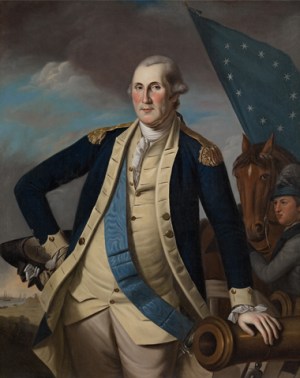
Charles Willson Peale, "George Washington," ca. 1780-82 (Crystal Bridges Museum of American Art)
Wal-Mart heiress Alice Walton’s mammoth Crystal Bridges Museum of American Art in Arkansas will soon be open for business, and The Washington Post’s Philip Kennicott snagged the coveted first look.
The $800 million museum has been subject to sharp skepticism in the art world (though not, it should be noted, in The New Yorker or The New York Times). Many art professionals believe the museum is “too rich, too conservative, and too reflexively American” to be a major player, according to Kennicott. So what’s his verdict? Apparently, money may not buy the art world’s happiness, but it can buy a pretty impressive museum.
“There’s no embarrassment about the immense fortune that made the museum possible, no old-fashioned cultural money-laundering in the manner of Carnegie or Mellon,” writes Kennicott of the museum, which will be free for everyone, forever thanks to a $20 million donation from Wal-Mart. “It is a mature, serious, relatively progressive museum launched at a
time when increasing numbers of people consider themselves
socially tolerant and fiscally conservative.”
◊ ◊ ◊ ◊ ◊
Writing for Architectural Record (17 October 2011), Fred Bernstein responds to Moshe Safdie’s building . . .
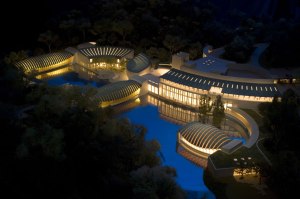
Model of Moshe Safdie's design for Crystal Bridges Museum of American Art (Photo: John Horner)
. . . Putting a museum containing many of the acknowledged masterpieces of American art above ponds fed by an active spring smacks of hubris. But a complex flood control system, approved by three separate consultants and monitored by the Army Corps of Engineers, has been designed to protect the building and its contents. Crystal Bridges’ executive director, Don Bacigalupi, said in an interview that the confluence of running water and precious artworks worried him when he first took the job—but now, having studied the plans, he believes, the museum is prepared for what he called “the next Noah flood.”
The high-water act pretty much sums up the paradox of Crystal Bridges. Alice Walton, the Walmart heir who founded, and largely funded, the museum, chose to build it in the town where her father opened his first five-and-dime. (Sam Walton’s original store, now operated as a cozy Walmart history museum, is a few blocks away.) But Sam’s daughter, who is famous for being unpretentious, let the project evolve into an architectural extravaganza, comparable to some of Safdie’s other recent projects, the curving Kauffman Center for the Performing Arts, in Kansas City, and the Marina Bay Sands resort complex in Singapore (with a park cantilevered off three 55-story towers), beautiful forms arranged for maximum impact. . . .
The full review is available here»
Call for Papers: Chicago Art Journal
From the Chicago Art Journal:
Chicago Art Journal: Historiographies of New Media
Proposals due by 28 November 2011
 The Chicago Art Journal, the annual publication of the University of Chicago Department of Art History, is seeking submissions of original work by graduate students and faculty for its 2011-2012 edition. This year’s issue asks how new media have affected not only the production of art, but also the production of knowledge about art. What is at stake in approaching art history through the concept of new media?
The term ‘new media’ has been applied to a range of formats (from photography to video to the internet) that have revolutionized the modes of transmission and reproduction of ‘old’ media of art at particular historical moments. Although the concept of new media seems to promise a mass media address, artists have often emphasized the limits of circulation—for instance, in closed circuit television, or zines that made use of Xerox processes and yet were distributed to small networks through the mail. Such a dialectical relation escapes media theory’s emphasis on mass distribution, and points instead toward misalignments and points of friction between the imaginative and material aspects of new media. Furthermore, from the double slide lecture to the publication of photographs in books, and from the use of facsimiles in the classroom to broadcasts of ‘art on television,’ the formation and performance of the art historical discipline has itself been contingent upon pivotal introductions of reproductive media. In turning our attention to new media, we consider art history’s rhetorics of description and display.
The importance of thinking through the art historical repercussions of new media has become paramount. Just as recent scholarship has addressed the nuances of ‘pre-modern’ and modern notions of mediality (including forms of mechanical reproducibility and audiovisual displays emergent in the middle ages), so might we aim to reframe more contemporary art historical categories of ‘lateness’ (such as Rosalind Krauss’s ‘post-medium condition’). Here we propose examining notions of new media within a long durée. How do such temporal categories foreground technologies that are positioned as obsolete? As Peter Weibel has proposed, “the intrinsic success of the new media resides less in the fact that they have developed new forms and possibilities of art than in the fact that they have enabled us to establish new approaches to the old media of art—and above all, have kept the latter alive by forcing them to undergo a process of radical transformation.” What conditions of possibility are embedded (or not) in the positioning of art as new media? How might we emphasize the aesthetic and pedagogical aspects of new media over notions that emerged out of communications theory, such as interactivity? We are especially interested in papers that address new media art histories that diverge from the well-known chronologies of Euro-American technological developments. Topics might include but are not limited to:
• performance and circulation of art history through facsimiles, photographs, slide projections, radio, and television
• responses and counter-responses to new media technologies within art criticism, critical theory, and film theory
• legacies of Friedrich Kittler and Miriam Hansen for theorizing new media
• analog and digital in art and art history
• historical modes of mechanical reproduction, imprinted coins, technologies of the book, seals, etc.
• ekphrasis
• transfers and transformations among media, media as reference for other media
• in what way are new media performative and public?
• materiality of new media, processes of materials
• new media and abstraction, issues of movement and circulation
• wider implications of artists’ practices in Xerox, zines, artists’ books, flip books, holograms, etc.
• relationship between art transmitted through media and art as media
• aesthetics of television in the context of capitalism and communism
• new media’s relevance for reframing art historical cycles and geographies of innovation
• challenges to medium specificity, from medium unspecificity to post-medium condition
• art and technology movements, including the role of dance and ‘new music’
• computerized models of art, computational ways of thinking
• collectivity and coalitions, notions of ‘social media’
• photography as new media
• historiographies of ‘video art,’ including the role of projection and the long durée of optical media
• queer aesthetics and new media
• painting after the advent of network theory
• theories of text as visual image and text as mediation
Submissions
Full papers must follow The Chicago Manual of Style, and should not exceed 4000 words. Each submission should include an abstract of approximately 500 words. If you would like to submit an abstract without a full paper, please contact the editors in advance. Both Word documents and PDFs are welcome. All contributors should include their name, address, telephone number, and email address. Authors are responsible for securing image reproduction rights and any associated fees. Please send submissions to the graduate student editors Solveig Nelson and Stephanie Su at UChicagoArtJournal@gmail.com by November 28, 2011.
Exhibition: Masterworks from the Speed Art Museum in Tulsa
Press release from the Philbrook:
Magnificent Vision: Two Centuries of European Masterworks from the Speed Art Museum
Philbrook Museum of Art, Tulsa, 9 October 2011 — 8 January 2012
Flint Institute of Arts, Flint, Michigan, 5 May — 19 August 2012

Adélaïde Labille-Guiard, “Portrait of Madame Adélaïde,” ca. 1787, oil on canvas (Louisville: Speed Art Museum)
After two exhibitions focusing primarily on work from 20th-century America, Tulsa’s Philbrook Museum of Art is preparing for a dramatic shift in both time and setting. For the Museum’s final and biggest show of the year, the Museum is taking a look back at Europe in the 17th and 18th centuries. Magnificent Vision: Two Centuries of European Masterworks from the Speed Art Museum features more than 70 major works by the likes of Rembrandt, Rubens, Tiepolo, and Gainsborough.
The works in the exhibition are entirely drawn from the permanent collection of the Speed Art Museum in Louisville, KY, one of this country’s premier regional art museums. Forming the backdrop to this exhibition, which is organized thematically, is a two-hundred-year period in which European art underwent a dramatic and radical transformation. During the 1600s, particularly in the Netherlands, a newly affluent populace with a desire to improve their standing in society helped to generate a tremendous demand for artwork, and the market for paintings boomed. In the 1700s, as the artistic profession became institutionalized, the mood shifted and the abundance and variety of the earlier period was replaced. As significant taste-making institutions like the Academie des Beaux-Arts in Paris gained new power, demand for paintings remained high but became more focused.
“It is a group of paintings that not only dovetails beautifully with Philbrook’s own collection, but it also elegantly reflects one of the most extraordinary and inspiring periods in European art; it was truly a Golden Age,” says Dr. Tanya Paul, Philbrook’s Ruth G. Hardman Curator of European Art.
Call for Papers: Cleveland Symposium
Cleveland Graduate Student Symposium — Things Fall Apart: Fragmentation in Visual Culture
Cleveland Museum of Art, 23 March 2012
Proposals due 15 December 2011
 The 2012 Cleveland Symposium invites graduate submissions exploring the theme of fragmentation in the visual arts. This trope has manifested itself in a variety of ways in response to political, social, ideological, or aesthetic trends of a particular epoch. Students are encouraged to interpret this theme broadly, through avenues such as iconoclasm, revolution, political upheaval, physical fragmentation of materials, or particular aesthetic movements.
We welcome submissions from graduate students in all stages of their studies and from all fields and geographic regions, ranging from ancient through contemporary art. We will also consider papers from a wide range of methodologies and approaches. A monetary prize will be awarded to the speaker who presents the most innovative research in the most successfully delivered paper.
Please send an abstract of no more than 300 words for papers of no longer than 20 minutes, along with a curriculum vitae or résumé, to clevelandsymposium@gmail.com by December 15, 2011. Please include “Cleveland Symposium Submission” in the subject line of your email. Selected presenters will be notified by January 1, 2012.
Reviewed: The Intelligence of Tradition in Rajput Court Painting
Recently added to caa.reviews:
Molly Emma Aitken, The Intelligence of Tradition in Rajput Court Painting (New Haven: Yale University Press, 2010), 352 pages, ISBN: 9780300142297, $65.
Reviewed by Catherine Glynn; posted 21 October 2011.
“Why Rajput paintings look the way that they do” is the enormous concept that Molly Emma Aitken addresses in ‘The Intelligence of Tradition in Rajput Court Painting’. Fortunately for readers entering into her innovative and complex thinking, Aitken is especially gifted in her word choice, graphically evocative, and the book is filled with well-reproduced images of stunning Rajput paintings. Her descriptions of the paintings and the artists who produced them give both the seasoned scholar and uninitiated reader a series of intriguing ideas to ponder.
Aitken’s premise is concisely explained in her introduction: conventions used in Rajput painting were purposefully developed; painters made choices based on intent. As she posits, much past analysis by scholars of Indian painting has juxtaposed “a simple, archaic aesthetic [Rajput painting] against a technically advanced idiom [Mughal painting]” (11). It is Aitken’s contention that Rajput painters were skilled in their own aesthetic, taking what they deemed useful from Mughal painting and rejecting those elements that did not fit into their vision. It was not a question of ability—the Rajput painters were able to paint in any style that they chose—it was a question of choice.
The full review is available here» (CAA membership required)










 Enfilade
leave a comment