Exhibition: Satire and Religion
From The Walpole Library:
Sacred Satire: Lampooning Religious Belief in Eighteenth-Century Britain
The Lewis Walpole Library, Farmington, Connecticut, 22 September 2011 — 2 March 2012
Curated by Misty Anderson and Cynthia Roman
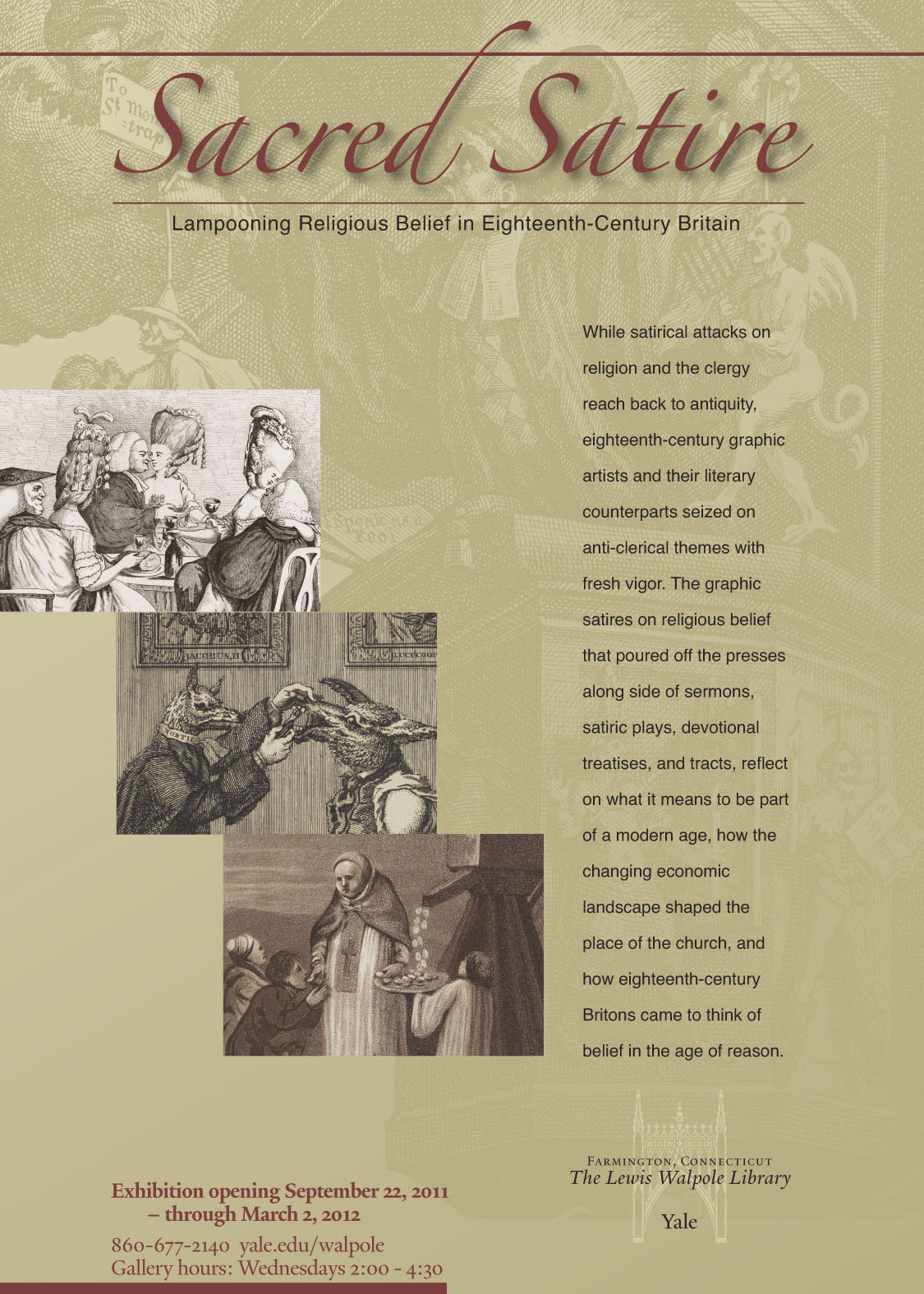 Religious beliefs and practices provided ample subject matter for the irreverent printmakers producing graphic satire in eighteenth-century Britain. While clerical satire is an ancient mode, eighteenth-century British artists seized on it with fresh vigor. Satirists appropriated centuries-old themes like corruption, hypocrisy, and greed, but updated them with contemporary concerns about the role of religion in the age of enlightenments. The visual rhetoric of these prints illustrates some of the ways in which eighteenth-century Britons were renegotiating their relationship to religious practice and belief.
The prints in this exhibition reflect a tension between a vision of religion as part of traditional life and the emergence of modern Christianity as a collection of new movements, practices, and ideas about belief. The eighteenth-century images on display preserve for us a moment in an ongoing conversation about the relationship of religion, representation, and modernity.
Call for Papers: London-Irish
The London-Irish in the Long Eighteenth Century, 1680-1830
University of Warwick, 13-14 April 2012
Proposals due by 31 January 2012
 The Irish became an intrinsic part of the London population through the course of the eighteenth century. Whether Catholic and Protestant, professional or plebeian, London provided opportunities for waves of Irish migrants. Irish migrants can of course be found throughout Britain (and Europe) at this time but London offered a burgeoning world capital that embraced all tiers of Irish society. The Irish, from both sides of the religious divide, could be found almost anywhere in London: in its kitchens, drawing rooms, legal chambers, banking houses, theatres, newspaper offices, and courts. Nevertheless robust systematic historical data on these migrants is scarce – such accounts that exist of the Irish diaspora in pre-1815 London (Denvir, Akenson, and Jackson) are useful but fragmentary and Irish historiography on the diaspora has generally tended to concentrate on the famine years.
There is work on Irish Catholics in Europe but only recently have more focused accounts of Irish networks operating in London in the eighteenth century begun to emerge. Yet despite the sparse accounts of their activities, there was certainly a strong Irish – Catholic as well as Protestant – presence in London throughout this period. Archbishop King warned that Irish visitors in London ‘converse only in a very sneaking private way with one another’ and this observation suggests a metropolitan space within which the Irish diaspora could form themselves into tight social and professional networks. The study of such networks would provide a fresh perspective on London in the long eighteenth century. How did such networks form? How did they evolve? To what degree were they inclusive/ exclusive? How did they represent ‘Irishness’ and/or Ireland to London? And how were they received?
This interdisciplinary conference is being organized by David O’Shaughnessy and will be hosted by the Department of English & Comparative Literature, University of Warwick. Plenary lectures will be given by Professor Toby Barnard (History, University of Oxford); Professor Claire Connolly (Literature, University of Cardiff; and Professor Mary Hickman (Sociology, London Metropolitan University). Papers will be welcomed in all disciplines and from scholars at all stages of their careers. The deadline for 300-word abstracts is 31 January 2011 (email: londonirish@warwick.ac.uk). Suggested topics might include but are not limited to:
- Quantifying the Irish diaspora (population, migration patterns/routes, births, deaths, baptisms, funerals)
- Defining an Irish community/network
- Catholic and Protestant communities/networks
- Professional Irish (lawyers, bankers, merchants, tutors, physicians, booksellers)
- Literary and artistic Irish (theatre, newspapers, literary clubs, artists, Society of Antiquaries, Royal Academy, bookshops)
- Labouring Irish (military, servants, sailors, shipwrights, builders)
- Religious Irish (places of worship, priests)
- Political Irish (clubs, societies, parliament, lobbyists, spies, petitioners, the Irish at court)
- Anti-Irish sentiment
- Irish language
- Riots
- Sport
- Irish societies and charitable organizations
- The Irish on trial (lawyers and criminals)
- The rise of the Irish pub (taverns/coffee houses patronised by the Irish)
- The Irish ‘ghetto’ (geography of the Irish in London)
- Irish elites and their circles (Burke, Goldsmith, Sheridan)
Frick Acquires Hard-Paste Sèvres Vase in Honor of Anne Poulet
Press release from The Frick, as noted at ArtDaily:
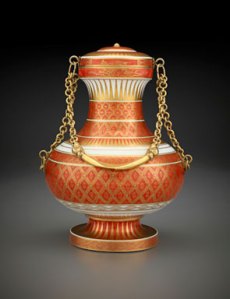
Vase Japon, 1774, Royal Manufactory of Sèvres, painted and gilded hard-paste porcelain with silver-gilt mounts, The Frick Collection; photo: Michael Bodycomb
The Frick’s Board of Trustees announces the acquisition of two objects that will enhance the museum’s holdings in areas that interested founder Henry Clay Frick at the end of his life: eighteenth-century French porcelain and Italian Renaissance drawings. A rare and beautiful vase created at the Royal Manufactory of Sèvres has been acquired in honor of Anne L. Poulet, who retired at the end of September after serving as Director for eight years. The vase, a partial purchase by the Frick and a partial gift from Alexis and Nicolas Kugel, is the first piece of hard-paste porcelain from the Royal Manufactory of Sèvres to enter the Collection. It complements the museum’s substantial Sèvres holdings made with the earlier soft-paste formula, objects obtained by Mr. Frick from the dealer Joseph Duveen. This latest acquisition is particularly appropriate given the interest of Director Emerita Anne Poulet in eighteenth-century French decorative arts. The vase will be displayed this winter alongside selections from a promised gift of hard-paste Meissen porcelain objects in the new Portico Gallery for Decorative Arts and Sculpture, which opens to the public on December 13. Also entering the collection is an important Italian Renaissance by drawing the Sienese artist Domenico Beccafumi (1486–1551), a two-sided sheet given to the Frick by Trustee Barbara G. Fleischman in honor of Deputy Director and Peter Jay Sharp Chief Curator Colin B. Bailey.
Despite its name, the Vase Japon is a French interpretation of a Chinese Yu (or Hu) vase from the Han Dynasty (206 B.C–A.D. 220). Examples of this type of baluster-shaped vessel survive in bronze and earthenware. Documents from the Sèvres archives indicate that the Frick vase was made in 1774 along with two others of the same size, shape, and decoration. Each bears the mark of the gilder-painter Jean-Armand Fallot, who was active at Sèvres between 1765 and 1790. Of the three, however, only the Frick vase is adorned with an elaborate silver-gilt handle and chain, which, like its shape and surface pattern, were directly inspired by the Chinese model. The mounts bear the mark of Charles Ouizille (1744–1830), who worked extensively for the French court throughout the 1770s and 1780s and became Marie-Antoinette’s favorite jeweler. He created exquisite gold mounts for the queen’s rare and precious collections of hard-stone vases and cups.
The shape and decoration of the Vase Japon derive from a woodblock print reproduced in a forty-volume catalogue of the vast Chinese imperial collections (a record compiled at the behest of the Qianlong Emperor who reigned 1735–1796). Included are entries for more than fifteen hundred ancient bronze objects—primarily ritual vessels, but also mirrors, lamps, and weapons—each accompanied by a brief description of its size and origin. Sometime during the 1770s, Father Joseph Amiot, a Jesuit missionary working in Peking, sent a copy of this catalogue to Henri Bertin in Paris. Bertin was France’s secretary of state and had recently been appointed the commissaire du roi at the Sèvres manufactory, an administrative position he held until 1780. In addition to being a politician and a businessman, Bertin was an art collector with a profound interest in China and Chinese art, and he likely played a key creative role in the production of this piece. (more…)
Call for Papers: Napoleonic Wars
From The Courtauld:
Contested Views: Visual Culture and the Revolutionary and Napoleonic Wars
Courtauld Institute of Art Research Forum at Tate Britain, London, 19-20 July 2012
Proposals due by 16 December 2011
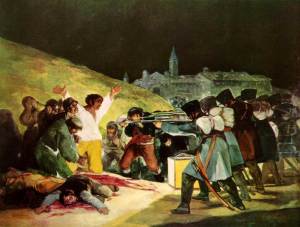
Goya, "The Third of May 1808," 1814 (Madrid: Prado)
In July 2012, in advance of commemoration of the bicentenary of the Battle of Waterloo, Tate Britain is to host a two-day conference exploring the impact of the Revolutionary and Napoleonic Wars on world-wide visual culture, from the outbreak of the pan-European conflict with France in 1792 to the present day. Centered on themed panels, plenary lectures and workshops, this cross-disciplinary conference will promote knowledge and understanding of the range of ways in which the ‘First Total War’ has been mediated in visual cultures, not only in Britain and continental Europe but throughout the world.
The organizers are keen to receive proposals for papers that present new research and/or methodological approaches. In particular they would like to encourage proposals from scholars from different disciplines who wish to work in collaboration with each other. Please send proposals of no more than 250 words to Phil Shaw ps14@le.ac.uk.
Organised by Martin Myrone (Tate Britain), Satish Padiyar (The Courtauld Institute of Art), Phil Shaw (University of Leicester), and Philippa Simpson (National Maritime Museum)
Seminar at The Frick: A 1767 Longcase Clock
From The Frick:
Seminar with Joseph Godla and Charlotte Vignon: “It’s About Time”
The Frick Collection, New York, 17 November 2011

Balthazar Lieutaud, Longcase Regulator with Mounts Emblematic of Apollo, 1767. Bronze Mounts by Philippe Caffiéri; movement by Ferdinand Berthoud (Frick Collection)
Clocks are among the most interesting and elaborate works of art in The Frick Collection. In this seminar, a curator and a conservator will discuss the design, history, and function of a magnificent French longcase regulator clock from the permanent collection. This exceptional example was made in 1767 by Ferdinand Berthoud, one of the leading Parisian clock and watchmakers of his day, together with case maker Balthazar Lieutaud and sculptor and bronze caster Philippe Caffiéri.
Click here to register at the regular rate of $100 per person. Members of The Frick Collection may click here to register at the discounted membership rate of $90 per person. Discounts will be applied upon verification of membership. To register over the phone, please call 212.547.0704.
Questions: seminars@frick.org
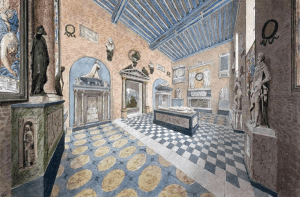
Journée d’étude: Alexandre Lenoir, histoire et collections
As noted at Le Blog de ApAhAu:
Le musée des monuments français et la construction de l’histoire
Institut national d’histoire de l’art, Paris, 17 November 2011
 8:30 Accueil des participants
9:00 Roland Recht (Collège de France), ouverture de la journée
9:15 Anne Ritz-Guilbert (École du Louvre), François Roger de Gaignières (1642-1715) : collection, méthodes, finalites
10:00 Jean-René Gaborit (conservateur général honoraire, musée du Louvre), Pour l’histoire de la sculpture française. Emeric David versus Alexandre Lenoir : la théorie et le pragmatisme
10:45 Odile Parsis-Barubé (université Charles-de-Gaulle-Lille 3/IRHIS – UMR CNRS 8529), Entre culture de l’inventaire et approche romantique des vestiges : le réveil historien de la province au lendemain de la Révolution (1800-1830)
11:30 Emmanuel de Waresquiel (École pratique des hautes études), Ecrire l’histoire sous la Restauration
12:15 Mary B. Shepard (Friends University, Wichita, Kansas), Alexandre Lenoir et George Grey Barnard : la perspective artistique et la construction de l’histoire
1:00-2:30 pause déjeuner
2:30 Valérie Montalbetti (fondation Pierre de Coubertin, Saint-Rémy-lès-Chevreuse), Alexandre Lenoir, Jean Goujon et la création d’un imaginaire artistique national
3:15 Claire Mazel (C.R.H.I.A., université de Nantes), Alexandre Lenoir, histoire de l’art et politique des arts
4:00 Pascal Griener (université de Neuchâtel), Alexandre Lenoir et le modèle anglais. La politique et l’histoire après la Révolution
4:45 Claude Rétat (CNRS UMR 5611-LIRE), Alexandre Lenoir et les formes du christianisme : art et religion chrétienne dans l’œuvre muséographique et dans le corpus maçonnique (musée des monuments français, œuvre maçonnique publiée et manuscrite)
Stormy Skies, Calm Waters: Vernet’s Lansdowne Landscapes
Press release (18 October 2011) from the Dallas Museum of Art (as noted at ArtDaily):
Vernet Pendants from Lansdowne House Reunited in Dallas
Dallas Museum of Art, 18 October — 11 December 2011

Claude-Joseph Vernet, "A Mountain Landscape with an Approaching Storm," 1775 (Dallas Museum of Art)
Two landscape paintings by eighteenth-century French master Claude-Joseph Vernet have been reunited for the first time in more than 200 years at the Dallas Museum of Art. Commissioned in 1774 at the height of Vernet’s career by famous English collector Lord Lansdowne, the two large-scale paintings depict the complementary scenes of unruly rustic landscape and tranquil seaport. The duo, A Mountain Landscape with an Approaching Storm and A Grand View of the Sea Shore, hung together in the collector’s home, Lansdowne House, Berkeley Square, London, until his death, when the paintings were sold to separate private collections in 1806.

Claude-Joseph Vernet, "A Grand View of the Sea Shore Enriched with Buildings Shipping and Figures" 1775
On view through December 11, 2011, the Dallas presentation is the first opportunity, since the Museum acquired A Mountain Landscape several decades ago, to bring the two paintings together to be viewed as Vernet originally intended. The exhibition will be accompanied by a new monograph published by the Dallas Museum of Art examining Vernet’s landscape practice.
The Dallas Museum of Art is presenting the paintings in its second-floor European art galleries, where they can be viewed in dialogue with other eighteenth-century masterworks. The landscapes, which are unusually large for the genre, measuring five by eight feet each, reflect both the collector’s neoclassical taste as well as Vernet’s powerful use of light and atmosphere. A Grand View of the Sea Shore depicts elegant buildings set against a tranquil sea at sunset, while A Mountain Landscape portrays an ominous rocky terrain with villagers scrambling to weather an impending storm.
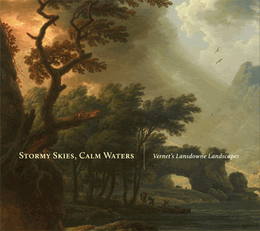
ISBN: 9780936227009, $20
The presentation of the Vernet paintings is made possible by the generous loan of A Grand View of the Sea Shore by collector David H. Koch. The landscape paintings will remain on view at the Dallas Museum of Art through December 11, 2011.
“The temporary reunion of the pair not only presents a singular opportunity for our audiences to experience anew a beloved painting in our collection, but allows for a new scholarly consideration of Vernet’s oeuvre,” said Olivier Meslay, Interim Director of the DMA and its Senior Curator of European and American Art and The Barbara Thomas Lemmon Curator of European Art. “Vernet’s precision in and exploitation of pairings has been highly influential to European art, and we are delighted to be able to display these
magnificent works together.”
“The Museum has sought to reunite these two landscape works since the realization, in January 2011, that A Grand View of the Sea Shore was not lost as presumed, and after such a lengthy separation the reunion is extraordinarily vivid, both historically and visually,” said Dr. Heather MacDonald, The Lillian and James H. Clark Associate Curator of European Art at the DMA. “In bringing the pair back together, we are finally able to fully experience the contrasting natural effects and the complex dialogue of aesthetics and ideas created by the two scenes. Their full meaning is finally revealed.”
A monograph, the first English book-length publication on Vernet’s work in thirty years, will be published in conjunction with the reunification of the pair at the DMA. The fifty-page illustrated catalogue, Stormy Skies, Calm Waters: Vernet’s Lansdowne Landscapes, with an introduction by Olivier Meslay and scholarly essay by Heather MacDonald, provides a reappraisal of the Lansdowne commission and examines the meaning of the pairing and the role of pendant canvases within Vernet’s practice as a whole.
◊ ◊ ◊ ◊ ◊
Heather MacDonald, Stormy Skies, Calm Waters: Vernet’s Lansdowne Landscapes (Dallas: Dallas Museum of Art, 2011), 48 pages, ISBN: 9780936227009, $20.
Call for Papers: The History of Jewish Art
Ars Judaica Conference: Traditions and Perspectives in History of Jewish Art
Bar-Ilan University, Israel, 10-13 September 2012
Proposals due by 6 November 2011
The conference will bring together historians of art and material culture and researchers in history, religions, semiotics, psychology, sociology, and folklore to explore the fields of interest of Ars Judaica: The Bar-Ilan Journal of Jewish Art that include, but are not limited to:
– The Jewish contribution to the visual arts and culture from antiquity to the present
– Art and architecture of Jewish sacred spaces
– Biblical texts as a source in Christian and Muslim visual arts
– Jerusalem and the Holy Land as an object and model in visual arts
– Images of Jews in visual arts
– Hebrew script in visual arts
– Patrons, collectors and museums of Jewish art
– Jews, arts and politics
Abstracts (limited to 200 words) of twenty-minute presentations with a short CV should be submitted (as attached MSWord documents) by January 6, 2012 to gr.ajudaica@biu.ac.il. The applicants will be notified of the decision regarding their proposals by February 6, 2012.
New Title: Drew Armstrong on Julien-David Leroy
From the publisher:
Christopher Drew Armstrong, Julien-David Leroy and the Making of Architectural History (Routledge, 2011), 300 pages, ISBN: 9780415778893, $125.00
 This book examines the career and publications of the French architect Julien-David Leroy (1724–1803) and his impact on architectural theory and pedagogy. Despite not leaving any built work, Leroy is a major international figure of eighteenth-century architectural theory and culture. Considering the place that Leroy occupied in various intellectual circles of the Enlightenment and Revolutionary period, this book examines the sources for his ideas about architectural history and theory and defines his impact on subsequent architectural thought. This book will be of key interest to graduate students and scholars of Enlightenment-era architectural history.
C O N T E N T S
Introduction: Positioning LeRoy
Part 1: Voyageur / Philosophe — 1. Traveler in the Academy 2. A Book by Its Cover 3. Measuring the Earth 4. Greek Architecture and the Doctrine of Vitruvius 5. Greece and the Orient 6. A New Way of Making History 7. Mentor in the Garden
Part 2: Academician / Mentor — 8. Architecture and Enlightenment 9. Science for the Public Good 10. Monument to a Revolutionary Hero. Select Bibliography
◊ ◊ ◊ ◊ ◊
Christopher Drew Armstrong is an Assistant Professor and Director of Architectural Studies in the Department of History of Art and Architecture at the University of Pittsburgh.










 Enfilade
leave a comment