At Bonhams: A Large Doccia Figure of the Farnese Hercules
Press release from Bonhams:
Bonhams: Fine European Ceramics
New Bond Street, London, 7 December 2011
 A very rare and important 82cm high porcelain figure of Hercules created at the Doccia factory in Tuscany in 1753-55 is to be sold at Bonhams, New Bond Street, London in the Fine European Ceramics sale on 7th December 2011. This is the first time that a Doccia figure of this size has come to auction and the piece is estimated to sell for £300,000-500,000. Nette Megens, Bonhams European Ceramics Specialist, comments, “It is an unprecedented event that a Doccia figure of this size and importance comes to the market by public sale. It is truly a once in a lifetime chance for an auctioneer to handle an object of this beauty and museum quality.”
The Doccia factory was founded in the middle of the 18th century by Carlo Ginori, and is still operating in Sesto Fiorentino, just outside of Florence. The factory started making large-scale porcelain figures, a hugely ambitions task, in the late 1740s. The stunning work on offer in this sale is based on the famous Antique sculpture of the Farnese Hercules, now in the Archaeological Museum in Naples. The gesso model used in its creation has not moved since the 18th century, and is still kept in the Doccia factory museum. The factory often used bronze models from well-known sculptors to translate into porcelain and even bought the waxes from the workshops of Massimiliano Soldani Benzi and Foggini. For this Hercules, artists were sent to Rome to take casts of one of the many smaller marble versions of the monumental Farnese Hercules, which was one of the most famous Antique sculptures in the 18th century. These moulds were brought back to the Doccia factory to be re-worked into porcelain by the most famous sculptor-modeller at the factory, Gasparo Bruschi. Models of this size were generally kept at the factory, while smaller examples, often with their titles on the base, were sold as expensive souvenirs to travellers on the Grand Tour.
Porcelain sculptures of this size are very rare; Most of the known examples are now in museum collections. Dr. Rita Balleri, guest-curator at the Doccia Factory and author of ‘Omaggio a Venere’ has added an article on the Doccia Hercules, which has been published in the printed catalogue.
◊ ◊ ◊ ◊ ◊
From the Bonhams online catalogue:
Bonhams: Fine European Ceramics, 7 December 2011 (Sale 19110)
Lot #30 — An important unrecorded large Doccia figure of the ‘Farnese Hercules’, ca. 1745-55
Estimate: £300,000 – 500,000 / € 350,000 – 580,000
Comparative Literature:
Klaus Lankheit, Die Modellsammlung der Porzellanmanufaktur Doccia (1982);
John Winter (ed.), Le Statue del Marchese Ginori (2003);
John Winter, “Die Skulpturen der Porzellanmanufaktur Docia,” in J. Kräftner (ed.), Barocker Luxus Porzellan, exhibition catalogue, Liechtenstein Museum (2005), pp. 179-189;
Alessandro Biancalana, Porcellane e Maioliche a Doccia (2009)
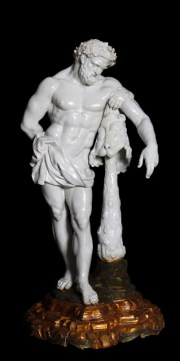 From the important series of large-scale figures and groups produced at the instigation of the founder of the Doccia manufactory, Marchese Carlo Ginori, between 1744 and Ginori’s death in 1757. No other example of this figure is recorded in the literature. The Inventario de’Modelli, the list of plaster, wax and terracotta models that were exhibited as a Galleria, or kind of museum, throughout six rooms of the Doccia manufactory, which was probably compiled by Gaspero Bruschi sometime between 1765 and 1780, includes two mentions of the Farnese Hercules:
- (Busti e statue posate sul banco della seconda stanza, nale è in Campidoglio) — No. 16 Una statua rappresentate Ercole di Farnese. L’originale è dei Signori Marchesi Verospi, senza forma (pagina 14) (published by Lankheit, p.115).
- (Sesta Stanza, Quinto palchetto) — No. 1. Vi è 14 statuette parti di Galleria di Firenze e parte di altri luoghi che sono Mercurio. Ganimede la seconda. Le terza la Baccante. La quarta la Pomona. La quinta la Venere de Medici. La sesta il Fauno. La settima 2 Venere delle belle chiappe. L’ottava Ercole del Farnese. La nona Apollo di Belvedere. La decimal una Diana. L’undecima 2 Venere una vestita e l’altra nuda. La duodecima un Giove, e tutto colle forme. (pagina 76) (published by Lankheit, p. 153).
In 1753, Carolo Ginori appointed a Florentine living in Rome, Guido Bottari, as his agent in the search for Antique statues to copy for his porcelain manufactory. It is clear from the correspondence between the two men that Ginori regarded copies of Antique statues as being of great interest. The same year, he despatched one of the modellers in the manufactory, Francesco Lici, to Rome to produce copies of desirable models. The correspondence between Bottai and Ginori reveals the difficulties the former encountered in securing permission to copy Antique statues in the Capitoline Museum. Although permission to copy six statues was eventually granted in September 1753, Bottari had in the meantime obtained permission to make copies from more easily accessible collections, such as the Villa Medici and the Palazzo Verospi.
On 25 August 1753, Bottari wrote to Ginori: ‘Le trasmetto la Polizza di Carico della cassa, che contiene le forme del Fauno (one of the models copied by Francesco Lici), che spero sarà portata a Livorno colla solita diligenza. In titta la future settimana sarà terminata la Cleopatra, e poi subito il Formatore metterà mano all’Ercole che è nell’istessa Galleria Verospi.‘
[please find the bill for loading of the box, which contains the shapes of the Faun (one of the models copied by Francesco Lici), which I hope will be brought to Livorno, with the usual diligence. In the coming week, the Cleopatra will be finished, and soon the modeller then will also turn his hand on the Ercole in the same Verospi Gallery] (quoted by Biancalana, p.79).
In early September, Bottari wrote to Ginori:
‘mi do l’onore di dirle che la con saputa statua della Cleopatra del Verospi è stata restate ultimata, e le forme sono già trasportate in questo Palazzo ove ne sarà fatto il gesso, perché il Formator dice esser ciò necessario, perché crede impossibile che le Forme arrivino costì in buon grado da poter far uso […] Adesso metterà mano all’Ercoletto dell’istessa Galleria Verospi.‘
[It does me honor to tell you that the statue of Cleopatra of [galleria] Verospi is completed, and the forms are already carried in to our Palazzo, where it will be modelled in gesso, because the modeller says it must be, as he believes it impossible that forms will arrive in good order with you otherwise […] Now will turn his hand at the Ercoletto from that same Galleria Verospi] (Biancalana, p. 79).
During Spring and Summer of 1754, numerous crates with copies and plaster models by Lici were shipped from Rome to the Doccia manufactory. It is not completely certain from the above correspondence whether the source for the large figure of the Farnese Hercules was based upon a version in the Palazzo Verospi, or the version in the Palazzo Pitti in Florence. The Inventario de’Modelli suggests that an example in the Palazzo Verospi was the source, while the correspondence in August and September of 1753 between Bottari and Ginori raises the possibility that the Verospi example may have been a smaller version (Ercoletto), or a different depiction of Herules. There is no evidence published in the literature that Bottari and Lici gained access to the Palazzo Farnese and the Farnese Hercules now in the Capodimonte Museum, though this remains a possibility.
A further detailed footnote with more archival material by Dottoressa Rita Balleri, the author of ‘Omaggio a Venere: Il culto della bellezza ideale nei modelli della Manifattura di Doccia’ (Edizione Polistampa, 2010), will be published in the printed catalogue.










 Enfilade
leave a comment