At Sotheby’s: Zoffany and Joseph Wright
Press release from Sotheby’s:
Old Master & British Paintings Evening Sale, L11036
Sotheby’s, London, 7 December 2011

Johann Zoffany, The Garden at Hampton House
with Mr. and Mrs. David Garrick Taking Tea, 1762.
◊ ◊ ◊ ◊ ◊
Sotheby’s London Old Master & British Paintings Evening Sale realised a total of £20,074,500/ $31,364,399/ €23,437,051, comfortably within the pre-sale estimate of £17.6 – 24.2 million. The top lot of the sale was a pair of paintings by Johann Zoffany – the most important works by the artist to appear on the market in recent years – The Garden at Hampton House, with Mr and Mrs David Garrick Taking Tea and The Shakespeare Temple at Hampton House, which fetched £6,761,250/$10,563,777/ €7,893,784 (pre-sale estimate of £6-8 million). . . .
◊ ◊ ◊ ◊ ◊
Characterizing the auction as “a little subdued,” Bendor Grosvenor reports at Art History News that the two paintings were acquired by the Garrick Club:
The buyer was the Garrick Club, and the pictures will hang alongside their pre-eminent collection of theatrical portraits, including numerous Zoffanys. This is splendid news for the preservation of English heritage, for there was a risk the pictures could have been sold overseas. . . .
◊ ◊ ◊ ◊ ◊
 Also up for sale was Joseph Wright’s 1779 painting Virgil’s Tomb by Moonlight (Lot 37). Estimated to sell for £600,000-800,000, it roughly doubled that, fetching just under £1.5 million.
To be sure, along with these British highlights, the evening belonged to Jan Steen, whose Interior with Figures Playing Cards at a Table established a new auction record for the artist. At £4.8 million, it was a strong price, though still toward the low end of the estimate (£4.5-6million).
More information on the painting is available at Art Daily.org.
◊ ◊ ◊ ◊ ◊
For more information on the pair of paintings by Zoffany, see the original announcement from Sotheby’s (5 September 2011). From the press release:
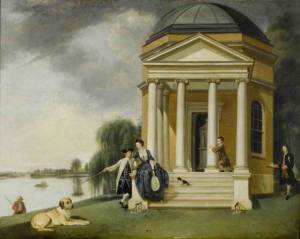 Sotheby’s announced the sale of the two most important works by Johann Zoffany to appear on the market in recent years. Both commissioned by David Garrick, Britain’s greatest actor, they depict him with his family and friends in the garden of his house on the banks of the river Thames at Hampton. Painted in 1762 they have only appeared once on the open market, when they were sold in 1823 from Garrick’s estate, and have descended in the family of a distinguished private collection ever since. From 2007 until 2010 the paintings hung together on loan at Tate Britain, in London, and have been requested as highlights for the forthcoming retrospective of Zoffany’s work at the Royal Academy later this year. They will be offered together as part of Sotheby’s Old Master & British Paintings Evening Sale on 7th December 2011 with an estimate of £6-8 million. (more…)
Exhibition: Boxes and Objets de Vertu
From the Cognacq-Jay, as noted by Hélène Bremer . . .
Boîtes en or et objets de vertu
Cognacq-Jay Museum, Paris, 21 December 2011 — 6 May 2012
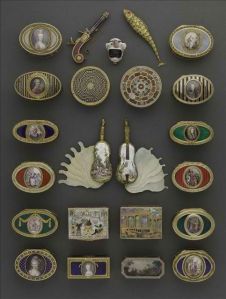 A l’occasion de la parution du Catalogue raisonné des Boîtes en or et objet de vertu, le musée Cognacq-Jay expose cet hiver sa riche collection de boîtes, tabatières, étuis, boîtes à rouge, à mouches, nécessaires de toilette, à écrire… Avec 240 objets, celle-ci est l’une des plus importantes des musées français.
Chefs-d’œuvre de l’orfèvrerie, en or, enrichis de pierres dures ou précieuses, d’émail, de porcelaine, d’ivoire ou de nacre. . . étaient dès le XVIIIe siècle l’objet d’orgueil et de convoitise Leur forme était parfois étrange, prenant l’apparence d’un dromadaire, d’un tatou, d’une jambe, d’une tête, d’un violoncelle. . . Leur usage, participant aux rituels de la vie quotidienne, témoigne des pratiques de la sociabilité au Siècle des Lumières : le tabac, les modes cosmétiques, le jeu. . .
L’exposition mettra exceptionnellement en lumière cette collection, au moyen d’une scénographie originale et surprenante, et en réunissant autour de ces
objets des dessins, des gravures pour mieux comprendre leurs secrets de
fabrication et leur usage.
◊ ◊ ◊ ◊ ◊
Catalogue: Objets de Vertus, Boites, Tabatieres, Etuis et Necessaires Collections D’Orfevrerie (Paris: Paris Musées, 2011), ISBN: 9782759601813, €44.
New Acqusitions at LACMA: Baratta’s ‘Wealth’ and ‘Prudence’

Giovanni Baratta (1640-1747), Pair of Allegorical Figures – "Wealth" and "Prudence," ca. 1703-08, photo © 2011 Museum Associates/LACMA
Press release from LACMA:
The Los Angeles County Museum of Art has acquired two life-size allegorical figure statues by the late Florentine Baroque master, Giovanni Baratta (1640–1747). The rediscovery of these sculptures, Wealth and Prudence, has been recognized as a major contribution to the study of early eighteenth-century Florentine art. The works are generous gifts to the museum by long-time benefactor, The Ahmanson Foundation, which has contributed extensively to the development of LACMA’s collection of European Painting and Sculpture over the last forty years. The sculptures are on view on the third floor of the Ahmanson Building, in the recently reinstalled European galleries.
Originally part of one of the artist’s most illustrious commissions, the works are noted for their refined elegance. The sculptures were commissioned by Niccolò Maria Giugni (1672-1717) for the gallery in his Palazzo on the Via degli Alfani in Florence. Facing one another at either end of the gallery, they were part of an elaborate iconographic scheme intended to glorify the Medici family and celebrate the Giugni family’s allegiance to the Medici. The choice of Wealth and Prudence was particularly appropriate to illustrate the joint virtues of the families, as some members of the Giugni family had advised the Medici in various aspects of their governance. (more…)
Holiday Gift Guide, Part 5: Historic Holiday Rentals
Back in September of 2009, I included a posting on the UK’s Landmark Trust, which rents some remarkable historic properties. Now at the end of another semester, as I’m facing piles of papers to grade (how could I possibly have gotten so far behind in just the past week?), daydreaming about quiet retreats is pretty tempting. Even grading those final exams in these wonderful locales wouldn’t seem quite so bad. What a lovely present indeed! The descriptions come from the Trust’s website (with the italics as my own additions) -CH
◊ ◊ ◊ ◊ ◊
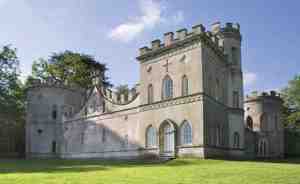 Clytha Castle — Near Abergavenny, Monmouthshire, Wales (1790s)
Roasted chestnuts, anyone? Maybe just the place after a visit to the newly restored Strawberry Hill.
This most affecting folly, which we lease from the National Trust, stands on the summit of a small hill, at the edge of a grove of old chestnuts. It was designed by a little-known architect and garden designer, John Davenport, perhaps with help from his client. Besides being an eye-catcher, the castle was used for grand picnics and as a retreat; the square tower contains fine rooms on both floors. When we arrived it had been empty for twenty-five years and before that had housed a gamekeeper. After more than thirty years as a Landmark, we carried out a major refurbishment in 2007 and reorganised the accommodation, making the circular room in the south turret a kitchen-dining room looking out into the clearing in the woods. . .
◊ ◊ ◊ ◊ ◊
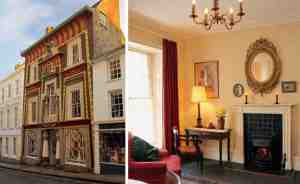 The Egyptian House — Chapel Street, Penzance, Cornwall (1830s)
Yes, I know, it’s a nineteenth-century house, but just the place for serious reflection on the Empire Style and Egyptomania. It was presumably inspired by the Egyptian Hall in Piccadilly, London (1812), which housed William Bullock’s collection, including items brought back by Captain Cook.
This unusual house is a rare and noble survivor of a style that enjoyed a vogue after Napoleon’s campaign in Egypt in 1798. It dates from about 1835 and the front elevation is similar to that of the former Egyptian Hall in Piccadilly, designed by P. F. Robinson. Robinson or Foulston of Plymouth are the most likely candidates for its design, though there is no evidence to support the claim of either.
It was built for John Lanvin as a museum and geological repository. When we acquired it in 1968, its colossal façade, with lotus-bud capitals and enrichments of Coade stone, concealed two small granite houses above shops, solid and with a pleasant rear elevation, but very decrepit inside. During our work to the front, we reconstructed them as three compact apartments, the highest of which has a view through a small window of Mounts Bay and St Michael’s Mount over the chimney pots of the town.
Why was there a geological shop here? Although picked over by Victorians (doubtless including Mr Lanvin) the beaches at Penzance still hold every kind of pebble, from quartz to chalcedony. You will find yourself at the bustling heart of Penzance, a handsome town accessible by train as well as road, where the pulse of the late nineteenth-century colony of artists known as the Newlyn School still beats strongly. Beyond it lies that hard old peninsular in which, at places like Chysauster and the Botallack mine, can be found moving evidence of human labour over an immense span of time.
◊ ◊ ◊ ◊ ◊
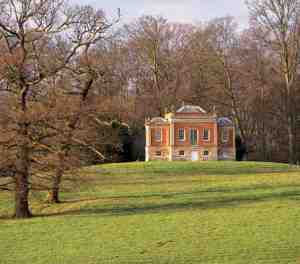 The Chateau — Gate Burton, Lincolnshire (ca. 1750)
Built as a weekend retreat from the city of Lincoln, it would seem ideally suited for getting away from it all.
This is the earliest recorded building by John Platt of Rotherham, designed in 1747 when he was 19 and almost his only work outside Yorkshire, where he practised and prospered for the next 50 years.
It stands on a grassy knoll above a big bend of the River Trent, on the edge of Gate Burton park. Built as a Gainsborough lawyer’s weekend retreat, and later used for picnics and other mild kinds of excursion, it had since been altered and then neglected. Its present owner gave us a long lease of it.
We have restored the Château to its original elaborate and slightly French appearance, an ornament in the landscape, which shows up well from the road some distance away. John Platt must have been a talented young man, because it is difficult to realise until one is inside just how small the scale of the building is; apart from the principal room upstairs, which has a high coved ceiling, there is little space in which to swing a cat. But there are fine views across the park and up a shining reach of the River Trent, along which big slow barges, piling the water in front of them, press on towards an enormous power station, whose cooling towers steam majestically in the distance.
◊ ◊ ◊ ◊ ◊
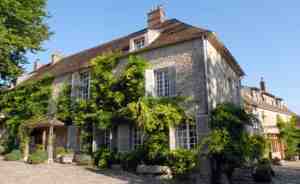 Le Moulin de la Tuilerie — Gif-sur-Yvette, Essonne (near Paris)
An eighteenth-century converted mill house that came to be home for the Duke and Duchess of Windsor, it’s perfect for anyone enamored of the story. I imagine we’re all going to hear lots more about the couple in the coming weeks with the wide release of Madonna’s new film, W.E.
The three buildings on the lovely site known as Le Moulin de Tuilerie in the town of Gif-sur-Yvette are our first French Landmarks. This was the former country weekend residence of the Duke and Duchess of Windsor. Edward VIII abdicated from the British throne in 1936 to marry the woman he loved, a twice divorced American, Wallis Simpson. In exile after the war, the Duke and Duchess of Windsor settled in Paris and Le Moulin de la Tuilerie was the only house they ever owned.
The Windsors were leading lights of international café society, and entertained the glitterati of the 1950s and 60s here, including Maria Callas, Marlene Dietrich, Elizabeth Taylor & Richard Burton, and Cecil Beaton. Edward especially was captivated by the site and commissioned English garden designer, Russell Page, to design the gardens, which he tended himself and whose layout remains today. The buildings are set around a courtyard behind huge oak gates, and the grounds open miraculously to views of the valley beyond. Each Landmark has a private terrace, and all who stay can wander the extensive grounds, parterre merging into ancient rocky woodland full of birdsong, where the Windsors buried their beloved pugs.
Le Moulin de la Tuilerie is on the edge of the town of Gif-sur-Yvette, approximately 35km south-west of Paris – a perfect staging post for journeying on to the rest of France. Just as for Edward and Wallis, still today this is a place for contrasts: a wonderful setting to play host, or enjoy deep tranquillity; an easy day trip by direct train to the bustle and culture of central Paris or the delights of Versailles, and yet a place where the city finally yields to deep countryside.
Holiday Gift Guide, Part 4: Gift Shop Finds
By Courtney Barnes
 Certain scents and sights instantly remind me of my grandparents and the holidays: bourbon mingling with chocolate; a tin of Virginia peanuts; and brass trivets and Duke of Gloucester Fifer ornaments from a Colonial Williamsburg gift shop. In terms of style, the iconic trivets are certainly versatile and very eye-appealing, but other historically connected gift options abound. More than ever, museums and historic foundations are going beyond the tote bags, mugs, and ubiquitous replicas by expanding their gift shop offerings to include locally crafted wares that speak to their roots.
Take, for example, some of the glass sold at Monticello. There are small cobalt blue vials ($18 each) based on Jefferson-era medicinal bottles and currently handmade in Virginia at the
Jamestown Glasshouse, as well as sculptural double-lipped water
pitchers made by West Virginia artisans ($55).
 At first mention, a magnolia paperweight might sound like the ultimate tourist purchase, but South Carolina’s Drayton Hall (the oldest surviving example of Georgian Palladian architecture in the U.S. and an important repository of African American heritage) offers an object with an interesting backstory: handcrafted by students from the American College of the Building Arts in Charleston—they visit Drayton to perfect their own craft through hands-on interaction with rare examples of intact eighteenth-century craftsmanship—the paperweight is modeled after a detail of the plaster ceiling in the house’s great hall ($20).
◊ ◊ ◊ ◊ ◊
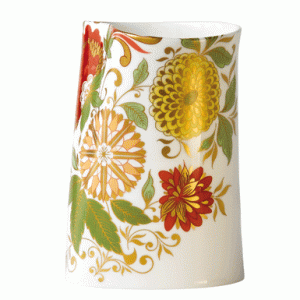 In the UK, contemporary ceramicist Ken Eastman has been working in collaboration with Royal Crown Derby Porcelain Company and adapting pattern manuscripts from the Derby factory archives to decorate new forms of bone china. The pieces impressed the V&A so much that the Museum added select items to its permanent collection and sells the wares in its shop. Limited but gorgeous V&A options are available online; a wider array can be found at Derby online.
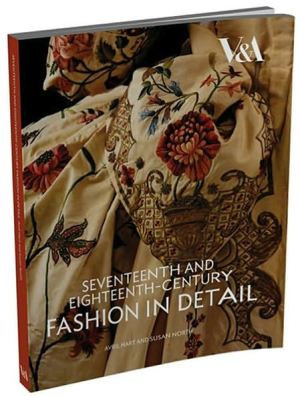
For the budding fashion student—maybe a teen intrigued with the craftsmanship of Catherine Middleton’s wedding dress—there is the V&A’s Fashion in Detail series. One example, Seventeenth and Eighteenth-Century Fashion in Detail, explores minute details that are not always visible to museum visitors: decorative
seams, refined stitching, slashing, stamping, and corseting.
◊ ◊ ◊ ◊ ◊
And finally something for the renovation junkie: Mount Vernon’s large scale paint fan deck, a collaboration between the Estate and Fine Paints of Europe. At $50, it’s a portable little luxury. The cost is refundable with future paint purchase. Although the name leads to some confusion, Fine Paints of Europe is a privately owned American company specializing in Dutch paint.
◊ ◊ ◊ ◊ ◊
Courtney Barnes writes the blog Style Court, which has been praised by editors at various national publications including Time, Elle Decor, Domino, Lonny, and The Washington Post. With a B.A. in art history and a Master’s in education, Courtney provides smart, stimulating coverage of the decorative arts, textiles, books, art exhibitions, and interior design.
Holiday Gift Guide, Part 3: Drink
By Ashley Hannebrink
As we continue the holiday series, eighteenth-century inspired drink would provide a fitting accompaniment to Monday’s fantastic musical selection and yesterday’s feast. Cheers!
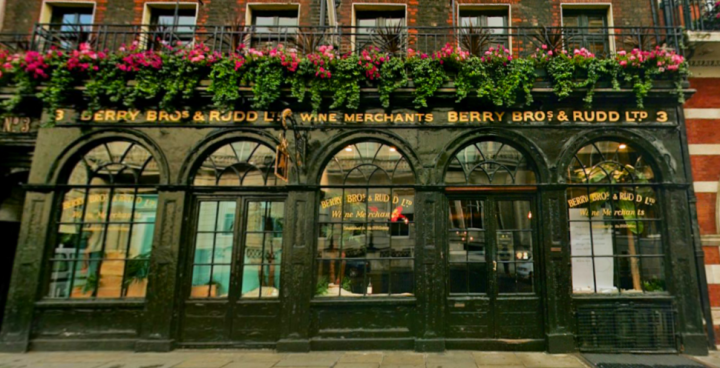
Berry Bros. & Rudd, 3 St James Street, London
Click on the image for a virtual tour at the company website
◊ ◊ ◊ ◊ ◊
1. A Bottle from Eighteenth-Century Tastemaker Berry Bros. & Rudd — It’s not quite going back in time, but a visit to London’s Berry Bros. & Rudd, the wine and spirit merchant relied on by King George III, might feel like it. Established in 1698 and still supplying the British Royal Family, the family-owned business prides itself on offering clients attentive service in addition to outstanding wines.
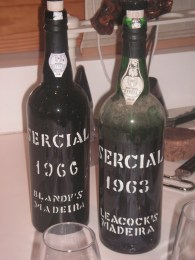 Experts at the St James shop suggest a Madeira or Port for the eighteenth-century enthusiast. The precursors to these fortified wines, such as Sack and Malaga, were particularly popular during the Georgian period as English and Scottish families flocked to destinations including Portugal and Madeira for business purposes. Importantly, these wines were forgiving in terms of preservation (through time and adverse conditions). At the shop’s blog, Simon Field describes “A Madeiran Adventure” (lots of information), and Simon Berry recommends a Malmsey 10-year-old Madeira, Broadbent Selection for the Christmas dinner:
Aged in oak casks for at least 10 years. A superb, full-bodied, wonderfully rich Madeira with a sweet, sumptous chocolate-like flavours and a concentrated bouquet. Best enjoyed with desserts, or on its own after a meal (£32.95).
And if a bottle (or two) won’t suffice, you might consider a wine luncheon in the
Napoleon Cellar.
◊ ◊ ◊ ◊ ◊
 2. A Sip Down Gin Lane — For something a bit stronger, one might return to that infamous eighteenth-century tipple, gin.
An interesting option comes from Sipsmith (£27.49 for its dry gin). This London artisanal distillery crafts its spirits using the first copper still to launch in London since 1820, a feat that required negotiating regulations that themselves date to the eighteenth century, when (at least according to an ES Magazine article on the company from April 2011) “one in four London houses had its own distilling equipment.” While the Gin Act was designed to protect the public from small-scale operations selling adulterated versions of the beverage, today Sipsmith’s special legal dispensation allows for pure enjoyment. The BBC ran a story on the company when it opened in 2009 (available here via YouTube). And maybe best of all? the copper still is named Prudence.
◊ ◊ ◊ ◊ ◊
3. For an Unusual Cup, Try a Leather Mug from Williamsburg — The shop at the Colonial Williamsburg Foundation offers several options: black or brown, pint or quart, small bottles, even a bucket that could be used for ice.
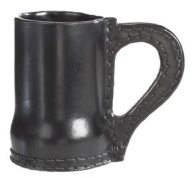 If it’s just too strange to drink from these containers, Courtney Barnes cleverly suggests they could be used to hold flowers, artists’ pencils, make-up brushes, or the like. From the Williamsburg Marketplace:
Leather mugs called jacks were in common use in England and her colonies during the 17th and 18th centuries. They were “jacked” or coated in pitch to make them watertight. Light and durable, these mugs varied in sizes and shapes from pint or smaller to gallons. Some had a spout for pouring. Our one-pint mug is handcrafted of safe, vegetable-tanned leather lined with “brewer’s pitch.” Sealed with wax on the outside and pitch on the inside our jackware is safe for drinking cold beverages such as wine and ale. It’s ideal for historical reenactments and also makes a distinctive gift. Clean by rinsing with warm water (no soap) and drying with a soft cloth. Not for use with hot beverages or pure grain alcohol. Do not put in dishwasher or microwave.
◊ ◊ ◊ ◊ ◊
4. The Perfect Book for a Nightcap — Sarah Hand Meacham, Every Home a Distillery: Alcohol, Gender, and Technology in the Colonial Chesapeake (Baltimore: Johns Hopkins University Press, 2009), 208 pages, ISBN: 9780801893124, $50.
From the publisher:
 In this original examination of alcohol production in early America, Sarah Hand Meacham uncovers the crucial role women played in cidering and distilling in the colonial Chesapeake. Her fascinating story is one defined by gender, class, technology, and changing patterns of production. Alcohol was essential to colonial life; the region’s water was foul, milk was generally unavailable, and tea and coffee were far too expensive for all but the very wealthy. Colonists used alcohol to drink, in cooking, as a cleaning agent, in beauty products, and as medicine. Meacham finds that the distillation and brewing of alcohol for these purposes traditionally fell to women. Advice and recipes in such guidebooks as The Accomplisht Ladys Delight demonstrate that women were the main producers of alcohol until the middle of the 18th century. Men, mostly small planters, then supplanted women, using new and cheaper technologies to make the region’s cider, ale, and whiskey.
Meacham compares alcohol production in the Chesapeake with that in New England, the middle colonies, and Europe, finding the Chesapeake to be far more isolated than even the other American colonies. She explains how home brewers used new technologies, such as small alembic stills and inexpensive cider pressing machines, in their alcoholic enterprises. She links the importation of coffee and tea in America to the temperance movement, showing how the wealthy became concerned with alcohol consumption only after they found something less inebriating to drink. Taking a few pages from contemporary guidebooks, Every Home a Distillery includes samples of historic recipes and instructions on how to make alcoholic beverages. American historians will find this study both enlightening and surprising.

Holiday Gift Guide, Part 2: Food
By Courtney Barnes and Craig Hanson
Culinary gifts — whether primarily about cooking or eating — regularly appear on holiday wish lists, but how much more fun it could be to give a taste of the eighteenth century.
◊ ◊ ◊ ◊ ◊
1. A Two-Day Historic Food Course with Ivan Day on Georgian Cookery — With forty years of experience cooking period food, Day is well-known for recreating historic tables, particularly in museum contexts. He’s also worked in television and radio and written books and articles on the history of English food. To judge from the website, I think it would be an incredibly fun experience — even better with four or five friends (Day’s blog, Food History Jottings, is also pretty wonderful). From the Historic Food website:
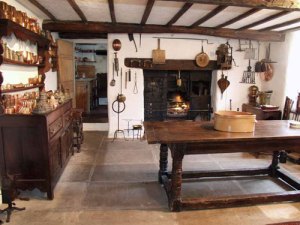
Ivan Day's Historic Food kitchen in Cumbria
We are located at Wreay Farm, a small seventeenth-century farmhouse in Cumbria, on the edge of the Lake District National Park. The farmhouse kitchen (known locally as a firehouse) is equipped with a wide range of antique kitchen utensils and a roasting range complete with clockwork jacks. It has frequently been used as a television kitchen (recently in the US Food Network’s Food Fit for a King and for BBC2 Open University’s Open Minds). We also have a confectionery room and a small bakehouse with wood-fired oven. We limit our group size to six participants per course, which means you get plenty of individual attention. . .
And if this isn’t enough to tempt you, there’s a lovely account of Day’s period sugarworks course at Fiona Leahy Designs (from May 2010).
◊ ◊ ◊ ◊ ◊
2. A Visual Feast at Houston’s Rienzi House — We noted the exhibition back in August here at Enfilade, but a visit to English Taste: The Art of Dining in the Eighteenth Century (organized by the Museum of Fine Arts Houston and installed, incidentally, by Day) would be a lovely way to spend an afternoon during the holidays. From the MFAH website:
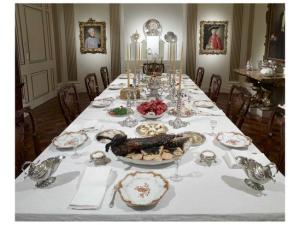 The 18th-century English dinner table was a feast for the eyes. In order to impress their guests and assure them that they were dining amid fashionable people of consequence, hosts served sumptuous dishes, adorned with towering sugar constructions and amusing trompe l’oeil (fool-the-eye) jellies of playing cards or bacon and eggs, all on exquisite silver and porcelain.
Rienzi re-creates this elaborate dining experience in English Taste: The Art of Dining in the Eighteenth Century. The first special exhibition ever held at Rienzi, the MFAH house museum for European decorative arts, English Taste treats you to a dining-room extravaganza typical of a 1760s English country house. Lifelike fish, fowl, and flummeries—complete with lavish, Georgian silver fittings and place settings—grace the table, created with guidance from the influential period cookbook The Experienced English Housekeeper by Elizabeth Raffald, the “Martha Stewart of the 18th century.”
◊ ◊ ◊ ◊ ◊
3. A Taste of Life at Mount Vernon — Stephen McLeod, ed., Dining with the Washingtons: Historic Recipes, Entertaining, and Hospitality from Mount Vernon (Chapel Hill: University of North Carolina, 2011), 224 pages, 9780807835265 $35. From the publisher:
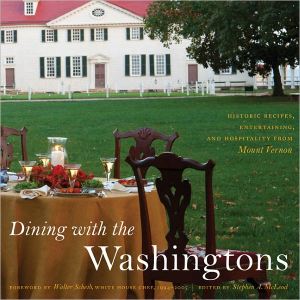 Combining vivid photography with engaging essays, Dining with the Washingtons explores the menus, diet, and styles of entertaining that characterized the beloved home of the nation’s principal founding father. Compelling accounts, historic artwork, and images of gardens, table settings, prepared food, and objects from the Mount Vernon collection blend to shed fresh light on the daily lives of George and Martha Washington, on their ceaseless stream of household guests and those who served them, and on the ways food and drink reflected the culture of eighteenth-century America. . .
Janet Blyberg provides a fine sampling of the book at her blog, JCB.
◊ ◊ ◊ ◊ ◊
4. A Guide to Kitchens in Eighteenth-Century France — If the food gets you wondering about the cooks who produced it, this new book might be just the thing for a cold winter day, ideally curled up next to a crackling fire. From the Johns Hopkins UP:
Sean Takats, The Expert Cook in Enlightenment France (Baltimore: Johns Hopkins University Press, 2011), 216 pages, 9781421402833, $60.
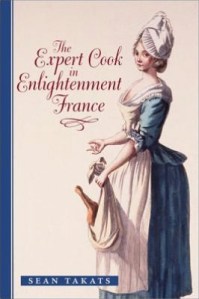 In the eighteenth-century French household, the servant cook held a special place of importance, providing daily meals and managing the kitchen and its finances. In this scrupulously researched and witty history, Sean Takats examines the lives of these cooks as they sought to improve their position in society and reinvent themselves as expert, skilled professionals. Much has been written about the cuisine of the period, but Takats takes readers down into the kitchen and introduces them to the men and women behind the food. It is only in that way, Takats argues, that we can fully recover the scientific and cultural significance of the meals they created, and, more important, the contributions of ordinary workers to eighteenth-century intellectual life. He shows how cooks, along with decorators, architects, and fashion merchants, drove France’s consumer revolution, and how cooks’ knowledge about a healthy diet and the medicinal properties of food advanced their professional status by capitalizing on the Enlightenment’s new concern for bodily and material happiness. The Expert Cook in Enlightenment France explores a unique intersection of cultural history, labor history, and the history of science and medicine. Relying on an unprecedented range of sources, from printed cookbooks and medical texts to building plans and commercial advertisements, Takats reconstructs the evolving role of the cook in Enlightenment France.
◊ ◊ ◊ ◊ ◊
 5. Dinner at Husk or McCrady’s in Charleston, South Carolina — Over the past year, Sean Brock has managed to astound quarters of America’s food establishment that don’t necessarily pay much attention to the South. Writing in The New York Times in February, for instance, Sam Sifton judged the experience “well worth . . . the flight from New York.” In September, Bon Appétit named Husk the year’s Best New Restaurant in America, and Brock has been featured in a dizzying array of publications from Esquire to The New Yorker. In the latter, Burkhard Bilger details what’s driving Brock’s success — an intense commitment to traditional Southern ingredients that have all but disappeared from the American table. There’s nothing purely eighteenth-century going on here, but there is a profound if simple point to be made: without ingredients that were used two or three centuries ago, it’s ultimately impossible to recreate what people ate. We can only hope this is more than just a passing trend and that other regions with rich culinary histories take up the challenge.
Holiday Gift Guide, Part 1: Music
Wondering what to get the dix-huitièmiste in your life for the holidays? This year at Enfilade, we’re here to help with our first (annual?) gift guide. Before the week is over, we’ll cover food, drink, travel, and some lovely finds from museum gift shops. From the accessible to the purely aspirational, you’ll at least get a wide variety of ideas. And the postings provide a fine chance to consider some of the things the past year has brought to the marketplace. Michael Yonan brilliantly kicks off the series with his top music picks. Feel free to add your own ideas in the comments sections, and enjoy! -CH
◊ ◊ ◊ ◊ ◊
By Michael Yonan
 The classical music recording industry, we are told, is dying, but you’d never know that when looking at new releases of eighteenth-century music. There were so many new recordings issued this year that even an avid music lover couldn’t possibly keep up with them. In the realm of opera alone, 2011 saw new releases of Handel’s Agrippina, Ariodante, and Alessandro Severo; Vivaldi’s Ottone in Villa, Il Farnace, and Teuzzone; Telemann’s Germanicus, and even José de Nebra’s Spanish-language Iphigenia en Tracia, first performed in Madrid in 1747. These appeared alongside literally dozens of new instrumental music recordings. The following is, therefore, a highly personal list that reflects my fancies and predilections, but all are also critically acclaimed recordings and easy to acquire.
 1. François-André-Danican Philidor, Sancho Pança (Naxos) This is an opéra comique first performed at Fontainebleau in 1762, realized by Opera Lafayette, a period-instruments group based in Washington, D.C. The story is based on Cervantes’s novel, but only loosely: here Sancho Panza is the governor of an imaginary island and suffers from delusions of grandeur not unlike those of his onetime master.
2. Gluck, Ezio (Virgin Classics) The 1750 version of Gluck’s opera, first performed in Prague in 1750. An international cast and liner notes by ASECS regular Bruce Alan Brown!
3. Johann Sebastian Bach, Cantatas BWV 82, “Ich habe genug,” and BWV 169, “Gott soll allein mein Herze haben,” Andreas Scholl, countertenor, and the
Kammerorchester Basel (Decca) Could this be the most
beautiful countertenor voice in the world? I think so.
 4. Carl Philipp Emanuel Bach, Sei concerti per il cembalo concertato, Wq43 (Harmonia Mundi) With Andreas Staier, harpsichord, and Petra Müllejans conducting the superb Freiburg Baroque Orchestra.
5. Handel, Amor Oriental: Händel alla Turca (Dhm) For something completely different, an interesting attempt to program works by Handel with performances by a traditional Turkish sufti singer.
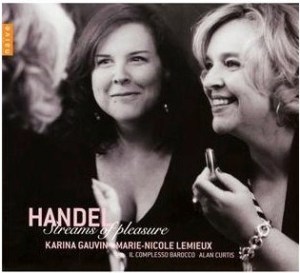
6. Handel, Streams of Pleasure, Karina Gauvin and Marie-Nicole Lemieux, with Il Complesso Barocco conducted by Alan Curtis (Naïve Classique) My top recommendation. Two extremely gifted French Canadian singers
with beautiful voices—Gauvin is a coloratura soprano, Lemieux a
true contralto—performing arias and duets from Handel’s English-
language oratorios.
◊ ◊ ◊ ◊ ◊
Michael Yonan is Associate Professor of Art History at the University of Missouri-Columbia. His book, Empress Maria Theresa and the Politics of Habsburg Imperial Art, appeared earlier this year from Penn State University Press (and would itself make for a lovely gift!).
Call for Papers: Curatorial Practices and Meaning
Cultures of Curating: Curatorial Practices and the Production of Meaning c. 1650-2000
University of Lincoln, 12-13 July 2012
Proposals due by 1 February 2012
The 2012 conference of the Museums and Galleries History Group
While museum history now acknowledges the constructed nature of the museum narrative, and maintains that museum work such as cataloguing, conserving and displaying is not neutral, but actually produces meaning, relatively little work has examined the ways in which curatorial practices have developed, and the specific consequences for museums. Display has attracted most of the work that has been done, but ‘behind the scenes’ activities have not been investigated in such depth. We seek submissions which investigate any aspect of the developing work of the curator, from creating an acquisitions policy, to labelling and documentation, to publicity work, as we wish to explore curating as both craft and profession. We also invite contributors to consider how curatorial practices constituted the museum object, and attempted to produce or suppress certain meanings for museum objects; and how such practices formed particular relationships between curators and other museum figures such as donors and visitors. We are interested in submissions which consider a wide variety of periods and places, and all types of curating, from fine art to science.
Keynote speaker: Dr Sam Alberti (Director, Hunterian Museum of the Royal College of Surgeons)
We invite papers on themes such as:
• How curators were trained, and how they understood their role
• Cataloguing and museum documentation
• Acquisition – the role of the curator
• Conservation and storage
• Display and interpretation
• How and why curatorial practices changed
• The role of place and space in shaping curatorial practices
• Curatorial practices, disciplines and discourses of knowledge
• Curatorial practices and relationships with the wider public
We also invite session proposals. Session proposals should include a brief outline of the session (250 words) as well as three abstracts (300 words max. each) for the proposed session. For session proposals, please indicate who will chair the session. Please send abstracts of no more than 300 words to chair@mghg.org or Kate Hill (khill@lincoln.ac.uk).
Meet Our New Intern: Ashley Hannebrink
I’m happy to introduce Enfilade’s current intern, Ashley Hannebrink, who already has lots of great ideas in store for the next couple of months. -CH
◊ ◊ ◊ ◊ ◊
Note (added 5 May 2025) — The full postings for interns have been archived offline.










 Enfilade
leave a comment