At Bonhams: A Large Doccia Figure of the Farnese Hercules
Press release from Bonhams:
Bonhams: Fine European Ceramics
New Bond Street, London, 7 December 2011
 A very rare and important 82cm high porcelain figure of Hercules created at the Doccia factory in Tuscany in 1753-55 is to be sold at Bonhams, New Bond Street, London in the Fine European Ceramics sale on 7th December 2011. This is the first time that a Doccia figure of this size has come to auction and the piece is estimated to sell for £300,000-500,000. Nette Megens, Bonhams European Ceramics Specialist, comments, “It is an unprecedented event that a Doccia figure of this size and importance comes to the market by public sale. It is truly a once in a lifetime chance for an auctioneer to handle an object of this beauty and museum quality.”
The Doccia factory was founded in the middle of the 18th century by Carlo Ginori, and is still operating in Sesto Fiorentino, just outside of Florence. The factory started making large-scale porcelain figures, a hugely ambitions task, in the late 1740s. The stunning work on offer in this sale is based on the famous Antique sculpture of the Farnese Hercules, now in the Archaeological Museum in Naples. The gesso model used in its creation has not moved since the 18th century, and is still kept in the Doccia factory museum. The factory often used bronze models from well-known sculptors to translate into porcelain and even bought the waxes from the workshops of Massimiliano Soldani Benzi and Foggini. For this Hercules, artists were sent to Rome to take casts of one of the many smaller marble versions of the monumental Farnese Hercules, which was one of the most famous Antique sculptures in the 18th century. These moulds were brought back to the Doccia factory to be re-worked into porcelain by the most famous sculptor-modeller at the factory, Gasparo Bruschi. Models of this size were generally kept at the factory, while smaller examples, often with their titles on the base, were sold as expensive souvenirs to travellers on the Grand Tour.
Porcelain sculptures of this size are very rare; Most of the known examples are now in museum collections. Dr. Rita Balleri, guest-curator at the Doccia Factory and author of ‘Omaggio a Venere’ has added an article on the Doccia Hercules, which has been published in the printed catalogue.
◊ ◊ ◊ ◊ ◊
From the Bonhams online catalogue:
Bonhams: Fine European Ceramics, 7 December 2011 (Sale 19110)
Lot #30 — An important unrecorded large Doccia figure of the ‘Farnese Hercules’, ca. 1745-55
Estimate: £300,000 – 500,000 / € 350,000 – 580,000
Comparative Literature:
Klaus Lankheit, Die Modellsammlung der Porzellanmanufaktur Doccia (1982);
John Winter (ed.), Le Statue del Marchese Ginori (2003);
John Winter, “Die Skulpturen der Porzellanmanufaktur Docia,” in J. Kräftner (ed.), Barocker Luxus Porzellan, exhibition catalogue, Liechtenstein Museum (2005), pp. 179-189;
Alessandro Biancalana, Porcellane e Maioliche a Doccia (2009)
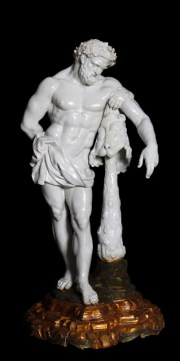 From the important series of large-scale figures and groups produced at the instigation of the founder of the Doccia manufactory, Marchese Carlo Ginori, between 1744 and Ginori’s death in 1757. No other example of this figure is recorded in the literature. The Inventario de’Modelli, the list of plaster, wax and terracotta models that were exhibited as a Galleria, or kind of museum, throughout six rooms of the Doccia manufactory, which was probably compiled by Gaspero Bruschi sometime between 1765 and 1780, includes two mentions of the Farnese Hercules:
- (Busti e statue posate sul banco della seconda stanza, nale è in Campidoglio) — No. 16 Una statua rappresentate Ercole di Farnese. L’originale è dei Signori Marchesi Verospi, senza forma (pagina 14) (published by Lankheit, p.115).
- (Sesta Stanza, Quinto palchetto) — No. 1. Vi è 14 statuette parti di Galleria di Firenze e parte di altri luoghi che sono Mercurio. Ganimede la seconda. Le terza la Baccante. La quarta la Pomona. La quinta la Venere de Medici. La sesta il Fauno. La settima 2 Venere delle belle chiappe. L’ottava Ercole del Farnese. La nona Apollo di Belvedere. La decimal una Diana. L’undecima 2 Venere una vestita e l’altra nuda. La duodecima un Giove, e tutto colle forme. (pagina 76) (published by Lankheit, p. 153).
In 1753, Carolo Ginori appointed a Florentine living in Rome, Guido Bottari, as his agent in the search for Antique statues to copy for his porcelain manufactory. It is clear from the correspondence between the two men that Ginori regarded copies of Antique statues as being of great interest. The same year, he despatched one of the modellers in the manufactory, Francesco Lici, to Rome to produce copies of desirable models. The correspondence between Bottai and Ginori reveals the difficulties the former encountered in securing permission to copy Antique statues in the Capitoline Museum. Although permission to copy six statues was eventually granted in September 1753, Bottari had in the meantime obtained permission to make copies from more easily accessible collections, such as the Villa Medici and the Palazzo Verospi. (more…)
Fellowships in American Art and Visual Culture
Smithsonian American Art Museum Research Fellowships
Washington, D.C.
Applications due by 15 January 2012
The Smithsonian American Art Museum and its Renwick Gallery in Washington, D.C., invite applications for research fellowships in art and visual culture of the United States. A variety of predoctoral, postdoctoral, and senior fellowships are available. Fellowships are residential and support independent and dissertation research. The stipend for a one-year fellowship is $30,000 for predoctoral fellows or $45,000 for senior and postdoctoral fellows, plus generous research and travel allowances. The standard term of residency is twelve months, but shorter terms will be considered; stipends are prorated for periods of less than twelve months.
Contact: Fellowship Office, American Art Museum, (202) 633-8353, AmericanArtFellowships@si.edu. For information and a link to the online application, visit the museum’s website.
Phillips Book Prize
Phillips Book Prize
Applications due by 15 January 2012
The Phillips Collection Center for the Study of Modern Art offers an annual prize for an unpublished manuscript presenting new research in modern or contemporary art from 1780 to the present. Preference is given to applicants whose research focuses on subjects related to the museum’s areas of collecting. The winner receives $5,000, and his or her manuscript will be published by the Univ. of CA Press. Scholars who received their PhDs within the past 5 years are strongly encouraged to apply.
TO APPLY: submit a cover letter, a CV, an abstract of the proposed book (1-page max), and a book proposal (8-10 pages). The book proposal should include a project overview, chapter outlines, a plan for revisions and completion of the manuscript, and a description of the book’s position in the literature of modern or contemporary art. Three current letters of recommendation are also required. Please send materials electronically to CSMAprograms@phillipscollection.org.
Panel Discussion of ‘The Image of the Black in Western Art’
From the National Gallery:
Image of the Black in Western Art, Part II
National Gallery of Art, Washington DC, 11 December 2011
Panel discussion includes David Bindman, emeritus professor of the history of art, University College London; Henry Louis Gates Jr., Alphonse Fletcher University Professor and director of the W. E. B. Du Bois Institute for African and African American Research, Harvard University; and Sharmila Sen, general editor for the humanities, Harvard University Press. Moderated by Faya Causey, head of academic programs, National Gallery of Art. Book signing of The Image of the Black in Western Art (volumes 1-3) follows. Sunday, 11 December 2011, 2:00pm, East Building Concourse, Auditorium.
◊ ◊ ◊ ◊ ◊
David Bindman and Henry Louis Gates, Jr., eds., associate editor Karen C. C. Dalton, The Image of the Black in Western Art Volume III: From the ‘Age of Discovery’ to the Age of Abolition, Part 3: The Eighteenth Century (Cambridge: Harvard University Press, 2011), 400 pages, ISBN 9780674052635, $95.
 In the 1960s, art patron Dominique de Menil founded an image archive showing the ways that people of African descent have been represented in Western art. Highlights from her collection appeared in three large-format volumes that quickly became collector’s items. A half-century later, Harvard University Press and the Du Bois Institute are proud to publish a complete set of ten sumptuous books, including new editions of the original volumes and two additional ones.
The Eighteenth Century features a particularly rich collection of images of Africans representing slavery’s apogee and the beginnings of abolition. Old visual tropes of a master with adoring black slave gave way to depictions of Africans as victims and individuals, while at the same time the intellectual foundations of scientific racism were established.
Postdoctoral Fellowship in DC
Postdoctoral Fellowship: Phillips Collection and The George Washington University
Washington, DC, 2012-2013
Applications due by 15 January 2012
The Phillips Collection and The George Washington University (GW) offers a Postdoctoral Fellowship available to support research and teaching on topics in American, European, or non-western art, including photography, from 1780 to the present. The Fellow will be expected to teach one undergraduate or graduate course at the Phillips Center for the Study of Modern Art or at GW, present at least one public lecture at the Phillips, and participate in other programs and discussions. The appointment carries a departmental affiliation with GW’s Department of Fine Arts and Art History and with The Phillips Collection, and carries a stipend. The Fellowship is open to untenured scholars who have received their PhDs within the past five years. Preference will be given to applicants whose projects focus on subjects related to the museum’s areas of collecting.
More information is available here»
December 2011 Issue of ‘The Art Bulletin’
The eighteenth century in the latest issue of The Art Bulletin:
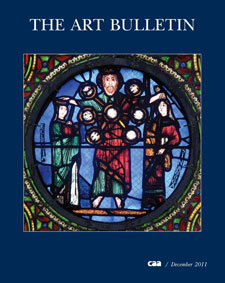 James M. Córdova, “Clad in Flowers: Indigenous Arts and Knowledge in Colonial Mexican Convents,” The Art Bulletin 93 (December 2011): 449-67.
Nuns in New Spain (colonial Mexico) wore spectacular flowery trappings when they professed and again when reposing on their funeral biers. Local artists, commissioned by the nuns’ families and convents, captured these stunning images. Despite differences in ethnicity, religious order, age, and other factors that distinguished these women, their flowery trappings have the effect of establishing an iconic image of the New Spanish nun. Furthermore, their regalia, which combine Euro-Christian and Mesoamerican practices and beliefs, not only represented the preeminence of the “brides of Christ,” they also conjured the spiritual transformations that nuns experienced in their ritual lives.
◊ ◊ ◊ ◊ ◊
Étienne P. H. Jollet, Review of Frank Fehrenbach’s Compendia Mundi: Gianlorenzo Berninis “Fontana dei Quattro Fiumi” (1648-51) und Nicola Salvis “Fontana di Trevi” (1732-62), The Art Bulletin 93 (December 2011): 491-94.
◊ ◊ ◊ ◊ ◊
N.B. — Notice of Jollet’s review did not appear in the original posting from 2 December 2011; it was added on 9 February 2012. I apologize for the initial oversight. -CH
Installing a Ceramic Room in Honolulu
As a follow-up to yesterday’s essay from Amanda Strasik, which relied heavily upon an interview she conducted with Amber Ludwig, today’s posting gives us a glimpse at one of the projects keeping Amber busy these days . . . From her posting at the Honolulu Academy of Arts Blog (1 November 2011) . . .
◊ ◊ ◊ ◊ ◊
 Many museums are reinstalling their ceramics collections in a manner that reflects the high point of innovation in Western ceramics—the 18th century. It was during the early 18th century that Europeans were finally able to produce the strong, thin, white-bodied ceramic known as porcelain, some 1,100 years after the Chinese began making it. Porcelain was so highly valued in the Western world that wealthy collectors displayed their collections not in large breakfronts or atop delicate tea tables, but in entire rooms filled floor-to-ceiling with “white gold,” as porcelain was commonly called.
Gallery five at the Honolulu Academy of Arts is the second gallery to be reinstalled as part of a year-long curatorial project that began with gallery four. The new design of gallery five includes a ceramics cabinet that reflects this curatorial trend of large-scale installations of porcelains and other ceramics. Currently, gallery five displays exquisite examples of 17th-century painting and sculpture. Soon, however, it will be reinstalled with European and American paintings and sculpture from the 18th and 19th centuries and will also include a floor-to-ceiling ceramics display, meant to evoke the great “ceramic rooms” of the 18th century.
I was hired in September as the Curatorial Assistant to Theresa Papanikolas, Curator of European and American Art, and, for my first project, Theresa asked me to research the Academy’s collection of European and American ceramics for the reinstallation. My academic background is 18th- and 19th-century European art, so this is a good fit and something I am enjoying immensely. For the past month, I’ve been scouring the Academy’s holdings of European ceramics to determine a checklist and to create a design for the gallery five ceramics cabinet. I find myself often visiting the Seattle Art Museum’s Guide to the Porcelain Room for inspiration. . . .
The full posting is available here»
From Student to Art Historian: Transitioning into Professionalism
As Enfilade’s internship program continues to develop and finds its way, I’m happy to give a large public word of thanks to Amanda Strasik as her two-months with us draws to an end. She’s done a fantastic job tracking down material — much of which was posted under her name (though plenty of things appeared generically under the ‘editor’ label). Even more, she patiently put up with my hectic fall schedule. Here, in her final posting, she, as a first-year Ph.D student, contemplates what the end of her graduate training might bring — all with the help of Amber Ludgwig, whom she interviewed for the essay. Many thanks, Amanda! -CH
◊ ◊ ◊ ◊ ◊
In ruminating over the development of academic identity, I’m grateful to Dr. Amber Ludwig for her insights. — AS
 s a new Ph.D. student immersed in the world of the classroom, I’ve already noticed that it’s easy to become absorbed in my own research and neglect greater thought to the existence of the professional world of art history—the very world I’m striving to join. While the completion of my graduate work lies in the distant future, I’ve begun to consider the evolution of my own identity as a young scholar, progressing toward the “transitional phase” that all successful graduate students eventually face, the period when one looks to the job market but still has not entirely shed the identity of a student. In an effort to help demystify the “transition” from student to professional in terms of the development of scholarly identity, Dr. Amber Ludwig, a 2011 doctoral graduate of Boston University, kindly volunteered to share some of her experiences as she went from a “deferential graduate student to a commanding ‘doctor.’” Currently a Curatorial Assistant at the Honolulu Academy of Arts and the Interim Co-Director of the University of Hawaii Art Gallery, Dr. Ludwig has, through her own insights, encouraged me to conjoin, rather than separate, my identity as a student-professional, in the course of pursuing my own career as a young art historian.
During our interview, Amber mentioned that the dissertation writing process was a period of time when she felt very much alone with her thoughts. As a student, she worked independently on topics of her choosing, and she was really responsible only to the professors on her dissertation committee. In addition to the personal enjoyment she found in her subject matter, the notion of introducing new ideas to the field of eighteenth-century art history was inspiring in itself. Now as a museum professional, she’s been forced to adapt to a more “team-like” setting that is constrained by budgetary restrictions and the specific interests of the university audience. While this framework alleviates much of the “what comes next” pressure, it’s a very different working environment than graduate school.
Amber notes, for instance, that whereas her audience was previously dominated by her adviser, it’s now large and varied in terms of scholarly backgrounds — and she adds, “surprisingly more critical!” She credits the dissertation defense as an “incredibly helpful exercise” for instilling confidence in one’s work. She also stresses that the dissertation process is the beginning of one’s career, not the end. Thus, the dissertation is not simply about exhibiting expertise on a particular subject; rather, one is expected to “use the lessons learned throughout the process to improve one’s scholarship and professional practice.” In Amber’s case, she found herself constantly evaluating and re-evaluating how she could improve both her argument and the process itself in order to transition into the professional world more confidently confidently.[i]

As I evaluate my own development of scholarly identity and moments of academic self-discovery, I asked Amber if she had any advice that might make the transition from grad student to professional a little less intimidating. In response, she emphasized the value of presenting at conferences. The experience not only builds students’ confidence to speak authoritatively about their work, but also facilitates networking among others with similar interests.
She concluded our interview with a thought that has made a real impression me: don’t take criticism too personally. For a quasi-sensitive graduate student like me, criticism of one’s academic performance is both necessary and terrifying. And so I’m going to do my best to keep her words in mind: “if you were already perfect, there would be no need for education. Think of it as money well spent.”
◊ ◊ ◊ ◊ ◊
[i] For an interesting take on the dissertation as the beginning of one’s academic career, see Karen Kelsky’s article, “Dissertation Limits,” from InsideHigherEd.com (12 September 2011). Kelsky explains how little, in her opinion, the dissertation itself matters in the bigger picture for a prospective academic job candidate. It’s an intriguing perspective when thinking about the formation of a graduate student’s scholarly identity.










 Enfilade
leave a comment