The Eighteenth Century in the October Issue of The Burlington
The Burlington Magazine 153 (October 2011)
◊ ◊ ◊ ◊ ◊
Editorial
• The Holburne Museum, Bath
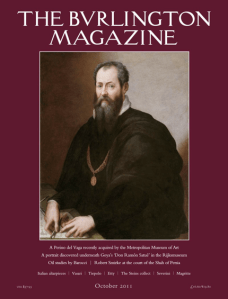 . . . Earlier this year, the Museum received extensive publicity when it re-opened after renovation and an extension carried out by Eric Parry Architects. This has included the daring and entirely successful moving of the central staircase of the house, to a few feet to the left, unblocking the vista through the ground-floor entrance to the gardens at the back; a beautiful full-height glass extension to the rear of the building that creates temporary exhibition rooms and a greater feeling of light and air; and the almost complete redisplay of the collections. While it has to be admitted that the Museum is distinctly eclectic and charmingly provincial (and in places still fussily crowded), in its renovated state its former shabby gentility has been vanquished. It now presents itself like Gainsborough’s Lord and Lady Byam, stepping out with the next generation, all in their finery, to greet the future.
The full editorial is available here»
◊ ◊ ◊ ◊ ◊
Articles
• Antonello Cesareo, “New Portraits of Thomas Jenkins, James Byres and Gavin Hamilton” — Two new portraits of Thomas Jenkins and James Byres by Anton von Maron and a self-portrait by Gavin Hamilton.
• Christopher Baker, “Robert Smirke and the Court of the Shah of Persia” — A watercolour study by Robert Smirke in the National Gallery of Scotland, Edinburgh, for a painting of the court of the Shah of Persia.
• Duncan Bull and Anna Krekeler, with Matthias Alfeld, Doris Jik, and Koen Janssens, “An Intrusive Portrait by Goya” — The discovery of an earlier three-quarter length portrait of a man by Goya beneath his Portrait of Ramón Satué (1823) in the Rijksmuseum, Amsterdam.
◊ ◊ ◊ ◊ ◊
Books
• Philip McEvansoneya, Review of N. Glendinning and H. Macartney, eds., Spanish Art in Britain and Ireland, 1750–1920: Studies in Reception in Memory of Enriqueta Harris Frankfort.
• Mark Stocker, Review of M. Kisler, Angels and Aristocrats: Early European Art in New Zealand Public Collections.
• Luke Herrmann, Review of M. and J. Payne, Regarding Thomas Rowlandson (1757–1827): His Life, Art & Acquaintance and P. Phagan, Thomas Rowlandson: Pleasures and Pursuits in Georgian England.
◊ ◊ ◊ ◊ ◊
Exhibitions
• Xavier F. Salomon, Young Tiepolo
Conference: Feminist Art History
What a lovely policy for conferences — free and open to the public!
The Second Annual Feminist Art History Conference
American University, Washington, D.C., 4-6 November 2011
Keynote Address:
Mary D. Sheriff, “The Future of Feminist Art History: Where Have We Come From, Where Are We Going?”
The Art History Program of American University (Department of Art, College of Arts and Sciences) presents our second annual Feminist Art History Conference which will take place from Friday November 4 to Sunday November 6, 2011. Corollary events begin on Friday afternoon (12:00-6:00 pm) at the National Portrait Gallery in Washington DC with a lunch, tour, and program in conjunction with the exhibition Seeing Gertrude Stein: Five Stories. Events continue on Friday evening at American University, with a reception and concert of choral music entitled “Gender Settings.” The conference sessions will take place on the American University (AU) campus in Northwest Washington, D.C. on Saturday (9:30 am to 5:30 pm) and Sunday (10:00 am until 12:30 pm). The keynote address will be presented on Saturday evening at 7:00 pm, following a reception.
This second annual Feminist Art History Conference (FAHC) continues to explore the legacy of two pioneering feminist art historians, Norma Broude and Mary D. Garrard, who are now professors emerita of art history at AU. This year’s conference had more than 90 proposal submissions and will include 51 papers in twelve sessions. The papers will span a broad range of topics and time periods, from the medieval era to contemporary art. Together they will demonstrate the myriad ways in which feminist research and interpretation have spread globally and across the spectrum of art historical analysis and scholarship.
The keynote address will be presented by Mary D. Sheriff, W.R. Kenan Jr. Distinguished Professor of Art History at the University of North Carolina, Chapel Hill. Her talk is entitled “The Future of Feminist Art History: Where Have We Come From, Where Are We Going?” In addition to her first book, Fragonard: Art and Eroticism (1990), Sheriff has published The Exceptional Woman: Elisabeth Vigee-Lebrun and the Cultural Politics of Art (1997), Moved by Love: Inspired Artists and Deviant Women in Eighteenth Century France (2008), edited the anthology Cultural Contact and the Making of European Art Since the Age of Exploration (2010), and written numerous articles and reviews. As a deeply engaged feminist art historian, Sheriff has motivated numerous graduate students at UNC-CH to develop feminist-focused dissertations and other research projects, and her publications have inspired feminist scholarship internationally.
At the first FAHC in 2010, participants found a lively forum in which to share views, debate issues, and network in an exciting synergy of feminist interchanges. The impressive number of proposals submitted for this second conference demonstrates the ongoing centrality of the issues raised by feminist art history—a testimony to the continuing vitality of research by feminist scholars developed over the past four decades. Given that Washington, D.C., is becoming a center for the nexus of gender and art, with the AU Art History Program’s longstanding emphasis on feminist methodologies, and the active presence of the National Museum of Women in the Arts, conference planners hope that the annual Feminist Art History Conference at American University will function as a worthy successor to the Barnard College Feminist Art History Conference in New York, which was an important forum for feminist scholarship throughout the 1990s.
The conference is free and open to the public. Advance registration (before 5 pm EST, Friday, October 28) is recommended. Please visit the conference website for more detailed information about the program, registration online, hotels, etc.
A full conference schedule is available here»
Milwaukee Art Museum Acquires Portrait by Copley
Press release from the Milwaukee Art Museum (12 September 2011) . . .

John Singleton Copley, "Portrait of Alice Hooper," ca. 1763 (Milwaukee Art Museum)
The Milwaukee Art Museum has acquired the portrait Alice Hooper, a major colonial American painting by John Singleton Copley (1738–1815). Copley is recognized as one of the great American artists of the day—and one of the first native-born painters to achieve success both at home and abroad. Alice Hooper, painted by Copley around 1763, depicts the seventeen-year-old daughter of the wealthiest man in Marblehead, Massachusetts, Robert “King” Hooper. Alice’s father commissioned this portrait to mark his daughter’s engagement to Jacob Fowle, Jr.
“Alice Hooper displays the traits that made Copley desirable in colonial Boston. Copley’s rendering of her fashionable sacque gown dazzles the eye, with its profusion of glinting blue satin and frothy lace spilling from its underdress,” said William Rudolph, curator of American art and decorative arts at the Milwaukee Art Museum. “The artist lingered on the highlights of Alice’s ruby earrings and choker, revealing the great wealth of her family. Yet her pensive gaze and half-shadowed face allude to her graciousness; she looks modest, rather than proud.”
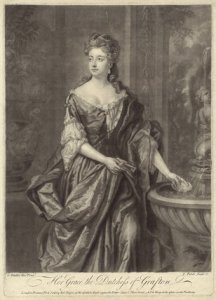
John Faber, after Sir Godfrey Kneller, "Isabella Fitzroy (née Bennet), Duchess of Grafton," (London: NPG #D30508)
According to Rudolph, Alice Hooper’s composition is one of a series of women depicted in fantasy garden settings, which all descend from John Faber’s 1691 engraving after Sir Godfrey Kneller’s Duchess of Grafton (ca. 1680).
The painting also provides vivid evidence of Copley’s working methods. Like many of his colleagues, the artist borrowed costumes and compositions from imported engravings of high-style British portraits. These appropriations were done with the full cooperation of his clients, who wanted to emulate the aristocrats of the mother country.
“The dress itself, although breathtakingly rendered, may not in fact be the property of Miss Hooper, given its remarkable similarity to that worn by several other sitters, and to the artist’s documented habit of copying elaborate gowns from mezzotints,” said Rudolph.
Copley’s work pleased the Hoopers and led to nine additional commissions for members of Alice’s immediate and extended families, securing Copley’s success.
“After winning the Hooper clan’s approval, Copley rocketed into the stratosphere as the go-to artist for fashionable New England—and for clients from as far away as Philadelphia and New York,” Rudolph said. (more…)
Exhibition: Chinoiserie
From the Milwaukee Art Museum:
Way of the Dragon: The Chinoiserie Style, 1710–1830
Milwaukee Art Museum, 30 June — 6 November 2011
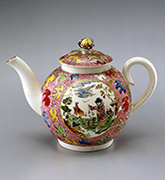
“Creamware Teapot”, ca. 1775, tin-glazed earthenware, London (Chipstone Foundation) Photo: Gavin Ashworth
Presented by the Chipstone Foundation, Way of the Dragon: The Chinoiserie Style, 1710–1830 explores how chinoiserie developed and subsequently degenerated in the eighteenth century. Chinoiserie objects represent Europe’s attempt to translate the arts and the ornament of China, Japan, and India, and was popular in all of Europe, but the English in particular were mesmerized by the allure of the exotic land and its people. Way of the Dragon investigates and questions European perceptions of China, as reflected in its decorative arts.
New Film: ‘Mozart’s Sister’
Mozart’s Sister, from French director René Féret, is now playing in select theaters. -AS
Reviewed by Manohla Dargis for The New York Times (18 August 2011) . . .

A 1779 portrait of the Mozarts: Nannerl, Wolfgang and their watchful father Leopold. Image Credit: Hulton Archive/Getty Images
Mozart’s Sister has just started when the French director René Féret makes the point that his fictional look at the early life and times of Wolfgang Amadeus isn’t interested in the pretty manners and nostalgia of many period movies. In truth, the film has little to do even with Wolfgang, a side note in a story focused on his only sister who’s first seen squatting on the side of a road taking care of business at a short distance from her similarly engaged father, mother and brother. This is the Family Mozart, Mr. Féret seems to declare with this scene, stripped down and at their most human.
That sister, Maria Anna Walburga Ignatia Mozart, born in 1751 and known as Nannerl, was said to posses a rare talent that, by some accounts, this film included, nearly rivaled that of her brother. Played by Marie Féret (the filmmaker’s daughter), Nannerl is an attractive, obedient and rather opaque 14-year-old going on 15, given to watchful silences and long looks at Wolfgang (David Moreau), who was younger by four and a half years. They were the only children out of the seven born to Leopold (Marc Barbé) and Anna-Maria (Delphine Chuillot) to survive childhood. If the calamity of those deaths weighed on the family it doesn’t register in “Mozart’s Sister,” which unfolds at the end of a long tour that began in 1763 when Wolfgang was 7.
Drawing on Leopold’s letters, among other sources, Mr. Féret paints a speculative, intimate portrait of a family bound by love, genius and ambition and almost undone by the same. . . .
For the entire review, visit The New York Times
◊ ◊ ◊ ◊ ◊
Furniture Restoration and Conservation: Stichting Ebeniste
This year’s event , as noted at Onderzoeckschool Kunstgeschiedenis, is held in Dutch (€85 / Students, €70), but next year it will be in English. For students of furniture, it might be a useful organization. As noted at the Stichting Ebeniste website:
The Ninth National Symposium for Wood and Furniture Restoration, Stichting Ebeniste
Amsterdam, 7 October 2011
The Stichting Ebenist is a non-profit organisation with the aim to provide a symposium about wood- and furniture conservation and restoration on a yearly basis. Each year alternating, the symposium is either national (in Dutch) or international (in English). After every symposium the lectures are gathered and published.
The aim of Stichting Ebenist is to learn and broaden our knowledge within the professional field. We want to be a platform where restorers and colleagues from neighbouring fields can meet to share information, experience and research. With these objectives we intend to promote discussion and new channels of communication. This will improve the standards of conservation and restoration, and thereby help us maintain our cultural heritage in the best possible way.
The symposium is attended by approximately 150 to 200 participants. The international symposium is usually spread across two days and includes excursions, while the national symposium lasts one day. The organisation is run by a group of 7 people, all from the restoration and conservation field. Several musea such as the Rijksmuseum and the Amsterdam Historical Museum have given us their support over the years. Also the Stedelijk Museum Amsterdam and the Van Gogh Museum have supported the symposium by providing accommodation. Other institutes such as the Technical University in Delft, the Gelders Oudheidkundig Contact, and auction houses such as Christie’s and Sotheby’s have enabled us to achieve our goals. The ICN and VeRes have helped us through the years to make the symposia possible up to this day. We look forward to seeing you at the next symposium.
Fashioning the Early Modern: Creativity and Innovation
◊ ◊ ◊ ◊ ◊
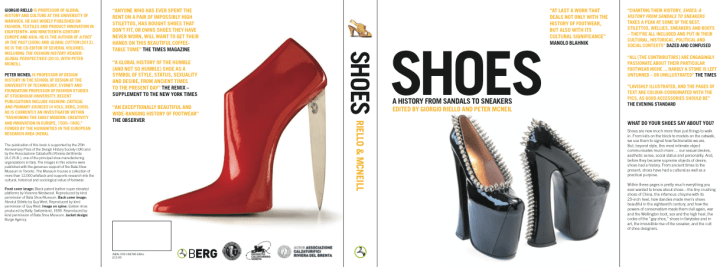
To judge from reactions to the Enfilade posting on the eighteenth-century shoe workshop, I would guess a number of you are quite keen on the topic. If so, you may be interested in this essay by Peter McNeil and Giorgio Riello, “Walking the Streets of London and Paris: Shoes in the Enlightenment,” in Shoes: A History from Sandals to Sneakers, edited by Giorgio Riello and Peter McNeil (London: Berg, 2006), which has just been released in paperback (448 pages for $30).
I learned of the book while perusing the ‘News’ section of the website, Fashioning the Early Modern: Creativity and Innovation in Europe, 1500-1800. The site is the public face of a multi-stage scholarly project. Workshops #3 and #4 are taking place in October and November in Copenhagen and Stockholm with a symposium to be held next year in London. -CH
◊ ◊ ◊ ◊ ◊
The following summary comes from the site:
Why did men from Spain to Sweden start to shave their heads and wear someone else’s hair in the mid-seventeenth century? Why did women decide that it was necessary to wear masks and other full-face coverings in public towards the end of the century? What was the economic and social impact of the sudden proliferation of ribbon-making machines?
Funded by the Humanities in the European Research Area (HERA), this project takes fashion seriously, asking the simple question: how and why did certain goods such as wigs, new textiles, ribbons, ruffs and lace become successful in early modern Europe while others failed? How far did these goods travel and how were they transmitted across linguistic, social and geographic borders? These are questions that remain relevant and our project demonstrates how a study of creativity and innovation as an economic and cultural force in the past can help our understanding of the same issues today.
Exhibition: ‘Claude Lorrain: The Enchanted Landscape’
From the Ashmolean:
Claude Lorrain: The Enchanted Landscape
Ashmolean Museum of Art and Archaeology, Oxford, 6 October 2011 — 8 January 2012
Städel Museum, Frankfurt, 3 February — 6 May 2012
Curated by Jon Whiteley
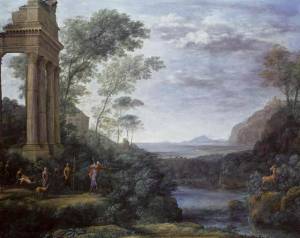
Claude Lorrain, "Landscape with Ascanius Shooting the Stag of Sylvia," 1682 (Oxford: Ashmolean Museum)
The Ashmolean’s major exhibition this autumn will be Claude Lorrain: The Enchanted Landscape, rediscovering the father of European landscape painting, Claude Gellée (ca. 1600–1682), or Claude Lorrain as he is best known.
In partnership with the Städel Museum, Frankfurt, the exhibition will bring together 140 works from international collections, created at different points in the artist’s career. By uniting ‘pairs’ of Claude’s paintings and making a comprehensive survey of his work in different media, the exhibition brings new research to bear on his working methods, to reveal an unconventional side to Claude which has previously been little known.
Born in France, Claude travelled first to Italy at the age of 13 or 14, settling in Rome for the rest of his life in 1627. The scenery of his great compositions was based on his studies of the ancient ruins and the rolling country of the Tiber Valley and the Roman Campagna. Claude’s ability to translate his vision of the countryside and the majesty of natural light with the aid of his brush won him the admiration of his contemporaries, above all else, as a ‘natural painter’. It has been his signature treatment of classical landscape and literature which has impressed itself on generations of artists and collectors, and which has made his name synonymous with great landscape painting.
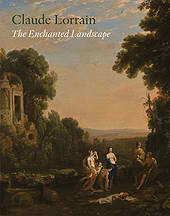
ISBN: 9781848220928, $80
The cult of Claude which grew up in the 18th and 19th centuries, begun by British ‘Grand Tourists’, has left a profound mark on our history and landscape. English country houses are well stocked with both originals by Claude and with copies. Responding to aristocratic taste and fashion, designers such as Capability Brown, Henry Hoare and William Kent reproduced his ideal views in the parklands of great houses from Blenheim Palace, Rousham House and Stowe, to Stourhead and Chatsworth. Claude’s drawings were collected with no less enthusiasm by English connoisseurs, as a result, over 40% of his drawings are now in the British Museum. Claude’s influence on later artists is apparent in the work of Gainsborough, Turner and Constable, who described him as ‘the most perfect landscape painter the world ever saw’.
A lesser-known side to Claude is the eccentricity of his graphic art. Claude Lorrain: The Enchanted Landscape will exhibit 13 paintings alongside related drawings and etchings from international and private collections, and from the Ashmolean’s own extensive holdings. Claude was a dedicated graphic artist. He drew for the sake of mastering the world of nature but also because drawing was a pleasure in itself. Many of his drawings were made as works of art in their own right. During his own lifetime Claude’s fame grew rapidly. As a guard against forgeries, he made copies of his paintings in a book, the Liber Veritatis (Book of Truth), which, by the time of his death, contained 200 drawings. The book also gave him a collection of ideas which he could reuse when necessary. Although he made only 40 prints in total, all of which are on display, he took a serious interest in printmaking. Similar to his drawings, his principle focus was to explore the potential of the medium. His exceptional technique – a painterly brush-and-ink style replicating natural effects – was a novelty in contemporary printmaking. The spectacular ‘Fireworks’ series, ten etchings made during a week of firework displays in Rome, illustrate his experimental style and will be on show together in the Ashmolean’s exhibition.
Unlike contemporaries who had an academic training, Claude’s style and artistic process were unique to him. He worked frequently with existing materials progressing from one painting to another through a process of variation and combination. His sketching excursions provided him with a stock of motifs, including trees, hills, rivers and antique ruins, which became constant accessories in his paintings. Figure groups were shifted from one composition to another. Landscapes, like stage scenery, were taken out for reuse with a different set of characters. Elsewhere he would cut compositions in two or enlarge them with separate sheets. Occasionally, he would pick up a discarded study and add detail to make it a finished work of art, often with peculiar results.
Claude was also the first artist to specialise in painting ‘pairs’. Approximately half his compositions were made as companion pieces, the earliest of which, on display here, are Landscape with the Judgement of Paris and Coast View (both 1633). The idea of pairs is also found among his prints. While many of his pairs show a compositional correspondence, contrast played as great a role as similarity. Often an Arcadian landscape is combined with a maritime view, or a morning scene with an evening setting. The pairs were not always executed concurrently: his very last painting, the Ashmolean’s great Ascanius and the Stag of Sylvia (1682), was made 5 years after its companion, Aeneas’s Farewell to Dido in Carthage (1676) now in Hamburg.
Claude Lorrain: The Enchanted Landscape will display some of Claude’s greatest masterpieces, works which have made his art familiar and well-loved. In placing these beside his graphic art and exploring his singular methods of working, the exhibition aims to expose an unexplored dimension to one of the western canon’s most famous names.
“Claude’s art is recognisable to almost all of us, even if we are less familiar with his name, and this important exhibition will reintroduce us to one of the greatest painters of all time.” Dr Jon Whiteley, Exhibition Curator and Senior Assistant Keeper of Western Art, Ashmolean Museum.
Catalogue: Martin Sonnabend, Jon Whiteley, and Christian Rumelin, Claude Lorrain: The Enchanted Landscape (London: Lund Humphries, 2011), 200 pages, ISBN: 9781848220928, $80.
◊ ◊ ◊ ◊ ◊
S E L E C T E D P R O G R A M M I N G
Colin Harrison (Senior Assistant Keeper of Western Art, Ashmolean Museum), Claude, Wilson, Turner
Saturday, 12 November, 11:00
Claude’s landscape paintings had a profound influence on British artists in the 18th and 19th century. This lecture focuses on his long-lasting inspiration, most apparent in the work of Richard Wilson (1714–1782) and J.M.W Turner (1775-1851).
Michael Clarke (Director of the Scottish National Gallery), Arcadia Revisited – Claude’s Enduring Legacy
Wednesday, 16 November, 2:00
Generally acknowledged as the founder of the European landscape tradition, Claude Lorrain was admired by many of the great European painters, especially Constable and Turner. His work exerted an enormous influence on later generations even eliciting praise from the Impressionist Camille Pissarro. This lecture charts the perennial attraction of an artist who ‘conducts us to the tranquility of Arcadian scenes and fairy land’ (Sir Joshua Reynolds).
Christopher Woodward (Director of the Garden Museum), Claude Lorrain and the Making of the English Landscape Garden
Wednesday, 7 December, 5:00
How did a French artist working in Rome in the 17th-century inspire the creation of 18th-century gardens such as Blenheim, Rousham and Stourhead? Christopher Woodward, Director of The Garden Museum and author of “In Ruins”, explores how Claude’s idyllic Italian scenes inspired the transformation of English gardens into visions of Arcadia.
Reviewed: ‘The Efflorescence of Caricature’
Recently added to caa.reviews:
Todd Porterfield, ed., The Efflorescence of Caricature, 1759–1838 (Burlington: Ashgate, 2011), 240 pages, ISBN: 9780754665915), $99.95.
Reviewed by Amelia Rauser, Franklin & Marshall College; posted 15 September 2011.
Caricature still has the power to inflame. In the last five years, several incidents—from the Danish satires depicting Muhammad to the racially tinged caricature of Barack Obama as a crazed chimp published by the ‘New York Post’ early in his presidency—have shown that caricature can still spark rage as well as pleasure. Developed in tandem with modern conceptions of identity, caricature is a quintessentially modern visual language. Caricature paradoxically reveals the truth of a person’s interior through the deformation of her or his exterior, thus making the invisible visible and satisfying a cultural desire for transparency and the unmasking of hypocrisy. At the same time, caricature is deeply subjective, its virtuosic linearity ostentatiously imaging the hand of the artist, and thereby providing an alibi for the truths that are unmasked: this is only my opinion, the caricature seems to say, and I’m only joking.
‘The Efflorescence of Caricature, 1759–1838‘, Todd Porterfield’s edited collection of essays on caricature’s “golden age,” is uneven, but on the whole it enriches and expands an understanding of the first flowering of caricature in the modern West. Emerging from a 2006 conference, the volume is more international than usual in two ways: the essays frequently address issues of influence, exchange, and imperialism among different nations; and the authors themselves are from several different countries, thus bringing refreshingly different approaches and concerns to bear in their contributions. Besides this internationalism, Porterfield also stresses the importance of a broad, “continental” definition of caricature in his introduction to the volume. This approach allows for a diverse array of satirical imprints to be included, including those that completely eschew bodily deformation as a means of communication. But it also invites inexactness and can lead to conceptual confusion . . .
The full review is available here» (CAA membership required)
Exhibition: Louis-Léopold Boilly (1761-1845)
From Art Media Agency:
Boilly (1761-1845)
Palais des Beaux-Arts de Lille, 4 November 2011 — 6 February 2012
 The Palais des Beaux-Arts in Lille will host the first international retrospective dedicated to Louis-Léopold Boilly (1761-1845). The event, celebrating the 250th birthday of the artist, will run from 4 November to 6 February. . . .
It is the first Boilly retrospective since the 1930s and it will feature works from numerous collections. It will underline the painter’s originality. His talent as a portraitist will also be highlighted, as well as his taste for trompe-l’œil and his role as the century’s chronicler, precursory to Daumier. The exhibition will feature more than 170 paintings, drawings, lithographs, miniatures and furniture. It will be divided into seven sections, in chronological and thematic order, recounting the painter’s itinerary.
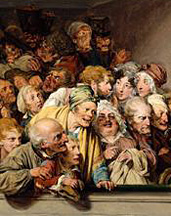
ISBN: 9782350391250
The full AMA posting is available here»
The exhibition press release (in French) is available here»
◊ ◊ ◊ ◊ ◊
Annie de Wambrechies, Louis-Leopold Boilly (1761-1845), exhibition catalogue (Paris: Chaudun, 2011), 304 pages, ISBN: 9782350391250, 42€ / $82.50 — The catalogue, scheduled for release in November, will be available from ArtBooks.com.










 Enfilade
leave a comment