New Titles from The Getty
Elena Phipps, Looking at Textiles: A Guide to Technical Terms (Los Angeles: Getty Publications, January 2012), 112 pages, ISBN: 9781606060803, $18.95.
 Textiles have been made and used by every culture throughout history. However diverse—whether an ancient Egyptian mummy wrapping, a Turkish carpet, an Italian velvet, or an American quilt—all textiles have basic elements in common. They are made of fibers, constructed into forms, and patterned and colored in ways that follow certain principles.
Looking at Textiles serves as a guide to the fundamentals of the materials and techniques used to create textiles. The selected technical terms explain what textiles are, how they are made, and what they are made of, and include definitions of terms relating to fibers, dyes, looms and weaving, and patterning processes. The many illustrations, including macro- and microscale photographs of a range of ancient and historic museum textiles, demonstrate the features described in the text.
Elena Phipps was a textile conservator at the Metropolitan Museum of Art for over thirty years. She has published numerous scholarly works on textile materials, techniques, and culture, including The Colonial Andes: Tapestries and Silverwork, 1530–1830 (Metropolitan Museum of Art, 2004), which was awarded both the Alfred H. Barr, Jr., Award (College Art Association) and the Mitchell Prize for best exhibition catalogue.
◊ ◊ ◊ ◊ ◊
Johann Joachim Winckelmann, introduction, translation, and commentary by Carol C. Mattusch, Letter and Report on the Discoveries at Herculaneum (Los Angeles: Getty Publications, January 2011), 240 pages, ISBN: 9781606060896, $50.
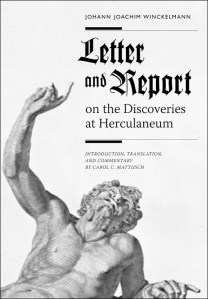 This new translation brings to light early scientific archaeology and the study of Herculaneum and Pompeii as observed by the erudite and acerbic art historian Johann Joachim Winckelmann (1717–1768). His Letter, published in German in 1762, displays his knowledge of geology, ancient literature, and art while offering a scathing critique of the Spanish Bourbon excavations around the Bay of Naples and of the officials involved. He further discusses these topics in his equally controversial Report of 1764.
The introduction describes the context in which these texts were written, identifies various politicians, academics, and collectors, and elucidates topics of particular interest to Winckelmann, from artifacts to local customs to the contents of ancient papyri. The illustrations, particularly those from the Bourbon publication—Le Antichità di Ercolano (1757–92)—illuminate how these monuments influenced contemporary perceptions of the ancient world.
Johann Joachim Winckelmann was a groundbreaking Prussian art historian and author of History of Ancient Art (1764). Carol C. Mattusch is Mathy Professor of Art History at George Mason University in Fairfax, Virginia, and author of The Villa dei Papiri at Herculaneum: Life and Afterlife of a Sculpture Collection (Getty Publications, 2005), which won the Charles Rufus Morey Book Award.
◊ ◊ ◊ ◊ ◊
Lance Mayer and Gay Myers, American Painters on Technique: The Colonial Period to 1860 (Los Angeles: Getty Publications, October 2011), 260 pages, ISBN: 9781606060773, $50.00
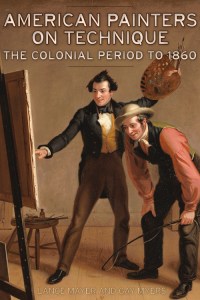 This is the first comprehensive study of an important but largely unknown part of the history of American art: the materials and techniques used by American painters. Based on extensive research, including artists’ recipe books, letters, journals, and painting manuals, much previously unpublished, the authors have also drawn on their many years as conservators of paintings for museums and collectors.
Information is provided on the methods of painters such as Benjamin West, Gilbert Stuart, Washington Allston, Thomas Sully, Thomas Cole, and William Sidney Mount. Topics include the quest for the “secrets” of the Old Masters; how artists saw their paintings changing over time; the application of “toning” layers; and the evolving self-confidence of American experimenters and innovators.
The book will be of interest to curators, art historians, painters, and conservators and will form the basis for future research on American painting techniques. At a time of discovering new approaches to art history, the story of how paintings were made parallels the better known histories about how styles changed and how paintings were commissioned, exhibited, and sold.
Lance Mayer and Gay Myers work at the Lyman Allyn Art Museum in New London, Connecticut, and as independent conservators.
Exhibition: ‘Luminous Paper, British Watercolors and Drawings’
From a Getty press release:
Luminous Paper: British Watercolors and Drawings
At the J. Paul Getty Museum, Getty Center, Los Angeles, 19 July — 23 October 2011
Curated by Julian Brooks

Thomas Girtin, "Durham Cathedral and Castle," ca. 1800 watercolor over pencil heightened with gum Arabic (Los Angeles: The J. Paul Getty Museum)
Watercolor is one of the most challenging artistic techniques—capable of extraordinary luminosity but often resistant to control. Luminous Paper: British Watercolors and Drawings presents more than 25 works of the 1700s and 1800s by some of the greatest masters of the medium, many on view for the first time.
Featuring the work of some of the most famous British artists, including J.M.W. Turner, William Blake, and Samuel Palmer, this exhibition reveals their multifaceted innovations in the field of drawing and watercolor painting. From Turner’s use of his thumbprint to roughen the texture of wash in a whirling seascape, to the reflected and re-reflected light built in layers by John Sell Cotman, the medium of watercolor was transformed beyond recognition. Other artists experimented with novel subject matter or new modes of representation, playing important roles in the development of European drawing and watercolor painting.
“Key works have been added to the Getty’s collection in the last few years as part of an ongoing initiative to build our holdings of British drawings and watercolors to better represent the wider European tradition,” said Associate Curator Julian Brooks, who curated the exhibition. “Many of these works have been recently acquired and we’re thrilled to be publicly displaying them for the first time in generations.”
Among the recent acquisitions is Durham Cathedral and Castle (about 1800) by Thomas Girtin, a dramatic view of a medieval cathedral and castle set on a rocky outcrop above the water, amid the moving light of a bright, cloudy sky. Girtin died of tuberculosis at the age of 27, two years after making this drawing. His rival J.M.W. Turner is reputed to have said “Had poor Tom lived, I would have starved.” Another is View of the Church of Our Lady of Hanswijk, Mechelen (1831) by Thomas Shotter Boys, a central figure in Anglo-French artistic exchange of the period, and one of the most sophisticated practitioners of watercolor. He excelled in capturing effects of atmosphere and mood. (more…)
Exhibition: ‘Sin and the City’, Hogarth at Princeton
From the exhibition website:
Sin and the City: William Hogarth’s London
Firestone Library, Princeton University, 26 August 2011 — 29 January 2012

William Hogarth, "Beer Street," 1751, etching and engraving (Princeton University: Graphic Arts Collection, Firestone Library)
This fall the Princeton University Library will celebrate eighteenth-century London as seen through engravings by one of its most popular storytellers. Sin and the City: William Hogarth’s London, on view 26 August 2011 to 29 January 2012, presents Hogarth’s unflinching chronicle of the city’s development from a medieval town to a swirling modern metropolis.
Whether examining scenes along the impoverished roads of St. Giles parish, peering into the dark cellars of Blood Bowl Alley, or accompanying a procession to the Tyburn gallows, Hogarth’s engravings plunge us into a city that is not only grand and powerful but also chaotic, crime-ridden, and sometimes even heartbreaking.
The exhibition includes 70 engravings by Hogarth, along with the work of his contemporaries, such as Jonathan Swift, John Gay, and Henry Fielding, among others. Period maps and original documents from the first production of The Beggar’s Opera will also be on view.
A full exhibition checklist is available here»
◊ ◊ ◊ ◊ ◊

Afternoon Roundtable Discussion: A Midnight Modern Conversation
Princeton University, 7 October 2011
With
Linda Colley, Shelby M.C. Davis 1958 Professor of History, Princeton University;
Mark Hallett, Professor of History of Art, University of York;
Tim Hitchcock, Professor of Eighteenth-Century History, University of Hertfordshire; and
Claude Rawson, Maynard Mack Professor of English, Yale University.
James Steward, Director of the Princeton University Art Museum will moderate.
A reception will follow.
◊ ◊ ◊ ◊ ◊
Additional information is available at the Events page. The exhibition organizers have also created a useful map detailing key locations for Hogarth’s prints.
Introducing the ‘Seminal Works Project’: Tim Blanning
As a new, occasional column here at Enfilade, the “Seminal Works Project” aims to identify and describe works that dixhuitièmistes consider to have been especially influential for their academic development. Such a ‘work’ could be a book, exhibition, journal article, even a television program — anything that had a great impact.
In the first installment, Tim Blanning of the University of Cambridge identifies Paul Bekker’s Das deutsche Musikleben [German musical life] as important for his thinking on musical form. Blanning’s research centers on the history of Continental Europe from the seventeenth century to the First World War, with various publications on eighteenth-century cultural history, most recently, The Triumph of Music in the Modern World (2008).
◊ ◊ ◊ ◊ ◊
Seminal Works
Tim Blanning, On Paul Bekker’s Das deutsche Musikleben (1916)
 Among the innumerable books and articles which have influenced me, the one that stands out for its originality is Paul Bekker’s Das deutsche Musikleben [German musical life], first published in 1916. Born in 1882, Bekker began life as a musician – early on at the very highest level indeed, leading the Berlin Philharmonic while still in his twenties. He then progressed briefly to conducting before devoting himself to writing, establishing a reputation as one of the most influential critics in Germany. After the First World War he served successively as artistic director at the state theatres of Kassel and Wiesbaden, while writing numerous books on musical theory and history. Forced into exile in 1933, he died in New York in 1937.
Although he was mainly concerned with contemporary music and the nineteenth century, his views on the interaction between society and music have just as much relevance for the eighteenth century. At the heart of his theory is the axiom that both the musician and society create. It would be wrong to allow the former alone the role of creator and assign to the latter just the role of receiving and performing. Musical form is usually understood as something confined to the sound (Klangbild) as recorded by the composer on the stave; and this sound is seen as the completed work of art. But that is to overlook the fact that such a sound is just inert matter – it acquires form only through perception. That perception can only take place through interaction with the milieu (Umwelt). Form appears only when matter and milieu relate to each other and only when the two of them get together does the finished work of art – the form – appear. The creative musician can be regarded as the creator of the form only in a limited sense: what he does is to set his music down on the stave, but to attain status of sound, it has to be performed, and however faithful the performer, he/she does participate in and add to its creation. That is even more true of the other element in form – perception. Perception is not passive reception but is an active process. By allowing the matter to become form through perception, it introduces a new element to the creative results of the musician: perceiving activity. This means that the milieu wins an independent share in the creation of form. Two separate creative powers enter into an active relationship with each other: the power of the musician, who arranges the matter, and the power of the milieu which perceives it. Although the laws which determine the formation of matter are fixed by the musician at the time of creation and are immutable, the perceptive power of the milieu is very mutable. So the potential for changes in form is as great as the changes in the milieu’s perception. The subject-matter is created by the composer in accordance with his perception of his audience’s ability to receive it. It is not formed as a result of any internal laws. It is the result of interaction with social reception. Consequently sound is not an aesthetic but a sociological construct. Through its particular composition, it is society which provides the foundations, and through its perceptive capacity it provides the preconditions for the formation of the musical subject-matter. There is much more besides in this wonderfully cogent and incisive book.
Tim Blanning
Sidney Sussex College, Cambridge
Video: Electronic Enlightenment Project
This video shows advances made by the Electronic Enlightenment’s Mapping the Republic of Letters Project, a fascinating collaboration between various institutions and scholars, which aims to investigate the ‘social network’ of the eighteenth century. Using new technologies such as geographical imaging, the project has created numerous maps of the correspondence of the Republic of Letters, which can be analysed, compared and contrasted. – FG
◊ ◊ ◊ ◊ ◊
From the Electronic Enlightenment Website:
Digging into Enlightenment: Mapping the Republic of Letters
An exciting collaboration between the Electronic Enlightenment Project (University of Oxford) and the Mapping the Republic of LettersProject (Stanford University) with participation of Chris Weaver at the University of Oklahoma.
This initiative involves mining and interpreting details relating to locations drawn from Electronic Enlightenment‘s corpus of 58,776 letters and documents from the long 18th century. The international project team will explore ways to visualize and annotate these relationships, developing sophisticated new tools to map and explore the complex geographical interconnections between these tens of thousands of letters to and from forty countries across Europe, Asia, and North and South America that can be found in the EE collection.
Call for Papers: EAHN Meeting in Brussels
European Architectural History Network Second International Meeting
Brussels, Belgium, 31 May — 3 June 2012
Proposals due by 30 September 2011
 The European Architectural History Network (EAHN) invites paper proposals for the twenty-three thematic sessions and four roundtable panels to be presented at its Second International Meeting. Sessions and roundtables will cover architecture of all periods, from antiquity, medieval, and early modern, up through the nineteenth and twentieth centuries, as well as topics from allied disciplines.
The following sessions may be of particular interest for historians of eighteenth-century architecture:
• Travel of Men and Models: Interpreting, Collecting and Adapting French Art and Architecture in Europe During the Seventeenth and Eighteenth Centuries
• The Spoils of Architectural Training: Studying School Manuals, Teaching Handbooks and Exercises Sheets in Europe (Eighteenth to Nineteenth Centuries)
Other sessions and roundtables address broad historic periods including the eighteenth century, for example:
• Clerical Ties: Architectural Networks and Networking in the Colonial Mission Field, c. 1500-1950
• Urban Representations of the Temporal
• Politics and Architecture: Definitions, Methods, Possibilities
• Fusion Architecture from the Middle Ages to the Present Day: Incorporation, Confrontation, or Integration?
For the complete call for papers, including full instructions for proposal submission, please visit the conference website: http://eahn2012.org.
Exhibition: American Colonial Revival Style in New York
From the Museum of the City of New York:
The American Style: Colonial Revival and the Modern Metropolis
Museum of the City of New York, 14 June — 30 October 2011
Curated by Donald Albrecht and Thomas Mellins
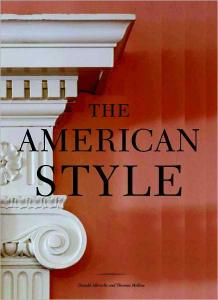 The American Style: Colonial Revival and the Modern Metropolis brings together extraordinary furniture, decorative objects, and photographs to survey, in New York City and beyond, the Colonial Revival movement in the realms of architecture and design. The exhibition covers the fertile period from the 1890s to the present, focusing on the years from 1900 to the 1930s, when New York City, through department stores, museums, and more, was the center for the style’s promotion nationwide.
Exhibition Catalogue: Donald Albrecht and Thomas Mellins, The American Style: Colonial Revival and the Modern Metropolis (New York: Monacelli Press, 2011), 224 pages, ISBN: 9781580932851, $50. Easily the most recognizable architectural style in America, with its brick or shingled facades trimmed in white and ornamented with restrained classical detail, the Colonial Revival emerged in the late nineteenth century and is still the basis for classical
design today. The American Style surveys the evolution of the Colonial Revival from the 1890s to the present, focusing on the period from 1900 to the 1930s when New York City was a major center of architecture and decorative arts. Leading architects, including McKim Mead & White, Delano & Aldrich, and Mott B. Schmidt, used its vocabulary for private residences and clubs as well as institutional buildings—banks, schools, churches, and museums.
◊ ◊ ◊ ◊ ◊
As Edward Rothstein writes in his review for The New York Times (13 June 2011) . . .
National Design That’s Hidden in Plain Sight
One sign of a powerful style is its invisibility. It is so familiar it is scarcely noticed. It is so natural, how could things be otherwise? We don’t really pay attention to the style itself. Instead we notice contrasts, variations, violations.
One of the achievements of the illuminating exhibition “The American Style,” which opens on Tuesday at the Museum of the City of New York, is that it helps make the invisible visible. With photographs of grand mansions and suburban residences; with images of high schools, apartment buildings, town halls and post offices; with examples of mass-market furniture and finely made cabinetry; with pewter candlesticks and pictorial wall murals and floor plans, the exhibition gradually helps us see what is all around us. Its subtitle defines the terrain: “Colonial Revival and the Modern Metropolis.”. . .
The style embraces both authority and intimacy, proclaiming the hopes of ordinary citizens as well as the heritage of those well established.
There is also a historical aspect to its appeal. The revival developed after the nation’s centennial celebrations in 1876, when the scars of the Civil War and the struggles of Reconstruction were salved by these allusions to an almost pastoral colonial past. Reproductions were made of early furniture. Paintings, vases and decorative plates incorporated images of Washington.
On display here is a hand-tinted photograph from the studio of Wallace Nutting, a minister who at the turn of the 20th century became something of a revival missionary, staging domestic tableaus in colonial-era homes and photographing them. The style gained another wave of energy from the renovation of Colonial Williamsburg in the 1930s, which even influenced architects of new urban developments.
The style, as the exhibition shows, eventually evolved into a national style meant “to invoke a national experience and express national values.” When the Metropolitan Museum of Art opened its American Wing in 1924, its first curator, R. T. H. Halsey, said the displays of early decorative arts would counter “the influx of foreign ideas” and present traditions “invaluable in the Americanization of many of our people.” . . .
The full review is available here»
Exhibition: A Subersive Art – Prints of the French Revolution
This exhibition, held at Waddesdon Manor, elaborates upon the the PhD research of co-curator, Claire Trevien (“Revolutionary Prints as Spectacle”). As she describes it, the thesis “undertaken at the University of Warwick, aspires to investigate the notion of spectacle and theatricality within the visual culture of the French Revolution. The aim of the thesis is to not reduce prints to simple historical witnesses or illustrations conveniently presented to suit an argument. Instead, it is a study of the metaphors used in the prints, a method that sheds new light on the links that exist between theatre, politics and visual culture during the French Revolution.” –FG
◊ ◊ ◊ ◊ ◊
From Waddesdon Manor:
A Subversive Art: Prints of the French Revolution
Waddesdon Manor, Buckinghamshire

Isaac Cruikshank, “The Martyrdom of Louis XVI, King of France” 1 February 1793 (Waddesdon, The Rothschild Collection)
Curated by Paul Davidson and Claire Trévien
This display features an extraordinary collection of prints about the French Revolution, acquired by Baron Ferdinand. Bound into four large volumes, they record major events (such as the storming of the Bastille and the executions of Louis XVI and Marie-Antoinette), but also some of the more ephemeral episodes, often with a highly satirical, political eye. The prints are being catalogued as part of a collaborative research project with the Universities of London (Queen Mary) and Warwick, and will eventually be available to study online.
In addition to the display on the second floor, visitors will be able to follow a trail around the house, highlighting objects depicting or associated with significant figures of the French Revolution. The wealth of French material at Waddesdon reflects the interest of the Rothschild family in that turbulent period of history.
Exhibition: Toile de Jouy, Printed Gardens and Fields
I’m happy to welcome one more addition to the Enfilade team! The Paris-based Ph.D. student Hélène Bremer will be weighing in with occasional contributions. She completed her M.A. in Art History at the University of Leiden in 2000 and is now working on her dissertation (also at Leiden) “Grand Tour, Grand collections: The Influence of the Grand Tour Experience on Collection Display in the Eighteenth Century.” She’ll be reporting not only on events in France but also sharing news from the Netherlands. We start things off with an exhibition sketch in response to the Musée de la Toile de Jouy. -CH
◊ ◊ ◊ ◊ ◊
Parties de Campagne, Jardins et champs dans la toile imprimée XVIIIe-XIXe siècle
Musée de la Toile de Jouy, Jouy-en-Josas, 29 April — 20 November 2011
Exhibition sketch by Hélène Bremer

Founded in 1977, the Musée de la Toile de Jouy moved into its current home, the nineteenth-century Château d'Eglantine in 1991. The museum's holdings include some 5000 objects.
The Musée de la Toile de Jouy at Jouy-en-Josas is an ideal destination for anyone taken with wonderful fabrics and eighteenth-century history. Just a few kilometers from the Château de Versailles (though far from its tourist throngs), the museum is located at the Château d’Eglantine. While this charming setting is alone worth a visit, the museum’s interiors offer lovely rooms full of toile-covered furniture. Not only do you find here a vast collection of Toile de Jouy, the displays explain the industrialization of toile-making, particularly the printing innovations of factory founder Christophe-Philippe Oberkampf, the German immigrant who introduced to Jouy-en-Josas, the use of engraved copper plates (1770) and then copper rollers (1797), replacing the older wood blocks.
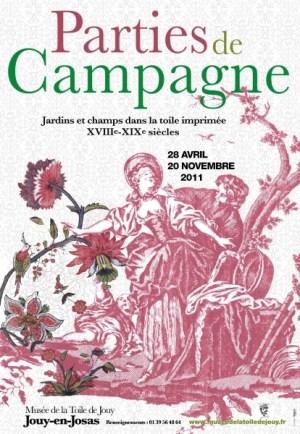 For the spring and summer, the staff of the museum have organized a delightful exhibition, Parties de Campagne, Jardins et champs dans la toile imprimée XVIIIe-XIXe siècles. The curators have assembled over 200 examples of fabrics depicting a wide variety of subjects: the four seasons, workers in the fields, shepherds and hunting scenes, children playing, landscapes with ruins, and fête champêtre motifs. There is also a nice, small fabric-covered balloon — to my mind, just begging to be shown with the fabric, Le Ballon de Gonesse, an example of which can be found nearby in the museum’s permanent display.
The sheer quantity of fabrics on display is impressive, suggesting at times the feel of a densely packed closet. The quantity indicates how much there is to explore on this interesting topic of la vie champêtre and how rich the museum’s holdings are, given that all the material comes from the museum’s own collection.
Having seen the exhibition, I’m curious about the accompanying book, edited by Anne de Thoisy-Dallem, which unfortunately was not yet available when I visited in early May. It promises to be a useful publication with two fully-illustrated volumes, addressing not only the exhibition themes but also outlining new research on rare costumes, the gardens of Toile de Jouy, and precious botanical books that provided inspiration for the pattern designers.
For more information, including terrific images, the press release (in French) is available here»
Call for Papers: HBA Young Scholars Session, CAA 2012
Historians of British Art, Young Scholars Session at CAA 2012
Los Angeles, 24 February 2012
Proposals due by 15 October 2011
The Historians of British Art, a CAA-affiliated society, seeks papers for an upcoming mini-session of work by emerging scholars to be held during the HBA Business Meeting at CAA in Los Angeles on February 24, 2012. Current or recent graduate students (if a Ph.D. recipient, the degree must have been earned within the past three years) are invited to submit proposals. Papers may address any topic related to British art, architecture, and visual culture and should be limited to fifteen minutes. This is an opportunity for informal presentations of new or ongoing research followed by open discussion.
To submit a paper for consideration, please send the following items to Colette Crossman, HBA 1st Vice President, at colettecrossman@yahoo.com: (1) a one page abstract; (2) a C.V. (limited to two pages).; and (3) a brief cover letter explaining interest in the field. The deadline for submission is October 15, 2010. Decisions will be made by November 1. Upon selection, presenters are requested to join HBA if not currently a member. For more information about the Historians of British art, visit our website, www.historiansofbritishart.org










 Enfilade
leave a comment