Art Market: Buyers Lose Their Taste for 18th-Century Art and Furniture?
This interesting article by Souren Melikian on the state of the art market appeared a couple of week ago in The New York Times (22 July 2011). Whether the vogue for the eighteenth century is in fact waning, it makes for a compelling read. The article also includes some lovely examples of decorative arts from the period (a full list of images from the Lyons Demesne auction, with sale prices, is available here) -FG
◊ ◊ ◊ ◊ ◊

Lyons Demesne House, County Kildare, Ireland, 1785-1797, acquired by Tony Ryan in 1996
Last week, 450 works ranging from furniture to paintings and sculpture that had adorned Lyons Demesne, the Irish Georgian house restored at vast expense by the late Tony Ryan, who founded Ryanair, were dispersed at Christie’s to great fanfare [Sale 8012].
The fine catalog did justice to the mansion in County Kildare designed in 1797 by Oliver Grace for the wealthy businessman Nicholas Lawless. The son of a rich Dublin draper, Lawless further expanded his financial position by marrying the heiress of a brewer, Margaret Browne, and was made a peer. As the 1st Baron Cloncurry, Lawless acknowledged this costly promotion by writing to the Viceroy: “If I have obtained any honours, they have cost me their full value.”
His son Valentine was more pugnacious. He joined the Society of United Irishmen set up in 1791 to fight against the Act of Union with Great Britain and was incarcerated in the Tower of London following the 1798 uprising but was released in 1801, the year of the Act of Union. Whereupon, the 2nd Baron Cloncurry redirected his energy toward the embellishment of Lyons Demesne and embarked on a wild art-buying spree in Italy. Among his purchases were the granite columns from the Golden House of Nero, which had been re-employed in the Palazzo Farnese and now support the portico at Lyons.
Past history fired up Mr. Ryan. Having saved the grand mansion from ruin in the most ambitious program of restoration ever undertaken privately in Irish history, according to Hugh Montgomery-Massingberd, who tells the story in “Great Houses of Ireland,” the businessman proceeded to furnish it at top speed. Christie’s made the most of the Lyons Demesne motif — house sales traditionally gave furniture and other objects a halo that substantially enhanced their commercial value.
While the July 14 sale went remarkably well, with 90 percent of the lots finding takers, it also underlined the decline of the traditional furniture and decorations beloved by members of the Western upper class until the late 20th century. Good 18th-century furniture that does not belong in the superlative museum category did not fare well. . . .
Read the rest of the article here»
Call for Papers: The Florida State Graduate Symposium
The Florida State University Art History Graduate Symposium
Tallahassee, 4-5 November 2011
Proposals due by 29 August 2011
Keynote Speaker: John T. Paoletti, Kenan Professor of the Humanities, Emeritus and Professor of Art History, Wesleyan University
The Art History faculty and graduate students of The Florida State University invite students working toward an MA or a PhD to submit abstracts of papers for presentation at the 29th Annual Art History Graduate Student Symposium. Paper sessions will begin on Friday afternoon, November 4, and continue through Saturday, November 5, with each paper followed by critical discussion. Symposium papers may come from any area of the history of art and architecture. Papers will then be considered for inclusion in Athanor, a nationally-distributed journal published by the Department of Art History and the FSU College of Visual Arts, Theatre & Dance.
The deadline for receipt of abstracts (maximum 500 words) is 29 August 2011. Please indicate the title of the talk, graduate level, and whether the subject originated in thesis or dissertation research. Send the abstract either as a printout or an email attachment to: Dr. Lynn Jones, Symposium Coordinator, lajones@fsu.edu.
Reviewed: ‘Jean de Jullienne et les collectionneurs de son temps’
Isabelle Tillerot, Jean de Jullienne et les collectionneurs de son temps (Paris: Editions Maison des Sciences de L’homme, 2011), 510 pages, ISBN: 9782735112531, €48.
Reviewed for Enfilade by David Pullins
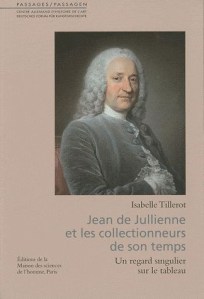 Between 1726 and 1735, Jean de Jullienne oversaw and financed the publication of some 495 prints in four volumes, all after the work of the recently deceased painter and draftsman, Antoine Watteau. This unprecedented form of commitment to a contemporary artist has rightly secured Jullienne’s fame ever since and earned the complicated publishing venture he spearheaded the unofficial title of the “Recueil Jullienne.” Émile Dacier and Albert Vuaflart’s three-volume Jean de Jullienne et les graveurs de Watteau au XVIIIe siècle (1921–29) remains indispensible for understanding the project, its chronology, and participants. A recent exhibition and catalog from the musée du Louvre, Antoine Watteau et l’art de l’estampe (2010), revisited the history of the publication by attempting to piece together what can be learned by comparing the wide variation between surviving copies. As the consolidation of an artistic personality that took into account all aspects of a single artist’s production, the Recueil Jullienne continues to have much to offer scholars not merely as documentation of lost works by Watteau, but also as a significant moment in the practice of writing and publishing the history of art.
In a substantial new monograph on Jullienne, Isabelle Tillerot deliberately devotes only a few pages directly to the Recueil in order to focus her attention on Julienne as a collector and amateur. While Jullienne no doubt will remain best known for the Recueil bearing his name, Tillerot’s work uncovers the social and commercial networks that he occupied in meticulous detail and plants him firmly in the ground of recent scholarship on the art market, collecting, and the amateur in eighteenth-century France. While consistent in its thoroughness with the monographs that have come out of France in recent years – including the most exhaustive examples, Guillaume Glorieux’s work on the dealer Gersaint (2002) or Christian Michel on Cochin (1993) – Tillerot’s book aims to connect with broader theories on collecting and the status of works of art as physical objects with citations from Maurice Blanchot and Michel Foucault. This framework speaks to a larger ambition for the potential of monographic studies, while at times not feeling entirely integrated with the primary material that is in the end the heart of her project.
For the history of collecting, Jullienne’s singularity is based largely on his social position as a successful dyer and cloth merchant and the survival of an album of watercolors illustrating the hang of his collection at his hôtel in the rue des Gobelins from around 1756 (now owned by the Pierpont Morgan Library). While Dacier and Vuaflart alerted scholars to both of these elements in the 1920s, Tillerot contributes additional archival research (providing more precise documentation of available sources) and then extrapolates from this material in order to argue for why Jullienne is of interest apart from his engagement with Watteau. Jullienne’s self-made status – “I declare that I have not inherited any means either from my father or mother and that all I have comes solely from my own efforts and pains,” he wrote in 1764[i] – and strong mercantile ties make him unusual among French collectors of the first half of the eighteenth century. His patent of nobility, granted in 1736, was in fact based on his success in business; when he met Rosalba Carriera, probably through Pierre Crozat in 1721, he gave her a piece of scarlato, an expensive fabric related to his trade.[ii]
Tillerot highlights Jullienne as an early example of the merchant-collector in France and works through the unlikely but intimate connection of his family to the circle of the comtesse de Verrue, a pioneer in the collecting of Flemish painting, but also a representative of a more conventional, aristocratic model in Tillerot’s account. The illustrated album of Jullienne’s collection – the survival of which is a remarkable piece of historical luck – allows Tillerot to discuss the means through which Jullienne integrated the longstanding French admiration for Italian painting, newly developing taste for Flemish painting, and his own interest in the contemporary French school. By the time of his death in 1766, Jullienne owned a significant group of contemporary French paintings by Watteau, Boucher, Greuze, and de Troy (both father and son). In charting his relationship to the art of his own time, Tillerot works from Colin Bailey’s articulation of a “goût patriotique,” and, again, Jullienne emerges as a particularly early and notable example of a model more familiar later in the century. In dialogue with the recent work of Charlotte Guichard on the institutional framework supporting the amateur in eighteenth-century France, this aspect of Jullienne’s collection returns her to his publishing project and his gift in 1739 of the four volumes after Watteau to the Académie royale, which in turn granted him the title conseiller honoraire et amateur.
The impact of Tillerot’s work is evident already in Christoph Vogtherr and Jennifer Tonkovich’s current exhibition and catalogue for The Wallace Collection, Jean de Julienne: Collector & Connoisseur (2011), which relies heavily on the research presented in Tillerot’s dissertation, completed under Christian Michel in 2005 and on which the present book is closely based. The relevance of Tillerot’s research will continue to be felt with the massive, continued efforts to document the life and work of the collector Jean-Pierre Mariette – who, as Tonkovich has detailed in the Wallace catalogue and related articles, heavily annotated the catalog of Jullienne’s collection when it was sold over fifty-four days in 1767. While the documentary evidence Tillerot provides (including a lengthy index of his painting collection and images from the album) proves an important resource, her shift towards a more integrative approach, taking into account the broader social network in which Jullienne functioned moves her study away from the recent impulse toward the exhaustive monograph and points to the potential for examining the almost maddening interconnectedness that characterizes collecting in eighteenth-century France.
Life & Luxury Programming
From the MFAH:
Programming for the Life & Luxury Exhibition at the Museum of Fine Arts, Houston
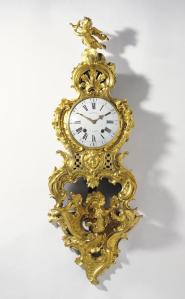
Clock movement by Jean-Romilly Case attributed to Charles Cressent Bracket by Jean-Joseph de Saint-Germain Clock on Bracket (Cartel sur une console) ca. 1758 (Getty Museum)
23 & 24 September 2011
Peter Björn Kerber (J. Paul Getty Museum), Sister Arts: Opera and Painting in Eighteenth-Century Europe
7 & 8 October 2011
David E. Brauer (Glassell School of Art, MFAH), From the Sun King to the Revolution: The Real vs. the Ideal in Eighteenth-Century French Painting
14 & 15 October 2011
Eric T. Haskell (Scripps College), Edens of Excess: Gardens of Eighteenth-Century Paris
Comments Off on Life & Luxury Programming
Reviewed: Life and Luxury in Paris
The exhibition Paris: Life and Luxury in the Eighteenth Century closes today at the Getty. It opens at the Museum of Fine Arts, Houston on September 18th and runs through December 11. With her typically lucid prose, Amanda Vickery reviews the exhibition for The Guardian (29 July 2011). . .
Opulence, bling and luxury provoke powerful responses in an age of austerity, from wistful envy to righteous disgust. Working girls flocked to see lamé gowns on the silver screen in the hungry 1930s, but Marie Antoinette is scorned for wondering why in the 1790s the poor didn’t eat brioche when the bread ran out. “Luxury” sounds so old fashioned, but the word still flourishes in marketing. The 21st-century “luxury goods market” embraces everything from jewels and luggage to private jets. In yoking a brand to luxury, advertisers draw on a vintage notion of refined taste – harking back to a world of connoisseurs, exquisite workmanship and, above all, sophistication.
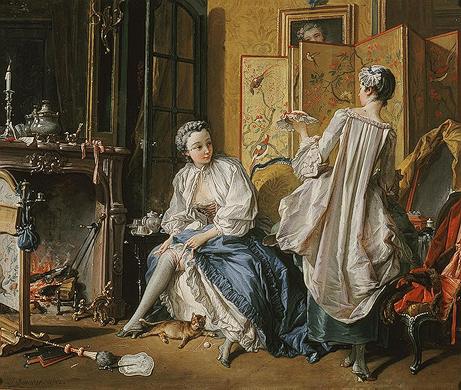
François Boucher, "A Lady Fastening Her Garter (La Toilette)," 1742 (Madrid: Museo Thyssen-Bornemisza)
It is this mélange of consumerism and lifestyle that the Getty exhibition Paris: Life and Luxury in the Eighteenth Century seeks to evoke. It is built round the outstanding collection of French decorative art that Jean Paul Getty, oil tycoon and once America’s richest man, left to his museum at his death. Ancien Regime Paris was the epicentre of European style. “Fashion is to France what the gold mines of Peru are to Spain,” concluded Jean-Baptiste Colbert, Louis XIV’s minister in 1665. French manufacturing was geared to the carriage trade. Demolish the Paris luxury industry, the Baroness d’Oberkirch concluded, and French international supremacy would wither overnight.
Across the channel the British were grinding their teeth. France was Britain’s only real economic and diplomatic rival – the two countries went to war seven times between 1688 and 1815. France was everything the new Protestant parliamentary state abhorred – Catholic, authoritarian, pleasure loving and effervescent. Yet still those thrifty Anglo Saxon Protestants could not contain their desire for French silks, tapestry, porcelain, mirrors, clocks and cabinetwork. “We are the whipped cream of Europe,” sighed Voltaire in 1735. . . .
Read the full article here»
Call for Papers: ASECS 2012 in San Antonio
2012 American Society for Eighteenth-Century Studies Conference
San Antonio, Texas, 22-25 March 2012
Proposals due by 15 September 2011
The 2012 ASECS conference takes place in San Antonio, 22-25 March. Along with our annual luncheon and business meeting, HECAA will be represented by two panels chaired by Christopher Johns, Heidi Strobel, and Amber Ludwig and Melissa Hyde and Heidi Kraus. In addition to these, a wide selection of sessions that might be relevant for HECAA members are also included below. A full list of panels is available at the ASECS website.
◊ ◊ ◊ ◊ ◊
Exoticisms: Global Commodity Exchange in the Long Eighteenth Century (Historians of Eighteenth-Century Art and Architecture)
Christopher Johns, Heidi Strobel, and Amber Ludwig, for Strobel: Dept. of Archaeology and Art History, 1800 Lincoln Ave., U. of Evansville, Evansville, IN, 47722; Tel: (812) 746-9711; Fax: (812) 488-2430; E-mail: hs40@evansville.edu
Global commodity exchange radically altered European culture in the long eighteenth century. Exoticisms became fundamental to understanding colonization and routes of international exchange, as well as iconographic and stylistic transformations in the arts. Each paper proposal should define exoticism, its geographical parameters, and its unique and unfamiliar qualities. The role of material culture, decorative arts, and prints in defining and developing the idea(s) of exoticism(s) is of particular interest. Interdisciplinary approaches are welcome and encouraged.
◊ ◊ ◊ ◊ ◊
New Scholar’s Open Session (Historians of Eighteenth-Century Art and Architecture)
Melissa Hyde, University of Florida and Heidi Kraus, University of Iowa; Tel: (Hyde) (352) 273 3057; E-mail: mhyde@ufl.edu AND heidiekraus@yahoo.com
This panel, sponsored by the Historians of Eighteenth-Century Art and Architecture, seeks papers that deal with any aspect of visual art and culture, or architecture. It is open to graduate students (priority will be given to those who are ABD) or who have received the Ph.D. in the past 5 years.
◊ ◊ ◊ ◊ ◊ (more…)
The Wallace Collection’s Reynolds Research Project
Exciting news from The Wallace Collection (22 July 2011) . . .

X-Ray Image of the Portrait of 'Mrs Jane Braddyll', Wallace Collection, 2011
The Wallace Collection Reynolds Research Project is a three year project funded by The Paul Mellon Centre for Studies in British Art. A collaboration between the Wallace Collection and the Conservation and Scientific Departments at the National Gallery, its purpose is to investigate the techniques and materials used by Reynolds by examining twelve of his paintings, which are in the Wallace Collection; and use this research as a basis for their conservation.
To examine the paintings, images are captured using high resolution digital photography, infrared and x-ray, and small paint samples are taken. Initial results have already revealed how complex Reynolds’ technique really was!
This very exciting project will continue to yield new and surprising results, with all the research being made publicly available later in the project. Alongside this, the Wallace Collection will continue to provide updates as new discoveries are made. The first restored painting has already arrived back at the Collection: Mrs Elizabeth Carnac, which can now be seen in the Great Gallery. The project will culminate in an exhibition, catalogue and scholarly conference at the Collection in 2014, which is sure to be well worth the wait!
Searching for Shelley’s Ghost on Shelley’s Birthday
The storied poet, Percy Bysshe Shelley, was born on this day in 1792. This exhibition helps explain how some of those stories were framed by his grieving wife in the wake of his death. From Dove Cottage and the Wordsworth Museum:
Shelley’s Ghost: Reshaping the Image of a Literary Family
Wordsworth Museum and Art Gallery, Grasmere, Cumbria, 7 July — 30 October 2011
Curated by Stephen Hebron
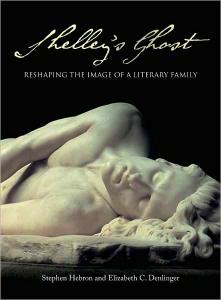
ISBN: 9781851243396, $35
Few families have such a remarkable reputation for their contribution to the literary and intellectual life of Britain as the Godwins and the Shelleys. In the course of their lives, each of the important writers in these families accumulated an archive of letters, notebooks and literary papers. After their death, surviving family members pored over this material, publishing some records and withholding others in an attempt to control that reputation.
Now, parts of this archive material are being brought together for display from two great Shelley collections – the Bodleian Libraries in Oxford and the New York Public Library, home of the Carl H. Pforzheimer Collection of Shelley and his Circle. Shelley’s Ghost will open in the Wordsworth Museum on 7 July 2011, and show until 31 October. The exhibition provides a fascinating insight into the real lives of three generations of a family that was blessed with genius, marred by tragedy, and often surrounded by scandal. It begins with the relationship between Wordsworth’s radical friend William Godwin and the feminist campaigner Mary Wollstonecraft; it goes on to cover their daughter Mary’s elopement and subsequent relationship with the poet Percy Bysshe Shelley, whose expulsion from Oxford for the publication of The Necessity of Atheism and elopement four months later with the 16-year-old Harriet Westbrook had already caused notoriety; and it concludes with the roles played by the Shelleys’ only surviving child, Sir Percy Florence Shelley, and his wife Jane, Lady Shelley, as the guardians of the family papers.
A central theme of the exhibition is the effort made by the grieving Mary Shelley in 1822, immediately after Shelley drowned aged 29 in the Bay of Lerici, to collect and edit his work and create a compelling image of his character. Shelley expected posterity to judge him as a poet: the court, he said, was ‘a very severe one’, and he feared the verdict would be ‘guilty death’. Sir Percy and Lady Shelley went on to house the family manuscripts in a special ‘Shelley Sanctum’ alongside treasured family relics such as portraits, personal possessions and locks of hair. For years they guarded them closely, seeking to protect the images of Shelley and Mary that we see in the portraits: smiling, ethereal, other worldly. Much of this archive remained intact when it was gifted to the Bodleian in 1893, as a collection which now enables us to see the dramas of these years preserved in private letters and journals, written in times of great stress and recording the most painful emotions. The exhibition will therefore show how the deliberately selective release of the manuscripts on display, which have been the basis of many biographies, has shaped public knowledge of this great literary family. The exhibition will also include rare books and family possessions, the first draft of Mary Shelley’s Frankenstein, and the best-known portrait of Shelley, painted in Rome by the amateur artist Amelia Curran in 1819.
The exhibition’s interactive website is available here»
◊ ◊ ◊ ◊ ◊
About Dove Cottage:
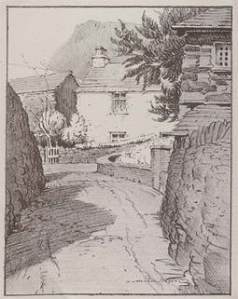 Dove Cottage was the home of William Wordsworth from December 1799 to May 1808, the years of his supreme work as a poet. As with many old buildings, the early history of Dove Cottage is difficult to trace accurately; although the date of its construction is not recorded, this is likely to have been during the early 17th century. Its original use is also unknown, but during the second half of the 18th century it became an inn called the Dove and Olive. Many of the building’s distinctive features date from this time; its white-washed walls, flagstone floors and dark, wood panelling. However, in the early 1790s, the Dove Cottage was closed down. It seems likely that the building remained empty for the next few years, until William and Dorothy Wordsworth arrived as tenants on 20th December 1799.
In the building’s time as a pub, the downstairs bedroom would have been used as a drinking room, but for the Wordsworths, it was always used as a bedroom. Initially this is where Dorothy slept and it would have been here that she wrote much of her ‘Grasmere Journals’. In the summer of 1802 this became William’s bedroom in preparation for his marriage to Mary Hutchinson in October. The washstand displayed in this room belonged to William and Mary and is a rare example of a double washstand. (more…)
Acces to French Theses
This free resource, theses.fr indexes some 6000 theses defended since 2006 with direct access to the texts in many cases. It seems that in most instances, there’s also an English summary.
◊ ◊ ◊ ◊ ◊
As noted at Le Blog ApAhAu:
 L’ABES (Agence Bibliographique de l’Enseignement supérieur) a ouvert le 11 juillet 2011 theses.fr . Ce portail des thèses françaises inventorie environ 6000 thèses de doctorat soutenues depuis 2006 dans les établissements français, voire en collaboration avec des institutions étrangères. L’accès au texte intégral est disponible pour plus de 4000 thèses. Dans les prochains mois, theses.fr s’enrichira des données sur les thèses de doctorat en préparation, notamment celles disponibles dans le Fichier central des thèses ainsi que de la bibliographie nationale des thèses, répertoire exhaustif de toutes les thèses soutenues en France depuis 1985, disponible aujourd’hui au sein du catalogue Sudoc. Il a donc l’ambition d’être un portail d’accès unique aux thèses pour en améliorer la visibilité.
Les mots clés s’affichent lors de la recherche ; les réponses peuvent être triées par dates, établissements, écoles doctorales, disciplines, langues, directeurs de thèse, domaines. La recherche peut aussi cibler uniquement les thèses en ligne. Il n’y a pas de recherche experte disponible. On peut s’abonner à une requête effectuée via l’icône « s’abonner ». Chaque référence comprend un résumé français et anglais ainsi que des mot-clés.
Quelques efforts restent encore à faire pour l’indexation. Il est, en effet, très difficile d’obtenir des réponses cohérentes pour les thèses soutenues en histoire de l’art. D’une part, la discipline fait l’objet de plusieurs entrées ; d’autre part, « histoire de l’art » utilisée comme mot-clé renvoie aux titres des thèses comprenant les termes « histoire » « de » « l’art » avec des résultats pour le moins curieux (par exemple : « Histoire et épistémiologie de l’art dentaire »).
Call for Papers: Scientiae Conference in Vancouver
From the conference website:
Scientiae: Disciplines of Knowing in the Early Modern World
Simon Fraser University, Vancouver, B.C., 26-28 April 2012
Proposals due 30 September 2011 [extended to 18 October 2011]
Paper and panel proposals are invited for Scientiae: a new interdisciplinary conference on early-modern science, to be held in Vancouver, B.C. (under the auspices of Simon Fraser University), April 26th-28th, 2012. The working assumption of the conference is that interdisciplinarity is not only an option, but a necessity, for the study of early-modern culture in its knowledge of the natural world. That is because period science is itself an interdisciplinary function, emerging from Biblical exegesis, advanced design, and literary humanitas; as well as from natural philosophy, alchemy, craft traditions, etc. By the same token, emergent science lends unique coherence to the gathered diversity of early-modern or Renaissance scholarship, when it is taken as an intellectual focal point. Scientiae offers a forum for scholars of the period’s art and literature, as well as its intellectual history, to illuminate aspects of early-modern science in the latter’s proper strangeness. Topics and questions may include, but are by no means limited to: (more…)










 Enfilade
leave a comment