Exhibition: Revisiting the Regency: England, 1811–1820
From The Huntington:
Revisiting the Regency: England, 1811–1820
The Huntington Library, San Marino, CA, 23 April — 1 August 2011

Thomas Rowlandson, “Vauxhall Gardens,” from "Microcosm of London" (London: T. Bensley, ca. 1808–11)
In October of 1810, England’s King George III slipped into that final madness from which only death would release him, nearly a decade later. The following February, Parliament authorized the king’s estranged and profligate eldest son, the Prince of Wales (the future George IV), to rule in his place as regent. Extravagant, emotional, controversial, and self-indulgent, the prince regent lent his name and many of his characteristics to a glittering era.
In commemoration of the 200th anniversary of this extraordinary decade, The Huntington presents an exhibition titled Revisiting the Regency: England, 1811–1820. Opening April 23 in the West Hall of the Library and continuing through August 1, the exhibition draws on The Huntington’s extensive holdings of rare books, manuscripts, prints, and drawings documenting this historic era.
The term “Regency England” usually evokes Jane Austen’s world of graceful country-house living and decorous village society, the elegance of London’s fashionable elite, or the licentious activities of the prince and his aristocratic Carlton House set. Ladies followed the latest fashions in La Belle Assemblée while gentlemen copied Beau Brummell’s severe elegance. Readers found new works by a generation of England’s greatest poets and novelists: Austen, Lord Byron, John Keats, Samuel Taylor Coleridge, and Sir Walter Scott. Londoners enjoyed a rich theatrical and musical life, watching Edmund Kean’s premiere in Richard III or hearing the first English production of Mozart’s Don Giovanni. Art lovers followed the latest exhibits at the Royal Academy. Under the prince’s patronage, architect John Nash created the fantasy Royal Pavilion at Brighton and remade London’s West End with the new developments of Regent’s Park and Regent Street.
Yet underneath this ordered upper-class surface lay a far more complex and turbulent world: more than a century of intermittent war with France ended at Waterloo, but peace revealed wrenching poverty, social unrest, the strains of rapid industrialization, and growing calls for political reform. The first railroads, gas lighting, and other advances in technology altered the landscape of everyday life. This rich cavalcade of people and events provided irresistible targets for a brilliant generation of visual satirists. The witty, savage, and iconic images of George Cruikshank and his fellow caricaturists, well represented in the exhibition, capture all the vagaries of an extraordinary decade in English arts, letters, science, and society.
Mary Robertson, William A. Moffett Curator,
English Historical Manuscripts
Reviewed: ‘The Temperamental Nude’
Recently added to caa.reviews:
Tony Halliday, The Temperamental Nude: Class, Medicine and Representation in Eighteenth-Century France, Studies on Voltaire and the Eighteenth Century (Oxford: Voltaire Foundation, 2010), 272 pages, ISBN: 9780729409940, £55.
Reviewed by Dorothy Johnson, University of Iowa; posted 14 July 2011.
In “The Temperamental Nude: Class, Medicine and Representation in Eighteenth-Century France,” the late Tony Halliday studies a neglected facet of visual representation in Enlightenment culture, namely, the revival and significance of the theory of the temperaments and its impact on the depiction of the human figure, specifically the male figure, in painting, sculpture, and prints. His study focuses principally on mid- to late eighteenth-century France, with particular emphasis on the Revolutionary period. The contested idea of the new citizen (who was male according to French convention and law) and his fluctuating image in the visual arts during the Revolution, Republic, and Directory (1789–99) constitute the principal matter of the book. . . .
The full review is available here» (CAA membership required)
Exhibition: ‘Making History: Antiquaries in Britain’

Making History: Antiquaries in Britain
McMullen Museum of Art, Boston College, 4 September — 11 December 2011
Yale Center for British Art, New Haven, 2 February — 27 May 2012
Making History celebrates the achievements of the Society of Antiquaries of London, the oldest independent learned society concerned with the study of the past. The exhibition, featuring one hundred works selected from the Society’s treasures (with a number of additions from the collections at the Center), focuses on the discovery, recording, preservation, and interpretation of Britain’s past through its material remains. It explores beliefs current before the Society was founded in 1707, and reveals how new discoveries, technologies, and interpretations have transformed our understanding of the history of Britain since the eighteenth century.
 Making History is organized into nine sections. Highlights include antiquities such as a rare Late Bronze Age shield (ca. 1300–1100 BCE) discovered on a farm in Scotland in 1779; an early copy of the Magna Carta (ca. 1225); a medieval processional cross reportedly recovered from the battlefield of Bosworth (1485); the inventory (1550–51) of Henry VIII’s possessions at the time of his death; and a forty-foot-long illuminated “roll chronicle” on parchment detailing the genealogical descent of Henry II from Adam and Eve. Also on display will be an extraordinary collection of English royal portraits painted on panel, from Henry VI to Mary Tudor.
The exhibition is organized by the Society of Antiquaries of London in association with the McMullen Museum of Art, Boston College, and the Center. It will be on display at the McMullen Museum of Art from September 9, 2011, to January 2, 2012, where the organizing curator is Nancy Netzer, Director. The organizing curator at the Center is Elisabeth Fairman, Senior Curator of Rare Books and Manuscripts.
◊ ◊ ◊ ◊ ◊
More information is available at the exhibition website.
Two CAA Publishing Grants
From CAA News (13 June 2011) . . .
CAA is offering two publishing-grant opportunities this fall—through the Millard Meiss Publication Fund and the Wyeth Foundation for American Art Publication Grant—that support new books in art history and related subjects. The publisher must submit the application to either grant or to both funds, though only one award can be given per title. Awards are made at the discretion of each jury and vary according to merit, need, and number of applications. Both programs have a deadline of October 1, 2011. CAA will announce the recipients of the Meiss and Wyeth grants in late November or early December 2011.
◊ ◊ ◊ ◊ ◊
Millard Meiss Publication Fund
CAA awards grants from the Millard Meiss Publication Fund to support book-length scholarly manuscripts in the history of art and related subjects that have been accepted by a publisher on their merits but cannot be published in the most desirable form without a subsidy. For complete guidelines, application forms, and a grant description, please visit www.collegeart.org/meiss or write to publications@collegeart.org. Deadline: October 1, 2011.
Wyeth Foundation for American Art Publication Grant
Thanks to generous funding from the Wyeth Foundation for American Art, CAA awards a publication grant to support book-length scholarly manuscripts in the history of American art and related subjects. For purposes of this program, “American art” is defined as art created in the United States, Canada, and Mexico prior to 1970. Books eligible for the Wyeth Grant have been accepted by a publisher on their merits but cannot be published in the most desirable form without a subsidy. For complete guidelines, application forms, and a grant description, please visit www.collegeart.org/wyeth or write to publications@collegeart.org. Deadline: October 1, 2011.
Call for Papers: Conference on Statuary Erotics
This interdisciplinary conference seeks to investigate how statues facilitate this interplay of sexuality and history. It explores the numerous ways statues – as historical and imagined artifacts– allow us to think about the past and its relation to sex, gender and sexuality. The conference may be of interest to HECAA members working on sculpture of the period, as well as those working on the reception of antique sculpture within an eighteenth-century context. Reflections on gender, particularly with regard to the female consumer of sculpture could make for a fruitful submission. –FG
◊ ◊ ◊ ◊ ◊
From H-ArtHist:
Desiring Statues: Statuary, Sexuality and History Conference
University of Exeter, 27 April 2012
Proposals due by 1 October 2011

Antonio Canova, "The Three Graces," ca. 1814 Image © Victoria & Albert Museum, 2011
Keynote Speakers: Dr Stefano-Maria Evangelista (University of Oxford) and Dr Ian Jenkins (British Museum)
Statuary has offered a privileged site for the articulation of sexual experience and ideas, and the formation of sexual knowledge. From prehistoric phallic stones, mythological representations of statues and sculptors, e.g. Medusa or Pygmalion, to the Romantic aesthetics and erotics of statuary and the recurrent references to sculpture in nineteenth- and twentieth-century sexology and other new debates on sexuality, the discourse of the statue intersects with constructions of gender, sex and sexuality in multiple ways.
As historical objects, statues give insight into changing perceptions of the sexed body and its representation; they tell stories of ownership and appropriation of sexualities across diverse cultural locations and historical moments. As an imaginary site, statues can serve to trouble the distinction between subject and object, reality and unreality, presence and absence, and present and past, thereby offering rich possibilities for
thinking about the relation between individual and communal identities,
sexuality and the past.
The conference brings together contributors from a wide variety of disciplines, including history, gender and sexuality studies, literary and cultural studies, art history, classics, archaeology and philosophy. Contributions from postgraduate research students are very welcome. Papers should explore how statuary intersects with questions of sexuality and gender, and temporality, specifically history. Possible topics include, but are not limited to:
• Uses of Statuary in Sexual Science
• Statues in Colonial and Postcolonial Contexts
• Representations of Statues and Sculptors (in Literature, Visual Arts, New Media)
• Sculptures and the Construction of Gender, Racial and National Identity
• Use of Statuary in Sexual Reform Movements
• Psychoanalytic Uses of Statuary
• Statues, Gender and Sexuality in Myths, Legends and Their Adaptations
• Sculpture and Figurations of Desire
• Statuary Representations of the Gendered Body
• Reception Histories of Individual Statues
The conference is organised by Dr Jana Funke (j.funke@exeter.ac.uk) and Jennifer Grove (jeg208@exeter.ac.uk) as part of the interdisciplinary Sexual History, Sexual Knowledge project, funded by the Wellcome Trust, and led by Drs. Kate Fisher and Rebecca Langlands. Please send 300-500 words abstracts to j.funke@exeter.ac.uk and jeg208@exeter.ac.uk. The deadline for abstract submissions is 1 October 2011.
Exhibition: Madame Geoffrin
From the Maison de Chateaubriand:
Madame Geoffrin, une femme d’affaires et d’esprit
Maison de Chateaubriand, Vallée-aux-loups, 27 April — 24 July 2011

Entre 1727 et 1766, après Mme de Rambouillet et sa célèbre chambre bleue et avant Mme Récamier, Mme Geoffrin occupe le devant de la scène des salons, éclipsant par son savoir-faire toutes les autres concurrentes de son temps. Aidée dans son entreprise par une fortune confortable que lui procurent ses actions à la Manufacture royale des Glaces, elle crée un cercle qui séduit tous les beaux esprits du temps et connaît un succès au-delà de ses espérances.
Correspondant avec Catherine II, l’impératrice Marie-Thérèse et plus encore Stanislas-Auguste Poniatowski, élu roi de Pologne en 1764, elle fait en 1766 un voyage à Varsovie qui lui octroie une renommée européenne. À Vienne, elle accepte d’être l’ambassadrice de l’impératrice afin de promouvoir en France la renommée de celle que l’on destine au dauphin, Marie-Antoinette. En remerciement, elle reçoit un somptueux service en porcelaine de Meissen, qui sera montré pour la première fois au public, accompagné du grand surtout de glace commandé par Mme Geoffrin afin de pouvoir présenter cette précieuse vaisselle dignement sur sa table.

Jean-Marc Nattier, "Portrait of Madame Geoffrin," 1738 (Tokyo: Fuji Art Museum)
Sans pouvoir évoquer toutes les facettes du personnage, l’exposition permettra d’en mesurer l’envergure par la présentation non seulement de documents d’archives mais de souvenirs lui ayant appartenu ou de tableaux provenant de sa collection, exécutés par François Boucher, Claude-Nicolas Cochin, Joseph Vernet, Carle Van Loo, aujourd’hui conservés essentiellement en collections privées, qui nous livrent les secrets des goûts de cette protectrice des arts. Après un portrait inédit de Mme de Rambouillet par Philippe de Champaigne, l’exposition s’ouvre par des portraits peints de Mme Geoffrin et des portraits psychologiques dressés par sa fille ou les gens de Lettres qui l’ont connue. Suit la section consacrée à la femme d’affaires, évoquée grâce au concours de Saint-Gobain. Puis le visiteur pénètre dans l’intimité de l’hôtel Geoffrin – notamment par deux dessins d’Hubert Robert – et de ses invités. L’exposition s’achève par le retour de Pologne à Paris de notre héroïne, alors au zénith de sa gloire, la fin de sa vie et son rayonnement posthume.
Third Anglo-Italian Conference at York
This interdisciplinary conference is devoted to investigations of ‘the Marginal and the Mainstream’ in and between Italy and Great Britain in the eighteenth century. A number of sessions may be of interest to HECAA members, particularly the ‘Cultural Transfers’ and ‘Taste in the Arts’ panels. For registration details and accommodation information, see the Centre for Eighteenth-Century Studies website. –FG
◊ ◊ ◊ ◊ ◊
Third Anglo Italian Conference: The Marginal and the Mainstream in the Eighteenth Century
King’s Manor, York, 13-14 September 2011
Event Organisers: Frank O’Gormanand Lia Guerra
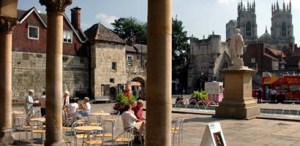 The counterpoint between the marginal and the mainstream has been for many decades a compelling and an important one. The idea of a ‘mainstream’ or ‘major stream’ may have an aquatic origin but in recent centuries has come to be associated with the idea of important or principal matters in hand, implying also the notion of something important, mighty, or even popular. In recent decades, the implication of ‘scholarly fashion’ may also have been added. Down to the sixteenth century the notion of ‘the marginal’ referred to the margin of a text, the space between the edge of the book and the text itself. Later, this idea admitted the concept of a boundary and later still the notion of the contour and border beyond which something ceases to be possible and desirable. Today, most scholars recognise a yet further extension to these definitions, the idea of dissident ideas, practices or opinions existing on the sidelines of the majority. (more…)
Call for Papers: Facts & Feelings, Artists’ Emotions
Facts & Feelings: Documentary Evidence on Emotions of Artists, 1600-1800
Catholic University of Leuven, Belgium, 8-9 December 2011
Proposals due 15 September 2011

Arenberg Castle, ca. 1500, part of the Catholic University of Leuven (Photo: Wikimedia Commons)
The art history research unit of the University of Leuven (Katholieke Universiteit Leuven, Belgium) announces the Call for Papers for the symposium Facts & Feelings: Documentary Evidence on Emotions of Artists in the Early Modern Period, 1600-1800 to be held at the Faculty of Arts on 8-9 December 2011. The symposium’s aim is to bring together researchers in various historical disciplines to focus on a rare type of source material: documents revealing emotions of early modern artists from the Low Countries and neighbouring countries (1600-1800).
Although these sources are hard to find, they are essential to shed (new) light on personal issues and inter-human relationships of early modern artistic communities. Topics are not limited to but may address any of the following aspects: written evidence of empathy, friendship, inspiration, doubt, pride, envy, dispute, etc. Potential contributors are invited to submit a paper abstract (max. 400 words) in the language of the paper (preferably Dutch, English, French or German), accompanied by a brief curriculum vitae including a list of max. five publications to the symposium organisers no later than 15 September 2011. The proceedings will be published.
Organisers: Prof. dr. Katlijne Van der Stighelen, Prof. dr. Koen Brosens, and Dra. Leen Kelchtermans
• Katlijne.VanderStighelen@arts.kuleuven.be
• Koen.Brosens@arts.kuleuven.be
• Leen.Kelchtermans@arts.kuleuven.be
Forvo — You Say Tomato, I Say Tomato
Note from the Editor
One of the challenges of ‘doing’ art history, whether at the introductory, student level or as an established scholar, is knowing how to pronounce lots of unfamiliar words and names. That making sense of the eighteenth century requires such a wide range of international knowledge just compounds the difficulties. A working knowledge of French and Italian go a long way, but they hardly solve all of one’s problems (and incidentally just reinforce how large the gaps are in what often counts as the field’s dominant terrain). The important addition of German helps a lot, but there’s still plenty of room for serious gaffes. Latin is always useful with languages, though sometimes it can hurt with pronunciations. And names can be tough even in one’s native language. At least for American speakers, British names like Albemarle, Derby, and Leicester are tricky enough without the likes of Featherstonhaugh (which is sometimes, maybe all the time?, pronounced Fanshaw).
The digital revolution has transformed lots of what we do, but until recently, the usage model depended upon reading as an exclusively visual (and thus silent) experience. How often have I heard fine presentations from my students, marred by their serious mispronunciation of some crucial term or person in their paper? How often have I done the same thing, realizing only a few moments before giving a talk that I’ve never actually heard that name pronounced before?
One indication of the expanding sensory dimensions of the web comes from a source that I stumbled across several months ago, Forvo. The site’s tagline is clear enough: All the words in the world. Pronounced. Well, they’re not there yet (at least as of today, no Featherstonhaugh), but what is included is impressive. This past May, the site passed the million mark, with 267 languages represented . . .
 ◊ ◊ ◊ ◊ ◊
We are celebrating these days our third year online and coinciding with this anniversary we have reached an amazing number of pronunciations: 1,000,000. We have no words to thank you for making this possible but we have a graphic instead : )
Our friend Asier has created this nice infographic where you can see the evolution of Forvo and also the key data in our way.
◊ ◊ ◊ ◊ ◊
The site allows users to see how the same word would be pronounced in multiple locations. The proper pronunciation, for instance, of the British surname, Albemarle, would be a mispronunciation of the eponymous town in North Carolina. Forvo gives you both.
I still have questions. Is it affectation for an American to pronounce the city Bath with a British accent? Or in fact a mispronunciation of the city’s name not to do so? It also is often quite useful to know how names were pronounced in the eighteenth century (sometimes the shifts have been substantial), and at least currently Forvo appears to deal only with the present. Still, I think it’s a really valuable tool. I’ll be pointing students to it and also checking words myself (likely much more often than I would care to confess). -CH.
Exhibition: The Eighteenth Century Back in Fashion
From the Palace of Versailles:
Le XVIIIe au goût du jour / A Taste of the Eighteenth Century
Grand Trianon, Château de Versailles, 8 July — 9 October 2011
Curated by Olivier Saillard
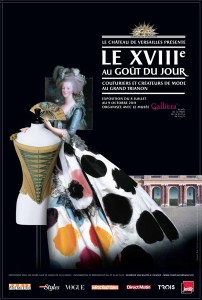 The Palace of Versailles and the Musée Galliera present an exhibition in the apartments of the Grand Trianon dedicated to the influence of the 18th century on modern fashion. Between haute couture and ready-to-wear, fifty models by great designers of the 20th century dialogue with costumes and accessories from the 18th century and show how this century is quoted with constant interest. These pieces come from the archives of maisons de couture and from the Galliera’s collections.
Influencing all the European courts, French culture of the 18th century was embodied by Madame de Pompadour, Madame Du Barry and even more so Marie-Antoinette – paragons of frivolity that has always fascinated the cinema, literature and the fashion world. With its huge powdered hairstyles, whalebone stays and hoop petticoats, flounces, frills and furbelows, garden swings and whispered confidences, the 18th century brought artifice to its paroxysm…
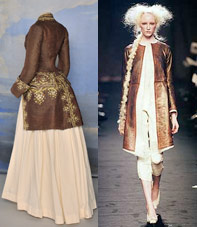 A fantasized style which gives free rein to interpretation: the Boué Sisters in the twenties revive panniers and lace in their robes de style, Christian Dior and Pierre Balmain offer evening gowns embroidered with typically 18th-century decorative patterns, Vivienne Westwood brings back brazen courtesans, fashionable Belles are corsetted by Azzedine Alaïa, Karl Lagerfeld for Chanel invites Watteau with his robes à la française, the Maison Christian Dior adorns duchesses with delicate attires, Christian Lacroix drapes his queens with brocades lavishly gleaming with gemstones and Olivier Theyskens for Rochas summons up the ghost of Marie-Antoinette in a Hollywood film.
While the elegant simplicity in black and white is played by Yves Saint Laurent, Martin Margiela transforms men’s garments into women’s, Nicolas Ghesquière for Balenciaga enhances women in little marquis dressed with lace and Alexander McQueen for Givenchy clothes his marquises in vests embroidered with gold thread. With Yohji Yamamoto, court dresses are destructured and so does Rei Kawakubo with riding coats. While Thierry Mugler hides oversized hoops under the dresses, Jean Paul Gaultier puts them upside down.
Couturiers and fashion designers invite you to discover this 18th century back in fashion, in the Grand Trianon.
◊ ◊ ◊ ◊ ◊
Suzy Menkes’s review for The New York Times (11 July 2011), is available here»










 Enfilade
leave a comment