Exhibition: ‘Revolution!’
From the New-York Historical Society:
Revolution! The Atlantic World Reborn
New-York Historical Society, 11 November 2011 — 15 April 2012
Details of additional venues to be announced later
Curated by Richard Rabinowitz

ISBN: 9781904832942, $65
Revolution! The Atlantic World Reborn, an international exhibition sponsored by the New-York Historical Society, will open in New York in November 2011 and travel to sites in Britain, France, the United States, and Haiti. Occupying about 3,500 square foot (325 m2), the exhibition will feature magnificent paintings, drawings, and prints from collections in a half-dozen countries; historical documents, maps, and manuscripts penned by participants in these revolutions; audio-visual presentations and computer-interactive learning stations; inventive and beautiful works of art commissioned for this exhibition; and curriculum materials for students from kindergarten through graduate school. The exhibition will be fully accessible in English, French, and Haitian Kreyol. Dr. Richard Rabinowitz of the American History Workshop, is Chief Curator of the exhibition. A beautifully illustrated catalog, with scholarly essays by leading scholars in revolutionary studies and edited by Professors Thomas Bender of NYU and
Laurent Dubois of Duke, will accompany the exhibition.

Noel le Mire, "General Washington," 1780, engraving (New York Historical Society)
The exhibition explores the enormous transformations in the world’s politics and culture between the 1763 triumph of the British Empire in the Seven Years War and the end of the Napoleonic Wars 52 years later. For the first time, this story will be told as a single global narrative rather than as chapters within national histories. Opposing the power and reach of European imperial authorities, the diverse men and women of the Atlantic world — natives of Africa, Europe, and the Americas — registered their grievances in both legal argument and violent protest. Their first major outbursts, comprised in the American Revolution, triggered an explosion of radical ideas. And these in turn drew many Britons to the antislavery crusade, then fomented a fierce antagonism to entrenched privilege among French revolutionaries, and finally spawned the astonishing insurrection on the island of Saint Domingue leading to the world’s only successful slave revolt and the establishment of the first nation fully committed to equality and emancipation, Haiti.

John Greenwood, "Sea Captains Carousing in Surinam," ca. 1752-58, oil on bed ticking (Saint Louis Art Museum)
Linking the attack on monarchism and aristocracy to the struggle against slavery, Revolution! explores how thousands of revolutionaries across the Atlantic world made freedom, equality, and the sovereignty of the people into universal goals. The eighteenth-century revolutionaries certainly did not succeed in obliterating every trace of the Ancient Regime, but they invented the notions of human rights, within a world of nation states, that still fire the desire for justice everywhere.
◊ ◊ ◊ ◊ ◊
Exhibition catalogue: Thomas Bender and Laurent Dubois, eds., Revolution! The Atlantic World Reborn (London: Giles, 2011), 288 pages, ISBN: 9781904832942, $65.
Exhibition: ‘Life, Liberty, and the Pursuit of Happiness’
Life, Liberty, and the Pursuit of Happiness: American Art from the Yale University Art Gallery
Speed Art Museum, Louisville, 7 September 2008 — 4 January 2009
Seattle Art Museum, 26 February — 24 May 2009
Birmingham Museum of Art, Alabama, 4 October 2009 — 10 January 2010
Yale University Art Gallery, New Haven, 29 July 2011 — 8 July 2012 (in three parts)

John Trumbull, "The Declaration of Independence, July 4, 1776," 1786–1820 (Yale University Art Gallery)
This exhibition draws upon the Gallery’s renowned collection of American paintings, decorative arts, and prints to illuminate the diverse and evolving American experience from the time of the settlements of the late seventeenth century to the World’s Columbian Exposition in 1893. The more than 200 works in this traveling exhibition—including treasures such as John Trumbull’s Declaration of Independence and Winslow Homer’s Morning Bell—now return to New Haven for a three-part presentation.
Exhibition and publication organized by Helen A. Cooper, the Holcombe T. Green Curator of American Paintings and Sculpture, with Robin Jaffee Frank, the Alice and Allan Kaplan Senior Associate Curator of American Paintings and Sculpture; Elisabeth Hodermarsky, the Sutphin Family Associate Curator of Prints, Drawings, and Photographs; and Patricia E. Kane, Friends of American Arts Curator of American Decorative Arts, all Yale University Art Gallery.
◊ ◊ ◊ ◊ ◊
Exhibition catalogue: Helen A. Cooper, ed., Life, Liberty, and the Pursuit of Happiness: American Art from the Yale University Art Gallery (New Haven: Yale University Press, 2008), 368 pages, ISBN: 9780300122893.
 The American experience—from its colonial beginnings to the modern age—has captured the imagination of all Americans, including its artists. This richly illustrated book explores works from the renowned collections of American paintings, decorative arts, prints, and photographs at the Yale University Art Gallery and creates a vivid portrait of a young country defining itself culturally, politically, and geographically.
Distinguished scholars shed new light on American history by examining some of the most familiar and revered objects in American art—paintings by Trumbull, Peale, Copley, Eakins, Church, and Homer; silver by Revere and Tiffany; furniture by Roux and Connelly; and photographs by Muybridge, among others. The authors discuss how issues of cultural heritage, patriotism, politics, and exploration shaped America’s art as well as its attitudes and traditions.
Snuff Boxes at Bonham’s — New Record
Press release from Bonham’s:

Meissen gold-mounted Royal snuff box made for Augustus III, Elector of Saxony and King of Poland, ca 1755. Estimate: £100,000 - 150,000
The most important collection of porcelain snuff boxes ever assembled is to be sold at Bonhams, New Bond Street, London on 5th July 2011 (Sale 19483). Comprising 80 boxes, the Helmut Joseph Collection gives a comprehensive overview of the history of European ceramics in snuff boxes, with examples from all major factories including Capodimonte, Meissen, Fulda, and Sevres. These exceptional and exquisite objects were considered the pinnacle of refined eighteenth-century court culture at its most luxurious and the collection has been exhibited in the world-renowned institutions of the Rijksmuseum, Amsterdam (1972-2000), alongside the Gilbert Collection in Somerset House (2003-2008) and most recently at the Bowes Museum, Co. Durham. The entire collection is estimated to fetch £800,000-1,000,000.
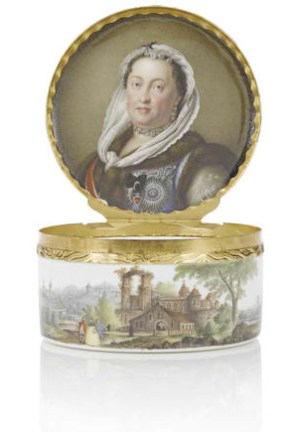
Gold-mounted circular snuff box with a portrait of Maria Josepha, Electress of Saxony and Queen of Poland, ca 1755. Estimate: £40,000 – 60,000.
Prolonged exposure to air causes snuff to dry out and lose its quality, so pocket snuff boxes were designed to be airtight containers with strong hinges, generally with enough space for a days worth of snuff only. The jewel-like objects are immensely tactile and widely varied in design and style. The most expensive in the collection has an intricately detailed depiction of a Dresden landscape on the inside lid, which is after an engraving by Bernardo Bellotto (estimate £100,000-150,000). There are also more affordable boxes, such as a small St Cloud example dating to the 1730s in the shape of a horse with diamond eyes (estimate £3,000-5,000). The collection has a large variety of boxes made as diplomatic gifts between nobility, as well as intimate family gifts, such as a magnificent Meissen box with the portrait of Maria Josepha, mother-in-law of Louis XVI. This extremely rare box painted by Heinrici was most likely a gift to one of her daughters.
Rich in detail and made from precious materials these gem-like pieces were among the most precious and intimate gifts bestowed by princes and monarchs. Many of them feature in the standard reference on the subject by Barbara Beaucamp-Markowsky, who writes: “Superbly decorated boxes in gold, enamel, mother-of-pearl or precious stones, and above all in porcelain, were adored by the ‘beau mode’ of the eighteenth century, indeed, such was their passion that it has been described as the ‘box culture period’ of the siècle gallant. Snuff-boxes were then the ‘musts’ of the world of elegance. They bore gracious witness to one’s good taste and refinement. Porcelain boxes from the colourful European factories possess such exquisite elegance and attractiveness, the delightful paintings on the inside of the lids so fascinating, that they are comparable in their fineness with that of the most exacting miniature paintings.”
The examples for sale at Bonhams come from what is without doubt the greatest collection of snuff boxes in the twentieth century, formed by Helmut Joseph. Joseph began collecting boxes following the example of his father, who already has a substantial collection before WWII. A real connoisseur of early Meissen porcelain, he had a profound and intimate relationship with his subject, and a deep knowledge of the field. Helmut Joseph generously made his collection available to the public; he always showed an interest in sharing information, and indeed supporting the development of knowledge on ceramics, be it by funding museums, or publishing his own collection.
◊ ◊ ◊ ◊ ◊
Sale results (updated 7 July 2011), from a Bonham’s press release:
Snuff Box with Dresden Landscape Sells for £860,000
 The most important collection of porcelain snuff boxes assembled in the 20th century sold for a fantastic £1,700,000 at Bonhams, New Bond Street, London on 5th July 2011. The top lot was a magnificent made for Augustus III, Elector of Saxony and King of Poland. With an intricately detailed depiction of a Dresden landscape on the inside of the cover, painted after an engraving by Bernardo Bellotto, the box had attracted a pre-sale estimate of £100,000-150,000. After a protracted bidding battle on the telephones the hammer finally came down on the staggering price of £860,000. This is a world record price for a porcelain snuff box at auction. . . .
The Grand Canal on a Grand Scale: Guardi at Sotheby’s on July 6
Press release from Sotheby’s:

Francesco Guardi, "Venice, a View of the Rialto Bridge, Looking North, from the Fondamenta del Carbon," oil on canvas, 45¼ by 78½ inches.
Guardi’s Venice, a View of the Rialto Bridge, Looking North, from the Fondamenta del Carbon, estimated at £15-25 million, is the centrepiece of the sale. This dramatic, atmospheric evocation of 18th-century Venice measures an impressive 115 by 199.5cm (45¼ by 78½ in) and is one of four works that Guardi painted on this grand scale, all executed in the late 1760s, which together constitute the pinnacle of his output as a painter of vedute. Generally considered to be Guardi’s greatest works, they are the first and fullest expression of the artist’s mature style. The oil on canvas has an exceptional provenance, having been sold just once since it was first acquired in Venice in 1768 by the English Grand Tourist, Chaloner Arcedeckne and then passed by inheritance from Arcedeckne until 1891. Throughout its existence, the painting has almost always hung in private. It has been on loan for a short period recently to the Iveagh Bequest at Kenwood House in London, but before that, has only been on show twice in its long history. . . .
◊ ◊ ◊ ◊ ◊
In addition to several impressive seventeenth-century paintings, there’s this pair of peculiar pictures attributed to Giandomenico Tiepolo:

Attributed to Giandomenico Tiepolo are two highly distinctive, majestic depictions of polar bears – possibly the first individual depictions of the animals in Italian art. Believed to be designed as overdoors, the spectacular pair – oils on canvas with gold ground – is estimated at £400,000-600,000.
◊ ◊ ◊ ◊ ◊
Sales results (updated 7 July 2011), from a Sotheby’s press release:
Guardi’s Monumental Veduta Beats Estimates to Top $42.8 Million

Tonight Sotheby’s London Old Master & British Paintings Evening Sale was led by Francesco Guardi’s monumental masterpiece Venice, a View of the Rialto Bridge, Looking North, from the Fondamenta del Carbon, which established the highest price of the week of London Old Master Sales when it sold for an astonishing £26,697,250/$42,865,105/ €29,834,146 (est. £15-25 million). Achieving a record as the second highest price for any Old Master Painting sold at auction, a record for any Venetian view painting at auction, as well as a record for the artist’s work, the painting was sought after by two determined bidders and finally sold to an anonymous telephone bidder. Overall the sale achieved a total of £47,640,900/$76,492,229/ €53,238,651 (pre-sale est. £31,110,000-48,120,000), with an average lot value for the works sold of £952,818 million. The sale was 68.5% sold by lot and 91.6% sold by value. . . .
And in case you were wondering, the bears attributed to Giandomenico Tiepolo fell comfortably in their estimate range, selling for £469,250.
Stubbs at Christie’s on July 5
Press release from Christie’s:

George Stubbs, "Gimcrack on Newmarket Heath, with a Trainer, a Stable-Lad, and a Jockey," 1765 (Photo: Christie's Images Ltd 2011)
Christie’s announce that they will offer for sale one of George Stubbs’ most important works at the Old Master and British Paintings Evening Sale on 5 July 2011 in London. Gimcrack on Newmarket Heath, with a Trainer, a Stable-Lad, and a Jockey by George Stubbs (1724-1806) is a true masterpiece of both British art and sporting painting, portraying Gimcrack, one of the most popular and admired of all eighteenth-century racehorses. It is offered from the Woolavington Collection, one of the finest private collections of Sporting Art, and is expected to realise in excess of £20 million.
John Stainton, Senior Director of British Pictures, Christie’s: “This is a truly exceptional example of eighteenth-century painting which holds immense importance on many levels — as an Old Master picture, as a great masterpiece of British Art, and as one of the finest sporting pictures ever painted. It is a great privilege for us to be able to work with this painting and to offer it at auction. Stubbs is an artist admired and collected by individuals and institutions from all around the world, and we look forward to presenting the opportunity for clients to acquire one of his greatest works at Christie’s on 5 July.”
Richard Knight, International co-head of Old Master and Nineteenth-Century Art at Christie’s: “Painted the year before James Christie oversaw our company’s first auction, the sale of this masterpiece will be a cornerstone moment in the history of Christie’s. It is telling that as a result of the global nature of the twenty-first-century art market, Stubbs, a very British artist, is set to join a small and select group who represent the most valuable old master artists ever sold, placing him alongside Raphael, Rubens, Rembrandt, and Turner.”
George Stubbs (1724-1806) is often celebrated as the greatest artist-scientist since Leonardo. His early career was spent working as a portrait painter, first in his native Liverpool, and subsequently in York. Having briefly visited Rome in 1754, Stubbs spent 18 months in a farmhouse in Lincolnshire dissecting and drawing horses in preparation for the publication of his famous book The Anatomy of the Horse. His striking depictions of animals are true to science and he held an ability to portray the magnificence of beasts in paint with complete accuracy and with no compromise to sentimentality. His exceptional talent earned the artist the patronage of many important aristocrats, particularly those involved in horseracing, the ‘sport of Kings’.
Gimcrack on Newmarket Heath, with a Trainer, a Stable-Lad, and a Jockey (40 x 76¼ in. / 101.6 x 193.6 cm.) was executed in 1765 having been commissioned by the horse’s owner, Frederick St. John, 2nd Viscount Bolingbroke, who led an extravagant lifestyle pursuing his main interests of racing and gambling. Gimcrack was one of the most popular and admired of all eighteenth-century racehorses. Although he was small, he had great stamina and won an impressive 28 of his 36 races, finishing unplaced only once. The painting shows Gimcrack twice: in the background he is seen winning a ‘trial’ by some distance, and in the foreground he is depicted with his trainer and jockey, a stable-lad rubbing him down. Gimcrack is portrayed with the full magnificence of the artist’s talent; anatomical perfection with even his veins shown pulsing through his skin. A secondary, autograph version of the painting was owned by Lord Grosvenor (a subsequent owner of Gimcrack) and is now in the collection of the Jockey Club, Newmarket.
The painting is making its third appearance at Christie’s. Sold by the Bolingbroke family in 1943, it was bought by Walter Hutchinson, founder of the National Gallery of British Sports and Pastimes, before being sold again at Christie’s in 1951 when it made £12,600 and entered the Woolavington Collection. One of the greatest collections of Sporting Art in the world, the core of the Woolavington Collection was formed at the end of the nineteenth and the early twentieth century by Lord Woolavington, a whisky magnate, philanthropist, and successful racehorse owner. The collection also includes other paintings by Stubbs, as well as exceptional works by Marshall, Ferneley, Herring and Munnings.
◊ ◊ ◊ ◊ ◊
Sale Results (updated 7 July 2011), from a Christie’s press release:
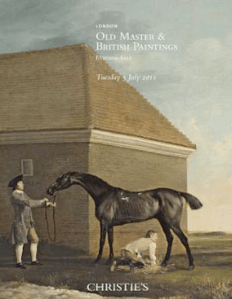 Stubbs’s Gimcrack on Newmarket Heath Fetches $35.9Million
The Evening Sale of Old Master & British Paintings realised £49,766,050 / $79,625,680 / €54,991,485, selling 67% by lot and 83% by value. The evening’s top price was paid for Gimcrack on Newmarket Heath, with a Trainer, a Stable-Lad, and a Jockey by George Stubbs (1724-1806) which sold for £22,441,250 / $35,906,000 / €24,797,581, becoming the third most valuable Old Master painting ever sold at auction. A masterpiece of both British art and sporting painting, it portrays Gimcrack, one of the most popular and admired of all eighteenth-century racehorses. It was last sold at auction in 1951 when it realized £12,600. . . .
The Irish Georgian Society to Restore Dublin’s City Assembly House
From the Irish Georgian Society:
 One of the most exciting developments in the history of the Irish Georgian Society has been its acquisition of the old City Assembly House, on South William Street, on a lease from Dublin City Council. In partnership with the Council, the Society aims to restore and revitalise this landmark building as a centre for its heritage and cultural activities but also, and most importantly, to give back to the life of the city one of its long forgotten but once venerable public spaces — the octagonal Exhibition Room of the former Society of Artists.
Over fifty years the Irish Georgian Society has established an unparalleled reputation for rescuing and restoring historic buildings throughout Ireland. In turning its attention to the City Assembly House, the IGS, in partnership with Dublin City Council, aims to restore this historically and architecturally significant building to its former glory. To achieve this the Irish Georgian Society, through its international membership in Ireland, the UK and the US, need to raise €2,000,000 over three years. Significant fundraising has already taken place on both sides of the Atlantic.

Once fully restored, the City Assembly House will become:
- An incomparable middle sized venue for exhibitions, lectures, musical performances and for other public gatherings.
- Headquarters for the Irish Georgian Society A centre for those interested in the Society’s activities relating to the preservation and conservation of our built heritage and support for the nation’s heritage in the decorative arts.
- A venue for other organizations active in the architectural conservation and heritage fields.
- A significant addition to the amenities of one of the oldest streets in Dublin, of the local community and as a new tourist destination for visitors to Dublin.
Please join with us in this amazing adventure. Our ambition is to complete this task in time for the building’s 250th anniversary in 2016 and for this we need your support. Information about how you can donate is available here»
◊ ◊ ◊ ◊ ◊
On Sunday, 3 July 2011, from 2-4pm, the City Assembly House (58 South William Street) will be open to visitors. Staff and the IGS Committee will be on hand to guide you around the house.
Resources Offered at the Irish Georgian Society Website
In addition to providing news about numerous events and various programmes, the website for the Irish Georgian Society includes two interesting resources: 1) A Register of Traditional Building Skills and 2) A Catalogue of Irish Theses and Dissertations Relating to Architecture and the Allied Arts. The following information comes from the IGS site:
◊ ◊ ◊ ◊ ◊
Traditional Building Skills Register
The needs of historic buildings and structures differ to those of new buildings. In dealing with a historic building professional input is vital and craftsmen with traditional skills are a necessity. Those involved need to understand the principles and practices of conservation, as using incorrect, inappropriate or unnecessary methods can do a great deal of irreversible damage. The Register was established to ensure that those undertaking conservation work can identify craftspeople and professionals with good conservation expertise.
Users of the register should be mindful that the register has been complied from information given by those listed and no responsibility is accepted by the Irish Georgian Society for the accuracy of the information, or for any fault or accident arising from the workmanship of anyone listed, or from materials used or supplied by them. Descriptions of conservation work undertaken was requested, and is listed under each entry, so that the skills and achievements of each individual or firm can be assessed by the user of the register. Inclusion should not be regarded as either a recommendation or an endorsement by the Society. The Register is not comprehensive and no criticism is implied or intended of an individual or firm not included. Every reasonable care has been taken in the compiling of the register but no responsibility is accepted for errors and omissions. . . .
More information and access is available here»
◊ ◊ ◊ ◊ ◊
A Catalogue of Irish Theses and Dissertations Relating to Architecture and the Allied Arts
This catalogue is an academic resource tool that has been compiled by the Irish Georgian Society in collaboration with Ireland’s academic institutions. It provides a centralised database of Irish theses and dissertations relating to architecture and the allied arts, which have been submitted as part of an academic qualification awarded on the island of Ireland. . . .
More information and access is available here»

Call for Papers: Centre and Periphery in the Enlightenment
From the society’s website:
Centre and Periphery in the Enlightenment: The Annual Conference of the Werkgroep 18e Eeuw
Groningen, The Netherlands, 20-21 January 2012
Proposals due by 30 June 2011
In recent years, Enlightenment studies have moved away from a traditional national, most often Francocentric or Anglocentric focus toward a new view of the Enlightenment as an international process. New conceptual categories have emerged, including that of an international, transnational or Atlantic Enlightenment, while older categories such as the Republic of Letters have been revived. Yet these categories do not fully do justice to the power relations also underlying much Enlightenment debate, in the Low Countries and beyond. As attractive as the notion of a transnational Enlightenment may be, it obscures the unequal access to power of different participants in Enlightenment debate, not only in terms of geography but also related social, institutional, and gender identifications.
This conference would therefore like to ask whether the older concept of centre and periphery might be useful in addressing power discrepancies between participants in Enlightenment debates. In doing so, it takes up the provocative question formulated by one of the conference’s key-note speakers, Jorge Cañizares-Esguerra: whose Enlightenment was it anyway? Who defined what the Enlightenment’s central discourse and players were, and who defined its periphery? Can centre-periphery relations be perceived not only horizontally, i.e. across national borders, but also vertically, i.e. within them? What was the relation between various forms of regionalist consciousness and Enlightenment discourse? Topics that may be considered include, but are not restricted to:
• colonial discourse on / and the Enlightenment
• regionalism and Enlightenment
• the participation of ‘small’ or peripheral countries and regions to Enlightenment debate
• gatekeepers controlling access to Enlightenment discourse
• key institutions / mediators within larger configurations of power structures
• authors’ positioning as insiders / outsiders
Prospective speakers are invited to submit a 300-word paper proposal, together with a short bio-bibliographical statement, by 3oth June 2011 to the conference organizers: M.M.Lok@uva.nl and A.C.Montoya@rug.nl. Accepted proposals will be printed as abstracts in the conference booklet, together with high-resolution illustrations where relevant. Speakers will be asked to limit their papers to 20 minutes. The conference language will be English.
◊ ◊ ◊ ◊ ◊
From the society’s website:
The Werkgroep 18e Eeuw / The Dutch-Belgian Society for Eighteenth-Century Studies
The ‘Werkgroep 18e Eeuw’ endorses research into all aspects of eighteenth-century history in the Low Countries (Belgium and the Netherlands). The society is open to anybody who is interested in eighteenth-century history; both interested laymen and professional researchers alike. The Werkgroep intermediates between members and is a meeting place for all those interested in eighteenth century history. The Werkgroep approaches its objectives primarily through the organisation of annual conferences and the publication of the periodical De Achttiende Eeuw. By means of an electronic news letter, the Werkgroep keeps its members informed about conferences, calls for papers, guest lectures by foreign experts, and other current developments. Each year, the Werkgroep awards a the author of the most outstanding MA thesis on a topic concerning eighteenth-century history. (more…)
Bernheimer-Colnaghi at Masterpiece London
Press release from Colnaghi:
Masterpiece London
The Royal Hospital Chelsea, London, 30 June — 5 July 2011
 Bernheimer-Colnaghi will show the unusual combination of Old Master paintings and contemporary photographs at the second staging of Masterpiece London, the luxury fair that was launched to great acclaim last summer and will take place in the South Grounds of The Royal Hospital Chelsea, London SW3, from 30 June to 5 July 2011. The stand will be divided into two parts, the large photographic masterpiece by Candida Höfer from her Louvre series forming a bridge between the two disciplines.
Amongst the Old Master paintings will be a selection of works inspired by artistic life in Rome in the 18th century. One of the highlights is the Architectural Capriccio with Figures Discoursing among Roman Ruins by Giovanni Paolo Panini (1691-1765), the leading 18th-century painter of vedute in Rome. He worked exclusively in the Eternal City, where his patrons included Pope Innocent XIII, and his capricci of the ruined monuments of ancient Rome appealed greatly to Grand Tourists. In this example, signed and dated 1730, the artist has invented a grand, monumental setting with architectural elements inspired by the Basilica of Constantine and the Temple of Castor and Pollux while the statues of Athena and the crouching lion may be based on real sculptures from the antique.

Giovanni Paolo Panini, "Architectural Capriccio with Figures Discoursing among Roman Ruins," 1730
Bernheimer-Colnaghi will also be exhibiting the only known portrait of Panini (apart from the small-scale depictions in some of his own paintings). This extremely rare portrait of the vedutista was painted by Louis-Gabriel Blanchet (1705-1772), one of the leading French painters in 18th-century Rome, and presents the sitter as a relaxed and elegant gentleman-painter amidst the tools of his trade, standing before his easel and leaning on a portfolio, brush in hand. That Panini would have been formally portrayed by a French artist should not be surprising as he was closely associated with the French community in Rome from the outset of his career and counted many important French collectors among his patrons.
The international aspect of the Roman art world in the 18th century is also shown by another fine portrait being exhibited by Bernheimer-Colnaghi. The picture depicts the Scottish architect, art dealer and antiquary James Byres (1733-1817) and was executed by the Austrian artist Anton Von Maron (1733-1808), who settled in Rome in 1755. It was probably painted around the time of Byres’ election to the Accademia di San Luca in 1768, where he had won 3rd prize for architectural design in 1762, and features one of his drawings prominently in the foreground.
Hubert Robert (1733-1808) was one of a number of French artists who visited Italy as a young man. His River Landscape with an Artist Sketching beneath a Ruined Temple, possibly the Temple of the Sibyl at Tivoli, probably painted in the late 1770s, draws upon that visit. The temple with its Corinthian columns is undoubtedly inspired by the famous Temple of the Sibyl at Tivoli outside Rome, although the artist has taken considerable liberties with the surrounding landscape which is depicted as much gentler and more low-lying than the actual rugged terrain. (more…)
Exhibition: ‘Georges de Lastic: Amateur, Collector, and Curator’
As reviewed by Bénédict Ancenay for The Art Tribune (18 February 2011) . . .
Georges de Lastic: Le Cabinet d’un amateur, collectionneur et conservateur
Musée de la Chasse et de la Nature, Paris, 7 December 2010 — 14 March 2011
Musée de la Vénerie, Senlis, 7 December 2010 — 14 March 2011
Musée d’Art Roger-Quilliot, Clermont-Ferrand, 4 October 2011 — 5 February 2012
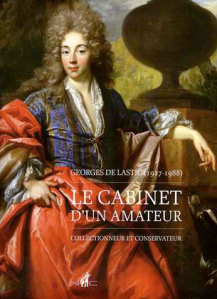
ISBN: 978-2350391021, 42.00€
One man and two exhibitions, Georges de Lastic (1927-1988), a curator and collector, amply deserves this celebration in the two locations which distinctly marked his professional life. . . . An aesthete and historian, both in his professional and personal life, Georges de Lastic assembled a private collection which is now highlighted in the double exhibition presented at the Musée de la Vénerie in Senlis and the Musée de la Chasse et de la Nature in Paris. . . .
In 1970, Georges de Lastic inherited the château de Parantignat, his “little Versailles in Auvergne,” the residence for the Marquis de Lastic for over three centuries which, along with his Parisian apartment on quai de Bourbon, housed his collection of 17th- and 18th- century French paintings acquired over the years at the Drouot auction house and from various art dealers. The ensemble is made up mainly of three artists, the portraitists Nicolas de Largillierre and Hyacinthe Rigaud, representative of the “grand genre” in the Grand Siècle and the Regency, as well as François Desportes, an artist who illustrated the Sun King’s hunting parties. His wife, Françoise de Lastic and his son, Anne-François, who today are in charge of preserving the collection, accepted to lend over sixty paintings, drawings and sculptures. . . .
All of these magnificent pieces now on display to the general public will soon return to their private residence, but the catalogue will remain in testimony. The entries, under the supervision of Pierre Rosenberg, were all written by the most respected specialists of each of the artists in the exhibition. Curators, university scholars, historians or researchers, each has achieved a hymn to the glory of French painting during the Grand Siècle and Georges de Lastic’s refined taste.
A visit to the Marais, at the Musée de la Chasse et de la Nature, is a traditional part of any art lover’s itinerary. They should now add a trip to Senlis to better understand the range and complexity of the Lastic collection. This sidetrip will also allow visitors to rediscover the Musée de la Vénerie, which houses a valuable collection presented with great quality, thus going far beyond the misleadingly limited confines of its name in a historic city which has known how to preserve all of its charm.
The full review is available here»
◊ ◊ ◊ ◊ ◊
Exhibition catalogue: Pierre Rosenberg et al., Le cabinet d’un amateur, Georges de Lastic (1927-1988), collectionneur et conservateur (Paris: Chaudun, 2010), 240 pages, ISBN: 978-2350391021, 42€.










 Enfilade
leave a comment