At the Louvre: New Multimedia Exhibition Highlights Sèvres Porcelain
Press release from the Louvre:
Sèvres Porcelain: An Art of Living in the 18th Century
Musée du Louvre, Paris, from 8 June 2011

Vase à fleurs "Duplessis," manufacture de Vincennes, ca. 1752 (Musée du Louvre, département des Objets d’art. N° d’inventaire OA 7610) © 2010 musée du Louvre / Martine Beck-Coppola.
Feast your eyes on the beauty of 18th-century Sèvres porcelain in the Louvre’s magnificent Napoléon III Apartments. Cuttingedge multimedia resources, designed in the context of the Museum Lab project, will help you discover how these porcelain pieces were made and provide an introduction to this aspect of the French art of living. Visit Rooms 93 and 95 on the first floor of the Richelieu Wing, where a multimedia experience awaits you! The displays entitled “Court dining in France” and “Manufacturing technique of soft-paste porcelain” will appeal to new and regular visitors alike, adding an entertaining, interactive dimension to their museum experience.
The manufacturing process of what was referred to as “white gold” was long a well-kept secret and the preserve of the most experienced craftsmen. The animated images in this display offer visitors an insight into traditional manufacturing techniques and the materials that were used to produce soft-paste porcelain since the founding of the Vincennes-Sèvres Manufactory in 1746.
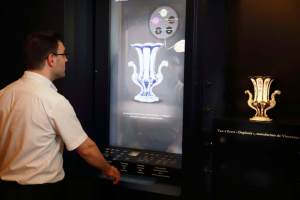 On April 21, 1757, Louis XV held a supper for his guests at the Château de Choisy. The dishes were presented “French style,” which meant that the food was served in successive courses, and guests could help themselves to soups and hors-d’oeuvre, medium and large entrées, roast meats and salads, hot and cold entremets, and desserts. Each course required a specific range of plates and hollow ware. This multimedia display invites museum visitors to the King’s table. They approach the touch-table, select their language, and experience the atmosphere of a royal supper served on Sèvres porcelain.
The porcelain technique was first mastered in France in the mid-18th century, at the Vincennes-Sèvres Manufactory. Technique, form and design constantly evolved as craftsmen emulated FarEastern then European models, and this is reflected in the pieces on display—a vase and tableware in “soft-paste” porcelain (so-called because of the fragility of the enamel). The quality of the colors and elegance of the decoration testify to the skill of the Manufacture’s craftsmen, while the various forms and functions evoke the sophistication of the French art of living in the 18th century. (more…)
Call for Papers: François Cointeraux and Earthen Architecture
François Cointeraux (1740-1830), Pioneer of Modern Earthen Architecture:
Theory, Teaching and Dissemination of a Vernacular Technique
Lyons, 10-12 May 2012
Proposals due by 31 July 2011
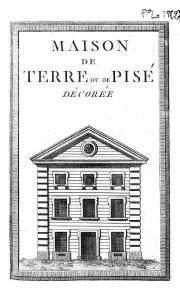 From 1785 onwards, the builder and master mason François Cointeraux actively promoted a construction technique of vernacular origin, known as pisé de terre (or ‘rammed earth’), which was at that time confined to southeast France. His cahiers or fascicules from the Ecole d’architecture rurale (School of Rural Architecture), published in Paris in 1790-91, were rapidly translated into seven languages (German, Russian, Danish, English, Finnish, Italian and Portuguese). They attracted the attention of major architects such as Henry Holland (1745-1806) in England, Thomas Jefferson (1743-1826) in America, David Gilly (1748-1808) in Germany and Nicolaï L’vov (1751-1803) in Russia, founder of a flourishing school of earthen architecture in Tiukhili near Moscow, based on Cointeraux’s school of the Colisée in Paris. Through his publications, Cointeraux generated an almost universal interest for this material, as cheap as it was abundant, and encouraged its adaptation to rural or residential architecture.
This success can largely be explained by a desire to revive rural architecture, which was in perfect harmony with both the physiocrats’ line of thought and the actions of agricultural societies. However, Cointeraux never managed to popularise its use widely and lastingly in France. His numerous publications did not achieve their expected uptake with the institutions concerned. He is nonetheless representative of a culture of invention and innovation, highly characteristic of the first industrial revolution and the birth of modern architecture. The aim of the conference is to present a synthesis of the extensive research carried out on François Cointeraux over the course of the last twenty years and to re-situate his work in the wider context of the evolution of ideas and techniques.
T H E M E S O F T H E C O N F E R E N C E (more…)
Reviewed: ‘Thomas Gainsborough and the Modern Woman’
Benedict Leca, Aileen Ribeiro, and Amber Ludwig, Thomas Gainsborough and the Modern Woman, ed. Benedict Leca (London: Giles Limited, 2010) 196 pages, ISBN: 9781904832850, $49.95.
Reviewed for Enfilade by Susan M. Wager
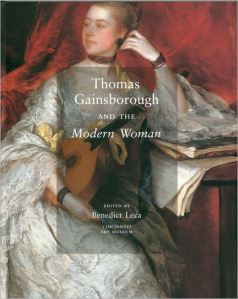 After a visit to Thomas Gainsborough’s studio in October 1760, the socially and culturally accomplished Mary Delany wrote, “There I saw Miss Ford’s picture—a whole length with her guitar, a most extraordinary figure, handsome and bold; but I should be sorry to have any one I loved set forth in such a manner.” The picture in question, Gainsborough’s Ann Ford of 1760, and the ambivalent reactions (like Mrs. Delany’s) it has engendered, is the central focus of Thomas Gainsborough and the Modern Woman. This lavishly illustrated catalogue, published to accompany an exhibition of the same name that originated at the Cincinnati Art Museum in 2010 before traveling to the San Diego Museum of Art earlier this year, was edited by Benedict Leca, Curator of European Painting, Sculpture, and Drawings at the Cincinnati Art Museum.
The portrait of Ann Ford—an eighteenth-century woman who garnered an ambiguous reputation by daring to organize public performances of her talent at the viola da gamba (unusual for a woman at the time)—was acquired by the Cincinnati Art Museum in 1927 and remains a highlight of the Museum’s collection. Leca has cleverly constructed an exhibition around the portrait, enriching our understanding of it through the juxtaposition of several well-selected loans. These include some of Gainsborough’s portraits of other “demireps”—women whose “social and sexual assertiveness combined with their flair for personal style and public exposure ran counter to propriety,” as defined by Leca. The catalogue’s three essays—by Leca, Aileen Ribeiro, and Amber Ludwig—all seem to be underpinned, implicitly, by the question: to what extent were these “demireps” in control of the constructed identities mediated through their painted portraits?
Leca’s approach to this question is decidedly optimistic. Drawing on compelling evidence such as Ann Ford’s published writings on the merits of the female sex, Leca argues that Gainsborough and Ford, in addition to some of his other female sitters, were equal partners in the production of images that challenged circumscribed gender codes and asserted female liberation from masculine control. Leca reads the correlation of Gainsborough’s signature loose brushwork—deemed “feminine” by his contemporaries—with painted passages of conventionally feminine accessories adorning sexually assertive women as the artist’s ironic and progressive rejection of masculinist norms. As Leca writes, Gainsborough’s portraits present “provocative women provocatively painted.”
Ribeiro’s essay considers how the costumes worn by Gainsborough’s demireps participated in the negotiation of reputation, class, and status. Ribeiro subtly complicates Leca’s reading of Ann Ford by evoking scholars who have suggested that paintings of accomplished women like Ford could be seen as relatively traditional presentations of ideal and precious objects of beauty, served up for the viewer’s delectation. Although Ribeiro ultimately disagrees with these readings, her essay nonetheless gestures toward the plurality of interpretations that can be gleaned from images of demireps.
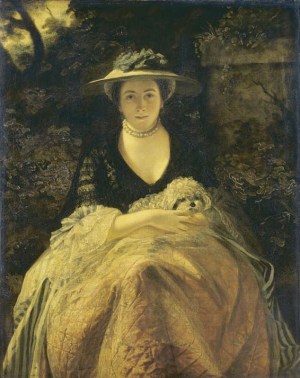
Joshua Reynolds, "Portrait of Nelly O'Brien," ca. 1762-64 (London: Wallace Collection)
Leca and Ribeiro mobilize two different portraits by Joshua Reynolds of the courtesan Nelly O’Brien to make divergent points about Ann Ford. Leca emphasizes the “subversive femininity” and “suggestiveness” of Ford’s pose by contrasting it to Reynolds’s 1762-4 portrait of O’Brien (The Wallace Collection). Whereas Reynolds dissembles the unsavory profession of O’Brien through the imposition of a pyramidal, closed, Marian pose onto her body, Gainsborough flaunts the immodesty and impropriety of Ford’s dynamic, crossed-leg attitude. Ribeiro, however, juxtaposes Ann Ford with a 1763-7 Reynolds portrait of O’Brien (The Hunterian Museum & Art Gallery, University of Glasgow) in order to underscore the formality of Ford’s dress in contrast to O’Brien’s “loose bed-gown.” The latter is far more scandalous than Ford’s costume, which would have been chosen precisely to shore up Ford’s ambiguous reputation. Conflicting readings like these do not detract from the overall thrust of the book; instead, they strengthen it, attesting to the complexity of the images under examination.

Joshua Reynolds, "Portrait of Nelly O'Brien," ca. 1763-67 (Glasgow: Hunterian Museum)
Indeed, complexity characterizes the images addressed by Amber Ludwig in her essay on how portraiture could attach the appearance of virtue to women with dubious reputations. Addressing pictures of Emma Hamilton, she underscores, for instance, tensions between the desires and personality of the sitter and the desires for propriety imposed by her husband or lover.
Thomas Gainsborough and the Modern Woman would be a welcome addition to the libraries of scholars and general readers alike. The catalogue’s clear prose is supplemented by sumptuous, full-color plates and extraordinarily high-resolution details, offering a worthy substitute for individuals who did not see the exhibition, or a handsome aide-mémoire for those who did.
◊ ◊ ◊ ◊ ◊
Susan M. Wager is a Ph.D. candidate in Art History & Archaeology at Columbia University. Her research examines eighteenth-century reproductions after François Boucher in the mediums of gems, porcelain, and tapestries at the intersection of consumer culture, natural history, antiquarianism and connoisseurship, and global exchange.
Call for Papers: 200 Years of Sense and Sensibility
I realize this is more literary than art historical, but how nice it would be to hear a strong visually-oriented talk on sensibility in Austen’s context. From the conference website:
200 Years of Sense and Sensibility
University of St Andrews, 9-10 September 2011
Proposals due by 30 June 2011
Keynote speakers: Kathryn Sutherland (St Anne’s College, Oxford) and Paula Byrne (author of the new Harper Collins Jane Austen biography).
“I am never too busy to think of S&S,” Jane Austen wrote to her sister, Cassandra in April 1811. The year saw the publication of her first novel and to mark the anniversary, we are hosting a conference that reflects upon two hundred years of readership and opens up new interpretations of the novel. We invite proposals for 20-minute papers and round table panels on any aspect of the novel. Possible topics may include but are not limited to:
• Social and historical context
• Reception
• Tradition of Sensibility/contemporary aesthetic theory
• Literary influences
• Sibling relationships
• Feminist readings
• Adaptations and appropriations
• Re-writings and sequels
• The novel’s place in the canon
Please send abstracts of no more than 250 words to the conference organisers, Marina Cano López and Rose Pimentel, at 200sensibilities@gmail.com. Please also email us with any questions. The deadline for proposals is 30 June 2011.
Enfilade Turns Two!

An 18th-century balloon takes off (Library of Congress); illustration from Jane E. Boyd, "Artificial Clouds and Inflammable Air: The Science and Spectacle of the First Balloon Flights, 1783," 'Chemical Heritage Magazine' (Summer 2009); click to access the article.
After two years and 123,595 hits, I continue to be amazed at how much more the site has become than I ever initially imagined. Thanks to all of you for your kind input, your generosity in sharing news, and above all for your support in reading. To mark the anniversary, I want to make two plugs: one a familiar refrain, the other an announcement regarding the launch of an internship program.
First, if you’re a regular reader, please consider making a financial contribution to the Historians of Eighteenth-Century Art & Architecture. Enfilade is produced at absolutely zero costs to HECAA, but the organization needs financial resources to pursue its mission, an important part of which includes modest grants for graduate students. Anyone interested in the period is welcome to become a member; so if you’re reading, consider joining. For current members, now is a good time to send in your dues for 2011 if you’ve not yet done so (just $20/$5 for graduate students). Please also think about making an additional donation to help fund the Dora Wiebenson Prize or the Mary Vidal Memorial Fund. Checks should be sent directly to Denise Baxter (the transition to our new treasurer Jennifer Germann will occur soon, but for now Denise is still glad to cash your checks).
Second, I’m pleased to announce that Enfilade is now accepting applications for a new student internship program. The intern positions are intended to provide art historical experience for M.A. students in Art History, Architectural History, Museum Studies, or other related disciplines (exceptional upper-level undergraduates will also be considered). Duties will primarily consist of researching potential postings, gathering information about upcoming exhibitions, conferences, forthcoming books, &c. Depending upon an intern’s interests, expertise, and location, other projects are also possible. Starting dates are flexible. The internship runs for 8 weeks with the possibility of an extension. Students are expected to work a minimum of 5 hours per week. The position is unpaid, though it will include a one-year HECAA membership. Given the nature of the work, the internship can be completed from anywhere. Requirements:
- Basic computer skills with online access
- A minimum of five art history courses
- Strong writing skills
- Fluency in English, though additional languages are certainly advantageous
Application materials:
- Cover letter explaining the applicant’s interests, skills, and plans for the near future
- C.V.
- Writing sample of 3-5 pages
Applications should be sent to CraigAshleyHanson@gmail.com
As with everything with Enfilade, the internship program is an experiment. We’ll see how it goes and adjust accordingly. By all means feel free to send your own ideas, thoughts, and concerns. And again, thanks for reading! -CH.
Forthcoming Title: Geoff Quilley, ‘Empire to Nation’
Geoff Quilley, Empire to Nation: Art, History and the Visualization of Maritime Britain, 1768-1829 (London: Paul Mellon Centre for Studies in British Art, 2011), 304 pages, ISBN: 9780300175684, $80.
 Empire to Nation offers a new consideration of the image of the sea in British visual culture during a critical period for both the rise of the visual arts in Britain and the expansion of the nation’s imperial power. It argues that maritime imagery was central to cultivating a sense of nationhood in relation to rapidly expanding geographical knowledge and burgeoning imperial ambition. At the same time, the growth of the maritime empire presented new opportunities for artistic enterprise.
Taking as its starting point the year 1768, which marks the foundation of the Royal Academy and the launch of Captain Cook’s first circumnavigation, it asserts that this was not just an interesting coincidence but symptomatic of the relationship between art and empire. This relationship was officially sanctioned in the establishment of the Naval Gallery at Greenwich Hospital and the installation there of J. M. W. Turner’s great Battle of Trafalgar in
1829, the year that closes this study. Between these two poles, the book
traces a changing historical discourse that informed visual representation
of maritime subjects.
Geoff Quilley is senior lecturer in art history at the University of Sussex. He
was formerly curator of fine art at the National Maritime Museum, Greenwich,
London.
ECCO Texts and Print-on-Demand Possibilities
While working on an article related to William Cowper’s Myotomia Reformata, I recently discovered that I could purchase a paperback copy for less than $25 at Amazon or Alibris. I was surprised but guessed that these copies were the remainders from a recent printing of the 1724 text. In fact, however, they are the result of a print-on-demand initiative. Here’s the description from Alibris:
◊ ◊ ◊ ◊ ◊

As noted at EMOB, the covers of these new paperbacks do not come from the original books, and in this instance, the selection is hardly ideal. I'm not sure if the editor, Dr. Richard Mead, would be angry, appalled, or merely amused.
The 18th century was a wealth of knowledge, exploration and rapidly growing technology and expanding record-keeping made possible by advances in the printing press. In its determination to preserve the century of revolution, Gale initiated a revolution of its own: digitization of epic proportions to preserve these invaluable works in the largest archive of its kind. Now for the first time these high-quality digital copies of original 18th century manuscripts are available in print, making them highly accessible to libraries, undergraduate students, and independent scholars. Medical theory and practice of the 1700s developed rapidly, as is evidenced by the extensive collection, which includes descriptions of diseases, their conditions, and treatments. Books on science and technology, agriculture, military technology, natural philosophy, even cookbooks, are all contained here.++++The below data was compiled from various identification fields in the bibliographic record of this title. This data is provided as an additional tool in helping to insure edition identification: ++++British LibraryT132919Titlepage in red and black. Edited by Richard Mead, assisted by Joseph Tanner, James Jurin and Henry Pemberton. Large paper issue.London: printed for Robert Knaplock, and William and John Innys; and Jacob Tonson, 1724. [12],
lxxvii, [1],194p., plates: ill.; 2.
Condition: New
Publisher: Gale Ecco, Print Editions
Date published: 2010
ISBN-13: 9781140985778
ISBN: 1140985779
◊ ◊ ◊ ◊ ◊
An online search quickly turned up a fine discussion of the issue — not surprisingly — at Early Modern Online Bibliography. Eleanor Shevlin wrote a thoughtful posting on the subject last August, which has thus far occasioned 27 responses. The posting nicely lays out the potential advantages and drawbacks. Most objections relate to concerns over bibliographic completeness and uniformity. I’ve not yet looked to see what the art offerings might look like, but for anyone looking to incorporate primary sources into the classroom, this could be useful. I’ve included below a comment on the posting from Scott Dawson (24 August 2010) that clarifies some of these issues, but by all means have a look at the full discussion at EMOB. -CH. (more…)
The Prado Publishes New Acquisitions Catalogue *Only* Online — It’s Free
Is this the future or just an experiment along the way? From the Prado’s website:
José Manuel Matilla, ed., No solo Goya: Adquisiciones para el Gabinete de Dibujos y Estampas del Museo del Prado 1997-2010, exhibition catalogue (Madrid: Prado, 2011), 383 pages, ISBN: 9788484802204.
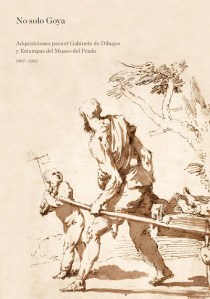 For the first time in the Museum’s history the catalogue has only been published in on-line format. An innovative new format has been designed that combines the benefits of the traditional printed book with the new possibilities offered by digital formats, such as links, attached archives, image enlargement, bibliographies and automatic searches.
The catalogue offers detailed descriptions and reproductions of the 111 works in the exhibition. The texts are written by curators at the Museum and by outside experts with whom the Museum is working on various projects that are currently in progress.
Evening of Linen at Fenton House
As noted at Treasure Hunt (with lovely photos), Selvedge Magazine, in association with the National Trust, is hosting an evening on linen. From the website invitation:
We Love Linen
Fenton House, Hampstead (London), 28 June 2011
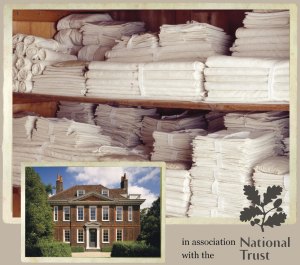
Linen cupboard at Hardwick Hall, Derbyshire ©NTPL, Nadia Mackenzie / Exterior of Fenton House ©NTPL, Matthew Antrobus
Join Selvedge at Fenton House in Hampstead on Tuesday 28 June. The charming 17th-century merchant’s house which has remained virtually unaltered over the last 300 years of continuous occupation, will provide a period backdrop to our evening dedicated to the beauty of linen. And if the weather is fine there will be a short time to explore the beautifully kept gardens, enjoy a glass of wine and strawberries and cream before the talks begin.
Our first speaker is Amanda Vickery, author of Behind Closed Doors: At Home in Georgian England and our “The Lure of White Linen” article, issue 39, page 22. Amanda will speak about the role of household linens in Georgian England. She will be followed by Elizabeth Baer, who will be sharing her lifelong passion for linen, and the forming of her collection. There will be time after the talks to view some of Elizabeth’s
antique linens and a selection will be available to purchase.
Ticket includes entrance to the house, glass of wine, and
strawberries and cream. Tickets, £35, concessions* £30.
Tickets are available here»
Call for Papers: ‘Art Against the Wall’ at the Courtauld
Art Against the Wall
The Courtauld Institute of Art, London, 19 November 2011
Organized by Thomas Balfe and Jocelyn Anderson

Anon. Fireplace with sculpture of birds, Claydon House, Buckinghamshire, 19th century. Source: Conway Library, The Courtauld Institute of Art
Art against the Wall, the third symposium of The Courtauld’s Early Modern department, will provide an occasion for established and emerging scholars to present and discuss their research together. This one-day symposium will explore the relationship between walls and art in early modern visual culture. During the period 1550-1850 the interplay between work and wall became increasingly complex as art objects began to pull away from the walls which had previously defined them. The enduring association between artistic skill and craft production meant that many art works were often still regarded as elements in overarching decorative schemes; paintings installed in eighteenth-century English domestic interiors, for example, continue to be described as part of the ornamentation, even as the furniture, of a room. Conversely, walls now had the power to redefine art works, giving them a new meaning through a new context; thus, in late sixteenth-century debates on the status of the religious image, walls – which map the division between sacred and secular space – take on crucial importance. Yet the wall could also become art, as the numerous examples of trompe l’oeil wall illustration to be found in seventeenth-century architecture and garden design suggest. Taking as its point of departure Derrida’s insight that there can be no clear separation of ergon (work) from parergon (not-the-work, ‘wall’), the symposium will attempt to investigate the rich questions raised by the phenomenon of art against the wall. We welcome contributions relating to paintings, sculptures, decorative schemes, architecture and works on paper. Topics for discussion may include, but are not limited to: (more…)










 Enfilade
leave a comment