Exhibition and Conference: ‘Palladio and His Legacy’
This show which was at the Morgan last summer opens at Notre Dame with a full conference this weekend. My sense is that the exhibition functions rather differently in these two venues — one might think not only about the reception of Palladio but also the reception of the exhibition. From the Snite website:
Palladio and His Legacy: A Transatlantic Journey
The Morgan Library and Museum, New York, 2 April — 1 August 2010
National Building Museum, Washington D.C., 2 September 2011 — 30 January 2011
Snite Museum of Art, Notre Dame, 5 June — 31 July 2011
Carnegie Museum of Art, Pittsburgh, 3 September — 31 December 2011
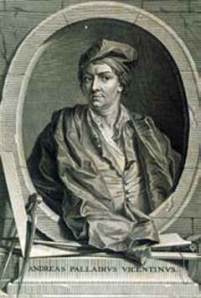
Conjectural portrait of Andrea Palladio, ca. 1715, engraved after Sebastiano Ricci (RIBA British Architectural Library)
This traveling exhibition organized by the Royal Institute of British Architects in association with the Centro Internazionale di Studi di Architettura Andrea Palladio, Vicenza, offers a rare opportunity to see thirty-one drawings by the famous 16th-century architect, Andrea Palladio, along with seven books, fifteen models of related buildings, and eight bas-reliefs of some of the drawings (3-D projections of architectural drawings).
The Late Italian Renaissance master Andrea Palladio (Italian, 1508–1580) is the most influential architect of the last 500 years. His architecture synthesized the lessons of the ancient Romans with the achievements of his predecessors and contemporaries, including Bramante, Raphael, and Michelangelo. Palladio’s mastery of the classical orders, proportion, and harmony was unparalleled. His projects in Venice and the surrounding region set new standards in design and redefined the potential of the art form, especially for domestic structures.
◊ ◊ ◊ ◊ ◊
From Vernacular to Classical: The Perpetual Modernity of Palladio
University of Notre Dame School of Architecture, 10-12 June 2011
Bringing together scholars, practitioners, educators, and students from various disciplines, the conference will explore how the Palladian tradition inspires the evolution of classical architecture. One of the most influential architects in history, 16th-century Italian Andrea Palladio’s impact is evident throughout the United States. Buildings such as the White House, the U. S. Capitol, the U.S. Supreme Court, and the National Gallery of Art bear his imprint. Thomas Jefferson’s Virginia home, Monticello, is modeled after Palladio’s famed Villa Rotonda in Vicenza, Italy. Conference participants will reconnect Palladian ideals to the living tradition that has informed these icons of American democracy and continue to shape vital paradigms for sustainable architecture and urbanism. Two exhibitions, Palladio and His Legacy: A Transatlantic Journey at the University of Notre Dame’s Snite Museum of Art and the New Palladians, an exhibition of 50 international classical architects’ work in the Bond Hall Gallery, also will be held in conjunction with the conference.
C O N F E R E N C E S C H E D U L E (more…)
Turkish Taste at the Frick Opens June 8
In conjunction with the exhibition at the Frick Collection, Turkish Taste at the Court of Marie-Antoinette (opening June 8), the museum is hosting a seminar on Monday, 27 June, 6:00-7:30 p.m. From the Frick’s website:
Carlotte Vignon and Adrienne L. Childs, Turkish Taste at the Court of Marie-Antoinette
The Frick Collection, New York, 27 June 2011
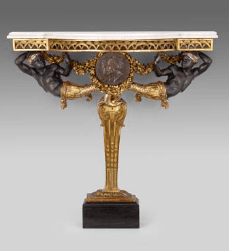
Small Console Table with Supporting Figures of Nubians (one of a pair), c.1780, gilded and painted wood and marble slab (NY: The Frick Collection), photo by Michael Bodycomb
This seminar will offer participants a detailed look at several objects from the special exhibition. Charlotte Vignon will discuss the Frick’s two French console tables, which feature Nubian slaves with pearl-accented turbans, floral garlands, and a frieze of crossed crescents, a symbol of the Ottoman Empire. She will also examine a pair of firedogs from Marie-Antoinette’s Turkish boudoir at Fontainebleau, on loan from the Musée du Louvre, and a pair of wall panels created for the Turkish cabinet of her brother-in-law, the comte d’Artois, from The Metropolitan Museum of Art. Click here to register at the regular rate of $100 per person. Members of The Frick Collection may click here to register at the discounted membership rate of $90 per person. Discounts will be applied upon verification of membership. To register over the phone, please call 212.547.0704.
Conference at York: The Portrait and the Country House
From York’s Centre for Eighteenth-Century Studies:
Placing Faces: The Portrait and the Country House in the Long Eighteenth Century
King’s Manor, York, 11 June 2011
Postgraduate Organisers: Jordan Vibert and Hannah Lyons
This interdisciplinary conference is concerned with the complex relationship between eighteenth-century portraits and the places they were so often ultimately destined for – the country houses of Britain’s landed elites. These grand houses were vast public spaces, used by their owners to systematically showcase their political power and social status. Commissioning and displaying portraits was one way in which a family could aggrandize themselves, whether by making a genealogical link to a military hero or a royal relative, or by making a broader national claim to political allegiance or imperial dominance. But portraits could also interact with country houses in other quite surprising ways, drawing together seemingly disparate contexts and narratives to create new and unexpected meanings. A portrait of a woman, for example, could vastly complicate seemingly confident masculine displays of martial heroism and political power, while a depiction of a dead child might forge unsettling connections between private grief and public narratives of bloody warfare and imperial dominion. It is these complex interactions between the portrait and the wide array of familial and national narratives at work in the country house that this conference sets out to unravel. Our speakers are a mixture of established academics, professional curators and young researchers working in a range of disciplines and environments.
P R O G R A M M E Printer-friendly programme (Word. doc)
10.30 Registration and tea/coffee
11.00 Session 1: The Portrait and the Estate
- Keynote Speaker – Dr Kate Retford (Birkbeck College, University of London) ‘The Topography of the Conversation Piece – A Walk around Wanstead’
- Dr Leslie Johansen (Council for British Archaeology) ‘A Look into the Prospect Beyond: The Portrait and the English Designed Landscape’
12.30 Lunch
1.25 Session 2: Collection and Display
- Desmond Shawe-Taylor (Surveyor of the Queen’s Pictures) ‘George IV as a Collector of full-length Portraits’
- Professor Marcia Pointon (University of Manchester) ‘The Woburn Abbey Portraits’
2.40 Tea/coffee
3.10 Session 3: Gendered Displays
- Professor Gill Perry (Open University) ‘Dirty Dancing at Knole: Portraits of Giovanna Baccelli and the Performance of ‘Public Intimacy’
- Jordan Vibert (University of York) ‘Lady Anne Stanhope and Sir Francis Blake Delaval at Ford Castle: Female Sociability, Military Masculinity and the Seven Years’ War’
The conference fee is £12 (£10 for registrations received before 31st March). This fee includes tea, coffee and a simple sandwich lunch.
For details concerning registration, consult the CECS website.
Exhibition: The Düsseldorf Gallery and Its Catalogue
Press release from the Getty:
Display and Art History: The Düsseldorf Gallery and Its Catalogue
Getty Research Institute, Getty Center, Los Angeles, 31 May — 21 August 2011
Curated by Thomas Gaehtgens and Louis Marchesano
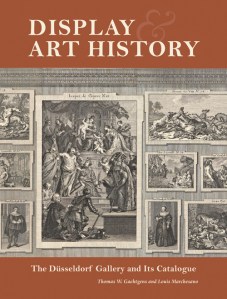
ISBN: 9781606060926, $20
Display and Art History: The Düsseldorf Gallery and Its Catalogue illustrates the making of one of the earliest modern catalogues, La galerie électorale de Dusseldorff (1778), a revolutionary two-volume publication that played a significant role in the history of museums and helped mark the transition from the Baroque to the Enlightenment.
Constructed by Elector Palatine Johann Wilhelm II von der Pfalz between 1709 and 1714, the Düsseldorf gallery is an early example of exhibiting an art collection in a nonresidential structure. It charted the course toward what would eventually become the institution of the public museum. The Düsseldorf gallery featured a new system of display in which the arrangement of objects was determined by art historical principles such as style and school, rather than subject. Published in the second half of the eighteenth century, the Düsseldorf catalogue represented this new display in numerous etchings; the accompanying text sought to educate a broader circle of readers.
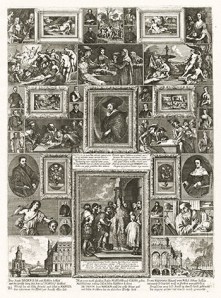
Fictive Wall of Paintings from the Imperial Collection in Vienna, Frans van Stampart and Anton Joseph von Prenner, etching. Prodromus (Vienna, 1735), pl. 21. 88-B2961
Display and Art History: The Düsseldorf Gallery and Its Catalogue, on view at the Getty Research Institute at the Getty Center from May 31 through August 21, 2011, showcases the exquisite watercolors, red chalk drawings, and architectural elevations that were used to produce this revolutionary catalogue. The exhibition explores their role in the printmaking process and underscores their value as precious works of art created by accomplished draftsmen. “We are most fortunate to have an almost complete set of preparatory drawings in our archives, which allows for the reconstruction of this ambitious enterprise and reflects a pivotal moment in the history of art as well as the history of the art museum,” says Thomas Gaehtgens, Director of the Getty Research Institute.
Prince-elector Johann Wilhelm II assembled one of the most important European art collections of the eighteenth century. He constructed a gallery to exhibit his nearly 400 paintings, 46 of which were by Peter Paul Rubens. At the time, many princes were reorganizing their substantial collections in order to convey the message that they not only possessed a wide variety of artistic treasures but were also able to care for them properly and make
them available for study.

Pierre-Louis de Surugue's etching after the "The Night" by Correggio, 1753–1757. Karl Heinrich von Heinecken, Recueil d'estampes d'apres les plus celebres tableaux de la Galerie Royale de Dresde..., vol. 2 (Dresden, 1757), pl. 1.
A generation later, Prince-elector Carl Theodor von der Pfalz, Johann Wilhelm’s nephew and successor, commissioned Lambert Krahe, director of the Düsseldorf Academy and gallery, to rehang the paintings collection following its storage during the Seven Years’ War (1756-63). Krahe broke with the Baroque tradition of decoratively covering entire walls with paintings. Instead, he displayed the paintings in a didactic, symmetrical arrangement ordered by schools, thus introducing a completely new and modern system of organizing art. Rather than hanging paintings frame-to-frame, Krahe integrated space between them, preserving their identity as separate works of art. This new display encouraged viewers to draw comparisons.
The Düsseldorf catalogue similarly fostered learning and education, in addition to celebrating the prestige of the collector. Produced by court architect Nicolas de Pigage, printmaker Christian von Mechel, and linguist Jean-Charles Laveaux, the catalogue illustrates Krahe’s display of paintings on the gallery walls. Unlike earlier catalogues that only provided brief inventories, Pigage’s publication offers an analysis of each painting that was aimed at an educated public. “In this sense, the catalog was very much a work of the Enlightenment, and the princely gallery, accessible to interested visitors,
became more like a museum as we understand it today,” says Gaehtgens.
Louis Marchesano, the GRI’s Curator of Prints and Drawings, adds, “The catalogue no longer simply represented princely magnificence; it now also fostered aesthetic reflection and art historical education.”
◊ ◊ ◊ ◊ ◊
Exhibition catalogue: Thomas W. Gaehtgens and Louis Marchesano, Display and Art History: The Düsseldorf Gallery and Its Catalogue (Los Angeles: Getty Publications, 2011), 104 pages, ISBN: 9781606060926, $20.
Call for Papers: MWASECS November 2011
Midwestern American Society for Eighteenth-Century Studies Conference
Indiana State University, Terre Haute, 4-6 November 2011
Proposals due by 19 August 2011
We are pleased to announce that the annual conference of the Midwestern American Society for Eighteenth-Century Studies will be held jointly with the Midwest Conference on British Studies at Indiana State University in Terre Haute, Indiana, November 4-6, 2011. Our plenary speaker will be Paula Backscheider, Phillpott-Stephens Eminent Scholar of English Literature at Auburn University, and author of Eighteenth Century Women Poets and Their Poetry.
MWASECS invites contributions on all aspects of the eighteenth century. We welcome traditional 20-minute paper presentations as well as more innovative formats such as round table discussions, performances, etc. Please send individual abstracts and/or proposals for complete sessions to mwasecs2011@gmail.com by August 19, 2011. For an early response, please submit your abstract/proposal by July 30.
New Title: ‘Roma Britannica: Art Patronage and Cultural Exchange’
David Marshall, Susan Russell, and Karin Wolfe, eds., Roma Britannica: Art Patronage and Cultural Exchange in Eighteenth-Century Rome (London: British School at Rome, 2011), 374 pages, ISBN 9780904152555, £35.00.
 Important as the Grand Tour was, there was much more to the cultural relationship between Britain and Rome in the eighteenth century than this. The contributions to this volume look at this relationship from the perspective of the Italian, as well as the British and other European visitors: Rome in the eighteenth century stood for cosmopolitanism rather than national rivalry, and had moved beyond being the centre for the renaissance of antiquity to being a place where the cross-pollination of the modern with the ancient allowed the culture of Europe to flower in new and unexpected ways.
Introduction
- David R. Marshall and Karin Wolfe, Roma Britannica
- Christopher M.S. Johns, Visual Culture and the Triumph of Cosmopolitanism in Eighteenth-Century Rome
Art for Religion: Catholic Britain and Jacobites in Rome
- Carol M. Richardson, Andrea Pozzo and the Venerable English College, Rome
- Edward Corp, The Stuart Court and the Patronage of Portrait-Painters in Rome, 1717–57
- David R. Marshall, The Cardinal’s Clothes: The Temporary Façade for the Investiture Celebration of Cardinal York in 1747
- Peter Björn Kerber, The Art of Catholic Recusancy: Lord Arundell and Pompeo Batoni
Culture for Sale: British Patrons, Collectors, Agents, and the Roman Art Market
- Karin Wolfe, Acquisitive Tourism: Francesco Trevisani’s Roman Studio and British Visitors
- James Holloway, John Urquhart of Cromarty: A Jacobite Patron in Rome
- Alastair Laing, Giovanni Paolo Panini’s English Clients
- Francis Russell, John, 3rd Earl of Bute and James Byres: A Postscript
Confrontations with the Antique: The British Reception of Egypt and Rome
- Edward Chaney, Roma Britannica and the Cultural Memory of Egypt: Lord Arundel and the Obelisk of Domitian
- Elizabeth Bartman, Egypt, Rome and the Concept of Universal History
- Edgar Peters Bowron, From Homer to Faustina the Younger: Representations of Antiquity in Batoni’s British Grand Tour Portraits
- Andrew Wallace-Hadrill, Romanizing Frescoes: From the Villa Negroni to Ickworth
Constructing the Future on the Ruins of the Past: The British and the Roman Practice of Architecture
- Tommaso Manfredi, Roma Communis Patria: Filippo Juvarra and the British
- Katrina Grant, Planting ‘Italian Gusto’ in a ‘Gothick Country’: The Influence of Filippo Juvarra on William Kent
- John Wilton-Ely, ‘My Holy See of Pleasurable Antiquity’: Robert Adam and His Contemporaries in Rome
- Letizia Tedeschi, Vincenzo Brenna and His Drawings from the Antique for Charles Townley
Universal Neoclassicism: Old Rome and New Britain
- Malcolm Baker, Commemoration ‘in a More Durable and Grave Manner’: Portrait Busts for the British in Early Eighteenth-Century Rome
- Desmond Shawe-Taylor, ‘The Modern … Who Recommends Himself’: Italian Painters and British Taste in Eighteenth-Century Rome
- Wendy Wassyng Roworth, Between ‘Old Tiber’ and ‘Envious Thames’: The Angelica Kauffman Connection
- Kevin Salatino, Fuseli’s Phallus: Art and Erotic Imagination in Eighteenth-Century Rome
◊ ◊ ◊ ◊ ◊
Orders should be sent to: The British School at Rome, at The British Academy, 10 Carlton House Terrace, London, SW1Y 5AH.
Electronic Enlightenment, Part II
After a few minutes exploring the ‘classroom’ resources at Electronic Enlightenment (free until the end of June), I was impressed by the possibilities. So often amazing electronic resources are presented (or at least perceived) as if the value lay simply in the information that’s been digitized. It’s nice to see EE thinking about the pedagogical potential (I really like Meghan Roberts’s lesson plan for ‘Inoculation in the Age of Enlightenment’).
Perhaps at some point, Enfilade could feature a series of lesson plans generally. Members’ contributions are most welcome. -CH.
◊ ◊ ◊ ◊ ◊
Electronic Enlightenment, Classroom
Through a collaboration with academics using EE in their teaching, EE is pleased to present a selection of lesson plans suitable for undergraduate classes. We would like to thank the academics involved, and also to extend an offer to others who would like to make their lesson plans available to get in touch with us.
◊ ◊ ◊ ◊ ◊
Dissonance in the Republic of Letters
Christopher Tozzi, Johns Hopkins University
Abstract: This lesson plan highlights the diversity of opinion within the Republic of Letters by presenting a few of the personal and intellectual conflicts in which thinkers of the seventeenth and eighteenth centuries involved themselves. By reading letters exchanged by Enlightenment thinkers, students will gain an appreciation of the intellectual nuances of the period and the way in which knowledge was pursued.
◊ ◊ ◊ ◊ ◊
Inoculation in the Age of Enlightenment
Meghan Roberts, Northwestern University
Abstract: This lesson would be suited to courses that deal with the Enlightenment, the history of science and medicine, and could also be adapted to courses on early modern France and early modern Europe.
◊ ◊ ◊ ◊ ◊
National Identity and Otherness in the Eighteenth Century
Neven Leddy, University of Ottawa
Abstract: This session tackles the complexities of identity in 18thC Great Britain and Europe. The correspondence of the key figures of the Scottish Enlightenment is used to illuminate the personal experiences which structure 18thC theories of the Other. In this session EE can be productively interleaved with electronic texts from other sources to structure a dialogue between biography and philosophy. The aim of this session is to problematize the modern nation-state as a conceptual lens to view the past. Students will become familiar with the 18thC model of a multi-ethnic state, a well the many layers of national and human identity.
◊ ◊ ◊ ◊ ◊
Optimism and Cosmopolitanism in the Enlightenment
Neven Leddy, University of Ottawa
Abstract: This session introduces the Enlightenment through the Lisbon Earthquake of November 1st, 1755 focusing on the elements of Optimism and Cosmopolitanism. In the process it illuminates the diffusion of “news” through the eighteenth century Republic of Letters. The methodological thrust of the lesson plan is interdisciplinary, demonstrating the crossover and feedback between history, philosophy, religion and literature. It assumes a bilingual student body.
◊ ◊ ◊ ◊ ◊
The Restoration and Early Eighteenth-Century Theatre World
Anne Greenfield, University of Denver
Abstract: This section will discuss the value of incorporating correspondence into courses on History and/or Literary History. Writers of letters tend to move from topic to topic far more readily and abruptly than do writers of more singularly-focused works (e.g., essays, poems, or political treatises). For this reason, correspondence gives students of History and Literary History a more expansive vision of the past, exposing them to writers’ insights into a wide variety of phenomena.
Free Access to the ‘Electronic Enlightenment’ til the End of June
Various announcements from Robert McNamee, Director of the Electronic Enlightenment Project:
 Try Electronic Enlightenment Free Till the End of June
Electronic Enlightenment is being offered on a free trial till the end of June. Access this growing correspondence network, with over 7,100 distinct correspondents and nearly 60,000 letters. Simply go to www.e-enlightenment.com and login with:
Username: ee2011
Password: enlightenment
◊ ◊ ◊ ◊ ◊
EE Colloquium — Epistolary Quarrels: Matter and Manner
Oxford, 19 November 2011
Proposals due by 9 September 2011
I will not deprecate you with regard to our Quarrel, for if any thing escaped me (as you pretend) that seemed strong, that is, that hurt you a little, I am not conscious of any such meaning, & you would not have me apologize for mere words, or an ill-contrived expreſsion.
— Thomas Gray to Edward Bedingfield (10 August 1757)
The colloquium is intended to provide a forum for both academics and graduate students exploring correspondence in the early modern period. The papers given by academics will be 40 minutes; those given by graduate students will be 20 minutes. Conference papers can be in English or French. A selection of papers will be published electronically in the Electronic Enlightenment Project’s Letterbook. Please send us your proposals (max 250 words) by Friday 9 September 2011: eecolloquium@e-enlightenment.info
◊ ◊ ◊ ◊ ◊
Write a Lesson Plan and Win a Book from Oxford University Press
Submit a lesson plan to onlinemarketing@oup.com on a subject of your choosing, and if chosen you will win £40 worth of books from OUP’s catalogue of outstanding print publications. To see our current selection of lesson plans, go to www.e-enlightenment.com/classroom/
◊ ◊ ◊ ◊ ◊
The latest review of EE in The Charleston Advisor:
Jennifer Dekker, The Charleston Advisor 12.4 (April 2011): 28-31.
Electronic Enlightenment is a new-generation digital collection offered by the Bodleian Library at Oxford University. It not only functions as a repository and access point for valuable correspondence and related documentation on the eighteenth century, but it is also an interactive community project continually building new resources into its database and encouraging external users to participate in its evolution. For example, readers are invited to correct information in the EE resource base and are even welcome to add letters that have not yet been included. This level of interaction is not often seen in commercial tools, but because EE is facilitated, hosted, and marketed by a major research library in collaboration with an established group of eighteenth century scholars, this database is more innovative and flexible than a typical commercial product. 4.750/5 stars.
Johan Zoffany, More to Come — Exhibition, Catalogue, and Conference
From The Yale Center for British Art:
Johan Zoffany RA: Society Observed
Yale Center for British Art, New Haven, 27 October 2011 — 12 February 2012
The Royal Academy of Arts, London, 10 March — 10 June 2012
Curated by Martin Postle with Gillian Forrester and MaryAnne Stevens

Johan Zoffany, “The Drummond Family” (detail), ca. 1769 (New Haven: Yale Center for British Art)
Of all the major artists working in eighteenth-century England, none explored more inventively the complexities of Georgian society and British imperial rule than Johan Zoffany (1733–1810). Born near Frankfurt, Zoffany trained as an artist in Germany and Italy. In 1760 he moved to London, where he adapted brilliantly to the indigenous art culture and patterns of patronage, creating virtuoso portraits and subject pictures that proved to be highly desirable to a wide range of patrons. Zoffany’s work provides an invaluable and distinctive appraisal of key British institutions and edifices: the art academy, the Court, the theatre, the families of the aristocracy and bourgeoisie, and the burgeoning empire. Despite achieving considerable success in England, Zoffany remained in many ways an outsider, scrutinizing British society and its customs and mores. Restless and drawn to a peripatetic existence, he traveled for extended periods in his native Germany, Austria, Italy, and India. After his death there was no move to situate Zoffany as one of the key figures in the burgeoning British school of art; this exhibition aims to correct that oversight and will demonstrate his central importance to the artistic culture of eighteenth-century Britain and Europe. (more…)
Just Published: Mary Webster on Zoffany
On the heels of Penelope Treadwell’s biography, Johan Zoffany: Artists and Adventurer (University of Washington Press, 2009), comes this massive tome by Mary Webster. From Yale University Press:
Mary Webster, Johan Zoffany, R.A. 1733-1810 (New Haven: Yale University Press / London: Paul Mellon Centre for Studies in British Art, 2011), 720 pages, ISBN: 9780300162783, $100.
 Universally recognized as a brilliant and gifted 18th-century artist, Johan Zoffany (1733-1810) was regarded by Horace Walpole as one of the three greatest painters in England, along with his friends Reynolds and Gainsborough. Yet he has remained without a detailed study of his life and works, owing to the fascinating and complex vicissitudes of his career, now established from widely scattered sources. From being a late-baroque painter at a German princely court to working under the royal patronage of George III and Queen Charlotte, from his serious interest in Indian life and landscape, developed while living near Calcutta, to his attacks on the bloody progress of the French Revolution, Zoffany created pictures that document with incomparable liveliness the worlds and people among whom he moved.
Mary Webster was formerly at the Warburg Institute and was curator
of the College Art Collections at University College London.










 Enfilade
1 comment