Call for Papers: St. Thomas Graduate Symposium
University of St. Thomas Art History Graduate Symposium
St Paul, Minnesota, 17-18 November 2011
Proposals due by 15 June 2011
The University of St. Thomas (MN) Art History Graduate Program invites proposals for its second annual graduate student research symposium. This year’s event will be held November 17-18, 2011, with a keynote talk by Dr. Steven Nelson (Associate Professor of African and African American Art History and chair of the Graduate Council at the University of California, Los Angeles) on Thursday night and student papers on Friday, November 18.
For consideration please submit a 250-word abstract and CV as attachments to artgradstusym@stthomas.edu by June 15, 2011. Selected participants will be notified by June 30 and your full paper will be due by October 1. Paper presentations will be 20 minutes in length, and the Graduate Program will award a prize to the best paper of the symposium. For more information about the event please contact artgradstusym@stthomas.edu. We look forward to your submission!
Call for Papers: The Florida State Graduate Symposium
The Florida State University Art History Graduate Symposium
Tallahassee, 4-5 November 2011
Proposals due by 1 August 2011 [extended to 29 August]
Keynote Speaker: John T. Paoletti, Kenan Professor of the Humanities, Emeritus and Professor of Art History, Wesleyan University
The Art History faculty and graduate students of The Florida State University invite students working toward an MA or a PhD to submit abstracts of papers for presentation at the 29th Annual Art History Graduate Student Symposium. Paper sessions will begin on Friday afternoon, November 4, and continue through Saturday, November 5, with each paper followed by critical discussion. Symposium papers may come from any area of the history of art and architecture. Papers will then be considered for inclusion in Athanor, a nationally-distributed journal published by the Department of Art History and the FSU College of Visual Arts, Theatre & Dance.
The deadline for receipt of abstracts (maximum 500 words) is Monday, August 1, 2011. Please indicate the title of the talk, graduate level, and whether the subject originated in thesis or dissertation research. Send the abstract either as a printout or an email attachment to: Dr. Lynn Jones, Symposium Coordinator, lajones@fsu.edu.
Reviewed: Portrait of the County of Dorset
Notice of the exhibition appeared here back in February. Alex Kidson’s recent review is, however, much more illuminating — and laudatory — than the general description.
Alex Kidson, “Review of Georgian Faces: Portrait of a County,” The Burlington Magazine 153 (April 2011): 274-75.
Anyone expecting . . . the kind of celebratory ‘treasures from local houses’ show that was a staple of regional museums until the later part of the last century is in for a surprise. The sixty-seven portraits that make up this exhibition are for the most part not masterpieces; but they have been selected with immense rigour. . . Gwen Yarker, the curator, for whom the show is a triumph, has lived in Dorset for many years, and her understanding of the history of the county is apparent at every turn. She has explicitly based her selection on the structure of the Revd John Hutchin’s ‘History and Antiquities of the County of Dorset’ of 1774, with its emphasis on social hierarchy, and has given full weight to eighteenth-century modes of patronage. She fearlessly prefers, for example, to include replicas over originals to remind us that our present-day obsession with ‘originality’ is not one that was shared in the eighteenth century. . . .
Yet in Yarker’s text [for the catalogue], as well as with her selection, art-historical revisionism is far from suppressed. . . . In fact, the show is full of art-historical trouvailles. . . . It seems almost an understatement to say that the exhibition is at the forefront of the current study of eighteenth-century British portraiture. More than that, in its concern for local detail, its accuracy, but also its willingness to confront problems and to speculate, it points the way forward for future research. In revealing just how powerfully the old county structure acts as a focus of inquiry, it occupies some of the same research terrain as the catalogues of the Public Catalogue Foundation, or some of the initiatives of the National Portrait Gallery’s Subject Specialist Network project Understanding British Portraits (which supported the exhibition’s study day); yet its impact is far more direct and forceful than theirs. . . What takes this exhibition out of the realms of the remarkable and into those of the miraculous is that it was accomplished on a budget of £1000. . . .
State Music Room at Stowe House To Be Restored
Press release from Sue Bond Public Relations:
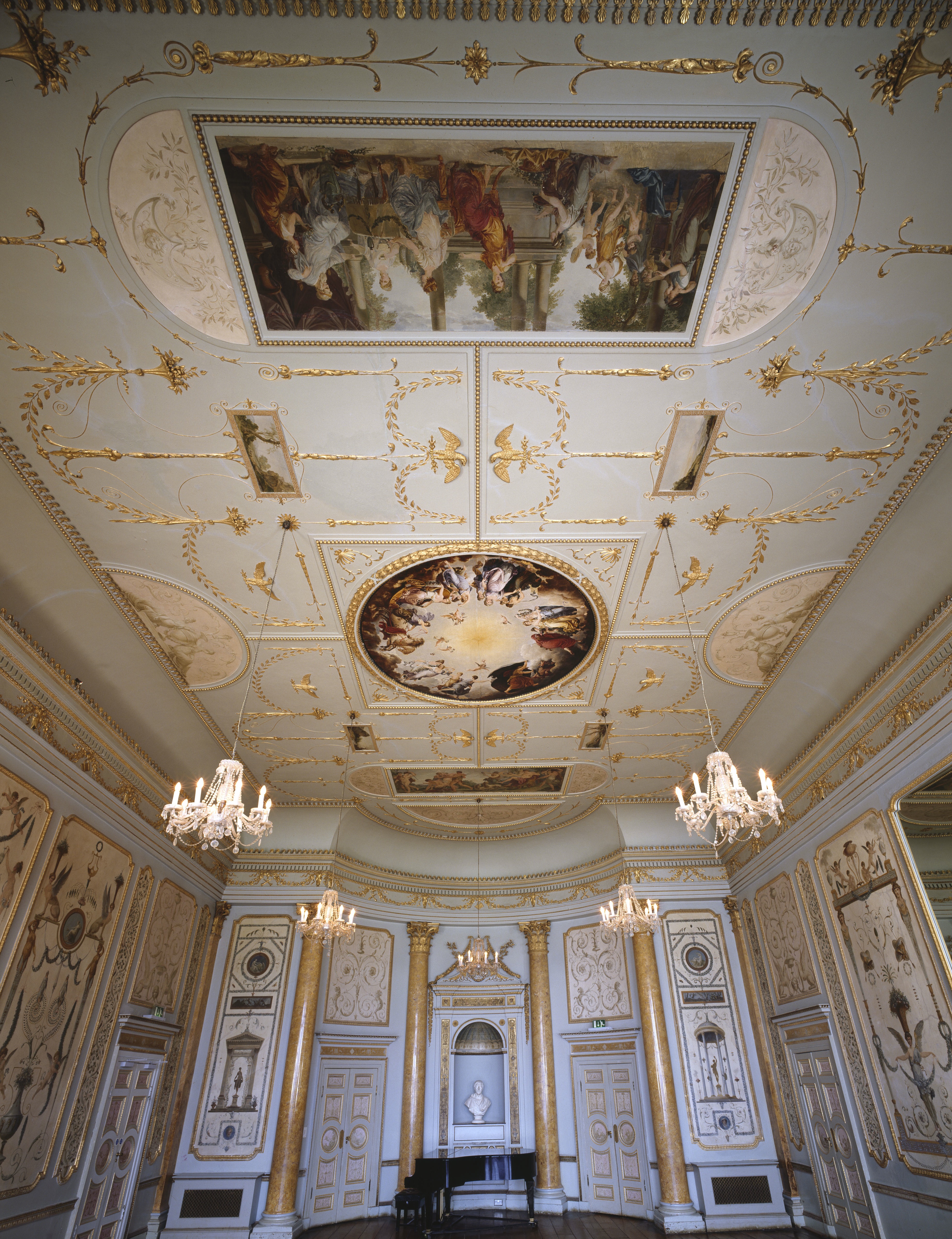 Through World Monuments Fund (WMF), The Paul Mellon Estate has announced a pledge of $250,000 towards the restoration of the State Music Room at Stowe House, the magnificent Grade I listed Neo-Classical palace set in 400 acres of landscaped park in Buckinghamshire. The funding means that the work will begin this year and should be completed by 2012-13.
WMF Britain’s Chief Executive Dr Jonathan Foyle said “The generous gift of The Paul Mellon Estate, along with donations from our members, trusts and foundations and others who responded to our recent Music Room Challenge, will allow one of the principal rooms of Stowe to be restored for everyone to enjoy. This magnificent response brings WMF’s £10 million fundraising challenge for Stowe to within £410,000 of its target – wonderfully positive news in these economically challenged times.” Completion of the State Music
Room will allow the core of historic spaces at Stowe to be presented as they
were at the turn of the 19th century, following the recent restoration of the
Marble Saloon and the Large Library.
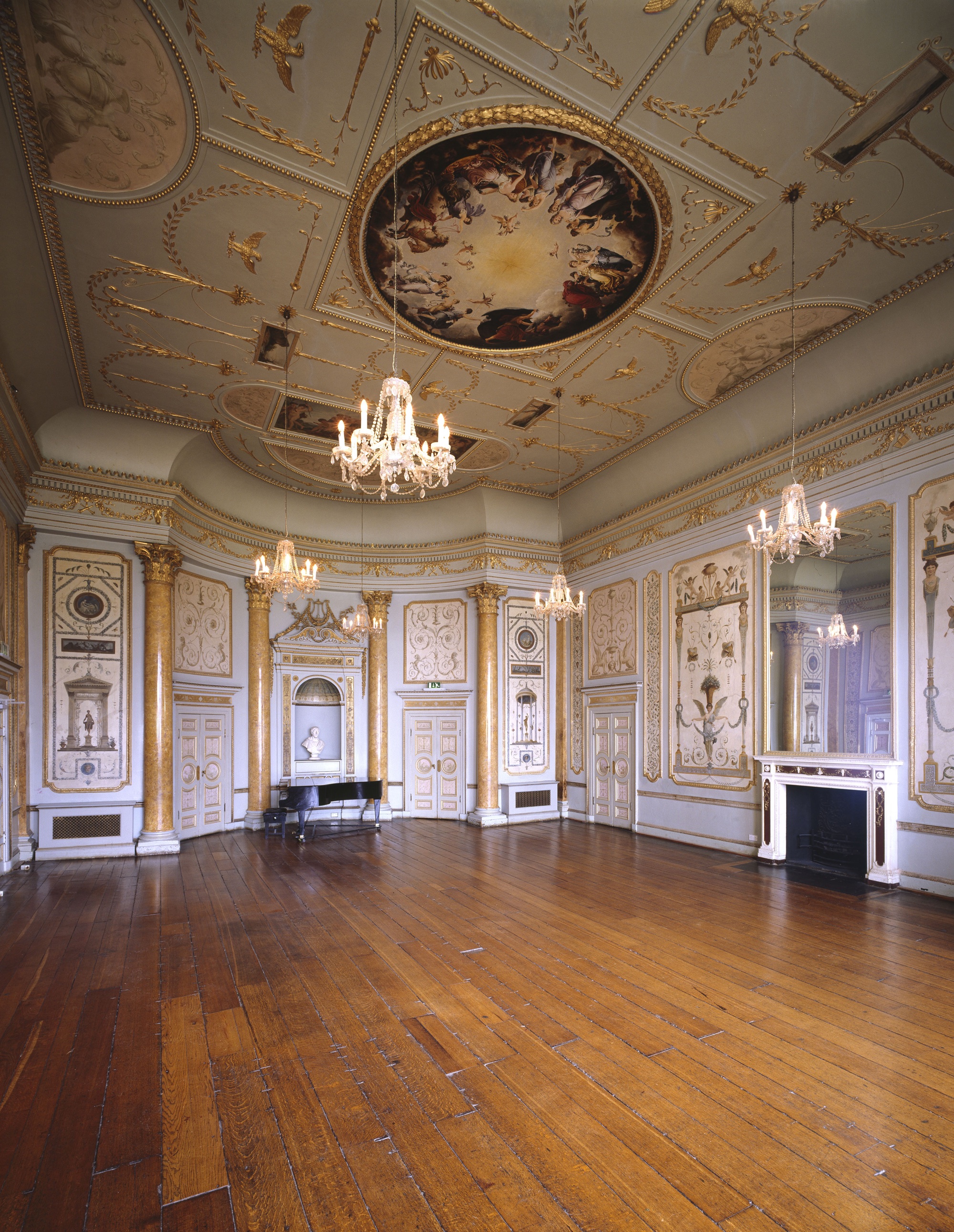 World Monuments Fund Britain (WMF) included Stowe in its 2002 Watch List of endangered sites and began to support the project by substantially funding the restoration of the astonishing Marble Saloon with its 57-foot-high dome which was completed in 2005. One of the largest and most spectacular spaces to be found in any British country house, the Saloon is an oval version of the Pantheon in Rome. WMF in partnership with Stowe House Preservation Trust (SHPT) has undertaken the daunting challenge of restoring this great mansion with its 400 rooms and 1/6 mile-wide façade.
Situated between the Marble Saloon and the Large Library, the State Music Room is one of the finest late 18th century spaces in Britain, showcasing Italian artistry in the heart of England. Whilst begun in 1676, it was only after a century of ceaseless building and landscape gardening that Richard Grenville-Temple (1711-79), 2nd Earl Temple to some, largely completed
Stowe House, including the south front, the Temple Room and the Music
Room in the 1770s. (more…)
This Month’s ‘Burlington Magazine’
This month’s issue of The Burlington Magazine is devoted to British Art with the following eighteenth-century offerings:
 The Burlington Magazine 153 (April 2011)
- Richard Hewlings, “Nicholas Hawksmoor in Chester,” pp. 224-28.
- Hugh Belsey, “Reading the Caricature Groups of Thomas Patch,” pp. 229-31.
- Malcolm Warner, Review of British Paintings in the Metropolitan Museum of Art, 1575-1875, Katharine Baetjer, p. 257.
- Brian Allen, Review of James Barry, 1741-1806: History Painter, ed. Tom Dunne and William Pressly, pp. 258-59.
- Timothy Wilcox, Review of Constable, Jonathan Clarkson, pp. 259-60.
- Giles Waterfield, Review of The English Virtuoso: Art, Medicine, and Antiquarianism in the Age of Empiricism, Craig Hanson, pp. 266-67.
- Alex Kidson, Review of the exhibition Georgian Faces: Portrait of a County, pp. 274-75.
Conference in Paris: Art and Sociability in the Eighteenth Century
If you will be in Paris for the summer, do not miss Art et Sociabilité au 18e siècle. The full conference program is now available online. –JF
Art et Sociabilité au 18e siècle
Institut national d’histoire de l’art, Paris, 23-25 June 2011
 Over the past two decades, sociabilité has become a useful and hotly debated concept for discussing the social, political and cultural changes during the eighteenth century. The works of Daniel Roche, Dena Goodman, Daniel Gordon, Antoine Lilti, and others have demonstrated that sociabilité can be fruitfully approached from the perspectives of sociology, philosophy and anthropology. In the eighteenth century, the Encyclopédie defined the term as “This inclination we have to do to others all the good that we can, to reconcile our happiness with that of others, and always to subordinate our personal advantage to the overall and communal advantage” (Louis de Jaucourt, 1751-1765) – that is, it was an abstract concept that explained the desire humankind had to participate in society. At the time, it was intricately linked to the social practice of commerce, broadly defined as any reciprocal communication or exchange. The emerging public sphere of the period, constituted by spaces such as academies, literary salons, and Masonic lodges,
was the stage on which such exchanges were enacted.
Since the publication of Thomas Crow’s Painters and Public Life in Eighteenth-Century Paris, art historians have taken an interest in the role of artists in the public sphere. These studies tend to take a monographic approach that is more interested in reconstructing the history of an individual artist, salonnière, or collector rather than the role that artworks played in larger systems of practice and exchange. This symposium will examine sociabilité in the eighteenth-century art world through the theme of social practice. By investigating the social practices of artists, amateurs, critics, salonniers and others we seek to uncover the larger networks of social exchange created by the commerce of material objects through collection practices, the art market and the display of art, and by the commerce of ideas through writing and conversation. To what extent did social practices in the public sphere influence artistic production and the material, economic, and verbal exchanges that took place around that production?
Lecture: The Figure of the Amateur in the Eighteenth Century
From Le Blog de L’APAHAU:
Charlotte Guichard, La figure de l’amateur au XVIIIe siècle
Centre allemand d’histoire de l’art, Paris, 28 April 2011

Jean-Baptiste Greuze, "Portrait of Claude-Henri Watelet," ca. 1765 ( Louvre)
Traditionnellement associé au collectionneur ou relégué au rang de simple dilettante, l’amateur est en réalité au XVIIIe siècle une figure centrale dans la constitution des savoirs artistiques. A distance de la conception kantienne, le langage du goût renvoie alors à des opérations cognitives dans le monde des amateurs. Non pas désintéressés, mais passionnément liés aux objets, à leur matérialité et à leur ordonnancement, les savoirs de l’amateur sont des savoirs du geste, articulés à un faire et à une praxis. La conférence présentera la spécificité de cette figure et son rôle dans la formation du discours de l’histoire de l’art, à travers l’exemple des « Rymbranesques », ces gravures d’artistes amateurs qui furent un des lieux où se construisit la grandeur de Rembrandt et son intégration dans le canon artistique.
Study Tour of Scotland / Conference on Edinburgh Cast Collection
This study tour sounds appealing enough on its own, but I was especially struck by the timing: it’s organized in conjunction with the EAHN/Docomomo conference. So often it seems that academic conferences could do a better job exploring the host area’s resources, and yet schedules tend to hold little room for excursions. This seems like an interesting solution. Also, as noted on the itinerary, there is at the same time a conference on the Edinburgh Cast Collection. -CH
EAHN Architectural Study Tour of Scotland
8-11 September 2011
Registration due by 1 June 2011

Princes Street Gardens, Edinburgh (Photo by James Denham, Wikimedia Commons)
Join the European Architectural History Network for an architectural study tour of Scotland from 8-11 September 2011. Tour highlights include Edinburgh, Glasgow, and five centuries of Scottish architecture, ranging from a selection of castles through postwar mass housing. The tour will be led by local scholars and will be accompanied by a coordinator from the EAHN. The tour fee of 96 euros includes guides and tour bus transportation; it does not include hotels, meals, or international transportation. For complete information and registration details, please consult the schedule.
◊ ◊ ◊ ◊ ◊
Cast Collection, Edinburgh College of Art
Also in September, the Edinburgh College of Art and the University of Edinburgh will host a conference on the Edinburgh Cast Collection. Founded in 1798, this is the second oldest educational collection in the UK, with donations by Lord Elgin, Canova, Thorvaldsen. The conference will be a major academic event with a section on Architecture and Cityscape. Details will be available in June.
New Title: ‘Maria Spilsbury’
Charlotte Yeldham, Maria Spilsbury Taylor (1776-1820): Artist and Evangelical (Aldershot: Ashgate, 2010), 230 pages, ISBN: 9780754669913, $124.95.
 Maria Spilsbury Taylor (1776-1820) lived and worked in London and Ireland and was patronized by the Prince Regent. A painter of portraits, genre scenes, biblical subjects and large crowd compositions – an unusual feature in women’s art of this period – she is represented in major museums and art galleries as well as in numerous private collections. Her work, hitherto considered on a purely decorative level, merits closer attention.
For the first time, this volume argues the relevance of Spilsbury’s religious background, and in particular her evangelical and Moravian connections, to the interpretation of her art and examines her pervasive, and often inovert references to the Bible, hymnody and religious writing. The art that emerges is distinctly Protestant and evangelical, offering a vivid illustration of the mood of patriotic, Protestant fervour that characterized the quarter century succeeding the French revolution. This focus may be situated in the general context of increasing interest in the religious faith of historical actors – men and women – in the eighteenth century, and in the related contexts of growing acknowledgement of a religious aspect to “enlightenment” art, as well as investigations into Protestant culture in Ireland. The book is extensively illustrated and contains a list of all of Spilsbury’s known works.
Contents: Introduction; Family background; A Moravian childhood; Early career; Themes 1798–1813; Exhibition and marriage; Ireland 1813/14 to 1820; Reputation; List of works; Bibliography; Index.
Charlotte Yeldham is an independent scholar based in the UK.
Women’s Studies Group Annual Workshop in London
From the Women’s Studies Group website:
Annual Workshop of the Women’s Studies Group 1558-1837
University College London, 25 June 2011
 We are delighted to announce that Dr Ann B. (Rusty) Shteir will be the guest speaker at our annual workshop on Saturday 25 June. The topic is ‘Myths of Flora: Representing, Repudiating, Recuperating the Goddess of Flowers’. Dr Shteir is Professor of Women’s Studies and Humanities, York University, Toronto. Her book Cultivating Women, Cultivating Science: Flora’s Daughters and Botany in England, 1760 to 1860 was awarded the Joan Kelly Memorial Prize for Women’s History, American Historical Association, 1996. She will introduce eighteenth-century Flora mythologies as depicted in mythology textbooks and other visual and textual forms and discuss the different interpretive methods for analysing the Flora Story.
Delegates are invited to bring presentations in the following subjects:
Women and Science
Women and Botany
Mythologies
Women’s Writing in the Long Eighteenth Century
Full details are now available on our website. All are welcome – please forward this message to your friends and colleagues. We recommend early registration as places will be limited.










 Enfilade
leave a comment