Call for Papers: Midwest Conference on British Studies
From the MWCBS:
Midwest Conference on British Studies 57th Annual Meeting
Indiana State University, Terre Haute, 4-6 November 2011
Proposals due by 15 April 2011
The Midwest Conference on British Studies is proud to announce that its fifty-seventh annual meeting will be hosted by Indiana State University in Terre Haute, IN. The plenary speaker will be Paula Backscheider, Phillpott-Stephens Eminent Scholar of English Literature at Auburn University, and author of Eighteenth Century Women Poets and Their Poetry. Peter Bailey, Professor Emeritus at the University of Manitoba, and the author of Leisure and Class in Victorian England, will deliver the keynote address. The program will also include panels honoring the career of Hilda Smith, Professor at the University of Cincinnati, and author of All Men and Both Sexes.
The MWCBS seeks papers from scholars in all fields of British Studies, broadly defined to include those who study England, Scotland, Wales, Ireland, and Britain’s empire. We welcome scholars from the broad spectrum of disciplines, including but not limited to history, literature, political science, gender studies and art history. Proposals for complete sessions are preferred, although proposals for individual papers will be considered. Especially welcome are roundtables and panels that:
* offer cross-disciplinary perspectives on topics in British Studies
* discuss collaborative or innovative learning techniques in the British Studies classroom
* situate the arts, letters, and sciences in a British cultural context
* examine representations of British and imperial/Commonwealth national identities
* consider Anglo-American relations, past and present
* examine new trends in British Studies
* assess a major work or body of work by a scholar (more…)
Germanic Drawings at the Getty
From the Getty:
Spirit of an Age: Drawings from the Germanic World, 1770–1900
Getty Center, Los Angeles, 29 March — 19 June 2011
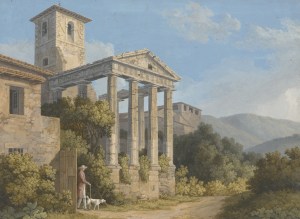
Jakob Philipp Hackert, "The Temple of Hercules in Cori near Velletri," 1783 (Los Angeles: The J. Paul Getty Museum)
Introducing recent acquisitions that represent a new area of the J. Paul Getty Museum’s collection, this exhibition features German and Austrian drawings made between 1770 and 1900. During that period, the Germanic world underwent profound changes—intellectual, social, economic, and political. Events such as the publications of Johann Wolfgang von Goethe, the Industrial Revolution, the formal unification of Germany into a nation state, and the invention of psychoanalysis shaped modern life and its representations in art.
In the early 1800s, the philosopher Georg Wilhelm Hegel professed that art was a fundamental mode of consciousness whereby humans could reach a profound understanding both of themselves and the world. Art, therefore, reflected the spirit of the age (“Zeitgeist” in German) in which it was created; this influential notion held sway over the 19th century. In fact, drawing—along with music—proved to be an essential expression of the period. It achieved an extremely high rank among the pictorial arts, sustained by the rise of art academies, which particularly emphasized draftsmanship as part of artistic training and practice. . . .
More information is available here»
Call for Papers: 2012 SAH Conference in Detroit
From the SAH website:
Society of Architectural Historians 2012 Conference
Detroit, 18-22 April 2012
Proposals due by 1 June 2011
The 2012 Society of Architectural Historians Annual Meeting is now accepting abstracts for 30 paper sessions. To read paper session descriptions and to submit abstracts, click here. . . . This year we are introducing an on-line system for the submission of abstracts, which will help us streamline the logistics involved in expanding the number of sessions we plan to offer this year and in the future. . . .
◊ ◊ ◊ ◊ ◊
Buildings and Objects: Baroque, Rococo, and Beyond
17th- and 18th-century architecture and decorative arts shared a common materiality, a basis in natural matter transformed through human ingenuity into self-conscious artifice. Immobile and spatial, that artifice could be architectural. Or, as portable and discrete, it could take the form of an object. Modern disciplinary divisions have tended to separate environmental and material cultures into distinct spheres of inquiry. The perils in this approach for modern architecture are well understood; the pitfalls in uncoupling objects and spaces in studies of 17th- and 18th-century buildings remain less well explored. Art historians have demonstrated that painting, sculpture, and interiors of the period were often informed by the production of ornamental objects. How, in turn, might attention to object design impact our understandings of architecture? Some 18th-century artists familiar today as creators of decorative objects, such as Juste-Aurèle Meissonnier, considered themselves architects and drew no strong boundary between designing things and designing buildings. Similarly, the crafting of ornament and furniture was integral to the practice of architects from Gianlorenzo Bernini to Filippo Juvarra or Robert Adam.
This panel seeks to reunite the study of 17th- and 18th-century European architecture and objects. How did architecture structure or negotiate human interactions with things? Were the period’s many newly formulated categories of luxury goods understood in specific relationships with spaces? What were the terms by which spatiality and materiality came to be understood as discrete? Topics might include the design of commercial spaces and the commodities for sale within them; practices of display in the noble salon or in purpose-built galleries and collectors’ cabinets; liturgical objects and devotional spaces; and the decoration of domestic or ceremonial interiors. Cross-disciplinary approaches to these arenas are encouraged, and papers that draw from or challenge the methodologies of architectural history, art history, and material culture studies are particularly welcome. Session chair: Kristel Smentek, Class of 1958 Career Development Professor, Department of Architecture, MIT; 617-253-5133 smentek@mit.edu.
◊ ◊ ◊ ◊ ◊
City Air
In his 2004 lecture “Building Breathing Space,” cultural historian Steven Connor called on architects to reconsider the relationship between built form and air, eschewing their respective autonomy, recognizing instead their complicity. He suggested we think of buildings as the articulation of air, of air as the animator of buildings.
This session examines Connor’s request at the urban scale, asking how air fashions and is fashioned by the city. If for Classical writers on city-building, air was a cosmic version of the continuum of the humors, valued for its heterogeneity and transformative properties, by the 19th century it was part of a medicalized physiology of the city; a potential harbourer of germs, it was corrupt if constrained, but purifying if in motion, and ultimately available for capture, conditioning and mechanical circulation. Air urbanists of the 1960s, from Archigram to Buckminster Fuller, showed a propensity towards the control of air, whether as a social and political act or as an attempt to use it as an explicit building material.
To control air’s forces means to envisage detachment from them. Gaston Bachelard insists that only by recognizing air’s variability can we conceive of rising through and beyond it. Only by acknowledging its specific material qualities can it be endowed with clarifying possibilities. When we homogenize and tame it, we deny air its generative abundance; in Luce Irigaray’s terms, we neglect the spreading, nourishing infinitude that makes it our ultimate dwelling.
This session calls for papers that explore air’s involvement in the city: the representation of air, the nature of air, and the attempted systematization and domestication of air in its relationship with the city. We seek investigations into the role of air both as an element essential to city life and as a component of the material imagination–explorations into what air means, as well as what it does for the city. Session chairs: Amy Catania Kulper, Assistant Professor, Department of Architecture, The University of Michigan; (323) 804-5434;akulper@umich.edu; and Diana Periton, Senior Lecturer, Leicester School of Architecture, De Montfort University; dp_cs@mac.com.
◊ ◊ ◊ ◊ ◊
Drawing in the Design Professions, 1500 to 1900
A recent SAH session elicited papers on the role of drawing from antiquity to the early modern period in the design of both landscape and architecture. These papers suggested the value of further investigation into drawing from the early modern period forward, especially how designers used drawing to represent ideas and the role drawing played in creating the modern design professions. Beginning in the 15th century, we can trace the use of drawing as a means to communicate ideas for an emerging architectural project. By the late 19th century educational programs with drawing at the core were established—a key step in establishing the professional status of these fields. This session calls for papers addressing the broad role of drawing in the emergence of the design professions between 1500 and 1900. How did drawing gain its primacy as a representational tool and what relationship did it have to the emerging definition of the design professions? How have architects and landscape architects used drawing differently in response to distinct needs and visions? How did new drawing techniques (perspective, axonometric, for example) influence actual design? And how did the mastery of such techniques shape the design professions? How does carefully looking at the drawings alter the narratives of the histories of these design professions? We invite papers that explore a wide range of approaches, from those addressing broader themes to those that consider individual projects or designers. Drawing has become the primary means by which architects and landscape architects think, create, and communicate. Thus, a more careful analysis of drawing and its own history may lead to a better understanding of these disciplines and practices. Session chairs: Thaisa Way, Associate Professor, College of Built Environments, University of Washington; tway@uw.edu; and Ann Huppert, Assistant Professor, College of Built Environments, University of Washington; ahuppert@uw.edu.
◊ ◊ ◊ ◊ ◊
Landscape Architecture and Economics
As commissioned projects—and even if self-generated—all landscape architecture reflects the workings and influence of one or more economic systems. Whether propelled or limited by the resources of the client, by the intended use of the landscape, or the financial status of those who will use it, designed landscapes are rooted inherently in finance, overtly or covertly. This session welcomes submissions that investigate the subject of the designed landscape and economics from a variety of perspectives, from all periods in history, and from all cultures. However, primary emphasis should be placed on designed landscapes rather than cultural landscapes or planning projects.
Subjects might include: What was the role of forest production in the making of the English landscape garden or in other garden traditions? How did labor figure in the making of landmark gardens, parks, and suburbs? How have particular designed landscapes served colonial industries or in the making of company towns? How were/are landscape architects’ offices organized and what is the effect of that structure on the making of designed landscape? How does “branded” landscape architecture achieve an identity? How have superannuated industrial processes and their landscapes influenced the course of their redevelopment as landscapes for leisure? How have parks and gardens been cast as tourist destinations in and of themselves, either as ephemeral garden shows or expositions, or on a more permanent basis? Of course, these are only a few suggestions to illustrate the range of potential topics.
Session chairs: Sonja Duempelmann, Assistant Professor of Landscape Architecture, Department of Plant Science and Landscape Architecture, University of Maryland; 301-405-5491; sduempel@umd.edu; and Marc Treib, Professor of Architecture Emeritus, University of California, Berkeley; 510-849-1839, mtreib@socrates.berkeley.edu.
◊ ◊ ◊ ◊ ◊
Remembering George A. Kubler
This session pays tribute to renowned architectural historian George A. Kubler, on occasion of the 100th anniversary of his birth. Through a distinguished career as scholar, educator and prolific writer, Kubler helped shape the discipline in many important ways. His vast areas of expertise included theory and history of art and architecture, predominantly focused on the art and architecture of ancient America and of Spain, Portugal and their American dominions from 1500 to1800. Among his mentors were the pre-eminent scholars Walter Cook, Karl Lehmann, Erwin Panofsky, and Herbert Spinden; but his lieber meister was the great French humanist Henri Focillon, under whose direction he wrote his masterful dissertation of 1940 on The Religious Architecture of New Mexico in the Colonial Period and Since the American Occupation, a model of morphological analysis and interpretation. His best known book and the most influential, however, remains The Shape of Time of 1962, where he sought to advance the history of art and architecture by proposing new methodological approaches that neither privileged meaning over form nor form over meaning. By making explicit meaningful philosophical links with other disciplines, Kubler showed the way to new theoretical models, including interdisciplinary and cultural studies. Some of his favorite themes were: the interaction of local and alien traditions, the relation of frugality to expression, the pluralism of “style” at any time and place, and the permanence of efficient forms—all of which merit reconsideration in the present post-structuralist era. Preference will be given to paper proposals that address any of Kubler’s areas of expertise and which apply his research methods. Submissions from different disciplines and interdisciplinary studies are particularly welcome. Session chair: Humberto Rodríguez-Camilloni, Professor of Architecture, Virginia Tech; 540- 231-5324 (voice); 540-231-9938 (fax); hcami@vt.edu.
◊ ◊ ◊ ◊ ◊
Rethinking Architecture in the Age of Printing
Inspired by the writings of Jean-Louis Viel de Saint-Maux, Victor Hugo in Notre-Dame de Paris (1831) famously stated: “[t]he book will kill the edifice.” Frank Lloyd Wright similarly viewed the effect of printing on architecture in a negative light, while Siegfried Gideon characterized the Renaissance printed treatise as a false start which would be superseded by the “true mechanical reproduction” of the industrial era. In a reversal of this trend, Mario Carpo in his Architettura nell’Età della Stampa (1998) cast what Wright had called the “imitative realism” of the Renaissance in a positive light, characterizing “architecture in the age of printing” as the first truly image-based architectural culture, in contrast to the medieval period’s reliance upon oral transmission and “non-visual” imitation.
Despite these differing interpretations, what unites all of these views is the idea that mechanical reproduction fundamentally transformed architecture. With this session, we propose to ask: how truly revolutionary was printing to both the practice and production of architecture? This session seeks papers which challenge assumptions about the mechanical nature of printing, its ability to dominate all aspects of cultural production, and its marginalization of other representational media in regards to architecture. We invite papers relating to any period or region, especially those which consider questions such as: What is the mode by which printed images were translated into built form; conversely, how did the transmission of architecture through print condition its reception? Did printing in fact enable the codification and perpetuation of the architectural orders? To what extent did printing create stable, authoritatively identical reproductions that removed the creative drift associated with hand-made drawings? How did printed images interface with other media? Can any technology of representation define the architectural production of an entire period? Session chairs: Kathryn Blair Moore, [Institute of Fine Arts, New York University];kathryn.b.moore@gmail.com; and Michael J. Waters, [Institute of Fine Arts, New York University]; michael.waters1@gmail.com.
◊ ◊ ◊ ◊ ◊
Open Sessions
Potential speakers whose choose not to submit an abstract to one of the thematic sessions above may opt instead to submit an abstract to an Open Session. There will be five Open Sessions in Detroit, the papers for which will be selected by the five Open Session chairs:
- Charles Burroughs, Elsie B. Smith Professor of Liberal Arts, Department of Classics, Case Western Reserve University; 216-368-6095;charles.burroughs@case.edu
- Meredith Clausen, Professor, School of Art, Division of Art History, College of Architecture & Urban Planning, University of Washington; 206-616-6751; mlc@u.washington.edu
- Will Glover, Associate Professor, Taubman College of Architecture and Urban Planning, University of Michigan; 734-936-0203;wglover@umich.edu
- Katherine Fischer Taylor, Associate Professor, Department of Art History, University of Chicago; 773-702-0255; k-taylor@uchicago.edu
- Richard Cleary, Professor, School of Architecture, The University of Texas at Austin; 512-471-6165; cleary@mail.utexas.edu
Exhibition: ‘The Art of Courtly Lucknow’
I’m afraid this exhibition slipped past me when it was at LACMA. It opens today, however, at the Musée Guimet in Paris. Thanks to Hélène Bremer for pointing it out. The following description comes from the LACMA press release:
India’s Fabled City: The Art of Courtly Lucknow / Une cour royale en Inde: Lucknow
The Los Angeles County Museum of Art, 12 December 2010 — 27 February 2011
Musée National des Arts asiatiques-Guimet, Paris, 6 April — 11 July 2011
Curated by Stephen Markel and Tushara Bindu Gude
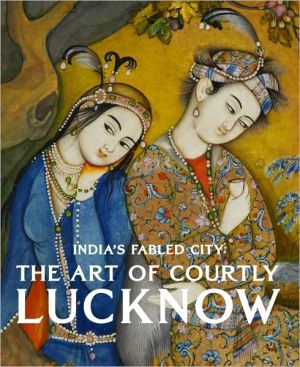
Exhibition catalogue, 272 pages, ISBN: 9783791350752
The Los Angeles County Museum of Art presents India’s Fabled City: The Art of Courtly Lucknow—the first major international exhibition devoted to the cosmopolitan culture of the northern Indian court of Lucknow, and the refined artistic production of the city’s multiethnic residents and artists. On view from December 12, 2010 through February 27, 2011, the exhibition will include almost 200 artworks: European oil paintings, watercolors, and prints; Indian opaque watercolor paintings generally made for albums, vintage photography, textiles, and garments, and a range of decorative art objects including metalwork, glassware, weaponry, and jewelry. Organized by Stephen Markel, LACMA curator of South & Southeast Asian art and department head, and Tushara Bindu Gude, associate curator, The Art of Courtly Lucknow will not only present the unique artistic traditions of Lucknow, but will also provide a framework for understanding the history of this extraordinary region and the nature of India’s colonial history and memory. . . .

After Johann Zoffany, "Colonel Polier Watching a Nautch," gouache on paper, ca. 1786-88 (Zurich: Museum Rietberg)
Lucknow was the capital of Awadh (a province in the Mughal Empire located in the present-day Indian state of Uttar Pradesh), and has become identified with the broader region and culture. From the mid-eighteenth century until the establishment of formal British rule in India in 1858, Lucknow overshadowed Delhi—the capital of the Mughal dynasty—to become the cultural center of northern India. Indian artists, poets, and courtiers flocked to Awadh seeking security and patronage, as Delhi suffered an extended period of unrest beginning in 1739. European artists, travelers and political agents were also soon lured to the region, seduced by tales of the wealth, opulence, and the generosity of Lucknow’s rulers (nawabs) and by the beauty of the city itself. The dynamic interaction between Indians and Europeans, the interplay
between their respective tastes and traditions, and the hybrid
lives led by many of Lucknow’s residents are explored in the
exhibition and accompanying publication. (more…)
Call for Papers: CAA 2012 in Los Angeles
College Art Association Annual Conference
Los Angeles, 22-25 February 2012
Proposals due 2 May 2011
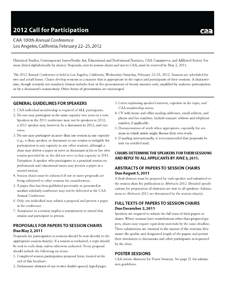 The College Art Association annual conference for 2012 takes place in Los Angeles, 22-25 February. The following sessions from the Call for Participation may be of interest to Enfilade readers. I would especially draw HECCA members’ attention to two sessions: first, a New Scholars Session, chaired by Kevin Chua (details forthcoming), and second, the panel that I’m chairing on ‘Pictures in Place’. Please consider submitting a proposal, and if you have questions, feel free to send me an email. To anticipate one query: why the bias towards pictures? — in formulating the description I was especially thinking about the relationship between two-dimensional images (i.e. paintings or prints) and space as a three-dimensional realm. Sculpture would work, I think, in relation to space somewhat differently. Still, I am willing to consider proposals that address sculpture (or decorative arts), especially if they raise methodological concerns relevant to the panel more generally. The complete Call for Participation (including details for submitting proposals) is available here»
◊ ◊ ◊ ◊ ◊
Historians of Eighteenth-Century Art and Architecture
Pictures in Place: Depicting Location and the Siting of Representation in the Eighteenth Century
Craig Hanson, Calvin College, CraigAshleyHanson@gmail.com
This panel invites papers that address the relationship between pictures and contexts in the eighteenth century—in terms of both imagery presented (the place portrayed) and the actual physical locations of pictures as experienced (the placement of pictures). In light of recent scholarship that has stressed the global eighteenth century—looking from Europe to the New World and to Africa and Asia—the session explores the role of place, be it geographical or phenomenological, in terms of how pictures functioned through consideration of where they functioned. Possible themes might include imperial or national ambitions; audience and politics of place; marketing strategies and the commodification of art viewing; exhibition venues; connections between painting and architecture; the relationship between painting, prints, and the decorative arts; and disjunctions between pictorial form and the siting of works of art. Considerations of methodological concerns in dealing with place are also welcome.
◊ ◊ ◊ ◊ ◊
Historians of Eighteenth-Century Art and Architecture
New Scholars Session
Kevin Chua, Texas Tech University, kchua71@yahoo.com
Details forthcoming [more available here]
◊ ◊ ◊ ◊ ◊
Historians of Netherlandish Art
Affect and Agency: The Netherlandish Portrait (1400–1750)
Ann Jensen Adams, University of California at Santa Barbara, ajadams@arthistory.ucsb.edu
Repeating an ancient trope, Constantijn Huygens wrote that portraits “perform a noble work, that more than any other is necessary for our human needs, . . . through them we in a true sense do not die; furthermore as descendants we can speak intimately with our most distant ancestors.” Through their perceived affective qualities, portraits in the early modern period served—consciously or unconsciously—as active cultural agents, from the formation of the self to strengthening familial bonds and producing social and political relations. This session seeks papers that expand our understanding of the imaginative and cultural function of portraiture in the Netherlands and in Germany, in the broadest sense. Genres might include the selfportrait, memorial (donor) portrait, court portrait, family portrait, group portraits of voluntary associations, portrait historié, printed portrait, imaginative portrait, and portrait sculpture, with an emphasis on the viewer’s understanding of the portrait and its personal and/ or cultural uses.
◊ ◊ ◊ ◊ ◊
American Society for Hispanic Art Historical Studies
New Research in the Early Modern Hispanic World
Michael A. Brown, 18099 East Orchard Place, Aurora, CO 80016; and Sofía Sanabrais, Los Angeles County Museum of Art, Department of Latin American Art, 5905 Wilshire Boulevard, Los Angeles, CA 90036; sofia.sanabrais@gmail.com
From the sixteenth to the eighteenth century, the art and architecture of Spain, Portugal, and their American dominions witnessed a period of tremendous transformation and provided fertile ground for the development of a new artistic vocabulary. This session examines new research and innovative approaches to the study of the early modern Hispanic world. In the last ten years, the field has attracted increased attention and produced groundbreaking exhibitions as scholars grapple with problems of patronage, the struggle between native and imported elements from Europe, the Americas, and Asia, and the use of art to create a sense of a New World identity distinct from its European sources. This session welcomes papers that present new research in the field of art and architectural history and conservation science.
◊ ◊ ◊ ◊ ◊
Italian Art Society
Territory and Border: Geographic Considerations of Italian Art and Architecture
Nicola Camerlenghi, University of Oregon; and Catherine C. McCurrach, Wayne State University; ncamerle@uoregon.edu and cmccurrach@wayne.edu
This session examines the geographic parameters that circumscribe the art and architecture of Italy. What common elements of intellectual inquiry are shared by scholars of Pompeii and those of Piedmont? How do the geographic boundaries of modern Italy shape the study of Italian art? What is gained—or distorted—by dutifully fitting eclectic and regional trends into a coherent narrative spanning centuries but limited to modern territorial borders? In light of Italy’s relation to the Mediterranean Sea, what geographic considerations ought to define the study of Italian art? As the culminating session of the year-long Italian Art Society theme “The Study of the Art and Architecture of Italy: A Reassessment of the Discipline,” papers reconsider fundamental assumptions underlying the current study of the art and architecture of Italy from antiquity to the present by addressing broad methodological themes centered around geographic definitions and boundaries.
◊ ◊ ◊ ◊ ◊
Information Visualization as a Research Method in Art History
Christian Huemer, Getty Research Institute; and Lev Manovich, University of California, San Diego; chuemer@getty.edu and manovich@ucsd.edu
Interest is growing in the use of information visualization across the humanities, as scholars in literature, history, and media studies discover its potential for their research. Large-scale digitization efforts by libraries, museums, and other cultural institutions are providing online access to significant collections of images and texts. Instead of using these large data sets merely for the retrieval of individual records, new software and computer interfaces enable art historians to explore complex relationships between many variables interactively. This panel presents concrete visualization projects in the field of art history and discusses questions surrounding its use as a research method: How do we combine the close reading of a small number of visual artifacts with the analysis of patterns that may manifest themselves across millions of these artifacts? How can we understand visualization in relation to other more established art-historical methods?
◊ ◊ ◊ ◊ ◊
Art History Open Session
Art and Architecture in Europe: 1600–1750
John Beldon Scott, University of Iowa, jb-scott@uiowa.edu
This session showcases current research in early modern European art, architecture, and urbanism. Papers that explore the persuasive intent and mass audience of the art production of the period are given preference.
◊ ◊ ◊ ◊ ◊
New Approaches to Post-Renaissance Florence, ca. 1600–1743
Eve Straussman-Pflanzer, Art Institute of Chicago; and Eva Struhal, Université Laval; estrau@artic.edu and eva.struhal@hst.ulaval.ca
Despite Rudolf Wittkower’s declaration that Florence became a “stagnant backwater” after the sixteenth century, recent scholarship has demonstrated the wealth of artistic activity that flourished in the city after that date. We seek to reevaluate this art-historical period by bringing together research that highlights and nuances the artistic, cultural, and intellectual riches of post-Renaissance Florence. We invite papers that consider any aspect of the period from ca. 1600 until the death of the last Medici in 1743. Paper topics might include the historiography of the period, literary academies and artists, the interchange between art and science, female patronage, women artists, or the intersection of art and music.
◊ ◊ ◊ ◊ ◊
No Talking Allowed: Making a Visual Argument about Art History
Jean Robertson and Craig McDaniel, Indiana University; jerobert@iupui.edu and crmcdani@iupui.edu
Anyone who has studied art history most likely has experienced the aesthetic and conceptual thrill of viewing adroit visual presentations that barely seem to require the professor’s verbal accompaniment. This experimental Open Forms session invites proposals for five twelve-minute presentations that analyze art-historical topics using visual means, either still or moving images, with minimal spoken or written words. (Nonverbal sound tracks are acceptable.) Models for the visual essays include such examples as exhibitions in which curators make conceptual points about artists, periods, styles, and themes through works of art alone; visual essays with minimal captioning created by photojournalists; and visual essays without accompanying text, such as John Berger’s visual argument about the gaze in his book Ways of Seeing. We welcome proposals from art historians, critics, curators, and artists with the goal of organizing a session that demonstrates an expansive range of possibilities for visual essays about art history. (However, we will not accept an artist’s visual essay solely about one’s own work.) Proposals may be in written form.
◊ ◊ ◊ ◊ ◊
Historians of British Art
Future Directions in the History of British Art
Peter Trippi, Fine Art Connoisseur Magazine and Projects in 19th-Century Art, Inc., 780 Riverside Drive, Suite 10F, New York, NY 10032; ptrippi@aol.com
The year 2012 marks the twentieth anniversary of the founding of Historians of British Art and thus is an ideal moment to scan the horizons of this field. Instead of looking back to document our recent evolution, this session highlights what lies ahead. Advanced graduate students and those who have earned a PhD or joined a museum staff since 2007 are invited to submit proposals on any aspect of British art and architecture, past or present, including ones that reflect Britain’s varied roles in the wider world. Particularly welcome are papers that employ emerging methodologies or ways of collaborating with colleagues in other disciplines.
Reviewed: ‘Artistic and Cultural Exchanges between Europe and Asia’
Recently added to caa.reviews:
Michael North, ed., Artistic and Cultural Exchanges between Europe and Asia, 1400–1900: Rethinking Markets, Workshops and Collections (Burlington, VT: Ashgate, 2010), 216 pages, ISBN: 9780754669371, $114.95.
Reviewed by David Carrier, Case Western Reserve University/Cleveland Institute of Art; posted 24 March 2011.
The necessary precondition for a world art history is the close study of cultural exchanges. Even nowadays, when you can travel from New York to Beijing in less than a day, the distance between America’s and China’s visual cultures is still immense. When such travel was much slower, and curators were not much concerned with exotic art, the diverse artistic traditions were relatively self-sufficient. But once Vasco da Gama circumnavigated the globe, it was inevitable that those artifacts called works of art would move from their places of origin to other cultures. The world had become one, which is to say that all art traditions were interconnected. This, then, is why close analysis of the slow-moving process in which Europeans brought their art to China, India, and other places outside the West, as well as collected non-European art, is extremely important.
“Artistic and Cultural Exchanges between Europe and Asia,” an anthology that collects the proceedings of a conference held in Sydney in 2005, contains an introduction by Thomas DaCosta Kaufmann and Michael North, and essays by Karl-Heinz Spiess on Asian artifacts in Western European courts during the Middle Ages; Peter Borschberg on the trade in Bezour stones, the minerals believed to possess magical properties; Ting Chang on French fantasies about Asia; Martin Krieger on Dutch collecting in colonial India, circa 1800; Alexander Drost on Mughal architecture as it was incorporated into European memorials in seventeenth-century India; North on art making by European companies in Asia; Mia Mochizuki on the uses of Dutch maps in Japan; Kaufmann on markets in Funi-e; and Yoriko Kobayashi-Sato on the relationships between Japan and the West during the Edo period. . . .
The full review is available here» (CAA membership required)
‘Street Cries’ at the Museum of London
From the Museum of London:
Street Cries
Museum of London, 25 March — 31 July 2011
Curated by Francis Marshall
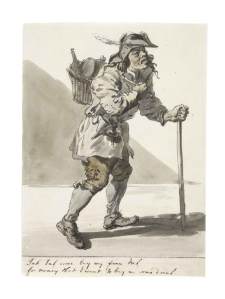
Paul Sandby, "Ink Seller," watercolour, ca. 1759 © Museum of London
Street Cries uses the Museum of London’s extensive art collection to consider how the urban poor were depicted from the 17th to the 19th century. Some of the earliest visual records of the urban poor were prints showing street traders. These first appeared in 15th-century Europe and continued to be made well into the 19th century. The market for this type of imagery was a flourishing one, particularly in London.
Many of these images presented an idealised vision of the poor. However, some artists, attempted greater realism. In 1760, for instance, Paul Sandby sought to redress the sanitizing tendency with his etchings Twelve London Cries Drawn from the Life. However, he anticipated a much larger set running to around forty images. He made watercolour drawings for these, of which the museum has an important group, but they were never published, probably because Sandby’s work was too realistic. Sixty years later, the French artist Théodore Géricault produced a print series depicting London’s poor. These powerful prints where a commercial flop largely because the imagery was too hard hitting to appeal to collectors at
the time.
Images of street vendors, and the urban poor generally, pose interesting questions about how society was organised, the motives of those making, selling and buying the prints, and the status and identity of the people depicted. Amongst other things, they can be seen as precursors of Mayhew’s efforts to produce a taxonomy of the London poor. The exhibition explores these issues as well as showcasing some of the Museum’s most important 18th- and 19th-century prints and drawings. Amongst the artists included are Paul Sandby, Gustave Doré, Théodore Géricault, and Thomas Rowlandson.
April 27, 3:00 — Curator Francis Marshall speaks on the exhibition at the Museum of London.
◊ ◊ ◊ ◊ ◊
Writing for The Independent (21 March 2011), Matilda Battersby reviews the show:
Put them all together and they resemble the cast of Oliver Twist: street urchins, prostitutes, beggars and street vendors all carefully drawn, painted or printed in the 17th and 18th centuries. They are some of the earliest depiction of London’s poor and are due to go on show at the Museum of London this week.
It is an interesting body of work for two reasons. Firstly, it encapsulates the diverse roles, functions and perceptions of Britain’s ‘underclass’ during those two centuries as well as giving insight into what was eaten, sold and readily available. Secondly, it shows an increased, although for the most part snobbish, awareness of what was then the ‘undeserving poor’ and an anthropological, if not exactly philanthropic, interest in them. . . .
The full review — plus a video with Francis Marshall discussing three images from the exhibition — is available here»
Call for Papers: Port Architecture
The Social Life of Port Architecture: History, Politics, Commerce, and Culture (1700-present)
Centre for Port and Maritime History, University of Liverpool, 23-25 June 2011
Proposals due by 29 April 2011
The architecture of port cities is entangled in the social, political, economic and cultural histories of these places. Historically, major architectural projects afforded the commissioning merchant class the capacity to materialize their status in prominent urban spaces in a way which embedded trade and commerce in a set of broader civilizational values. Architecture was one of the key sites for referencing the cultures of other places with historicist styles, civilizational discourses, ‘exotic’ motifs and — crucially — representations of the local. Architecture also housed the social interactions crucial for knitting together trading networks within and beyond the city, while the configuration of internal building spaces revealed assumptions about the ordering of wider social relationships and hierarchies.
Architecture provides a lens through which to study the economic, political and cultural practices of port-cities. How did the social practices and values (whether religious or secular) crucial for assembling trading networks shape the architecture of port-cities? Which achievements were represented and celebrated in urban space and why? How did rapidly professionalizing architects draw on and particularize repertoires of historicist and international symbols in order to create distinctive local images? What were some of the controversies centring on major architectural projects and what do they tell us about wider social issues? How were new technologies incorporated into the urban landscape? (more…)
Susan Taylor-Leduc on the French Picturesque Garden
From the Bard Graduate Center:
Susan Taylor-Leduc, The “Pleasures of Surprise” in the French Picturesque Garden
Bard Graduate Center, New York, 27 April 2011
Just as video games, smart phone ‘apps’ and online betting solicit the attention of early 21st-century subjects, gaming, particularly high-stakes gambling, was irresistible to eighteenth-century French Society. Whereas gambling was considered as an abstract science combining mathematical calculation and chance, its corollary, surprise, inspired the imagination. Baron de Montesquieu linked the two in his “Essay on Taste” in 1754, suggesting how the social practices of gambling inspired surprising images, behaviors, and sensations. Comparing playing cards, board games, engravings, and paintings to garden plans and extant garden sites, this talk investigates how gambling was projected from the card table to the picturesque gardens created by elite patrons who were themselves addicted gamers. It argues that by fostering a game-like sense of surprise, such gardens promoted new sensate experiences that reconfigured eighteenth century notions of amusement and pleasure and contributed to the formulation of modern aesthetic discourses. (more…)
Call for Papers: Merchants as Collectors
The dates of the conference topic range from 1450 to 1650 — yes, well before even the ‘long eighteenth century’ — but there’s one phrase in the Call for Papers that caught my attention: “topics falling outside of this date range will be considered if a compelling reason for their inclusion can be made.” Details are available here. -CAH
Early Modern Merchants as Collectors
Ashmolean Museum, University of Oxford, 15-16 June 2012
Proposals due by 31 May 2011
In 1615, Vincenzo Scamozzi highlighted the importance in Venice of the merchant-collectors Bartolomeo dalla Nave and Daniel Nijs by including descriptions of their collections in his L’Idea della architettura universale. Scholarship has also moved beyond the consideration of the artist and the patron as the principal protagonists in the history of collecting. As a result, merchants are now being regarded by historians as influential collectors in their own right.
With the 1985 publication of The Origin of Museums, a collection of conference papers edited by Oliver Impey and Arthur MacGregor, the Ashmolean Museum became established as a leading institution for research in the history of collecting. Recently re-opened with innovative galleries displaying objects exploring the theme ‘Crossing Cultures Crossing Time’, the new Ashmolean now affords an opportunity to re-visit the 1985 conference topic and not only to update but also to expand it into this fresh area of research and debate. This interdisciplinary conference will explore early modern merchants as collectors across a wide range of geographical regions and collecting categories, investigating whether there are any patterns connecting these merchant-collectors of the early modern period and what theoretical frameworks can be applied to them. (more…)










 Enfilade
leave a comment