Settecento Paintings in New York
The following press release comes from Sperone Westwater (as noted at Art Daily) . . .
Italian Paintings from the 17th and 18th Centuries
Sperone Westwater Gallery, New York, 7 January — 19 February 2011
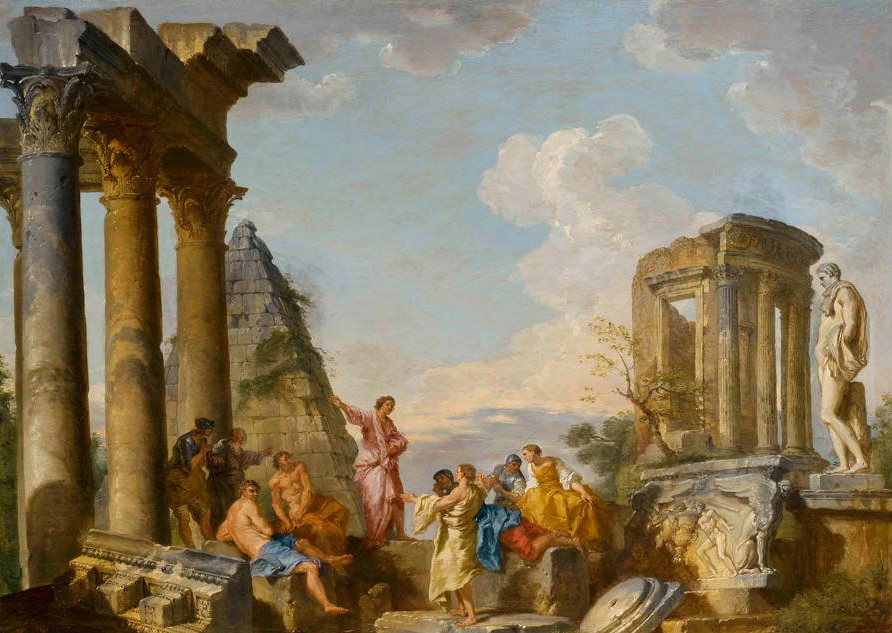
Giovanni Paolo Panini, "Architectural Capriccio with an Apostle Preaching," 1755-60, oil on canvas, 20 7/8 x 28 7/8 inches (52.9 x 73.5 cm). Courtesy Sperone Westwater, NY.
Sperone Westwater is pleased to announce an exhibition of Italian Paintings from the 17th and 18th Centuries in partnership with Robilant + Voena. This survey of Italian Old Master paintings, with notable masterpieces by painters such as Canaletto (1697-1768), Cavalier d’Arpino (1568-1640), Artemisia Gentileschi (1593-1653), and Michele Marieschi (1710-1743), intends to reassert the historical importance of Italian painting in the centuries following the Renaissance – a period which was to become an important foundation for modern art.
The exhibition unveils several new discoveries. One highlight is a very uncommon signed Portrait of an Unidentified Man (1630-1640) by Artemisia Gentileschi, among the most highly regarded female artists of the Baroque. It is exhibited alongside Tiberio Titi’s Portrait of Ferdinando Gonzaga, Duke of Mantua (ca. 1617) – also a new addition to his body of work. An early Francesco Guardi, Piazza San Marco, looking West, from the Campo di San Basso (1757-1758), a newly discovered work from the late 1750s, represents a period when he was still very much under Canaletto’s influence. When comparing this to Guardi’s later and previously unpublished painting, Venice. The Lagoon and the Fort of San Niccolo at Lido (1775-1785), it is possible to see how far the artist took his own individual interpretation of the Venetian veduta. Canaletto’s small and exquisite View of Dolo at the bank of the Brenta (1763) completes this set of important additions.
Other early masterworks will include two rare paintings by Cavalier d’Arpino, who first hosted Caravaggio in his studio after his arrival in Rome. The first, David with the Head of Goliath (1598) is a signed and dated work from the extensive Aldobrandini collection that was treasured by several papal Cardinals since its creation. It contrasts forcefully with d’Arpino’s Venus and Cupid (1602-1603), executed a few years later. Works by Battistello Caracciolo, Angelo Caroselli and Carlo Dolci further exemplify the prominence of religious narrative during the 17th century. Paintings by Marieschi, Panini and Joli also underline the 18th-century fascination with the veduta.
By jointly exhibiting Italian Baroque paintings and vedute from the 17th and 18th centuries in New York, Sperone Westwater and Robilant + Voena inaugurate a closer partnership between the two galleries. In 2011 both galleries will open a new shared space in London, 2nd Floor at 38 Dover Street, W1, with a joint show in 2011.
A fully illustrated, scholarly catalogue is being published on the occasion of the show. There will be an opening reception on 7 January from 6-8 pm. For more information, please visit www.speronewestwater.com or contact Maryse Brand at +1 (212) 999-7337 or maryse@speronewestwater.com.
CAA in New York
The 2011 College Art Association conference takes place in New York, February 9-12, at the Hilton New York. HECAA will be represented by two panels and a reception, as listed here. The following sessions may also be of interest for dix-huitièmistes. A full list of panels is available here»
HECAA EVENTS
New Scholars Session
Thursday, February 10, 12:30–2:00; Beekman Parlor, 2nd Floor, Hilton New York
Chair: Heidi Anne Strobel (University of Evansville)
- Susan M. Wager (Columbia University), “Madame de Pompadour’s Indiscreet Jewels: Boucher, Reproduction, and Luxury in Eighteenth-Century France”
- Heidi E. Kraus (University of Iowa), “Reflections on Civilization: Architecture and Memory in David’s Sabine Women“
- Kristina Kleutghen (Harvard University), “Staging Europe: Theatricality and Painting at the Chinese Imperial Court”
- Sally Grant (University of Sydney), “Garden Chambers and Global Spaces: Giandomenico Tiepolo’s Chinoiserie Room at the Villa Valmarana”
HECAA Reception
Thursday, February 10, 5:30-–8:30; Lincoln Suite, 4th Floor, Hilton New York (note revised time to accommodate the ASECS affiliate session)
◊ ◊ ◊ ◊ ◊
The Global Eighteenth Century
Saturday, February 12, 9:30–12:00; Regent Parlor, 2nd Floor, Hilton New York
Chairs: Kristel Smentek (Massachusetts Institute of Technology) and Meredith Martin (Wellesley College)
- Elisabeth Fraser (University of South Florida), “Miniatures in Black and White: Melling’s Eighteenth-Century Istanbul”
- Daniel McReynolds (Center for Advanced Studies in the Visual Arts), “A Venetian Abroad: Andrea Memmo and the Architecture of Diplomacy in Eighteenth-Century Istanbul”
- Chanchal Dadlani (Columbia University), “Between History, Ethnography, and Autobiography: The Gentil Album (1774) and Artistic Production in Eighteenth-Century India”
- Michele Matteini (Reed College), “The Market for Exotica in Eighteenth-Century Beijing: A View from Liulichang”
- Kevin Chua (Texas Tech University), “Macartney’s Globe, or Cartographic Refusal in 1793”
◊ ◊ ◊ ◊ ◊
OTHER SESSIONS RELATED TO THE 18TH CENTURY
Architecture, Space, and Power in the Early Modern Ibero-American World
Wednesday, February 9, 2:30–5:00; Gramercy B, 2nd Floor, Hilton New York
Chairs: Jesús Escobar (Northwestern University) and Michael Schreffler (Virginia Commonwealth University)
- Barbara Mundy (Fordham University), “Centers and Peripheries in Sixteenth-Century Mexico City”
- Stella Nair (University of California, Riverside), “From Inca Pampa to Spanish Plaza: Theatrical Politics and the Transformation of Imperial Public Space, 1480-1780”
- Catherine Wilkinson Zerner (Brown University), “The Visionary Spatial World of the Ibero-American Retable Altarpiece”
- Sabina de Cavi (Vlaams Academisch Centrum, Brussels), “Natione Italiana: Architecture of the Italian Minorities in Philippine Iberia (1580-1640)”
- Victor Deupi (Fairfield University), “Santissima Trinità degli Spagnoli and Ibero-American Patronage in Eighteenth-Century Rome”
◊ ◊ ◊ ◊ ◊
American Society for Hispanic Art Historical Studies: Rereading Spanish Early Modern Art Theory
Thursday, February 10, 9:30–12:00; Gramercy B, 2nd Floor, Hilton New York
Chairs: Giles Knox (Indiana University) and Carmen Ripolles (Metropolitan State College of Denver)
- Alejandra Giménez-Berger, “Aesthetics of Ideology in Felipe de Guevara’s Comentarios de la Pintura“
- Rebecca J. Long, “Italian Artists within the Spanish System”
- Melody Maxted-Wittry, “Knowing Nature: Artistic Production, Scientific Inquiry, and Catholic Devotion in Seventeenth-Century Spain”
- Ellen Prokop, “The Body of the Artist: An Anatomy of Faith in Early Modern Spain”
- Ray Hernández-Durán (University of New Mexico), “Francisco Pacheco in Sor Juana’s Library: Miguel Cabrera and the Academy in Eighteenth-Century New Spain”
◊ ◊ ◊ ◊ ◊
Representing Gothic
Thursday, February 10, 9:30–12:00; East Ballroom, 3rd Floor, Hilton New York
Chairs: Stephen Murray, Columbia University; Andrew J. Tallon, Vassar College
- Robert Bork (University of Iowa), “Speaking the Un-Speakable: Drawings, Texts, and the Explication of Gothic Design”
- Sarah Guérin (Columbia University), “Micro-Architectural Representation on Gothic Ivories”
- Michèle Hannoosh (University of Michigan), “Michelet and the Gothic: Architecture and the Writing of History in Nineteenth-Century France”
- Matilde Mateo (Syracuse University), “Re-Inventing the Gothic Grove: Recent Metamorphoses in Landscape Art, Science Fiction, and Animated Film”
- Matthew Reeve (Queen’s University), “Queer Gothic: Representing the Gothic at Walpole’s Strawberry Hill”
◊ ◊ ◊ ◊ ◊
Historians of British Art: Seeing through the Medium
Thursday, February 10, 12:30–2:00; Sutton Parlor South, 2nd Floor, Hilton New York
Chairs: Imogen Hart (Yale Center for British Art) and Catherine Roach (Cornell University)
- Holly Shaffer (Yale University), “Ta’ziyeh: Reference and Resemblance in North Indian Ephemeral Shrines, 1770-1830”
- Andrew Stephenson (University of East London), “Ciné-Texts: The Permeability of Modern Art, Film, and Snapshot Cultures in 1920s-1930s London”
- Elyse Speaks (University of Notre Dame), “Dissolution, Disillusion, and Deflation: Damien Hirst’s Double Act”
◊ ◊ ◊ ◊ ◊
Rococo, Late-Rococo, Post-Rococo: Art, Theory, and Historiography
Thursday, February 10, 2:30–5:00; Sutton Parlor Center, 2nd Floor, Hilton New York
Chairs: Melissa Hyde (University of Florida) and Katie Scott (Courtauld Institute of Art)
- Colin Bailey (The Frick Collection), “A Casualty of Style? Reconsidering Fragonard’s Progress of Love from the Frick Collection”
- Satish Padiyar (Courtauld Institute of Art), “Between Early and Late: Fragonard as a Late Rococo Artist”
- Elizabeth Mansfield (New York University), “Rococo Republicanism”
- Marika Knowles (Yale University), “Pierrot’s Periodicity: Watteau, Nadar, and the Circulation of the Rococo”
- Allison Unruh (independent scholar, New York), “Warhol’s Rococo”
◊ ◊ ◊ ◊ ◊
American Society for Eighteenth-Century Studies: Cosmopolitanism and Art in the Eighteenth Century
Thursday, February 10, 5:30–7:00; Petit Trianon, 3rd Floor, Hilton New York
Chair: Jennifer Milam (University of Sydney) — This session is dedicated to Angela Rosenthal
- Jeffrey Collins (Bard Graduate Center)
- Alicia Weisberg-Roberts (The Walters Art Gallery)
- Michael Yonan (University of Missouri)
- Jill Cassid (University of Wisconsin, Madison)
- Mark Cheetham (University of Toronto)
Historians of British Art: Young Scholars Session
Friday, February 11, 7:30-9:00am; Bryant Suite, 2nd Floor, Hilton New York
Chair: Colette Crossman (Blanton Museum of Art, University of Texas at Austin)
- Amanda Lahikainen (Brown University), “‘British Asignats’: Satirical Representation and the Politicization of Paper Currency in 1797”
- Keren Hammerschlag (King’s College London), “Artistic Scientists and Scientific Artists at the British Royal Academy 1860-1900”
- Emily V. Davis (Virginia Commonwealth University), “British Literary Periodicals Transform the Female Form in Turn-of-the-Century Glasgow”
◊ ◊ ◊ ◊ ◊
New Approaches to the Study of Fashion and Costume in Western Art, 1650–1900
Friday, February 11, 2:30–5:00; Clinton Suite, 2nd Floor, Hilton New York
Chairs: Helen Burnham (Museum of Fine Arts, Boston) and Justine De Young (Harvard University)
- Kathleen Nicholson (University of Oregon), “When Isn’t Fashion Fashion? Late Seventeenth-Century French Fashion Prints and Dress in Portraiture”
- Amelia Rauser (Franklin and Marshall College), “Neoclassical Fashion in Art and Life in the 1790s”
- Heather Belnap Jensen (Brigham Young University), “Materializing the Maternal Body in Post-Revolutionary Fashion”
- Jennifer W. Olmsted (Wayne State University), “Fashioning Masculinity: Portraiture, Costume, and the Juste Milieu”
- Alison McQueen (McMaster University), “Empress Eugénie and Representations of Fashion in Second Empire France”
◊ ◊ ◊ ◊ ◊
American Society for Hispanic Art Historical Studies: New Perspectives on Spanish Drawings 1500-1900
Friday, February 11, 5:30–7:00; Gibson Room, 2nd Floor, Hilton New York
Chair: Lisa A. Banner (independent scholar)
- José Manuel Matilla (Museo Nacional del Prado), “Recently Acquired Albums and Sketchbooks at the Prado”
- Zahira Véliz (independent scholar and curator), “Designing the Ensemble: An Altarpiece Drawing by Alonso Cano”
- José Manuel de la Mano (independent scholar, Madrid), “Mariano Salvador Maella: Problems of a Catalogue Raisonné and Exhibition”
◊ ◊ ◊ ◊ ◊
Imitation, Copy, Reproduction, Replication, Repetition, and Appropriation, Part I
Saturday, February 12, 9:30–12:00; Madison Suite, 2nd Floor, Hilton New York
Chairs: Malcolm Baker (University of California, Riverside) and Paul Duro (University of Rochester)
- Maria Loh (University College London), “Time Is Out of Joint: Resetting the Laocoön”
- Lisa Pon (Southern Methodist University), “The Printed Image in the Age of Miraculous Reproduction”
- Ronit Milano (Ben-Gurion University, “Self vs. Collective Identity: The Reproduction of Portrait Busts in Eighteenth-Century France”
- Douglas Fordham (University of Virginia), “The ‘Real Spaces’ of Eighteenth-Century Prints”
- Tom Huhn (School of Visual Arts), “Reflections on the Imitation of Winckelmann”
◊ ◊ ◊ ◊ ◊
Cultural Appropriation, Part II
Saturday, February 12, 9:30–12:00; Concourse G, Concourse Level, Hilton New York
Chairs: Elizabeth K. Mix (Butler University) and Gabriel P. Weisberg (University of Minnesota)
- Annika Johnson (University of Minnesota), “Cahier d’Oiseaux Chinois: The French and Fantastic Appropriation in the Chinoiseries of Jean-Baptiste Pillement”
- Colette Apelian (Berkeley City College), “Bhabha’s Cultural Hybridity and Early Twentieth-Century Modifications of Fez, Morocco”
- Susanne Slavick (Carnegie Mellon University), “Erasure, Eternal Return, and Empathic Restitution”
- Chisato O. Dubreuil (St. Bonaventure University), “A New Look at the Costs of the Cultural Appropriation of Canada’s Traditional Totem Poles”
- A. Joan Saab (University of Rochester), “America Tropical and the Multi-Sited Mural”
◊ ◊ ◊ ◊ ◊
Historians of British Art: Radical Neo: The Past in the Present in British Art and Design
Saturday, February 12, 9:30–12:00; Bryant Suite, 2nd Floor, Hilton New York
Chairs: Jason Rosenfeld (Marymount Manhattan College) and Tim Barringer (Yale University)
- Zirwat Chowdhury (Northwestern University), “The Elephanta in the Room: Indian Antiquity and British Antiquarianism in the Late Eighteenth Century
- Ayla Lepine (Courtauld Institute of Art), “Manifesting the Rule: Designing for Monasticism in Victorian Oxford”
- Katherine Faulkner (Courtauld Institute of Art), “Domestic Dreams and Utopian Idylls: Medieval Dress in the Work of William Reynolds-Stephens”
- Lee Hallman (The Graduate Center, City University of New York), “Unseen Landscapes: Paul Nash and the Geography of History”
- Mark A. Cheetham (University of Toronto), “Yinka Shonibare’s Enlightenment: Revising British Art for the Twenty-First Century”
Watteau and His Circle at The Wallace
From The Wallace:
Esprit et Vérité: Watteau and His Circle
The Wallace Collection, London, 12 March — 5 June 2011

Jean-Antoine Watteau, "A Lady at her Toilet (La toilette)," ca. 1716-18 (London: Wallace Collection)
In two exhibitions of great paintings, the Wallace Collection celebrates Antoine Watteau, the artist who died in his prime yet changed the course of French painting, and Jean de Jullienne, his publisher and one of France’s greatest collectors; a perfect accompaniment to the concurrent exhibition of Watteau drawings at London’s Royal Academy of Arts.
The exhibitions will consist of a redisplay of the great Watteau canvasses in the Wallace Collection, in the intimate setting of the West Gallery at Hertford House; and downstairs, in the Collection’s Exhibition Galleries, significant masterworks of the 17th and 18th centuries by artists, including Rembrandt, Rubens, Greuze and Vernet, drawn from the collection of Watteau’s publisher and most important dealer, Jean de Jullienne.
The relationship between Watteau, the most influential artist of his time, and Jean de Julienne, one of France’s most significant art collectors, represents a key moment in the development of French 18th-century painting and patronage. Within his short career, Watteau (1684-1721) changed the course of painting. He revitalized the Baroque style, and invented the fête galante, a novel category of genre painting depicting pastoral and idyllic compositions where stage characters of the French and Italian comedies mingle with fashionable contemporaries.
Jean de Jullienne (1686-1766), supported 18th-century contemporary artists. His strong interest in French art and Netherlandish painting, led the way for a new generation of rich Parisian collectors who had only loose connections with the French court. As a result, the 18th century saw the establishment of a new cultural avant-garde.
Jean de Jullienne is famous for his role as editor of and dealer in Watteau’s work, but a unique illustrated inventory of his collection from 1756, lent to the exhibition by the Morgan Library & Museum in New York and on display for the first time, demonstrates the breadth of his tastes. ‘Esprit et Vérité: Watteau and His Circle includes works by: Rubens, Rembrandt, Wouwermans, Netscher, Bourdon, Carle Van Loo, Greuze and Claude-Joseph Vernet from Jullienne’s collection; the Wallace Collection’s group of eight Watteau paintings, and two Watteau paintings from the Sir John Soane’s Museum, London and York Art Gallery. The Watteau paintings present a rare opportunity to reassess this artist’s impact on the course of art history.
Watteau’s artistic innovations went beyond his invention of the fête galante. The French tradition of depicting the female nude in a domestic setting, rather than as a goddess or a nymph, began in the 18th century. Watteau’s A Lady at her Toilet in the Wallace Collection is an early example of what might have been considered a controversial painting in its day and is one of only three surviving paintings by the artist in this new erotic genre. Watteau is said to have later repented and ordered that these paintings should be destroyed on this death.
Watteau died of tuberculosis, probably aged thirty-seven, and Jean de Jullienne was responsible for distributing engravings of Watteau’s work after his death, thus ensuring the artist’s longevity.
The exhibition will provide an opportunity to present new research on the Wallace Collection’s Watteau paintings and view them in the context of more recent developments in Watteau studies.
Watteau’s Drawings in London
From the Royal Academy of Arts:
Watteau’s Drawings: Virtuosity and Delight
Royal Academy of Arts, London, 12 March — 5 June 2011

Jean-Antoine Watteau, "Three Studies of a Young Girl Wearing a Hat," ca. 1716. Red and black chalk, graphite on paper. 138 x 246 mm. Collection of Ann and Gordon Getty
In March 2011, the Royal Academy of Arts will present the first retrospective exhibition of the drawings of Jean-Antoine Watteau (1684–1721) to be held in the UK. The display will contain over 80 works on paper produced by the French artist. Watteau is perhaps best known for his invention of a new genre: the fêtes galantes, small pictures of social gatherings of elegant people in parkland settings. He was also an exceptional draughtsman. His drawings were praised for their subtlety, freedom of execution, lightness of touch and grace, and remain widely admired today.
Watteau is particularly renowned for his mastery of the ‘three chalks’ or trois crayons technique, the subtle manipulation and expert balancing of red, black and white. The drawings on display will be presented chronologically to give a sense of the artist’s stylistic development. Together they will demonstrate the full range of his subject-matter, from theatre pieces, portraits, and shop interiors to fêtes galantes.
Attingham Applications Due Soon
The Attingham Trust for the Study of Historic Houses and Collections — 2011 Courses

Summer School 2010 at Chatsworth (Photo: Rebecca Parker)
The Attingham Trust is an educational charitable trust offering specialised study courses for people professionally engaged in the field of historic houses, their collections and settings including the history and contents of English Royal Palaces. Since its foundation in 1952 it has enjoyed success with its high academic standards. The courses are highly regarded by museums, universities, heritage bodies, architectural practices and conservation workshops all over the world as an excellent opportunity for career and continuing professional development.
The 60th Attingham Summer School
1–19 July 2011
Directed by Lisa White and Dr Helen Jacobsen, and accompanied by specialist tutors and lecturers, this intensive 18-day course will include visits to approximately 25 houses in Sussex, Nottinghamshire, Derbyshire and Shropshire. The Summer School will examine the country house in terms of architectural and social history, and the decorative arts. Full and partial scholarships are available and applications are invited from those working in related fields. Closing date for applications: 31st January 2011.
Royal Collection Studies
4–13 September 2011
Run on behalf of the Royal Collection Trust, this strenuous 10-day course based near Windsor is directed by Giles Waterfield. The school will visit royal palaces in and around London with specialist tutors (many from the Royal Collection) and study the extensive patronage and collecting of the royal family from the Middle Ages. The course is open to all but priority will be given to those with a professional or specialist knowledge of British architecture, history or the fine and decorative arts. Some scholarship assistance is available.
Closing date for applications: 15th February 2011.
The Attingham Study Programme, Glasgow and the West of Scotland
17–25 September 2011
This intensive 9-day programme directed by Giles Waterfield will be based in Glasgow and West Scotland and will examine the Scottish house. It will include visits to Dumfries House, Drumlanrig Castle, Mount Stuart, The Hill House, Helensburgh and Pollok House, Glasgow. Some scholarship assistance is available and applications are invited from those employed or seriously interested in architecture and the fine and decorative arts. Closing date for applications: 28th February 2011.
For further information please visit our website: www.attinghamtrust.org or email Rebecca Parker: attinghamtrust@btinternet.com or Mayuri Amuluru: attingham@verizon.net for applicants from the USA.
Reviewed: ‘The Marlborough Gems’
From the December issue of Apollo Magazine:
John Boardman, The Marlborough Gems: Formerly at Blenheim Palace, Oxfordshire (New York: Oxford University Press, 2009), ISBN: 9780199237517, $325.
Reviewed by Lucia Pirzio Biroli Stefanelli; posted 1 December 2010.

In the February 2008 issue of ‘Apollo’, Sir John Boardman described how he was devoting himself to the reconstruction of the most important 18th-century English private collection of cameos and intaglios, that of George Spencer, 4th Duke of Marlborough (1739–1817). The result of this vast labour is a splendid and wonderfully rich volume written with the collaboration of Erika Zwierlein-Diehl, Claudia Wagner and Diana Scarisbrick, who contributed an analysis of the jewelled settings.
The Marlborough collection, comprising 800 intaglios and cameos covering all periods from antiquity to the late 18th century, became – along with telescopes – the duke’s main interest after he became disillusioned with the world of politics,
and retired. He kept his collection close at hand in Blenheim
Palace, where it remained until 1875 . . .
The full review is available here»
Chardin Exhibition in Ferrara and Madrid
Roderick Conway Morris reviews the Chardin exhibition currently in Ferrara for The New York Times, 22 December 2010, “Chardin’s Enchanting and Ageless Moments” . . .
Chardin: The Painter of Silence
Ferrara, Palazzo dei Diamanti, Ferrara, 17 October 2010 — 30 January 2011
Museo Nacional del Prado, Madrid, 1 March — 29 May 2011
ISBN: 9788889793107, $90
“We stop in front of a Chardin as if by instinct,” wrote Diderot in his review of the Paris Salon of 1767, “like a traveler weary of the road choosing, almost without realizing, a place that offers a grassy seat, silence, water and cool shade.”
Jean-Siméon Chardin’s small still lifes and genre scenes have been working their magic ever since the 18th century. And trying to explain how Chardin created his enchanting effects has never ceased to exercise writers on art.
The Louvre has the world’s largest collection of Chardins, and Pierre Rosenberg, formerly the director of the museum, has made a lifelong study of the painter. He is now the curator of “Chardin: Painter of Silence,” the first exhibition devoted to the French artist ever to be staged either in Italy or Spain (the show will travel on to the Prado in February). The event brings together 52 pictures (with four additional works and a few substitutions in the Madrid version). . . .
The full article is available here. Didier Rykner reviewed the exhibition for The Art Tribune in October. The catalogue is available at artbooks.com.
New Website for ‘Early Modern Architecture’

Announcing: there is a new website devoted to the architecture of Europe and its colonies, 1400-1800 at: http://earlymodernarchitecture.com. The site aims to:
- highlight new research trends (through announcements of CFPs, upcoming conferences, and recently published volumes)
- provide basic information about the field (from images to fellowships and jobs)
- offer the opportunity for discussion and photo exchange.
-Editors, Freek Schmidt and Kimberley Skelton
In Memoriam
Anne Layton Schroder (1954-2010)
By Mary D. Sheriff
For a serious scholar, Anne Schroder certainly laughed a lot. It was such a pleasure to hear that generous, mirthful, and above all contagious laugh, a laugh filled with optimism. That optimism and joy, I also heard in Anne’s serious talk about the scholarship that she loved. But where her laughter came spontaneously and without effort, her scholarly work demanded time, patience and determination as well as intellect and invention. Her keen mind, astute eye, fertile imagination and sheer love of her work are perceptible in all her writings, but her elegant and fluid prose render invisible the effort and labor that went into producing them.
As Anne’s graduate school adviser, and then her friend and colleague, I had the good fortune of working with Anne over many years. Anne, in fact, was my first dissertation student, and I met her when I interviewed for my job at UNC. In those years there were very few art historians specializing in eighteenth-century French art, and to find at UNC a brilliant student who shared my enthusiasms was pure kismet. Over the years I worked with Anne, I saw her perseverance as well as her brilliance. Anne continued her dissertation research in Paris through a season of metro bombings that were frightening indeed, and she continued her dissertation writing while holding a demanding full-time position at the Museum of Fine Arts in Springfield. Anne produced an outstanding and original thesis requiring the sort of detective work that she recently showed in locating an unknown early work by Francois Gérard for the Nasher Museum of Art. In fact, Anne has long been a finder. In the course of her dissertation research, she combed through old records and located a drawing by Fragonard long forgotten in the storerooms of a French museum. She wrote to the museum about the drawing, hoping to see and publish the work. But before she could get there, the museum scooped her, announcing its “discovery” of a previously unknown Fragonard drawing. Like many other scholars, Anne experienced this sort of treachery at different points in her career, but if wiser for such experiences, she remained generous to students and colleagues, optimistic about the future of scholarship, and deeply committed to her own work. Even in professional positions that neither supported nor encouraged her own scholarship, nor gave her the time to pursue it, Anne never stopped writing.
For those who specialize in eighteenth-century art, Anne was not only a well-known scholar, she was also a well beloved colleague and friend. Anne had a knack for getting along with everyone: and I cannot think of a single colleague who was so universally liked and respected. She served the Historians of Eighteenth-Century Art and Architecture, in various roles, including a term as president, and she was instrumental in sustaining and growing the organization. She will be sorely missed by all.
Over the years I knew Anne, she never lost the optimism that always seemed to echo in her laughter. If she experienced setbacks and obstacles, she never gave up her scholarship. If before Spalding there were heartbreaks, she never lost faith in family, and if before Eric there were disappointments, she never lost faith in love.
With Deepest Sympathy
Note from the President

Dr. Anne L. Schroder, 1954-2010
I am very sorry to begin the new year with sad news. Our friend and colleague Anne Schroder passed away after a brief and unexpected illness on December 23. Anne served HECAA as newsletter editor, treasurer, and president. Far beyond these official capacities, she was an extraordinary voice of enthusiasm, support, and good cheer for our community. She will be greatly missed.
The notice from the Nasher Museum of Art is available here»
Cards can be sent to her husband Eric Vance at 2507 Foxwood Drive, Chapel Hill, NC 27514.
In lieu of flowers, the family requests that donations can be made to the Smith College Fund and directed to scholarship support. Gifts may be made online, by calling (800) 241-2056, or by mailing a check to the Gift Accounting Unit, Smith College, 33 Elm Street, Northampton, MA 0106. A memorial service in Chapel Hill, NC, is planned for Saturday, January 15, 2011, at 2 PM at Binkley Baptist Church, 1712 Willow Drive, Chapel Hill, NC, 27514; phone (919) 942-6186. A graveside service will take place in Atlanta at a later date.
Dr. Julie-Anne Plax
Professor of Art History
University of Arizona
jplax@email.arizona.edu










 Enfilade
leave a comment