French Porcelain Society Conference Honors Rosalind Savill
From The French Porcelain Society’s website:
A Two-Day Symposium in Honour of Dame Rosalind Savill
The Wallace Collection, London, 13-14 April 2012
Symposium Organisers: John Whitehead, Susan Newell, Patricia Ferguson and Mia Jackson
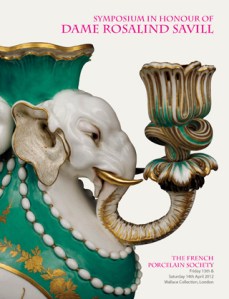 The French Porcelain Society is delighted to announce a two-day symposium to be held in honour of our President, Dame Rosalind Savill. Ros became a star of French decorative arts with the publication of her ground-breaking 3 volume Catalogue of Sèvres Porcelain in the Wallace Collection in 1988. Her career as a museum curator started at the Victoria & Albert Museum and continued at the Wallace where she served for 37 years, the last 19 as Director. The symposium is a tribute to her dedication to Sèvres porcelain research and her enjoyment and enthusiasm for the French decorative arts in general. New research on a wide range of subjects relating to French porcelain and the decorative arts will be presented by around 30 speakers – a veritable ‘Who’s Who’ of those currently involved in these fields including:
Andreina d’Agliano, Antoine d’Albis, Vincent Bastien, Sir Geoffrey de Bellaigue, Anthony du Boulay, Juliet Carey, Yves Carlier, Maureen Cassidy-Geiger, Aileen Dawson, Virginie Desrante, Claire Dumortier, Oliver Fairclough, Alden Gordon, Michael Hall, Ulla Houjkaer, Catrin Jones, Bet McLeod, Errol Manners, Jeffrey Munger, Tamara Préaud, Christophe de Quénétain, Marie-Laure de Rochebrune, Pamela Roditi, Linda Roth, Adrian Sassoon, Dame Rosalind Savill, Timothy Schroder, Christoph Vogtherr and Samuel Witwer.
The first day’s proceedings will be followed by an evening Reception in the upstairs galleries, and on Saturday 14th there is a celebratory Dinner in the Wallace Collection restaurant. For members only, on Sunday 15th, there is an Outing to Boughton. The symposium is open to members and non-members of The French Porcelain Society. Bursaries are available for scholars who wish to attend.
◊ ◊ ◊ ◊ ◊
P R O G R A M M E
Friday, 13 April 2012
9.30 Errol Manners (Chairman of the French Porcelain Society), Welcome
9.35 Tamara Préaud – Chairman for the morning session
9.40 Adrian Sassoon (Author and dealer, London), Looking at Vincennes and Sèvres Porcelain — Reflections on how Rosalind Savill has shared with Adrian Sassoon and so many others how to look at, study and enjoy Sèvres porcelain.
10.00 Bernard Dragesco (Author and dealer, Paris), How Was Saint-Cloud Porcelain Made? — Important unpublished documents and the careful examination of a teapot allow a fresh look at the manufacturing techniques of Saint-Cloud porcelain, the mother of all French soft pastes.
10.20 Antoine d’Albis (Former Chief Scientist of the Manufacture Nationale de Sèvres), Thoughts on the possible identification of painters at Vincennes before 1753 — It may be possible tentatively to identify a “pointilliste” painter at the Vincennes factory. The jug with the tin glaze and the military scene and the half-bottle cooler of 1747 or 1748 with Watteau-inspired scenes, both in the museum at Sèvres, could perhaps be the work of Liot, the head of the painters’ workshop, who was there from 1744. But it should be stressed that this remains in the realm of speculation.
10.40 Errol Manners (Author and dealer, London. Chairman of the French Porcelain Society), The earliest chinoiseries at Vincennes and the attribution of a figure — The earliest years at Vincennes saw some brief forays into Japanese and Chinese styles. This paper will consider these rare pieces and the attribution of an unrecorded model.
11.00 Tea & Coffee
11.30 Maureen Cassidy Geiger (Adjunct Professor at the Parsons School of Design), Meissen figures for France: specialty production for the marchand-mercier Gilles Bazin in 1756 — Little-known watercolors in the archives of the State Porcelain Manufactory at Meissen document the production of specialty figures and tablewares for the French market during the Seven Years War (1756-63). The sheets are variously inscribed with the names of the marchands-merciers Gilles Bazin, Jean-Charles Huet and “veuve Lair,” widow of Michel-Joseph Lair. This paper will consider the sources and production of the Meissen children in Turkish costume for Bazin in 1756.
11.50 Pamela Roditi (Collector and author) A vase à oignon or a lampe de nuit? — ….to discuss the “lampe de nuit” candleholder from various French porcelain factories, their metal counterparts, to show them in contemporary print sources and finally to show how they were used.
12.10 Andreina d’Agliano (Art historian and lecturer), Some new archival references on the porcelain of the Dukes of Parma — The author will concentrate on some Meissen and Sèvres porcelain from the collections of the Dukes of Parma, now in the Quirinale in Rome, in the Palazzo Pitti in Florence and in the Parma Galleries. Some new archival reference will be given in order to throw new light on already known objects and new documents will be shown to open further research.
12.30 Alden Gordon (Professor of Art History, Trinity College, Hartford, Connecticut), Madame de Pompadour’s exchange of gifts with the Duke of Newcastle — In 1751 during the lull between the war of the Austrian Succession and the Seven Years War, an unusual exchange of gifts took place between the Marquise de Pompadour, maîtresse en tître of Louis XV, and Thomas Pelham-Holles, first Duke of Newcastle, at the time a Whig Secretary of State and brother of the British Prime Minister, Henry Pelham. Each gift reflected the passions of the respective donors and represented nationally differentiated fields of excellence.
12.50 L U N C H
14.10 Adrian Sassoon – Chairman for the afternoon session
14.15 Catrin Jones (Assistant Curator, Ceramics & Glass, Victoria & Albert Museum), Painted luxury: imitations as decoration on Sèvres porcelain — Exploring the variety of luxurious materials recreated in enamels on Sèvres porcelain from the 1760s onwards, this talk will look at the connections between inspiration and imitation.
14.35 Marie-Laure de Rochebrune (Curator, château de Versailles), The Antique style vase, a leitmotiv of the early neo-classical period — In the 1750s, during the early phase of the neo-classical revival, which looked principally towards Ancient Greece, a number of iconographic motifs are found repeatedly in art. This is particularly true of the Antique vase, which appears in all aspects of the decorative arts, including gilt bronze, carved and marquetry furniture, tapestry, boiserie, clock making, porcelain, goldsmith’s work… Various examples will be shown, to demonstrate the recurring nature of these motifs and their diffusion among the various branches of the decorative arts.
14.55 Dame Rosalind Savill (Curator Emerita of the Wallace Collection and President of the French Porcelain Society), The Sixth Earl of Coventry’s purchases of Sèvres porcelain 1763-69 — George, Sixth Earl of Coventry (1722-1809), owner of Croome Court in Worcestershire, recently acquired by the National Trust, was a brief but keen purchaser of Sèvres porcelain in Paris in the 1760s, and some of his pieces survive. Luckily these can be tallied with his bills from the Parisian dealers Rouveau, Bachelier and Poirier, and the Sèvres sales records, together with some fascinating letters from Bachelier, as well as bills from the London dealer Morgan.
15.15 Juliet Carey (Curator, Waddesdon Manor, The Rothschild Collection), The Riches of the Earth: microscopes, mineralogy and caillouté patterns on Sèvres porcelain — This talk will consider caillouté patterns on Sèvres vases in the context of eighteenth-century ideas about the earth.
15.35 Tea and coffee
16.05 Sir Geoffrey de Bellaigue (Surveyor Emeritus of The Queen’s Works of Art), Fidelity and Sensibility — The subject of the talk is the emergence from the shadows of two late 18th century Sèvres biscuit figures, probably acquired by George IV, which languished unrecognised in a picturesque ruin and escaped the net of my French porcelain catalogue.
16.20 Vincent Bastien (Art historian), A garniture of Sèvres porcelain vases painted with subjects after Jean-Baptiste Greuze — The Sèvres factory’s sales registers and other documents have made it possible to retrace the history of a garniture of five vases with a beau bleu ground.
16.40 Isabella Savill (Student), Catherine the Great and classical imagery: a case study of her Sèvres porcelain dinner service of 1779 — This talk will focus on the unexpected discrepancies discovered in a comparison between a 1778 iconographical programme for the service and the 900 painted scenes on the plates largely in the Hermitage Museum, St Petersburg.
17.00 Selma Schwartz (Curator, Waddesdon Manor, The Rothschild Collection), A Family Affair: the Maria-Theresia service reconsidered — The two and a half year delay between the signing of the famous ‘reversal of alliances’ in 1756 and the arrival of the Sèvres gifts in Vienna casts some doubt on the accepted story that the porcelain was a diplomatic gift to celebrate the treaty. Some other possibilities will be presented.
17.20 Questions and answers
Saturday, 14 April 2012
9.30 John Whitehead – Chairman for the morning session
9.35 Samuel Wittwer (Director of palaces and collections at the Prussian Palaces and Gardens Foundation Berlin-Bradenburg), The importance of being rose: Mix-up over a garniture of Sèvres vases in Berlin — Prince Henry of Prussia, younger brother to Frederick the Great, was most proud of a garniture of three rose ground vases in his collection, notwithstanding their differences. The set, today in the Metropolitan Museum New York, stayed highly appreciated by the royal household throughout the nineteenth century and became especially famous, when in the early 1920s the communist party interfered over compensation for the Hohenzollern family. The lecture illustrates the story of the vases, their cultural environment and political impact as well as their influence on Berlin porcelain.
9.55 Oliver Fairclough (Keeper of Art at the National Museum of Wales in Cardiff), Thomas Morgan: selling French porcelain in London in the 1770s — Little is known about Thomas Morgan who is recorded as a chinaman in the Piccadilly area of London from 1747 to his death in 1782. During the 1750s he was selling mainly English and Oriental wares, but by the late 1760s he had become London’s principal retailer of continental porcelain, especially of Sèvres, Meissen and Tournai. This short paper is based on two auction sales of his stock, on the Sèvres sales registers, and on surviving bills for goods supplied by him.
10.15 Michael Hall (Curator to Lionel de Rothschild), Heraldic Sèvres: some questions and no answers — There are only 25 extant or recorded pieces of eighteenth century Sèvres armorial porcelain. Despite the wide variety of social types represented – the Royal family, courtiers, provincials, clerics and several foreigners – why so few?
10.35 Virginie Desrante (Curator, Sèvres – Cité de la céramique), New acquisitions for the Musée National de Céramique — This talk will focus on three exciting new acquisitions made in 2011 by the museum at Sèvres, now reunited with the factory into one body, Sèvres – Cité de la céramique.
10.50 Tea and Coffee
11.25 Dr. Aileen Dawson (Curator, Department of Prehistory and Europe, The British Museum, London), Two Sèvres portrait medallions identified: Melchior Parent and his wife — Amongst the Sèvres medallions in the British Museum collection, two have long remained unidentified. Recent information has come to light which reveals that they are of the factory’s director between 1773 and 1778, Melchior Parent. This lecture will discuss this new information and assess the importance of the medallions.
11.45 Timothy Schroder (Art historian), Plundering the Antique: an English manufacturer’s print album — A few years ago, the author was presented with an album of decorative engravings that had been assembled from a variety of sources sometime around 1800. The prints mostly comprised vase forms of one sort or another and ranged in date from the sixteenth to the eighteenth century. The album had belonged to a firm of Sheffield plate manufacturers and had evidently been put together as a design resource. It is an eloquent testimony to pioneering manufacturers’ use of historic material in their efforts to be “inventive and new.”
12.05 Guillaume Séret (Art historian) and Christophe Huchet de Quénétain (Author and dealer, Paris), Sèvres vases from Rothschild collections in French museums — The recent acquisition by the Sèvres museum of a pair of Sèvres “vases flacon à chaînons” with a dark blue ground and pastoral scenes after Boucher provides an appropriate opportunity not only for a comparison with the pair of “vases ferré” in the Musée Ile-de-France at Saint-Jean-Cap-Ferrat, but also to retrace their shared provenance from Baron Alphonse de Rothschild (1827-1905).
12.25 Tamara Préaud (Former Archivist of the Manufacture Nationale de Sèvres), Chronological disorders — An exploration of the problem of models reproduced in catalogues of eighteenth century Sèvres sculpture, despite the fact that they are either nineteenth-century inventions, or eighteenth-century ones which were not produced at the factory until the nineteenth or twentieth century.
12.45 L U N C H
14:10 Aileen Dawson – Chairman for the afternoon session
14.15 Ulla Houkjaer (Senior Curator at the Danish Museum of Art & Design, Copenhagen) The French connection: Royal patronage and the origins of porcelain production in Denmark — This lecture investigates the political and cultural climate that made it possible to establish a production of soft-paste porcelain on Danish soil during the years 1759-1766, under the leadership of a French artist, Louis Antoine Fournier. The “how, where and why?” is debated and key examples of the extant production from the manufactory are discussed in an art-historical context.
14.35 Bet McLeod (PhD student, The University of Glasgow), Sèvres and Scotland: a work in progress. The Hamilton and Eglinton guéridons — The “Auld Alliance” between Scotland and France is here explored using the medium of mid-nineteenth century Sèvres porcelain. Recent discoveries have led to the identification of two Sèvres guéridons that were gifts from the Empress Eugénie to two Scottish noblewomen. The construction, painting and provenance of these two pieces will be examined, together with an outline of the further research needed.
14.55 Yves Carlier (Chief Curator, château de Versailles), On the use of Sèvres vases at Fontainebleau in the 19th century — The abundance of Sèvres vases in Royal and Imperial palaces in the 19th century has been traditionally considered to have both an aesthetic origin (to decorate the apartments) and an economic one (to help maintain the factory’s production). However, it turns out they also had a practical use, which this lecture will bring to the fore, using the château de Fontainebleau as an example.
15.15 Jeffrey Munger (Curator, Metropolitan Museum, New York), From an Imperial gift: two vases Médicis of 1811 — In 1811 Napoleon included a pair of Vases Médicis in a lavish gift of works of art to his younger brother, Jérôme. These two vases, recently acquired by the Metropolitan Museum of Art, reflect both the remarkable technical skill and artistic ambition that characterize the best of the Sèvres factory’s production at this time.
15.35 Tea and coffee
16.05 Patrick Habets (Retired Professor of Mathematics) and Claire Dumortier (Former Curator at the Musées royaux d’art et d’histoire, Brussels), Pastoral scenes in Tournai porcelain, a German inheritance — In the 1760s, the success of Tournai porcelain obliged the factory to broaden the variety of decoration presented to clients. Besides the traditional flowers, indianische blumen and deutsche blumen, the manufactory developed services decorated with imaginary birds but also with figures, in pastoral and theatrical scenes. These were influenced by the Augsburg school and the production of German porcelain manufactories.
16.25 Linda Roth (Curator, Wadsworth Atheneum, Hartford, Connecticut), Sèvres at War — In 1917, in the midst of World War I, the Sèvres factory made a large stoneware vase, decorated by Léonard Gébleux with frogs and willow branches. Sèvres at War will include a brief discussion of this vase, including its manufacture and style, and then examine a fascinating if little-known period of the factory’s history.
16.45 Anthony du Boulay (Formerly Chairman, The French Porcelain Society), Sèvres Porcelain – the market and academic knowledge in the third quarter of the 20th century — A survey of the evolution of academic interest in and knowledge of French porcelain from 1950 up to the formation of the French Porcelain Society in 1984.
17.05 Questions and answers
◊ ◊ ◊ ◊ ◊
A PDF file with the programme and speaker biographies is available here»










 Enfilade
Thank you for your kind mention of the Symposium. We look forward to a very exciting and rewarding event.
You’re welcome! And it really does look extraordinary! -CH