Graduate Conference | Beyond Borders
From the conference website:
Beyond Borders: The Impact of Cultural Exchange in Art History
Magdalene College, University of Cambridge, 10-11 May 2012
Conference registration due by 1 May 2012
 The University of Cambridge History of Art Graduate Conference, Beyond Borders: The Impact of Cultural Exchange in Art History will be held on 10-11 May 2012 at Magdalene College, University of Cambridge. The two-day conference will address cross-cultural influences within the various art disciplines over a far-reaching geographical and chronological spectrum. The aim of the conference is to provide, and promote, an interdisciplinary forum for scholars investigating issues from appropriation of styles and motifs, to collecting and patronage. For more information and to register to attend, please visit: www.artconference2012.com. Please note that registration closes 1 May and seats are limited. For any queries, please contact us at: info@artconference2012.com
Keynote Speakers: Professor Partha Mitter (University of Sussex) and Dr. Sarah Turner (University of York)
◊ ◊ ◊ ◊ ◊
Thursday, 10 May 2012
9:30 Registration
10:00 Welcome address
10:05 Professor Partha Mitter, Introduced by Professor Jean Michel Massing
11:00 Panel I: India and Cultural Exchange, Chair: Professor Jean Michel Massing
• Kimia Shahi, ‘Translation and Transformation: Bernard Picart and Mughal Indian Miniatures’
• Rashmi Viswanathan, ‘The Tressider Album: A Case Study of a Private Ethnography’
• Krista Gulbransen, ‘Rao Surjan Singh and the Origins of Painted Portraiture in Bundi’
12:30 Lunch
1:30 Panel II: Architecture and Interiors, Chair: Dr. Frank Salmon
• Ellen Hurst, ‘The Reinvention of Russian Architecture: Italians in the Service of Vasily III, 1505-33’
• Hank Johnson, ‘Palladio Might with Envy View It? Eighteenth-Century British Design, British Self-Perception, and Italian Architecture’
• Josefine Baark, ‘”Small, Fat and Paunchy”: Chinoiserie Figures in Rosenborg Castle, Denmark’
3:00 Coffee
3:15 Panel III: Gift and Commercial Exchange, Chair: Dr. Meredith Hale
• Lejla Bajramovic, ‘A European Artist Collecting Non-European Art: Emil Preetorius’
• Andrew Chen, ‘Simone Martini’s Orsini Polyptych: A Gift from the Avignon Pope Clement VII to Philip the Bold, Duke of Burgundy, and the Politics of the Western Schism c. 1390′
• Antonia Gatward Cevizli, ‘The Marquis and the Sultan: Mantuan-Ottoman Cultural Exchange in the 1490s’
Friday, 11 May 2012
9:30 Registration
10:00 Panel IV: The Ancient World to 1000AD, Chair: Ms. Aurelie Petiot (PhD candidate)
• Samar Faruqi, ‘Orientalist Painting and the Victorian Art Market: Edwin Long’s Babylonian Marriage Market (1875)’
• Einav Zamir, ‘The Empire of Bacchus: Exchange from West to East’
• Theodore Van Loan, ‘From Symbol to Text: The Contingency of Influence in Umayyad Coin Design’
11:30 Coffee
11:45 Dr. Sarah Turner, Introduced by Dr. Polly Blakesley
12:30 Lunch
1:30 Panel V: Identity and Exchange, Chair: Mr. Duncan Robinson
• Liz Renes, ‘Sargent and His Mentors: Carolus Duran, Henry James and the Fostering of a Cosmopolitan Identity’
• Jill Baskin, ‘Picturing Freedom’s Shores: The Visual Culture of African Americans in Liberia, 1821-1865’
• Galina Mardilovich, ‘Rembrandt’s Shadow in Late Nineteenth-Century Russia’
• Loyd Grossman, ‘Benjamin West’s Confused Nationality’
3:30 Closing Address
Display | The Comte de Vaudreuil: Courtier and Collector
From the National Gallery of Art:
The Comte de Vaudreuil: Courtier and Collector
National Gallery, London, 7 March — 12 June 2012
 The Comte de Vaudreuil (1740–1817) was one of the leading courtiers and collectors of paintings in Paris during the 1780s. This display features Dutch and Flemish Old Master paintings in the National Gallery’s collection that were once owned by Vaudreuil or were in Parisian collections at that time. Vaudreuil’s collection provides an example of the decoration of wealthy homes in pre-Revolution Paris. Reflecting the fashion of the time, the paintings are hung according to their size and symmetry rather than by subject or chronology.
The Paintings
The display features paintings from the Comte’s collections by artists Jan Wijnants, Jacob van Ruisdael, Jan Steen and Adriaen van Ostade. Alongside these are works that were in French collections in the same period by artists Nicolaes Berchem, Aelbert Cuyp, Willem van de Velde and Gabriel Metsu. The paintings show a variety of subjects, from portraits of peasants to social life in 17th-century Holland to landscapes with ruined castles.
The 2012 Issue of ‘SECC’
Art history in the current issue of Studies in Eighteenth-Century Culture:
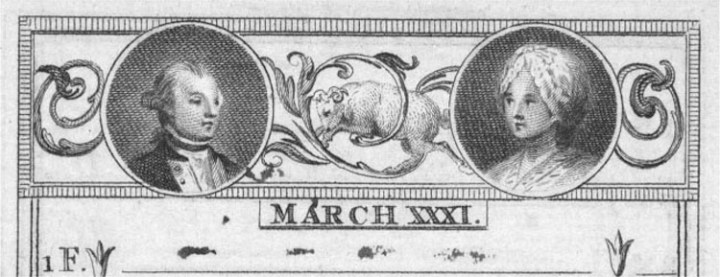
Head vignette, The Royal Engagement Pocket Atlas for 1781.
◊ ◊ ◊ ◊ ◊
• Michael Yonan, “The Wieskirche: Movement, Perception, and Salvation in the Bavarian Rococo,” Studies in Eighteenth-Century Culture 41 (2012): 1-25.
• Sandro Jung, “Print Culture, Marketing, and Thomas Stothard’s Illustrations for The Royal Engagement Pocket Atlas, 1779–1826,” Studies in Eighteenth-Century Culture 41 (2012): 27-53.
• Jennifer Germann, “Tracing Marie-Éléonore Godefroid: Women’s Artistic Networks in Early Nineteenth-Century Paris,” Studies in Eighteenth-Century Culture 41 (2012): 55-84.
• Marc H. Lerner, “William Tell’s Atlantic Travels in the Revolutionary Era,” Studies in Eighteenth-Century Culture 41 (2012): 85-114.
Reviewed | Charlotte Yeldham’s ‘Maria Spilsbury’
Recently added to caa.reviews:
Charlotte Yeldham, Maria Spilsbury (1776–1820): Artist and Evangelical (Burlington: Ashgate, 2010). 230 pages, ISBN: 9780754669913, $125.
Reviewed by Jonathan Rinck, Spring Arbor University; posted 22 March 2012.
In her short biographical work ‘Father and Daughter: Jonathan and Maria Spilsbury’ (London: Epworth, 1952), Ruth Young, a descendant of Maria Spilsbury (Spilsbury-Taylor, after her marriage in 1808), recounts a delightful anecdote in which the future King George IV visited Spilsbury’s studio on St. George’s Row, London. Impatient with how slowly work was progressing on his commission which, to his judgment, seemed complete, he exclaimed, ‘Really, Mrs. Taylor, I swear that you can do no more to that! You’ve finished it and a damned good picture it is’. Unconvinced, Spilsbury sought a second opinion from her maid. Upon close inspection, the maid astutely pointed out that, distressingly, the woman sewing in the painting still lacked a thimble. At this, the exasperated prince, Young writes, chased the maid out of the room, ‘her cap-strings flying’ (32). Any other artist might have obligingly yielded to the prince, but such was Spilsbury’s notoriety that visits from the Prince Regent, her chief patron, were merely commonplace.
In spite of her success and popularity, astonishingly little scholarly attention has been given to Spilsbury. Redressing this problem, Charlotte Yeldham’s ‘Maria Spilsbury (1776–1820): Artist and Evangelical’ fills a void that has remained embarrassingly vacant for too long. Additionally, Yeldham offers special attention to the influence of the Evangelical faith upon Spilsbury’s art, a topic which has also been largely ignored, not merely in the life of Spilsbury, but in the larger context of late eighteenth-century artists in general. On both fronts, this book will prove to be an invaluable and authoritative contribution to Spilsbury scholarship.
In the introduction, Yeldham writes that the intent of her book is to give attention to an artist who exhibited at the Royal Academy at the age of fifteen, was exhibited at the British Institution, is represented in public and private collections in England, Ireland, America, Australia, and New Zealand, and frequently present in auction houses, yet of whom very little is known . . .
The full review is available here» (CAA membership required)
Reviewed | ‘The Culture of Architecture in Enlightenment Rome’
Recently added to caa.reviews:
Heather Hyde Minor, The Culture of Architecture in Enlightenment Rome, Buildings, Landscapes, and Societies, vol. 6 (University Park: Pennsylvania State University Press, 2010), 312 pages, ISBN: 9780271035642, $95.
Reviewed by Richard Wittman, University of California at Santa Barbara; posted 22 March 2012.
The most famous works of eighteenth-century Roman architecture and urbanism, such as the Trevi Fountain or the Spanish Steps, have always seemed more at home at the end of histories of Baroque architecture than at the start of histories of modern architecture; there, one is more likely to encounter Laugier’s hut or Soufflot’s Sainte-Geneviève. The idea that the architectural initiative passed from Rome to the north sometime around 1700 extends back to the eighteenth century itself, and was rarely questioned in the century-long tradition of formalist architectural history inaugurated in the late nineteenth century. But while eighteenth-century Rome has had its apologists who complain that the quality of its architectural output is unfairly overlooked, it was the rise of culturally and socially oriented models of architectural history that really gave eighteenth-century Rome its second chance. These approaches were less concerned with aesthetic distinction or innovation than with interpreting architecture in relation to broader historical transformations. True, Rome had only a tenuous connection to the new master narratives of eighteenth-century scholarship, which center on that world-changing cocktail of Enlightenment ideas mixed with growing middle-class participation in public culture. (Rome had a negligible productive economy, and therefore lacked a bourgeoisie comparable to those of northern cities.) But this is not to say that the new ideas of the century had no impact in the Eternal City. On the contrary; but the impact came strictly within the politically stable limits of clerical culture, where such ideas inspired reformers hoping to re-arm the Church in its battle against the decline of Catholic influence. And it has been by studying how architecture and planning were drawn into these debates—debates local in scope but international in significance—that recent scholars have unlocked the rich interest of Roman architectural culture during this period. Heather Hyde Minor’s informative, wide-ranging, and deeply researched new book follows squarely in that path. . .
The full review is available here» (CAA membership required)
Colloquium | Chardin at Waddesdon Manor
Colloquium | Taking Time: Chardin’s Boy Building a House of Cards and Other Paintings
Waddesdon Manor, 14 July 2012
 On 14 July 2012, Waddesdon Manor will host a colloquium to mark the closing of the exhibition Chardin’s ‘Boy Building a House of Cards’ and Other Paintings. A conference fee of £40 will include coffee, tea, lunch, and drinks reception. For further details and application to attend, please contact Diane Bellis, Collections Department, Waddesdon Manor, Nr. Aylesbury, Buckinghamshire, HP18 0JH: diane.bellis@nationaltrust.org.uk. Places will be limited to 60 persons, and bookings will be taken strictly on a first come- first-served basis.
◊ ◊ ◊ ◊ ◊
Confirmed Speakers
Colin Bailey – Upstairs/Downstairs: Dress, Status, and the Imaginary in Chardin’s Genre Paintings
Emma Barker – Chardin’s Images of Women: Representing Domesticity
John Chu – Chardin, Hayman and Britain
René Démoris – subject to be confirmed
Charlotte Guichard – Des écritures ordinaires? Les signatures de Chardin
Anna Grundberg – The Archival Hunt for the Trail of the Destroyed Rothschild Chardins
Rachel Jacobs – Play and Learning: An Introduction to the 18th-century jeux de société at Waddesdon Manor
Humphrey Wine – Observations on the National Gallery Chardins
Call for Papers | European Portrait Miniatures
European Portrait Miniatures: Artists, Functions, and Collections
Residence Museum, Celle, Germany, 25-27 January 2013
Proposals due by 31 May 2012

Unknown (probably German), "Portrait of a Miniaturist," ca. 1740 (Tansey Collection Ref.-No. 010.958)
From the 16th century well into the 19th century, portrait miniatures represented the most widely circulating form of portraiture. Mounted as jewellery or often framed on everyday objects, they were easily worn or carried on one’s person and easily transported. They served within a wide range of social functions. Portrait miniatures could be offered as gifts at court and were frequently exchanged as keepsakes among loved ones. They could be displayed within one’s circle or contemplated in private. The portrait miniature often combined a high level of technical craftsmanship with artistic ingenuity and inspiration.
Indeed, the intrinsic attributes of the portrait miniature, its distillation within a minuscule format as well as its intimate nature, have tended to limit art historical research and museum exhibits to the greater advantage of large-scale portraiture. The expertise of a small circle of specialists is, thus, confronted with conspicuously limited findings in comprehensive research and the publication of regretfully few monographs. Knowledge about works in many existing collections remains to date substantially incomplete. The following topics will be addressed at the conference:
• Individual miniaturists, specific workshop contexts, and places of production
• Use of both court and private types and their protagonists
• Iconographies of representation or intimacy
• Evolution of techniques and materials
• Less well-known collections in museums
The symposium will be held on the occasion of the planned opening of the fifth exhibit of the Tansey Collection and the publication of the accompanying catalogue, Miniatures of the time of Marie-Antoinette from the Tansey Collection on January 25, 2013. The conference will be in English. Lectures should not exceed 25 minutes and are to be published separately following the conference. The Tansey Foundation will assume travelling expenses, accommodations, and meals. Proposals from curators of less well-known miniature collections and younger academics are particularly most welcome. Exposés should be in English and no longer than 1500 characters. They should be submitted by May 31, 2012, including name, address, and, if applicable, institution, and be sent to: bernd.pappe@miniaturen-tansey.de
Organisation
Bernd Pappe, Berne (Art Historian and Restorer)
Juliane Schmieglitz-Otten, Celle (Head of the Residence Museum at Celle Castle)
Gerrit Walczak, Berlin (Substitute Professor at the Ruhr-Universität Bochum)
Visual Conception – IT Coordination
Birgitt Schmedding, Hamburg (Photo Designer)
April 2012 Issue of ‘Apollo Magazine’
Eighteenth-century offerings from the latest Apollo Magazine (for the full text of each article, click on the images below). . .
◊ ◊ ◊ ◊ ◊
Anne Kapeller, “A Unique Heritage: Treasures of the Swiss National Museum in Nyon,” Apollo Magazine (April 2012).
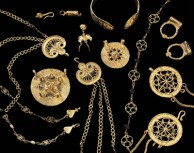 . . . In 1741, the curate Johann Georg Sulzer carried out a series of excavations at Lunnern, in the Reuss Valley near Zurich, leading to the discovery of a Roman temple, baths and a necropolis. On 17 November, he uncovered a hoard consisting of 17 pieces of gold jewellery and 84 silver coins, hidden in a recess. Three days later news of the sensational discovery reached Zurich. The painter Johann Balthasar Bullinger was commissioned to visit the site and produce a picture of the excavations. It was preserved along with the jewels in the art collection of the Wasserkirche in Zurich, before becoming part of the collections of the SNM. . .
◊ ◊ ◊ ◊ ◊
Lucy Davis & Christoph Martin Vogtherr, “A Taste for Blue,” Apollo Magazine (April 2012).
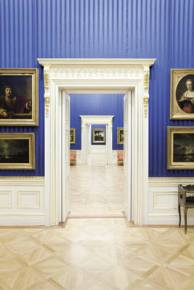 The Wallace Collection is famous for its exceptional group of works from the French 18th century. A smaller collection of around 150 Dutch 17th-century paintings is of equally fine quality, including masterpieces by Frans Hals, Rembrandt, Gerard ter Borch, Pieter de Hooch, Jan Steen, Gabriel Metsu, Caspar Netscher, Jacob van Ruisdael, Nicolaes Berchem, Philips Wouwermans and other leading painters of the Golden Age. It is particularly rich in genre paintings, landscapes by the Dutch Italianates and the work of some outstanding artists – Rembrandt first of all, but also Steen, Metsu, Willem van de Velde, Meindert Hobbema and Willem van Mieris. The resulting view of Dutch art does not provide a systematic overview but follows the personal preferences of the collectors and the typical view of Dutch art during the 18th and early 19th centuries. Artists such as Jan van Goyen, Hercules Seghers and Vermeer, but also the earlier periods before Rembrandt, are hardly represented. They were only admitted to the canon
at a time when the Hertford family had stopped collecting Dutch art. . .
◊ ◊ ◊ ◊ ◊
Juliet Carey, “A House of Cards: Taking Time,” Apollo Magazine (April 2012).
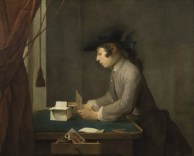 Waddesdon Manor is temporarily home to a small but extraordinarily beautiful group of works by one of the most revered of all French painters. The exhibition Taking Time: Chardin’s ‘Boy Building a House of Cards’ and Other Paintings is prompted by the recent acquisition of one of four works by Jean-Siméon Chardin (1699–1779) of a subject that particularly fascinated him. The last to enter the public domain, the Waddesdon canvas, is united for the first time with three other variations on the theme, on loan from national collections in France, Britain and the United States. . .
◊ ◊ ◊ ◊ ◊
Humphrey Wine, “The Art of a Connoisseur: Review of Pierre Rosenberg and Laure Barthélemy-Labeeuw, Les Dessins de la Collection de Pierre-Jean Mariette (2011),” Apollo Magazine (April 2012).
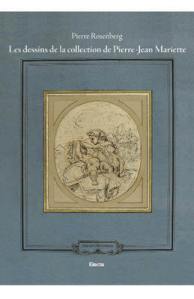 Soon after the death of Pierre-Jean Mariette (1694–1774) his heirs had Pierre François Basan organise a sale of his collection. It included paintings (among them Poussin’s Nurture of Bacchus, c. 1628, now in the National Gallery, London), terracottas, antique marbles, bronzes and engraved gems; the bulk of the sale, however, comprised some 9,000 Italian, Dutch, Flemish and French drawings. It was not only size that distinguished Mariette’s collection of drawings – the earlier collection of Pierre Crozat, built with Mariette’s advice, had been twice as large – but also its quality and comprehensive nature. . . .
Conference | Johan Zoffany and His International Contexts
From The Paul Mellon Centre:
Johan Zoffany and His International Contexts
The Royal Academy of Arts and the Geological Society, Burlington House, London, 14 May 2012
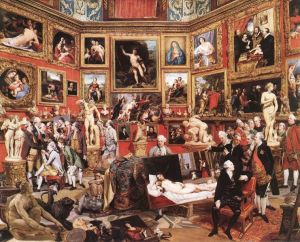
Johan Zoffany, "The Tribuna of the Uffizi," ca.1772-77. Oil on canvas. Royal Collection
The Paul Mellon Centre for Studies in British Art, the Royal Academy of Arts, London, and the Yale Center for British Art, New Haven, will be co-hosting a conference on Monday, May 14, 2012, to accompany a major exhibition on the eighteenth-century Anglo-German artist Johan Zoffany (1733–1810). The exhibition, Johan Zoffany RA: Society Observed, is curated by Martin Postle (Paul Mellon Centre), with Gillian Forrester (Yale Center for British Art) and MaryAnne Stevens (Royal Academy); it was on view at the Yale Center for British Art from October 27, 2011, to February 12, 2012, and can be seen at the Royal Academy from March 10 to June 10, 2012. The conference aims to address Zoffany’s art in the context of four locations that were central to his practice: Germany, England, Italy, and India.
Born in Frankfurt in 1733, Johan Zoffany trained as an artist in Germany and Italy. In 1760 he moved to London, where he adapted brilliantly to the indigenous art culture and patterns of patronage, creating virtuoso portraits and subject pictures that proved to be highly desirable to a wide range of patrons. Of all the major artists working in eighteenth-century England, none explored more inventively the complexities of Georgian society and British imperial rule than Zoffany. Yet, despite achieving considerable success there, he remained in many ways an outsider, looking dispassionately at British society. Resisting complete integration into his adopted country, Zoffany traveled for extended periods in Europe and spent six years in northern India. His body of work offers unique perspectives on key British and European institutions, including the art academy, the royal court, the theatre, and the families of the aristocracy and bourgeoisie. In India, Zoffany constructed new idioms for portraying the emerging colonial society in both public and private spheres, as well providing a nuanced account of the complex network of power relations, race, and culture at a critical moment in British imperial history.
Tickets for the conference and a conference program (pdf, 109 kb) are now available (also see below). To purchase tickets, and for further details about how to register, please visit the Paul Mellon Centre, London.
◊ ◊ ◊ ◊ ◊
P R O G R A M M E
Geological Society of London
9:00 Registration
9:30 Amy Meyers (Yale Center for British Art) Welcome and opening remarks
9:40 Martin Postle (Paul Mellon Centre for Studies in British Art) “Zoffany and his International Contexts: An Introduction to the Exhibition and Conference”
9:50 Morning session introduced and chaired by Robin Simon (University College, London)
9:55 Craig Hanson (Calvin College, Michigan) “Zoffany‟s Virtuosic Ambitions and the Theatre of Natural History”
10:25 Helen McCormack (University of Glasgow) “Zoffany and William Hunter: ‘Where Art May Join with Nature and with Sense'”
10:55 Questions
11:05 Coffee
11:35 Steffen Egle (Staatsgalerie, Stuttgart) “Johan Zoffany and Germany: Early Training and Later Reception”
12:05 Kate Roach (Virginia Commonwealth University) “Johan Zoffany’s Tribuna of the Uffizi: An International Visual Lineage”
12:35 Questions
12:45 Lunch
14:00 Afternoon session introduced and chaired by Kate Retford (Birkbeck College, University of London)
14:05 Anna Maria Massari (University of Urbino ‘Carlo Bo’, Palazzo Albani) “A Rediscovered Zoffany Madonna for the Grand Duke of Tuscany”
14:35 Kenneth Bendiner (University of Wisconsin, Milwaukee) “Johan Zoffany in Italy: The Beginning of Visual Dissonance”
15:05 Richard Leppert (University of Minnesota) “Zoffany and the Visual Politics of Private Musical Culture in England and India”
15:35 Questions
15:45 Tea
16:15 William Pressly (University of Maryland) “The Artist’s Role as Social Commentator: Zoffany’s Scathing Condemnation of Gillray as well as Hogarth in Plundering the King’s Wine Cellar”
16:45–17:30 Response, and discussion chaired by MaryAnne Stevens (Royal Academy of Arts)
Royal Academy of Arts
17:45 Drinks reception in the Reynolds Room
18:15–20:00 Private view of Johan Zoffany RA. Society Observed in the Sackler Galleries
Call for Papers | European Networks in the Baroque Era
As pointed out by Hélène Bremer, from H-Soz-u-Kult:
European Networks in the Baroque Era
Vienna, 26-29 September 2012
Proposals due by 30 April 2012
The first general conference of the ENBaCH Project is intended to bring together research on Baroque forms of exchange and networking, as a basis for a modern network of researchers working on themes related to the cultural heritage of Europe in the seventeenth and eighteenth centuries. The European Network for Baroque Cultural Heritage (ENBaCH, www.enbach.eu) — is a research project supported and funded by the European Commission.
“Baroque” of course has various connotations depending on regions and cultural contexts but also on various approaches in different research fields. As ENBaCH is defined as an interdisciplinary project it is intended to confront these aspects and discuss their impact on what might be defined as “European Cultural Heritage.”
A well-known historiograpical conundrum is the question of periodization. One useful, practicable approach is the collection of characteristics of an epoch from the cultural point of view: works of art, intellectual activities and developments, societal structures and contemporary ways of coping with diverse challenges in a specific society. Baroque culture was influenced by war, famine and epidemic diseases, and the resulting urgency of finding collaborative solutions for survival. New environments and infrastructures, increased mobility of craftsmen, artists and workers as well as the trade of artefacts and goods, and a vivid exchange of knowledge mark the period as much as its art, which represents a reaction to these threats to life in various ways.
We welcome papers on the following aspects of Baroque culture and exchange in particular:
• formal and informal networks of politics (e.g. the role of courts, diplomacy, agents) in the seventeenth and eighteenth centuries
• the Baroque circulation of ideas and knowledge (e.g. the Republic of Letters)
• the development of arts and cultural practices (“artists and artefacts on the move,” baroque festivals and piety, fashion, cooking, etc.)
• (with particular relevance to the venue of the conference): the Baroque perception of the human body in various works of art, death and dying in relation to confessional frameworks, coping with disease and disaster from a medical point of view (e.g. health care provisions, facing famine and epidemic disease) and collaboration in medicine and health care
Conference language: English. The papers should be given in English and should take max. 20 minutes. Discussions and commentaries by attending delegates may include also other languages. Abstracts of one page max., in English, accompanied by a very short CV, should be sent to baroquebodies@meduniwien.ac.at by the end of April 2012. We will be able to cover moderate travelling costs and accommodation for invited speakers other than those involved in the ENBaCH project. Please enquire for details.
Rooms are reserved at two hotels at a convenient location; speakers and conference delegates will benefit from a reduced room rate. Rooms are limited and available on first come, first served basis only. For any further questions about the conference practicalities please contact Paul Zogmann (paul.zogmann@meduniwien.ac.at).










 Enfilade
leave a comment