Exhibition | The Art of German Stoneware
From the Philadelphia Museum of Art:
The Art of German Stoneware
Philadelphia Museum of Art, 5 May — 5 August 2012
Curated by Jack Hinton

Inkstand and Candleholder with Musicians, Animals, and a Griffin, ca. 1740. German Salt-glazed stoneware with painted decoration, roughly 20 x 10 x 7 in. (Philadelphia Museum of Art)
From the fourteenth through eighteenth centuries, stoneware ceramics from Germanspeaking centers in modern-day Germany and the Low Countries were valued and widely traded throughout northern Europe. In the 1600s—the heyday of stoneware production—they found an enthusiastic market in colonial North America. The medium’s success is due to its stonelike durability and imperviousness to liquid, making it perfect for cooking, storage, and drinking vessels. The social aspect of stoneware ceramics explains the crisp relief decoration on sixteenth- and seventeenth-century pieces, which feature moralizing images or political figures and their coats of arms; later pieces often eschew such ornament for floral or geometric patterns inspired by Far Eastern porcelains imported to Europe. Inkstand and Candleholder with Musicians, Animals, and a Griffindemonstrates the inventiveness and artistry of stoneware potters, even when faced with a dwindling market for their works in the homes of the well-to-do. This exhibition examines German stoneware from its origins to later revivals in the nineteenth-century and celebrates its long-standing relationship with the city of Philadelphia. It features selections from the Museum, seventeenth-century Dutch pictures demonstrating the high status of stoneware, and a generous promised gift of around forty pieces of German
stoneware from Dr. Charles W. Nichols. The exhibition is accompanied by an
illustrated publication by Jack Hinton, Assistant Curator of European Decorative
Arts and Sculpture.
◊ ◊ ◊ ◊ ◊
From Yale UP:
Jack Hinton, The Art of German Stoneware, 1300-1900 From the Charles W. Nichols Collection and the Philadelphia Museum of Art (New Haven: Yale University Press, 2012), 60 pages, ISBN: 9780300179781, $20.
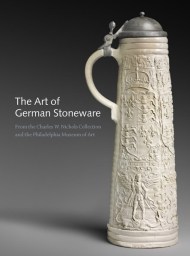 Beautiful and eminently useful, stonewares produced in the German-speaking lands from the Middle Ages onward were highly valued for their durability and suitability for a range of domestic and social uses. Widely traded throughout Europe, they were also among the first European ceramics to reach colonial North America. During the Renaissance the addition of brilliant salt glazes—s well as relief imagery that communicated with the user—raised the status of these wares. Later examples introduced abstract floral or geometric decorations and more unusual, original forms, which retained broad cultural significance.
About ninety fine stoneware pieces from the Philadelphia Museum of Art and a promised private collection testify here to the success, artful decoration, and fascinating variety of this medium. Jack Hinton describes the developments in stoneware through these notable examples, and beautiful color images bring
their details vividly to life.
Puzzle Jugs for Fools
I have long thought that museum gift shops would make a mint with good quality reproductions of these vessels, or perhaps even better, commissions for updated versions from local ceramicists. I first encountered the type as a graduate student, at The Smart Museum of Art in Chicago, and have been childishly enamored ever since. The following comes from Kathryn Kane’s posting at The Regency Redingote (3 July 2009). Happy Fool’s Day! -CH
◊ ◊ ◊ ◊ ◊
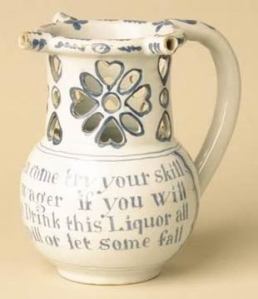
Puzzle Jug, tin-glazed earthenware, Liverpool, ca. 1750 (Liverpool: Walker Art Gallery)
Inscribed: "Here Gentlemen come try your skill, I'll hold a wager if you will, That you don't drink this liquor all, Without you spill and let some fall." For more information, click on the photo.
A diverting drinking vessel which could be found in village inns and public houses for centuries had a resurgence in popularity in the late eighteenth and early nineteenth centuries. These vessels had been made throughout England and northern Europe since at least the fifteenth century. Most commonly called puzzle jugs, they were also sometimes called teasing pitchers or wager jugs. It was a challenge to determine how to drink the liquor which they contained and wagers were often placed on the outcome of the attempt.
By the time of the Regency, puzzle jugs were being made not only for use in inns and taverns, but also for home use. Many gentlemen enjoyed entertaining their male visitors with drinking games using their own puzzle jugs.
Puzzle jugs are a puzzle because it is not obvious how to imbibe the beverage which they contain. The neck of the jug is perforated, often in ornamental patterns, so one cannot simply raise it to one’s lips and drink. Most puzzle jugs also have a hollow rim which can have between three to seven spouts which protrude from it. This hollow rim is connected to either a hollow handle, which opens into the lower part of the jug body, or the inside of the jug has a tube or pipe built into the jug wall. It is through this concealed piping that the liquid contents of the jug flow to the hollow rim. The secret of the puzzle jug is to know which of the spouts on the rim to plug with the fingers, while sucking the liquor out of the jug via the remaining spout. Some puzzle jugs have a small additional opening somewhere below the neck or beneath the handle which will spill the liquid on the hapless drinker if the jug is not held just so. . .
The full posting (including a brief reading list) is available at The Regency Redingote.










 Enfilade
leave a comment