Small Exhibition | Gems of European Lace, ca. 1600–1920
Press release (20 July 2012) for this exhibition now on at The Met:
Gems of European Lace, ca. 1600–1920
The Metropolitan Museum of Art, New York, 24 July 2012 — 13 January 2013
Oorganized by Devon Thein and Gunnel Teitel
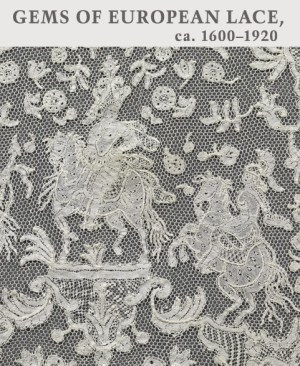
Cravat End or Rabat (det.), mid-18th century, Flemish, Linen, bobbin lace (point d’Angleterre). The quality of workmanship in this cravat end is consistent with its presumed exalted provenance. It is said to have been made for the Austrian empress Maria Theresa; given to her daughter the French queen Marie Antoinette; and then passed to the marquis de Chabert, a French admiral and astronomer, after which it descended in his family. The possibility of this association is supported by the crown at center resembling the Austrian archducal crown, though no further proof of the connection has been discovered. . . click on the image for more
A selection of 13 exceptional examples of handmade lace from the collection of The Metropolitan Museum of Art—one of the finest such collections in the United States—will be featured in the exhibition Gems of European Lace, ca. 1600–1920, opening July 24 in the Museum’s Antonio Ratti Textile Center. These delicate luxury textiles, created between 100 and 400 years ago, represent techniques and styles associated with some of the preeminent lacemaking centers of Europe.
Included in the installation are examples of the two major lacemaking techniques: needle lace (built up from a single thread that is worked in a variety of looping, or buttonhole, stitches) and bobbin lace (woven—or braided—together from multiple threads organized on individual bobbins). Beyond the two basic technical categories, lace is also often described with the name of the town or region where a particular style was first made.
The exhibition will include outstanding examples of Venetian (needle) lace, Brussels (bobbin) lace, and Devon (bobbin) lace. Of particular interest is a 19th-century handkerchief associated with King Leopold II and Queen Marie-Henriette of Belgium. The queen was a patron of the local lace industry. The best-quality lace was extremely expensive, due to the time-consuming and painstaking process of transforming fine linen thread into such intricate openwork structures. Rather surprisingly, the 17th-century English clergyman Thomas Fuller defended the wearing of lace and the nascent English lacemaking industry, writing that it cost “nothing save a little thread descanted on by art and industry,” and “saveth some thousands of pounds yearly, formerly sent over to fetch lace from Flanders.”
In the late 19th century, American women began to recycle antique lace for use in fashion. The American socialite and style setter Rita de Acosta Lydig, for example, often wore garments with insertions of antique lace. On view will be one of her dresses from 1920, completely made of lace in a horse-and-rider motif. As a result, many women began to collect and study lace, taking an interest not only in its artistry and complexity of construction but also in the historical and cultural contexts in which it was made and used. In large part, the collection of the Metropolitan Museum reflects the interest of these women who became serious collectors and who graciously donated their collections to the Museum.
The installation was organized by Devon Thein and Gunnel Teitel, volunteers in the Department of European Sculpture and Decorative Arts, under the supervision of Melinda Watt, Associate Curator, European Sculpture and Decorative Arts, and Supervising Curator, Antonio Ratti Textile Center. Established in 1995, the Antonio Ratti Textile Center at the Metropolitan Museum is one of the largest, most technically advanced, and well-equipped centers for the study, storage, and conservation of textiles in any art museum. Objects from the Metropolitan Museum’s collection of textiles are featured, on a rotating basis, in a small gallery at the entrance of the center.










 Enfilade
leave a comment